
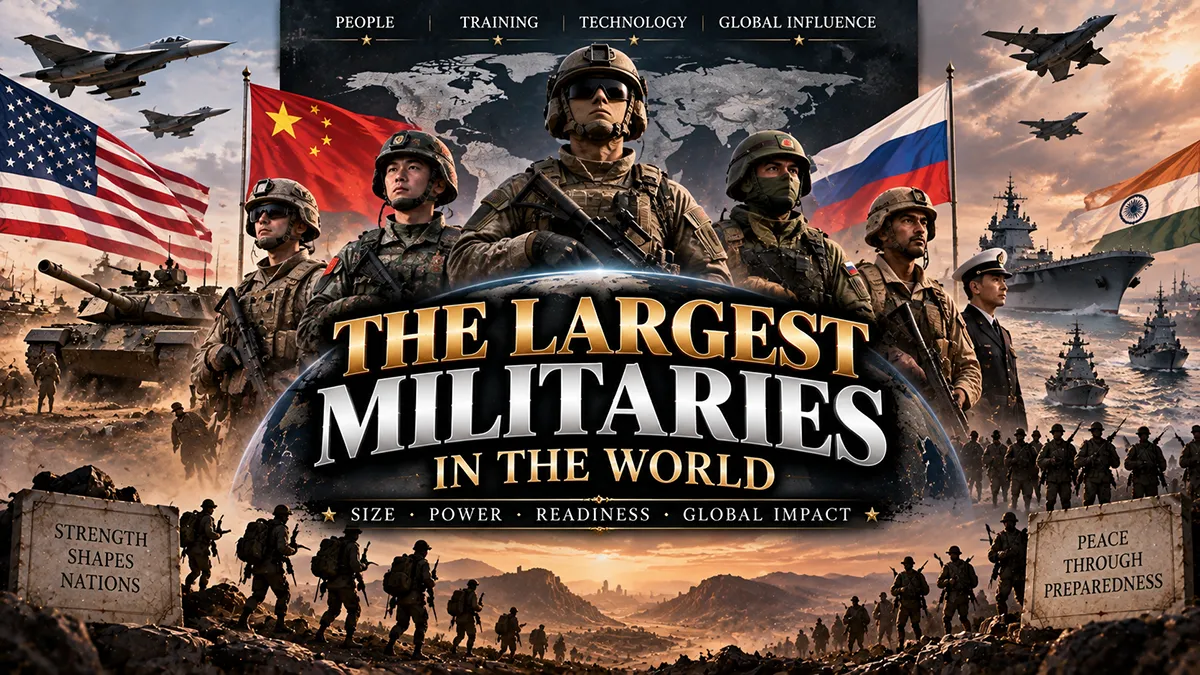
Ask most people who has the biggest army in the world and you’ll probably get a confident answer: “the United States, obviously.” It’s a reasonable guess — the U.S. spends more on defense than the next several countries combined — but it’s not actually correct once you start counting people in uniform.
The real answer depends on what you’re measuring: active-duty troops, reserves, paramilitary forces, or overall military power. And that’s before you even get to the other end of the spectrum, where entire countries get by with a police force, a coast guard, or no standing army at all.
This guide breaks down the largest militaries in the world by the numbers, explains why rankings shift depending on the source and the year, walks through how military units are actually organized, and finishes with the smallest armed forces on the planet — some of which might surprise you.
TL;DR: China currently fields the world’s largest active military by headcount, followed by India, the United States, and North Korea, but “biggest” and “strongest” are two very different questions — and a surprising number of countries get by with no standing army at all.
How Do You Actually Measure the “Largest” Military?
Before ranking anything, it helps to know what’s being counted, because this is where a lot of the confusion around “who has the largest military in the world” comes from.
- Active-duty personnel — full-time, currently serving service members. This is the figure most “biggest army” lists use.
- Reserve personnel — trained former or part-time service members who can be called up.
- Paramilitary forces — border guards, internal security forces, and militia that aren’t part of the formal armed forces but could be mobilized.
- Total military and paramilitary strength — active plus reserve plus paramilitary combined, which changes the leaderboard significantly.
- Military expenditure and hardware — tanks, aircraft, warships, and defense budgets, which measure capability rather than pure size.
Sources like the Global Firepower Index and the International Institute for Strategic Studies (IISS) Military Balance are the most commonly cited references for these figures, but they don’t always agree with each other, and numbers shift year to year — especially for countries currently mobilizing for conflict. So treat any specific figure below as a well-sourced estimate rather than an exact headcount, since governments don’t always publish precise, up-to-date troop numbers.
The 10 Largest Militaries in the World by Active Personnel
Based on widely cited estimates of active-duty personnel, this is roughly how the largest armies in the world stack up today. Rankings can shift slightly depending on the source and year, particularly around positions five through ten.
| Rank | Country | Estimated Active Personnel |
|---|---|---|
| 1 | China | ~2,000,000 |
| 2 | India | ~1,450,000 |
| 3 | United States | ~1,320,000 |
| 4 | North Korea | ~1,280,000 |
| 5 | Russia | ~1,000,000–1,300,000 |
| 6 | Pakistan | ~650,000 |
| 7 | Iran | ~600,000 |
| 8 | South Korea | ~550,000 |
| 9 | Vietnam | ~480,000 |
| 10 | Egypt | ~450,000 |
A few honorable mentions that regularly appear near the bottom of top-10 lists depending on the source and year: Indonesia, Myanmar, Brazil, Turkey, and Ukraine (whose active force has grown substantially since 2022 due to the ongoing war with Russia).
It’s worth pausing on North Korea here, because it’s a great example of why “biggest army” answers vary so much. North Korea’s active force alone is already enormous relative to its population, but once you add its reserve and paramilitary forces — often estimated at several million more — total mobilized manpower is sometimes cited as the largest in the world, ahead of even China. That’s the kind of nuance that gets lost in quick lists.
A Closer Look at the Top Three
China, often mentioned alongside a small handful of contenders for the oldest countries in the world, maintains the world’s largest active military, the People’s Liberation Army (PLA), with roughly 2 million personnel across its ground, naval, air, rocket, and strategic support forces. China has also been steadily modernizing its navy, which by ship count is now the largest in the world, even though the U.S. Navy retains an edge in tonnage and carrier capability.
India fields the second-largest active force, built around a large standing army shaped by its long land borders and regional security concerns. India also maintains one of the largest reserve forces in the world, and it’s a nuclear-armed state, like China.
The United States doesn’t top the personnel count, but it’s consistently ranked as having the world’s most capable and best-funded military by most defense analysts, thanks to its defense budget (larger than the next roughly ten countries combined), global base network, advanced airpower, and unmatched aircraft carrier fleet. So when people ask who has the biggest military force in the world in terms of overall power rather than headcount, the U.S. is usually the answer analysts give — even though it isn’t the largest by raw numbers.
Military Formations Explained: From Squad to Field Army

One reason “army size” gets confusing is that the word “army” means different things in different contexts. Sometimes it refers to an entire country’s ground force; other times it refers to a specific organizational unit. Here’s the general hierarchy used by most modern militaries, smallest to largest (exact numbers vary by country and branch):
- Squad/Section — roughly 8–12 soldiers, the smallest tactical unit.
- Platoon — around 30–50 soldiers, made up of several squads.
- Company — about 100–200 soldiers, made up of several platoons.
- Battalion — roughly 500–1,000 soldiers.
- Brigade/Regiment — around 3,000–5,000 soldiers.
- Division — approximately 10,000–20,000 soldiers.
- Corps — two or more divisions, often 20,000–50,000 soldiers.
- Field Army — multiple corps, potentially hundreds of thousands of soldiers.
So when someone asks “how many men are in a military troop,” the honest answer is: it depends entirely on which unit they mean, and terminology varies between countries. A U.S. “brigade” isn’t organized identically to a Russian “brigade” or a British “regiment,” even though the words sound interchangeable.
Size Isn’t Everything: What Actually Makes a Military “Strongest”
Here’s where the myth-busting really matters. Having the most soldiers doesn’t automatically mean having the most effective military, and defense analysts weigh several other factors when ranking overall strength:
- Technology and equipment — stealth aircraft, precision munitions, satellite networks, and cyber capability matter enormously in modern conflict.
- Logistics and global reach — the ability to deploy and sustain forces far from home, which historically has been a major U.S. advantage.
- Naval power — aircraft carriers, submarines, and blue-water fleets project influence well beyond a country’s borders.
- Nuclear arsenal — nine countries are known or believed to possess nuclear weapons, which changes the strategic calculus regardless of army size.
- Training, morale, and experience — a smaller, well-trained professional force can outperform a much larger conscript-heavy one.
- Economic backing — sustaining a modern military long-term requires a large, stable economy, not just a large population.
This is why “most powerful country in the world by military” rankings (like the Global Firepower Index) usually put the U.S., Russia, and China at the top even though neither Russia nor the U.S. leads in personnel — hardware, budget, and reach still count for a lot.
The Biggest Armies in History
Zooming out from today’s rankings, it’s worth noting that modern militaries are actually smaller, relative to population, than many historical forces — because ancient and early-modern armies relied heavily on manpower rather than technology.
Ancient sources, particularly Greek historian Herodotus, claimed the Persian invasion force under Xerxes I — ruler of one of the era’s great ancient civilizations — numbered in the millions when it invaded in 480 BCE. Most modern historians consider that figure a substantial exaggeration, common in ancient warfare accounts, with more realistic estimates in the low hundreds of thousands at most — still enormous for the era.
The Mongol Empire under Genghis Khan and his successors is often mythologized as having conquered the largest land empire in history through sheer numbers, but historians generally estimate its core mounted forces at well under 200,000 — the empire’s dominance came more from mobility, coordinated tactics, and logistics than raw headcount.
The closest thing to a genuinely verified answer to “what was the largest army in history” comes from the 20th century. During World War II, the Soviet Union mobilized more than 30 million people into its armed forces over the course of the war (not all simultaneously), while Nazi Germany mobilized around 18 million. These total wartime mobilization figures dwarf any standing army today, largely because industrialized nations could conscript and arm civilian populations at a scale earlier empires couldn’t sustain.
The World’s Largest Military Bases

Definitions of “largest” vary here too — by land area, by personnel, or by strategic significance:
- Fort Liberty (formerly Fort Bragg), North Carolina — frequently cited as the largest U.S. Army installation by population, home to tens of thousands of soldiers and their families, plus U.S. Army Special Operations Command.
- Naval Station Norfolk, Virginia — widely described as the world’s largest naval base by the number of ships and personnel stationed there, serving as home port for much of the U.S. Atlantic Fleet.
- Fort Hood/Cavazos, Texas — one of the largest military installations in the world by land area, historically home to entire armored divisions.
Outside the U.S., other massive installations include Russia’s various sprawling training grounds and China’s expanding network of naval and air bases, though comprehensive, comparable public data is harder to verify for non-Western militaries.
The 10 Smallest Militaries in the World
On the opposite end of the scale, a notable number of United Nations member states maintain either no standing army at all or an extremely small defense force. Some rely on treaties with larger neighbors, others on police forces for domestic security, and a few simply haven’t needed one due to geography or history.
Countries with no standing military at all include Costa Rica (which abolished its army in 1948), Panama (1990), Iceland (which has a coast guard and no army), Liechtenstein (abolished its army in 1868), Monaco, Andorra, and several small Pacific and Caribbean island nations such as Samoa, Kiribati, Tuvalu, Nauru, Palau, and the Marshall Islands. Vatican City maintains the Pontifical Swiss Guard, a small ceremonial and protective force rather than a conventional military.
Among countries that do maintain a small standing force, some of the smallest by personnel typically include:
- Antigua and Barbuda — a few hundred active personnel in its defense force.
- Seychelles — a small defense force focused on coastal and internal security.
- Suriname — a modest standing army given its small population.
- The Bahamas — the Royal Bahamas Defence Force, focused mainly on maritime patrol.
- Barbados — a small, tri-service defense force.
- Belize — a compact defense force supplemented by UK training partnerships.
- Sao Tome and Principe — one of the smallest armed forces in Africa.
- Cabo Verde — a small coast guard-centric force.
- The Gambia — a modest national army.
- Solomon Islands — maintains only a police force with a paramilitary wing, no formal army.
Exact figures for these smaller forces fluctuate and are reported inconsistently, so treat specific headcounts as approximate. The broader point holds either way: dozens of sovereign nations function perfectly well without anything resembling a large standing military, often by choice, treaty, or geographic isolation.
NATO’s Armies, Ranked by Size
Within NATO specifically, active personnel rankings look quite different from the global list, since the alliance’s member states vary enormously in population and defense policy:
- United States
- Turkey
- France
- Germany
- Poland (rapidly expanding its forces in recent years)
- Italy
- United Kingdom
- Spain
Poland in particular has been increasing its defense spending and troop numbers substantially since 2022, reflecting the broader shift in European defense posture following Russia’s invasion of Ukraine.
Final Thoughts: There’s No Single “Biggest Military”
If you take one thing away from all this, it’s that “the biggest military in the world” isn’t a single, fixed fact — it’s a moving target depending on whether you’re counting active troops, total mobilized manpower, hardware, or overall capability. China currently leads on raw active personnel, India and the United States follow closely, and North Korea’s massive reserve and paramilitary numbers complicate any simple ranking. Meanwhile, the U.S. remains the most heavily resourced and arguably most capable force overall, even without topping the personnel count.
And at the other extreme, it’s worth remembering that plenty of nations have decided a large military simply isn’t part of their national strategy at all — proof that “biggest” has never been the only way to measure security.
Frequently Asked Questions
What are the largest militaries in the world right now?
By active-duty personnel, the most commonly cited ranking puts China first (around 2 million troops), followed by India, the United States, North Korea, and Russia. These figures come from sources like the Global Firepower Index and IISS Military Balance and can shift slightly year to year, especially for countries actively mobilizing forces.
Who has the largest military in the world?
China has the largest active military by headcount, with roughly 2 million personnel in the People's Liberation Army. However, if you count reserves and paramilitary forces, North Korea's total mobilized manpower is sometimes cited as even larger, which is why the answer depends on exactly what you're measuring.
Does the US have the largest military in the world?
No, not by personnel count — the U.S. ranks third or fourth depending on the source. However, the U.S. is generally considered the most powerful and capable military overall due to its defense budget, technology, global base network, and naval strength.
How many soldiers does China have?
China's People's Liberation Army is estimated to have around 2 million active-duty personnel, making it the largest standing military in the world by that measure. Exact figures aren't published with full transparency, so this is a widely cited estimate rather than an official confirmed count.
Which country has the largest army by land forces alone?
China and India both maintain very large ground forces, with China's army component alone estimated at close to a million soldiers, followed closely by India. Rankings can vary depending on whether you count only ground troops or the full tri-service military.
What was the largest army in history?
By total wartime mobilization, the Soviet Union mobilized more than 30 million people over the course of World War II, likely the largest total mobilization in history. Ancient claims of multi-million-strong armies, like Herodotus's account of the Persian invasion force in 480 BCE, are generally considered exaggerated by modern historians.
What is the smallest army in the world?
Several countries, including Costa Rica, Panama, and Liechtenstein, have no standing army at all. Among nations that maintain a small force, countries like Antigua and Barbuda, Seychelles, and Sao Tome and Principe have some of the smallest standing militaries in the world, often numbering only a few hundred personnel.
What is the largest military base in the world?
Definitions vary, but Fort Liberty (formerly Fort Bragg) in North Carolina is often cited as the largest U.S. Army installation by population, while Naval Station Norfolk in Virginia is widely described as the world's largest naval base by ships and personnel.
How big is Greenland’s military?
Greenland has no independent military of its own; defense responsibility falls to Denmark through the Royal Danish Defence. The U.S. also operates Pituffik Space Base (formerly Thule Air Base) in Greenland under a longstanding defense agreement with Denmark.
How big is Hamas’s fighting force?
Hamas is a non-state militant and political organization, not a national military, so it isn't counted in standard military-size rankings. Estimates of its fighter numbers vary widely between Israeli intelligence assessments and Hamas's own claims, and independent verification is difficult, so any specific figure should be treated as disputed rather than confirmed.
Is there a maximum height limit in the military?
Most modern militaries don't impose a strict maximum height, though some roles—like fighter pilot or submarine crew—have physical fit requirements tied to cockpit or vessel dimensions rather than a fixed height cap. Requirements vary significantly by country and by role.
Which country has the largest air force?
The United States operates the largest and most advanced air force in the world by aircraft numbers and capability, followed by Russia and China, both of which have significantly expanded their air fleets in recent decades.

Alex Warren
Related Articles