
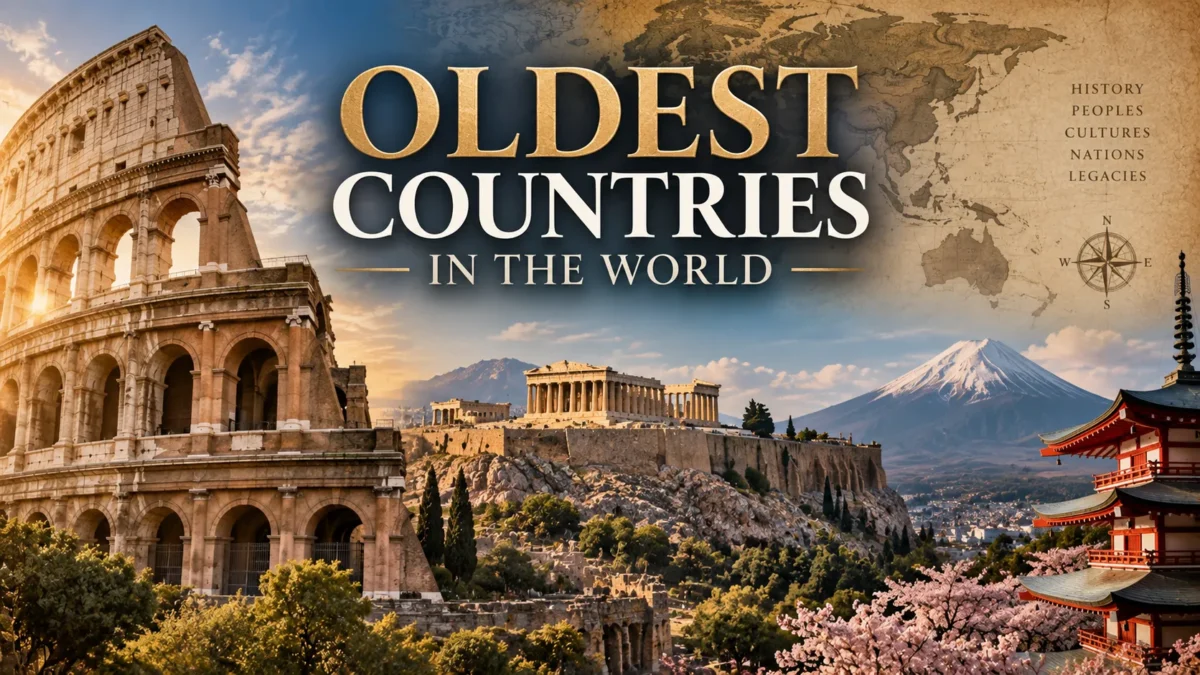
Ask ten historians “what is the oldest country in the world?” and you’ll likely get ten different answers — and a lecture on why the question is trickier than it sounds.
Is a “country” the land itself, the civilization that grew up on it, the government that rules it, or the borders drawn around it? Egypt, Iran, China, Ethiopia, Japan, and San Marino have all, at one point or another, been crowned the world’s oldest nation, and each claim rests on a slightly different definition.
This guide untangles the myths from the (well-sourced) history, walks through the oldest civilizations and nations on record, and gives you a clear, honest comparison — without pretending there’s a single, universally agreed winner.
TL;DR: There’s no single scientifically “correct” answer to which is the oldest country in the world — it depends on whether you’re measuring continuous statehood (San Marino, founded 301 AD), unbroken cultural identity (Iran or Egypt, going back thousands of years), or civilization itself (Mesopotamia and Egypt, over 5,000 years old).
Why There’s No Single Official Answer
The modern “country” — a sovereign nation-state with fixed borders, a flag, and a seat at the United Nations — is a relatively recent invention, really only standardized after the Peace of Westphalia in 1648 and the wave of decolonization in the 20th century.
Ancient peoples didn’t think in those terms. They had kingdoms, empires, city-states, and tribal confederations that rose, merged, split, and were conquered, sometimes every few generations.
So when someone asks “what is the oldest country in the world,” they’re usually really asking one of three different questions:
- Which sovereign state has existed continuously, without being dissolved or annexed, the longest? (favors San Marino, Bulgaria, or Denmark)
- Which nation has the longest unbroken cultural or ethnic identity tied to a specific territory? (favors Iran, Egypt, China, or Ethiopia)
- Where did the very first organized civilizations appear? (favors Mesopotamia and Egypt)
All three are legitimate ways to think about “oldest,” which is exactly why you’ll see different countries topping different lists online. Reputable historians generally avoid declaring one absolute winner — and this guide will do the same, while giving you the strongest, most commonly cited candidates for each definition.
So, What Is the Oldest Country in the World?
If you want the single most common answer given by historians and reference sources for “continuous sovereign statehood,” it’s San Marino. According to tradition, this tiny microstate perched on Monte Titano in Italy was founded on September 3, 301 AD by Saint Marinus, a Christian stonemason fleeing Roman persecution.
San Marino has never been absorbed into a larger empire since, making it arguably the world’s oldest surviving republic — though it’s worth noting the founding date comes from tradition and later chronicles rather than contemporary Roman records, so historians treat the exact date as legendary rather than firmly documented.
If instead you’re asking which nation has the oldest continuous identity, strong cases exist for:
- Iran, whose Persian identity and self-designation (“Iran,” meaning “land of the Aryans”) stretches back to the Achaemenid Empire founded by Cyrus the Great around 550 BCE — over 2,500 years of continuous cultural and political tradition, despite conquests by Greeks, Arabs, and Mongols along the way.
- Egypt, unified as a single kingdom around 3100 BCE under Narmer, often cited as the first true territorial nation-state, with a civilization that persisted along the Nile for millennia even as rulers changed.
- China, where a continuous written language, philosophical tradition, and sense of civilizational identity trace back over 3,000 years, with the first unified imperial state formed under Qin Shi Huang in 221 BCE.
- Ethiopia, one of the few nations in Africa or Asia never fully colonized, with roots in the ancient Kingdom of Aksum (from around the 1st century AD) and a monarchy tradition claiming descent from the Solomonic line.
So is Iran the oldest country in the world? Is Egypt? Is China? In the sense of longest continuous civilization and identity, all four have genuinely strong claims — it depends on which thread of continuity (political rule, culture, language, or religion) you weigh most heavily. There simply isn’t one internationally recognized, official ranking body that settles this.
The Oldest Civilizations That Came Before “Countries”
Before there were countries in any modern sense, there were civilizations — and this is where the phrase “oldest civilization in the world” comes in, a topic covered in more depth in this look at some of the most fascinating ancient civilizations. The leading candidates:
- Mesopotamia (modern-day Iraq): Home to Sumer, widely regarded as the cradle of urban civilization. Cities like Uruk and Eridu were flourishing by roughly 4500–4000 BCE, and Sumerians developed cuneiform, one of the earliest writing systems, around 3400 BCE.
- Ancient Egypt: Unified politically around 3100 BCE, with monumental architecture, writing (hieroglyphics), and centralized government appearing shortly after.
- The Indus Valley Civilization (modern Pakistan and northwest India): Sophisticated cities like Mohenjo-daro and Harappa were built from around 2600 BCE, with advanced urban planning and drainage systems.
- Ancient China: The Xia dynasty is described in later Chinese historical texts as beginning around 2070 BCE, though the earliest archaeologically confirmed dynasty is the Shang, from roughly 1600 BCE.
None of these were “countries” in the modern sense — they were networks of city-states or early kingdoms — but they laid the cultural, administrative, and technological groundwork that later nations built on. When people search for “the most ancient country in the world,” they’re often really pointing at these civilizations rather than any single unbroken political entity.
The Oldest Countries in the World: A Comparative List

Here’s a side-by-side look at the countries most frequently cited on “oldest countries” lists, along with the specific claim to fame behind each one. Treat traditional founding dates as historically informed estimates, not laboratory-verified facts.
| Country | Traditional Founding | Why It’s Considered “Old” |
|---|---|---|
| San Marino | 301 AD (traditional) | Oldest continuously surviving sovereign republic |
| Bulgaria | 681 AD | One of Europe’s oldest continuously named states |
| Denmark | c. 936 AD (Gorm the Old) | Oldest verified unbroken monarchy in Europe |
| Japan | Traditionally 660 BC (legendary); historically documented from ~5th century AD | Oldest continuing hereditary imperial line |
| Ethiopia | Kingdom of Aksum, c. 100 AD | Oldest independent nation in Africa, never colonized long-term |
| Egypt | c. 3100 BC (unification) | Oldest continuous civilization and territorial identity |
| Iran (Persia) | c. 550 BC (Achaemenid Empire) | Oldest continuous cultural-national identity in the Middle East |
| China | 221 BC (unification); civilization from c. 1600 BC | Oldest continuous civilization with unbroken written record |
| Portugal | 1143 AD | Oldest country in Europe with essentially unchanged borders |
| France | 843 AD (Treaty of Verdun) | Long continuous statehood despite regime changes |
This list isn’t a definitive top-10 ranking so much as a map of the different legitimate claims — it’s the closest thing to an honest answer to “what are the oldest countries in the world.”
Europe’s Oldest Countries
Within Europe specifically, three names dominate the conversation about the oldest country in Europe:
- San Marino — the strongest claim to oldest continuously sovereign state, dating to 301 AD by tradition.
- Bulgaria — founded in 681 AD when Khan Asparuh established the First Bulgarian Empire; despite centuries under Ottoman rule, Bulgarians point to a continuous national identity and name.
- Denmark — often cited as Europe’s oldest continuous monarchy, with a royal line traceable to Gorm the Old in the 10th century, making it a favorite answer to “Europe’s oldest country” among royal historians.
Honorable mentions go to Portugal, which has kept essentially the same borders since 1249 (making it one of Europe’s oldest nation-states in the geographic sense), and France, whose roots as a distinct political entity reach back to the division of the Carolingian Empire in 843 AD. Is Portugal the oldest country in Europe by borders? Quite possibly — few European nations can claim territorial continuity that long.
Asia’s Ancient Nations
Asia is home to some of the deepest continuous civilizational roots on the planet. China offers a compelling claim as the oldest continuous civilization, thanks to a writing system, philosophical tradition, and cultural identity stretching back more than three millennia — though its current political form, the People’s Republic of China, was only established in 1949.
Iran carries forward a Persian identity older than the Roman Empire, and Japan maintains the world’s oldest continuing hereditary monarchy, with an imperial line that — while its earliest emperors are considered legendary by historians — has documented, unbroken continuity from at least the 5th or 6th century AD onward.
Africa’s Oldest Independent Nation
When it comes to the oldest country in Africa, Ethiopia stands apart. Its roots trace to the ancient Kingdom of Aksum, a major trading power from around the 1st century AD, and its Solomonic monarchy tradition dates formally to 1270 AD, with legendary origins claimed even earlier.
Crucially, Ethiopia is one of the only African nations that was never formally colonized for an extended period (aside from a brief Italian occupation from 1936–1941), giving it an unusually strong claim to continuous sovereign identity on the continent.
What Was the First Country Ever?

If we’re asking what the very first country in the world was — the first time humans organized into something resembling a unified state rather than scattered city-states or tribes — most historians point to ancient Egypt around 3100 BCE, when Upper and Lower Egypt were unified under a single ruler, traditionally identified as Narmer.
This created a centralized government, a defined territory along the Nile, shared religious institutions, and a recognizable national identity — features we associate with statehood today.
Sumer, in Mesopotamia, arguably got there first in terms of urban civilization and writing, but it remained a patchwork of independent, often rival city-states rather than a single unified country. So while Sumer may be the cradle of civilization, Egypt has the stronger claim to being the first true country.
Oldest Continuously Inhabited Places on Earth
Distinct from “oldest country” is the question of the oldest continuously inhabited places in the world — settlements where people have lived, generation after generation, for an extraordinarily long time.
Jericho, in the West Bank, has archaeological evidence of settlement dating back roughly 11,000 years, making it one of the strongest contenders for oldest continuously inhabited city on Earth.
Damascus and Aleppo, both in Syria, also lay claim to the title, with continuous habitation stretching back several thousand years. Unlike the many historical towns that vanished off the map, these ancient cities predate the concept of “countries” entirely and offer a humbling reminder of just how long humans have been settling in fixed communities.
Old World Countries vs. the Oldest Countries
One quick point of confusion worth clearing up: “Old World countries” isn’t the same thing as “oldest countries.” The Old World is simply the historical term Europeans used for the parts of the globe known before the voyages of Columbus — Europe, Asia, and Africa — as opposed to the “New World” of the Americas.
So when someone searches for “old world countries,” they usually mean this geographic and historical category, not a ranking of national age. It’s a useful distinction, since the terms sound similar but answer completely different questions.
The Real Takeaway
The honest, myth-busting answer to “which country is the oldest in the world” is that it depends entirely on how you define “country” — and any list, including this one, is really comparing apples, oranges, and the occasional ancient Egyptian date palm. San Marino has the best claim to uninterrupted sovereign statehood.
Egypt has the best claim to being the first unified nation-state. Iran, China, and Ethiopia all have powerful cases for the longest continuous civilizational identity.
Rather than searching for one definitive champion, it’s more accurate — and honestly more interesting — to appreciate that human civilization’s oldest roots are tangled, overlapping, and spread across several continents, each with thousands of years of history still shaping the world today.
Frequently Asked Questions
What is the oldest country in the world?
There's no single official answer. San Marino, founded by tradition in 301 AD, is the most commonly cited oldest continuously sovereign state. However, Iran, Egypt, China, and Ethiopia are often called the oldest countries in the world when measuring unbroken cultural or civilizational identity rather than continuous statehood alone.
What was the first country in the world?
Most historians point to ancient Egypt, unified around 3100 BCE under Narmer, as the first country in the world in the modern sense — a centralized government ruling a defined territory. Sumer in Mesopotamia developed urban civilization slightly earlier but remained a collection of independent city-states rather than one unified nation.
Is Iran the oldest country in the world?
Iran has one of the strongest claims to the oldest continuous national and cultural identity, tracing back to the Achaemenid Persian Empire founded around 550 BCE. Its political rulers changed many times over the centuries, but Persian/Iranian identity has persisted for roughly 2,500 years.
Is Egypt the oldest country in the world?
Egypt has a strong claim as the oldest continuous civilization and one of the first unified nation-states, dating to around 3100 BCE. While its government and rulers changed dramatically over the millennia (Pharaonic, Persian, Greek, Roman, Arab, Ottoman, and modern republic), Egyptian civilization along the Nile has an unusually long continuous history.
Is China the oldest country in the world?
China is often cited as the oldest continuous civilization, with a written language and cultural tradition stretching back over 3,000 years and unification as an empire in 221 BCE. Its current government, the People's Republic of China, was founded in 1949, so 'oldest' here refers to civilizational continuity, not the current state's age.
Is Ethiopia the oldest country in the world?
Ethiopia is widely considered the oldest independent country in Africa, with roots in the ancient Kingdom of Aksum from around the 1st century AD and a monarchy tradition formalized in 1270. It's especially notable for never being colonized long-term, unlike most of the continent.
What is the oldest country in Europe?
San Marino is generally considered Europe's oldest continuously surviving sovereign state, with a traditional founding date of 301 AD. Bulgaria (founded 681 AD) and Denmark (a continuous monarchy since around 936 AD) are also frequently cited as contenders, depending on whether you're measuring statehood, name continuity, or monarchy.
What is the oldest monarchy in the world?
Japan's imperial line is traditionally described as the oldest continuing monarchy, with legendary origins dating to 660 BCE, though historians generally trace verified, documented continuity from around the 5th or 6th century AD. Denmark's monarchy, continuous since roughly 936 AD, is often cited as the oldest verifiably unbroken monarchy in Europe.
What country was before Israel?
Before the modern State of Israel was established in 1948, the territory was governed as the British Mandate for Palestine (1920–1948). Before that, it was part of the Ottoman Empire for roughly 400 years, and further back it was home to ancient kingdoms including Israel and Judah, later ruled by Assyrian, Babylonian, Persian, Greek, and Roman empires.
What is the oldest continuously inhabited place in the world?
Jericho, in the West Bank, is frequently cited as one of the oldest continuously inhabited settlements, with archaeological evidence of habitation stretching back roughly 11,000 years. Damascus and Aleppo in Syria also make strong claims to the title of oldest continuously inhabited city.
Which country has the earliest time zone?
This is a different question from 'oldest country' — it's about clocks, not history. The Line Islands (part of Kiribati) and parts of Samoa and New Zealand's Chatham Islands use UTC+14, the earliest time zone on Earth, meaning they're the first places to welcome each new calendar day.
What country has the oldest population?
If you mean median age rather than history, Japan and Monaco consistently rank among the countries with the oldest populations, with median ages well above 45, driven by long life expectancy and low birth rates.
What is the oldest democracy in the world?
This is debated. San Marino is often cited due to its long-standing republican constitution dating to 1600. Iceland's Althing, established around 930 AD, is sometimes called the world's oldest parliament, though it functioned more as a legislative and judicial assembly than a democracy in the modern sense.

Alex Warren
Related Articles