
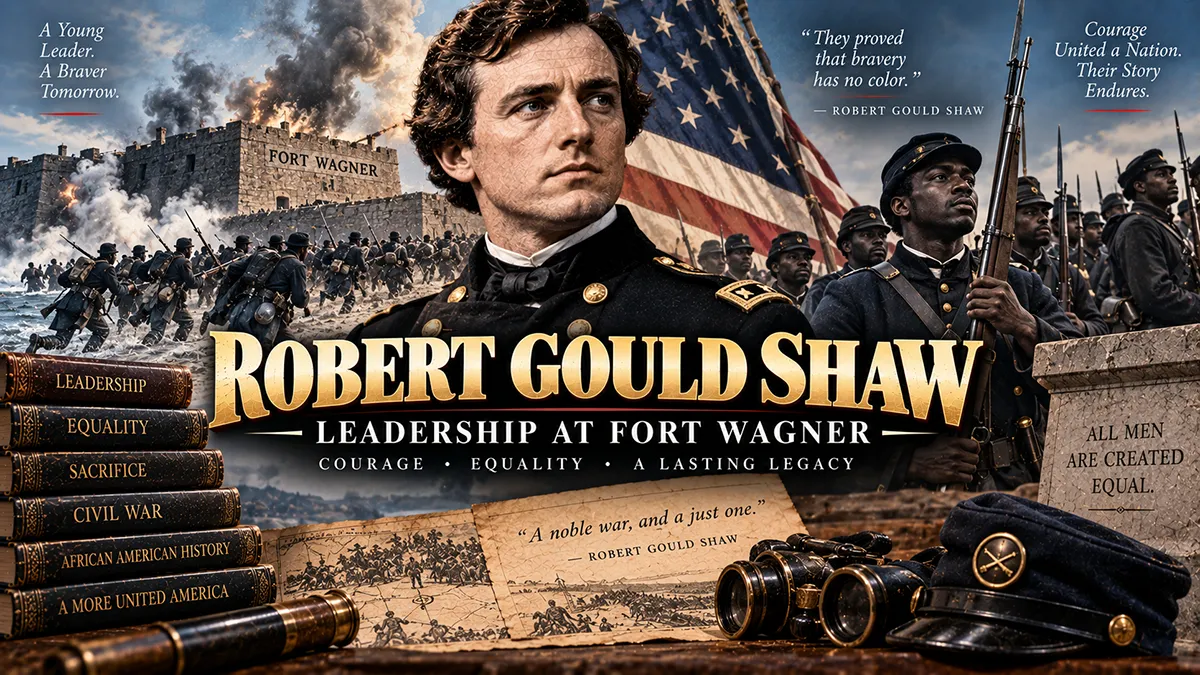
On the night of July 18, 1863, a young Union colonel climbed the parapet of a Confederate fort on a South Carolina sand dune, sword raised, and never came back down. His name was Robert Gould Shaw, and his death that night turned him into one of the most enduring symbols of the American Civil War. But the story doesn’t end with his death. What happened to his body afterward — and why it stayed exactly where it fell — is just as remarkable as the battle itself.
This is the real story of Colonel Robert Gould Shaw: who he was, how he died, why his remains were never recovered, and how that decision became one of the most quietly powerful statements of the entire war.
TL;DR: Colonel Robert Gould Shaw died leading the 54th Massachusetts’s assault on Fort Wagner in 1863, and when Confederate soldiers buried him in a mass grave with his Black soldiers as an intended insult, his own family refused to have his body separated from his men.
Who Was Robert Gould Shaw?
Robert Gould Shaw was born in Boston in 1837 to a wealthy and deeply abolitionist family. His parents, Francis George Shaw and Sarah Blake Sturgis Shaw, raised him within a social circle that included some of the most prominent anti-slavery voices in New England. That upbringing shaped nearly every decision he made as an adult, including the one that would define his short life.
Before the war, Shaw studied at Harvard, though he left without graduating, and worked briefly in his family’s mercantile business in New York. Like many young men of his class and era, he wasn’t especially destined for military glory. Circumstances, and his own convictions, changed that.
From Volunteer to Officer: Robert Shaw’s Military Service
When the Civil War broke out in 1861, Shaw enlisted in the 7th New York Militia and then joined the 2nd Massachusetts Infantry as an officer. He saw combat at Cedar Mountain and Antietam, two of the war’s brutal early engagements, and by all accounts proved himself a capable and courageous junior officer.
So yes, to answer a common question directly: Robert Shaw was very much in the military, and not just as a figurehead. He had already survived roughly two years of hard campaigning before he ever took command of the regiment that would make him famous.
Taking Command of the 54th Massachusetts
In early 1863, Massachusetts Governor John Andrew moved to organize one of the first official Black regiments in the Union Army, the 54th Massachusetts Volunteer Infantry. Andrew wanted an officer with abolitionist credentials, combat experience, and the social standing to command respect, and he asked Shaw to lead it.
Shaw initially hesitated, worried about the difficulty and danger of the assignment, but accepted after some reflection and encouragement from his family. He was commissioned as colonel, making him the man who led the 54th Massachusetts regiment through its training and into its first major combat test.
Under Shaw, the regiment trained rigorously at Camp Meigs in Readville, Massachusetts, and became a symbol of the Union’s willingness to arm and trust Black soldiers in a war that had started, for many white Northerners, as a fight to preserve the union rather than to end slavery. The 54th marched through Boston to cheering crowds before shipping south, a moment often cited as a turning point in Northern public opinion about Black soldiers.
The Assault on Fort Wagner: July 18, 1863
Fort Wagner guarded the approach to Charleston Harbor, one of the Confederacy’s most symbolically important ports. Union commanders planned a coordinated assault, and after some hesitation about which unit should lead the dangerous frontal attack, Shaw volunteered his own regiment for the honor.
On the evening of July 18, 1863, the 54th Massachusetts charged across open sand toward the fort’s earthen walls under withering artillery and rifle fire. Colonel Shaw led from the front, reportedly reaching the parapet of the fort itself before falling, shot multiple times, in the middle of the fighting.
The assault ultimately failed to take the fort, and the 54th suffered devastating casualties, including many of its officers. But the regiment’s discipline and bravery under fire silenced a great deal of skepticism about Black soldiers’ willingness to fight, and news of the battle spread quickly across the North.
How Did Robert Shaw Die? The Colonel’s Final Moments
So how did Robert Gould Shaw die, exactly? Historical accounts from soldiers present that night describe Shaw being struck by rifle fire as he stood atop the fort’s parapet, sword in hand, urging his men forward. He died almost instantly from his wounds during the height of the fighting.
What did Robert Shaw die of, in plain terms, was combat wounds sustained in a direct infantry assault on a fortified Confederate position. There is no mystery or ambiguity here; Robert Gould Shaw’s cause of death was gunfire received while leading his regiment in battle, consistent with countless other officer deaths of the era who chose to lead from the front rather than the rear.
His body remained on the battlefield after the assault was repulsed, along with hundreds of his men, because the Union forces were unable to hold the ground they had briefly gained.
Buried With His Men: An Insult That Became a Tribute
When Confederate soldiers gathered the Union dead the following day, they treated Shaw’s remains differently than customary battlefield etiquette of the time would have dictated for an officer. Rather than being given a separate, marked burial as officers usually received, Shaw was buried in a mass trench together with dozens of his soldiers.
Contemporary accounts suggest this was a deliberate insult on the Confederates’ part, meant to degrade Shaw specifically because he had commanded Black troops. Some accounts attribute a blunt remark to a Confederate officer in charge of the burial detail, essentially stating that Shaw had been buried alongside his men rather than given separate honors befitting his rank. The exact wording varies between sources, so it’s worth treating the precise quote with some caution even as the broader fact of the shared burial is well documented.
What the Confederates intended as degradation, history ultimately transformed into something else entirely.
“We Leave Him Where He Lies”: Francis Shaw’s Response
When Union officials later offered to recover Robert Gould Shaw’s remains and return them to Massachusetts for a proper burial, his father, Francis George Shaw, refused. He reportedly stated that he could imagine no holier place for his son’s body than lying among the brave men he had commanded and died alongside.
This decision stunned some contemporaries but resonated powerfully with abolitionist communities across the North. It reframed the Confederates’ intended insult as an act of solidarity, suggesting that a white officer resting eternally beside his Black soldiers was not a disgrace but an honor.
Because of that choice, Robert Gould Shaw’s body was never separately retrieved, identified, or reburied elsewhere. He remains, to this day, part of the unmarked mass grave near where Fort Wagner once stood.
Fort Wagner’s Mass Grave Location Today
Fort Wagner itself no longer exists in any recognizable form. The fort stood on Morris Island near Charleston, South Carolina, and decades of coastal erosion have washed away much of the original site, including, most historians believe, the exact ground where the mass grave was located.
This means there is no marked, visitable grave site at Fort Wagner today in the way visitors might expect from other Civil War battlefields. Morris Island remains largely undeveloped and is the subject of ongoing preservation efforts, but the shifting shoreline has made it extremely difficult to pinpoint the original burial trenches with certainty.
So if you’re wondering about the Fort Wagner mass grave location today, the honest answer is that the Atlantic Ocean has likely reclaimed most of it. It’s a strangely fitting, if unintended, extension of the family’s original wish that Shaw simply remain where he fell.
Robert Gould Shaw’s Grave: A Symbolic Marker, Not a Physical Resting Place
Because his body was never recovered, there is technically no traditional grave for Robert Gould Shaw containing his remains. Families of the era sometimes erected memorial markers or cenotaphs for soldiers whose bodies could not be brought home, and the Shaw family did participate in memorial efforts of this kind.
Visitors searching for “Robert Gould Shaw’s grave” or “Robert Shaw’s grave” today are more likely to find memorial markers, family plots referencing his death, and most famously, a monument in Boston, than an actual burial site. It’s an important distinction for anyone researching his story, since the physical grave and the memorial legacy are two very different things.
Honoring the Fallen: The Shaw Memorial in Boston
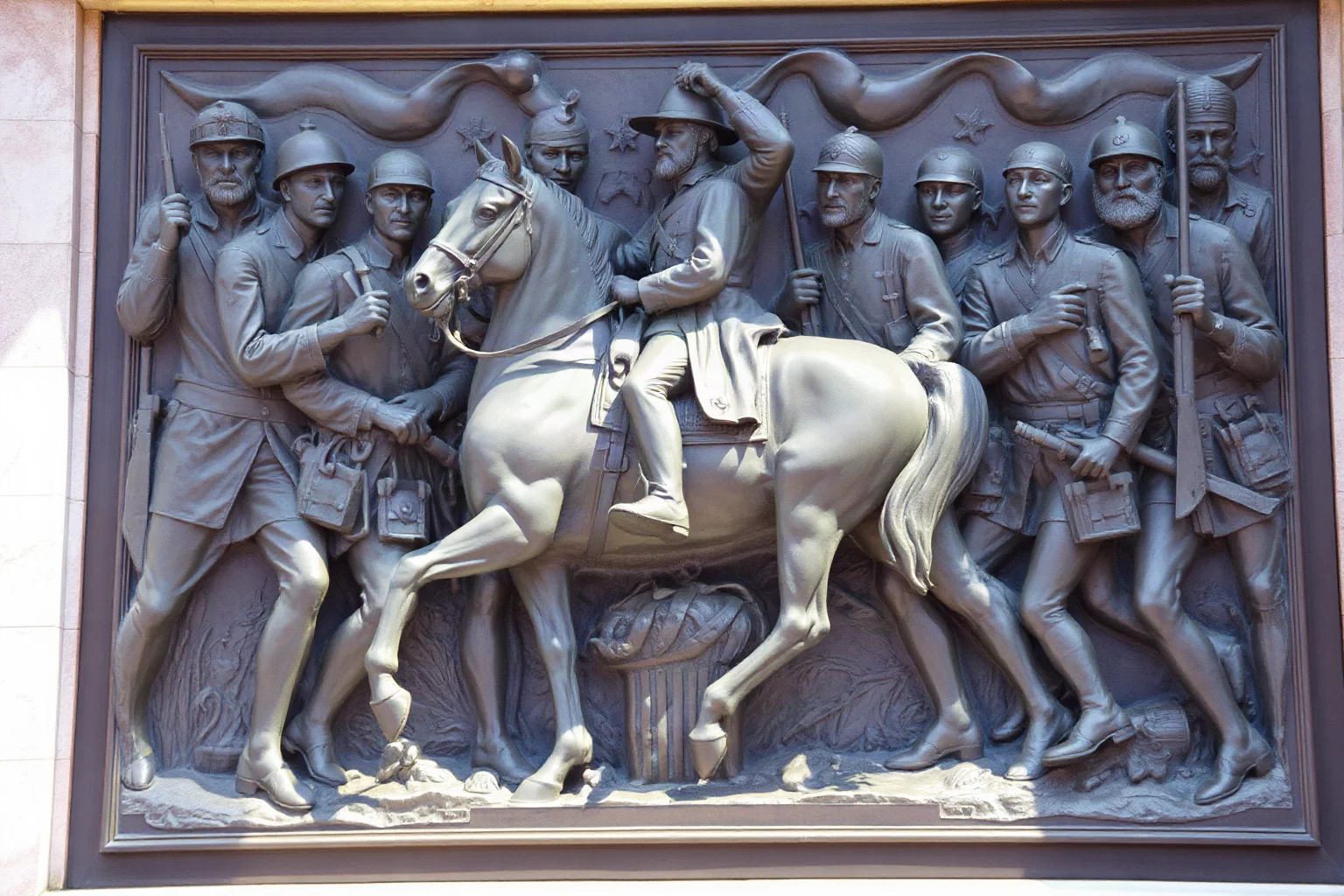
The most famous tribute to Colonel Shaw is the Robert Gould Shaw and 54th Massachusetts Regiment Memorial, a bronze relief sculpture by Augustus Saint-Gaudens unveiled in Boston in 1897. It stands across from the Massachusetts State House on Boston Common and depicts Shaw on horseback surrounded by marching Black infantrymen.
Saint-Gaudens spent roughly fourteen years working on the piece, and it’s widely regarded as one of the finest American sculptures of the nineteenth century. Notably, the monument honors the ordinary soldiers of the 54th by name on its reverse side, a rare choice for the period that reflected the same spirit behind Francis Shaw’s refusal to separate his son from his men.
The memorial remains a major historic site in Boston today and is often the first stop for people researching Colonel Robert Gould Shaw’s legacy in person.
Cabot Russel, Cabot Forbes, and the Other Officers Who Fell

Shaw wasn’t the only officer lost in the Fort Wagner assault. Captain Cabot Jackson Russel, a young officer from a prominent Massachusetts family closely connected to the Shaws through the tangled web of Boston’s abolitionist elite, was also killed that night and likewise never recovered from the battlefield.
Some modern searches reference a “Major Cabot Forbes” in connection with this story, which appears to be a mix-up rooted in the intertwined names of Boston’s old abolitionist families, the Russells, Forbeses, and Shaws among them, who were connected by marriage and shared political causes. Historical records document Cabot Jackson Russel’s death at Fort Wagner clearly, but there isn’t a well-documented “Major Cabot Forbes” tied directly to this specific battle in reputable Civil War sources.
Other officers, including Lieutenant Colonel Edward Hallowell, survived the assault despite serious wounds and went on to lead the 54th Massachusetts through the rest of the war. Their survival helped ensure the regiment’s story, and Shaw’s, was documented and preserved for future generations.
Who Led the 54th Massachusetts After Shaw?
After Shaw’s death, Lieutenant Colonel Edward Hallowell took over command of the 54th Massachusetts and led the regiment through additional campaigns in South Carolina and Florida. The regiment continued fighting until the war’s end in 1865, cementing its reputation as one of the most effective Black units in the Union Army.
The 54th Massachusetts’s service, and Shaw’s leadership specifically, helped pave the way for roughly 180,000 Black soldiers to eventually serve in the Union Army by war’s end. That’s a legacy that extends well beyond a single battle or a single officer’s death.
From History to Hollywood: Glory and Pop Culture
Much of the modern public’s familiarity with Robert Gould Shaw comes from the 1989 film Glory, which dramatized the formation and combat history of the 54th Massachusetts. Actor Matthew Broderick portrayed Colonel Shaw, and the film won three Academy Awards, introducing millions of viewers to a story many hadn’t learned in school.
People searching for “Robert from Glory” are almost always looking for this cinematic version of Shaw, and while the film takes some dramatic liberties common to historical filmmaking, it’s broadly credited by historians with popularizing an important but underrepresented chapter of Civil War history. It remains one of the most widely referenced dramatizations of Shaw’s story decades after its release.
Untangling the Search Confusion: Other “Shaws” You Might Be Thinking Of
Because “Shaw” is a common surname, a lot of unrelated searches get tangled up with Colonel Robert Gould Shaw’s story. If you searched “what happened to Doc Shaw,” you’re likely thinking of the actor and musician known professionally as Doc Shaw, born Louis Anthony Shaw III, who has no relation to the Civil War colonel.
Similarly, searches for “It: Welcome to Derry General Shaw” refer to a fictional character in a horror television series, not the historical figure covered in this article. Any similarity in name between fictional characters and the historical Colonel Shaw appears to be coincidental rather than an intentional reference, though without an official statement from the show’s creators, that connection shouldn’t be treated as confirmed either way.
It’s a good reminder that history and pop culture often collide in search results, even when the underlying stories have nothing to do with each other.
Why Robert Gould Shaw’s Story Still Matters
Colonel Robert Gould Shaw died at just twenty-five years old, but his death, and more specifically what happened to his body afterward, became a defining moral moment of the Civil War. A Confederate insult meant to dishonor a white officer for commanding Black troops was answered by his own father’s refusal to treat that shared grave as anything other than sacred ground.
That refusal turned a battlefield humiliation into one of the war’s most quoted acts of solidarity, and it’s a big part of why Shaw is remembered today far beyond footnotes about the 54th Massachusetts. His story sits at the intersection of privilege, conviction, and sacrifice in a way that still resonates with readers more than a century and a half later.
Whether you first encountered this story through a history class, the film Glory, or the Saint-Gaudens memorial on Boston Common, the core facts remain genuinely remarkable. Robert Gould Shaw chose to lead Black soldiers into one of the war’s deadliest assaults, died doing so, and his family chose to let him remain buried among them forever.
Frequently Asked Questions
Who was Colonel Robert Gould Shaw?
Colonel Robert Gould Shaw was a Union Army officer from an abolitionist Boston family who commanded the 54th Massachusetts Volunteer Infantry, one of the first official Black regiments in the Union Army, during the American Civil War. He is best known for leading the regiment's assault on Fort Wagner in South Carolina in July 1863, where he was killed in action.
How did Robert Gould Shaw die?
Robert Gould Shaw was killed on July 18, 1863, while leading the 54th Massachusetts in a frontal assault on Fort Wagner, a Confederate fortification near Charleston, South Carolina. Eyewitness accounts indicate he was struck by gunfire while standing atop the fort's parapet urging his soldiers forward, and he died from his wounds during the fighting.
What did Robert Gould Shaw die of, exactly?
Robert Gould Shaw's cause of death was combat wounds from gunfire sustained during the infantry assault on Fort Wagner. There is no ambiguity or unresolved mystery about it; he died leading a direct attack on a fortified Confederate position, as recorded by multiple soldiers present that night.
Why was Robert Gould Shaw’s body never retrieved?
After the failed assault, Confederate forces buried Shaw in a mass grave with his soldiers rather than giving him a separate officer's burial, reportedly as a deliberate insult tied to his command of Black troops. When Union officials later offered to recover his remains, his father, Francis George Shaw, declined, stating he wanted his son to remain buried among the men he had led.
Where is Robert Gould Shaw’s grave located today?
There is no traditional, marked grave containing Shaw's remains, since his body was never separated from the mass burial site near Fort Wagner. Coastal erosion on Morris Island over the decades has made it very difficult to identify the exact original burial location today, so most people instead visit his memorial in Boston.
Who led the 54th Massachusetts Regiment?
Colonel Robert Gould Shaw was the original commanding officer of the 54th Massachusetts Regiment. After his death at Fort Wagner, Lieutenant Colonel Edward Hallowell took over command and led the regiment through the remainder of the Civil War.
Was Robert Gould Shaw actually in the military before commanding the 54th Massachusetts?
Yes, Shaw had already served roughly two years in the Union Army before taking command of the 54th Massachusetts, including combat experience with the 2nd Massachusetts Infantry at battles such as Cedar Mountain and Antietam. He was an experienced junior officer by the time Governor John Andrew asked him to lead the new regiment.
Who was Major Cabot Forbes, and how does he relate to this story?
There isn't a well-documented Civil War officer known as 'Major Cabot Forbes' directly tied to the Fort Wagner assault in reputable historical sources. This search term likely reflects confusion with Captain Cabot Jackson Russel, an officer from a Boston family closely connected to the Shaws, who was also killed at Fort Wagner and never recovered.
Is ‘General Shaw’ from It: Welcome to Derry related to Robert Gould Shaw?
No, the character referenced in the horror series It: Welcome to Derry is a fictional creation for that show and is not based on Colonel Robert Gould Shaw. Any similarity in surname appears to be coincidental rather than a confirmed reference to the historical figure.
What happened to Doc Shaw?
Doc Shaw is a modern American actor and singer, born Louis Anthony Shaw III, known for roles in shows like That's So Raven. He has no relation to Colonel Robert Gould Shaw of Civil War history, despite the shared surname causing occasional search confusion.
Is the movie Glory an accurate portrayal of Robert Gould Shaw?
Glory (1989), which portrays Robert Gould Shaw and the 54th Massachusetts, is broadly praised by historians for popularizing this important story, though like most historical dramas it simplifies and dramatizes certain events and characters for narrative purposes. It remains the most widely referenced pop-culture depiction of Shaw's life and death.

Alex Warren
Related Articles