

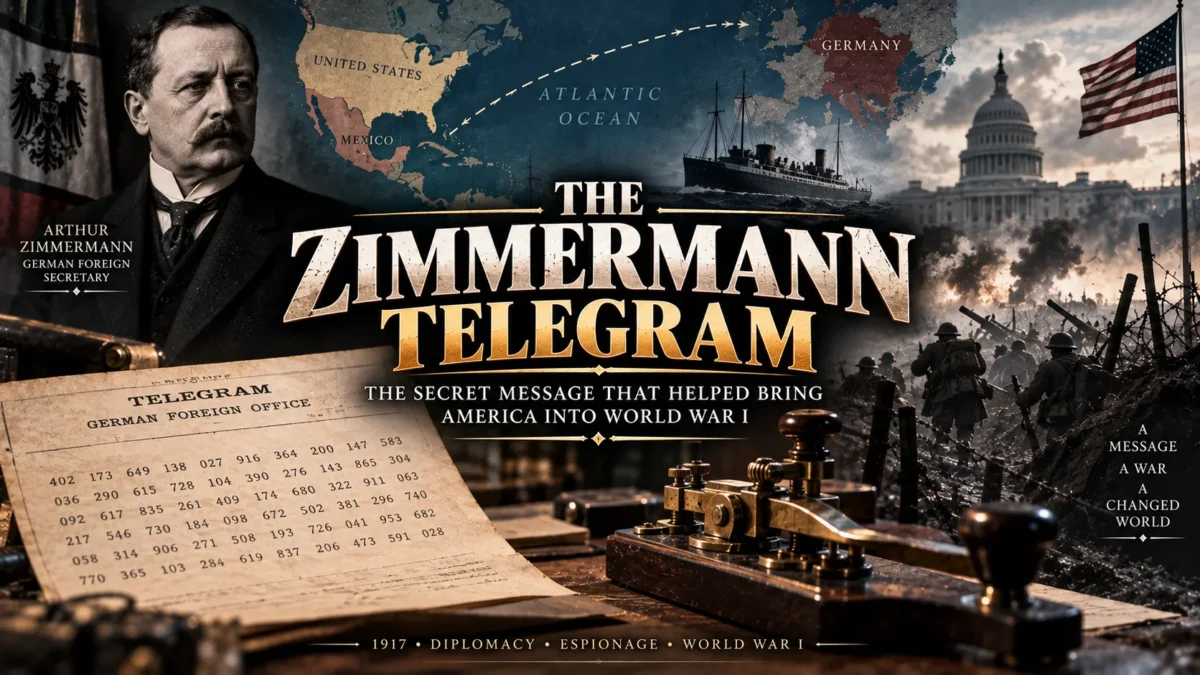
Imagine a single piece of paper, scrambled into nonsense code, changing the course of a world war. That’s not a movie plot — it’s exactly what happened in early 1917, when British codebreakers intercepted a secret German message and handed it to the United States.
Within weeks, a country that had spent nearly three years insisting it wanted no part of the fighting in Europe was marching toward war.
This is the story of the Zimmermann Telegram, arguably the most consequential piece of decoded correspondence in modern history. It’s a tale of codebreakers, spies, diplomatic blunders, and a proposal so audacious that many Americans initially refused to believe it was real.
TL;DR: The Zimmermann Telegram was a secret 1917 German proposal offering Mexico U.S. territory in exchange for joining an alliance against America, and its exposure was a key factor that pushed the United States into World War I.
What Was the Zimmermann Telegram?
So, what was the Zimmermann telegram, exactly? It was a coded diplomatic cable sent on January 16, 1917, by German Foreign Secretary Arthur Zimmermann to the German ambassador in Mexico, Heinrich von Eckardt. The message was routed through German diplomatic channels, partly through the American embassy in Berlin, which ironically helped the message travel while also exposing it to interception.
In plain terms, this was Germany reaching out to Mexico with a startling offer. If the United States entered World War I on the side of the Allies, Germany wanted Mexico to declare war on America as a distraction and a strategic partner. This single document is often shortened to the “ww1 telegram” in casual conversation, but its formal name honors the German official who signed off on it.
You’ll sometimes see it spelled “Zimmerman telegram” with one “n,” but the correct German spelling is Zimmermann, with two. Both spellings refer to the same event, and both are common in searches and history books alike, so don’t worry too much about which version you see online.
The World In Early 1917: Why Germany Took Such A Gamble
To understand why Germany sent this telegram at all, you have to picture the state of the war in late 1916 and early 1917. Europe had been locked in brutal trench warfare for over two years, with millions dead and no clear end in sight. Germany’s military leadership was growing desperate for a way to break the stalemate.
Germany’s naval command decided to resume unrestricted submarine warfare, meaning German U-boats would sink any ship — including neutral and civilian vessels — suspected of aiding the Allies. German strategists knew this policy carried a serious risk: it could easily drag the United States into the war on the Allied side. The Zimmermann Telegram was essentially an insurance policy against that risk.
The thinking in Berlin was straightforward, if reckless. If the U.S. was going to enter the war anyway because of submarine attacks, Germany figured it might as well arrange a distraction on America’s own doorstep. A Mexican-American conflict would tie down U.S. troops and resources, buying Germany more time to win in Europe before American forces could be sent overseas.
What Did The Zimmermann Telegram Propose?
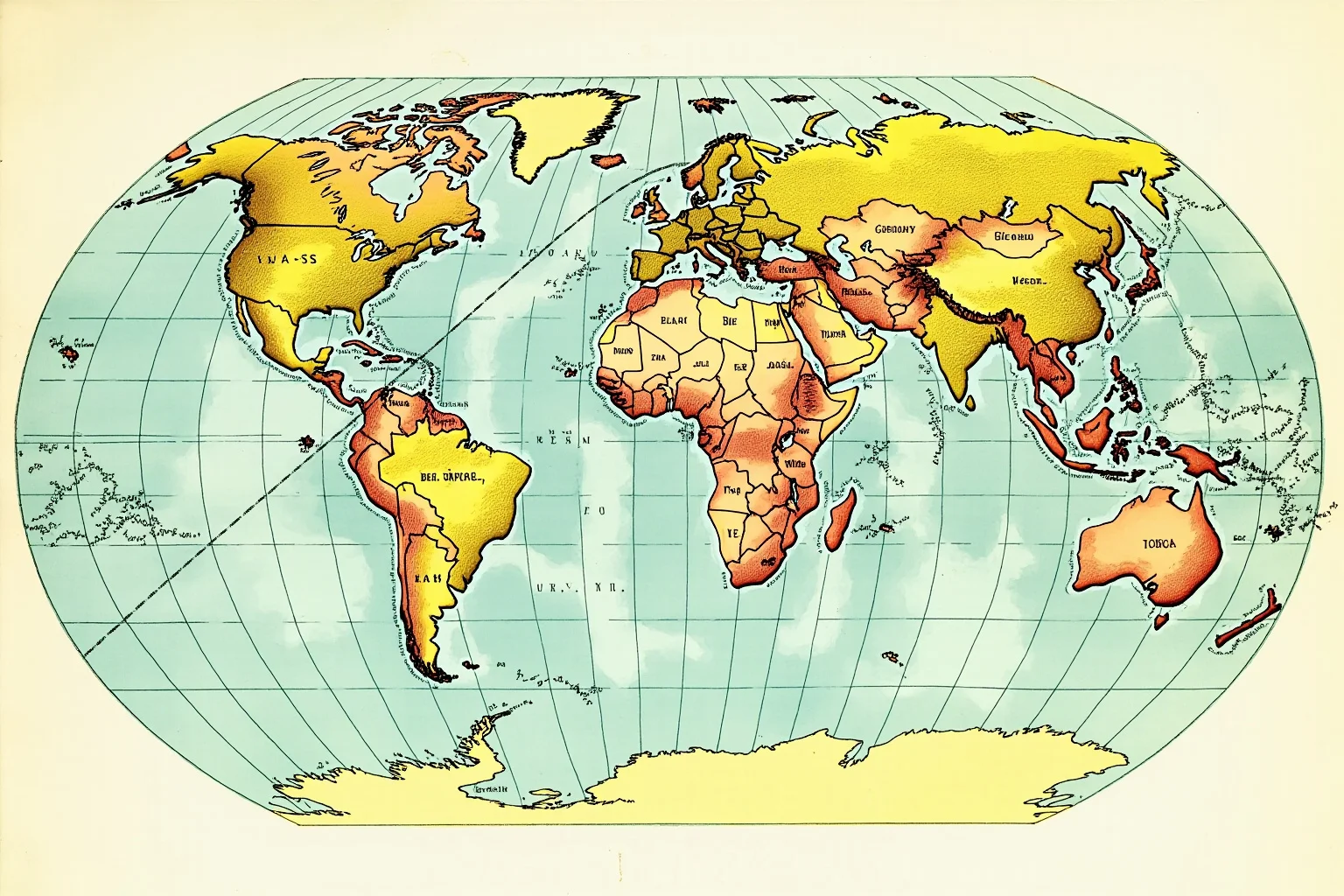
The actual content of the telegram was remarkably direct once decoded. Zimmermann instructed von Eckardt that if the U.S. declared war on Germany, he should approach the Mexican government with a proposal for a military alliance between Germany and Mexico. Germany would provide financial support and, crucially, help Mexico reconquer territory it had lost to the United States decades earlier.
That lost territory specifically named in the telegram included Texas, New Mexico, and Arizona — land Mexico had ceded to the U.S. following the Mexican-American War of the 1840s. It was an offer designed to appeal directly to long-standing Mexican grievances. Zimmermann also asked von Eckardt to encourage Mexico to help broker an alliance with Japan, adding another layer of ambition to the plan.
In short, this wasn’t a vague suggestion of friendship. It was a concrete pitch: fight America, and Germany will help you take back what you lost, plus bankroll the effort. For a document sent through supposedly secure diplomatic channels, it was strikingly blunt.
How Did The US Find Out About The Zimmermann Telegram?
Here’s where the story gets genuinely cinematic. Britain operated a top-secret code-breaking unit known as Room 40, based within the Admiralty in London. Room 40’s cryptographers had been quietly cracking German diplomatic and naval codes throughout the war, giving Britain a massive intelligence advantage that Germany didn’t fully appreciate.
When the Zimmermann Telegram was transmitted, it passed through cables that British intelligence could monitor, including a transatlantic line that ran through Britain itself. Room 40 codebreakers, working painstakingly through partially broken German cipher systems, intercepted and decoded the message by late January 1917. What they read left them stunned.
Britain faced a delicate problem. They desperately wanted to share this bombshell with the still-neutral United States to help pull America into the war on their side. But revealing the telegram’s contents risked exposing that Britain could read Germany’s most secret communications, a capability far too valuable to burn on one disclosure.
British intelligence solved this with a clever cover story. They obtained a copy of the telegram as it had been sent onward from Mexico City, using a different, lower-grade cipher, and claimed this was how they’d acquired it. This masked the fact that Britain’s codebreakers had access to Germany’s core diplomatic codes, protecting Room 40’s secret capabilities for future use.
On February 24, 1917, British officials formally handed the decoded telegram to Walter Hines Page, the American ambassador in London. Page relayed it to President Woodrow Wilson and the State Department, and the countdown toward American involvement in the war effectively began.
Skepticism And Confirmation: Was It A Hoax?
When news of the telegram reached American shores, plenty of people assumed it was fabricated. Wilson himself was reportedly cautious, and many in the press and in Congress suspected British propaganda designed to manipulate the U.S. into war. This wasn’t an unreasonable assumption given Britain’s obvious interest in seeing America join the fight.
The skepticism didn’t last long, though, thanks to an almost unbelievable twist. In early March 1917, German Foreign Secretary Arthur Zimmermann himself publicly confirmed the telegram was genuine during a press conference and later in statements to the Reichstag. He apparently believed that owning up to it, and framing it as a contingency plan only meant to take effect if America declared war first, would soften the blow.
It did not soften the blow. Zimmermann’s confirmation instantly silenced the hoax theories and handed American newspapers, and Wilson’s administration, exactly the proof they needed. It remains one of history’s great diplomatic own-goals, a moment when honesty did far more damage than any lie could have.
Why Was The Zimmermann Telegram Important?
So why was the Zimmermann telegram important, beyond just being a dramatic spy story? It mattered because it shattered the last real arguments for American neutrality. For years, Wilson had campaigned on keeping the U.S. out of the European war, and much of the public still saw the conflict as a distant quarrel that didn’t concern them.
The telegram changed that calculation overnight. This wasn’t some abstract European squabble anymore; it was a direct, documented plot to help an enemy invade American soil and dismantle U.S. territory. That hit differently for ordinary Americans, especially in the very states named in the plan.
The timing also mattered enormously. The telegram’s exposure came just as Germany’s resumption of unrestricted submarine warfare was already sinking American ships and killing American civilians. Together, these two developments created a one-two punch that made continued neutrality feel almost impossible to justify politically.
The Effect Of The Zimmerman Telegram On World War I
The effect of the Zimmerman telegram on World War I was immediate and historically decisive. American public opinion, which had been divided and largely anti-intervention, swung hard toward supporting entry into the war. Newspapers across the country ran the story on front pages, often alongside outraged editorials.
President Wilson, who had narrowly won re-election in 1916 partly on a platform of keeping America out of the war, found the political ground shifting beneath him. Combined with the mounting toll of German submarine attacks on American shipping, the telegram gave Wilson the public and congressional support he needed to change course. He asked Congress for a declaration of war on April 2, 1917, and Congress obliged just four days later.
It’s worth being careful here, though, in true myth-busting fashion: the telegram was a major catalyst, not the sole cause of American entry. Unrestricted submarine warfare and the resulting loss of American lives at sea were already pushing the U.S. toward war before the telegram became public. The telegram accelerated and hardened that shift rather than creating it from nothing.
What Was The Result Of The Telegram?
The most direct result of the telegram’s exposure was the United States declaring war on Germany on April 6, 1917, marking it as one of the biggest events in American history. This decision brought a massive and largely untapped pool of American manpower, industry, and financial resources into the Allied war effort. Germany’s gamble, hoping to distract America with a Mexican conflict, had spectacularly failed to prevent U.S. involvement.
As for Mexico, its government under President Venustiano Carranza never seriously pursued the alliance Germany proposed. Mexico was still recovering from its own revolution and had no realistic capacity to wage war against its much larger northern neighbor. The offer was essentially dead on arrival once it became public and once Mexican officials weighed the practical risks.
For Germany, the telegram became a diplomatic humiliation layered on top of a strategic failure. Rather than neutralizing the American threat, it had handed the Allies one of the most effective propaganda tools of the entire war. Within about a year and a half of the telegram’s exposure, fresh American troops and resources would help tip the balance on the Western Front.
Zimmermann Telegram Significance In The Bigger Picture
Looking at the Zimmermann telegram’s significance from a wider historical lens, it represents a turning point not just for World War I but for the role of intelligence and codebreaking in modern warfare. It demonstrated, for the first time on such a public stage, how intercepted communications could alter the course of international events. That lesson would echo loudly again in World War II, when codebreaking played an even larger role in Allied strategy.
The episode also illustrates how quickly public opinion can shift when abstract threats become personal ones. Many Americans had tolerated years of European bloodshed from a comfortable distance, but a credible plan involving Texas, New Mexico, and Arizona felt immediate and threatening. That psychological shift is a big part of why this single document carried so much weight.
Finally, the telegram highlighted the risks of relying on communication technology that could be intercepted, a lesson relevant far beyond 1917. Diplomatic and military secrets sent through cables and wires were never as secure as governments assumed, a vulnerability that intelligence services on all sides would spend decades trying to manage.
Telegraph Technology In World War I
It helps to remember just how central the telegraph was to World War I communications generally. The telegraph, and its underwater cousin the transatlantic cable, formed the nervous system of early 20th-century diplomacy and military coordination. Governments relied on these networks to send orders, negotiate, and gather intelligence across vast distances in near real time.
This reliance created an obvious vulnerability. Any message sent through a cable that passed through, or was rerouted by, a rival power’s territory could potentially be copied and analyzed. Britain’s control of key transatlantic cable routes gave it an outsized advantage in monitoring German communications throughout the war, the Zimmermann Telegram being the most famous example.
The episode is a useful reminder that World War I wasn’t only fought with rifles and artillery. It was also a war of codes, cables, and quiet intelligence work happening far from the trenches, with consequences just as significant as any battlefield victory.
Common Myths About The Zimmermann Telegram
A persistent myth is that the telegram alone caused America to enter World War I, as if Wilson woke up one morning and simply changed his mind. In reality, it was one major factor among several, including unrestricted submarine warfare, the sinking of American ships, and years of gradually eroding neutrality. The telegram was the dramatic final push, not the entire story.
Another common misconception is that Mexico eagerly embraced Germany’s proposal. Historical records show Mexican officials were skeptical and ultimately uninterested, recognizing the plan as impractical and dangerous given Mexico’s internal instability at the time. There’s no solid evidence that Mexico ever seriously moved to act on the offer.
Some also assume the telegram was leaked by a spy inside the German government. The truth is more technical and, frankly, more impressive: it was cracked through painstaking British cryptographic work in Room 40, not through espionage or betrayal. That distinction matters because it highlights the sheer skill involved in wartime codebreaking.
The Legacy Of A Single Decoded Message
More than a century later, the Zimmermann Telegram remains a textbook example of how intelligence work can shape history in ways battlefield strategy alone cannot. It’s studied in classrooms, referenced in espionage histories, and cited as an early proof of concept for signals intelligence. Few single documents from that entire war carry as much recognizable weight today.
It’s also a story about human overconfidence. German officials trusted that their diplomatic codes were secure enough to gamble the country’s strategic future on a single risky message. That misplaced confidence, more than any one villain or hero, is what ultimately doomed the plan.
When people ask what the Zimmermann telegram was, the short answer is a secret German proposal to Mexico. The fuller answer is that it was a wake-up call, a diplomatic disaster, and one of the clearest examples in history of how a single piece of paper can redirect the fate of nations.
Closing Thoughts
The Zimmermann Telegram didn’t start World War I, and it wasn’t the only reason America eventually joined the fight. But it was the spark that turned simmering tension into decisive action, arriving at exactly the right moment to tip American public opinion and political will toward war.
It’s a reminder that history often turns on small, almost bureaucratic moments rather than grand speeches or dramatic battles. A coded cable, a team of dedicated codebreakers, and one German official’s unexpected honesty combined to help reshape the 20th century. Few stories capture the strange, unpredictable mechanics of history quite so vividly.
Frequently Asked Questions
What was the Zimmerman telegram?
The Zimmermann Telegram was a secret coded message sent by German Foreign Secretary Arthur Zimmermann to the German ambassador in Mexico in January 1917. It proposed that if the United States entered World War I against Germany, Germany would help Mexico reclaim territory in Texas, New Mexico, and Arizona in exchange for Mexico declaring war on the U.S.
What did the Zimmermann telegram propose?
It proposed a military alliance between Germany and Mexico. Germany offered financial aid and support for Mexico to reconquer Texas, New Mexico, and Arizona if the U.S. joined the Allies, and it also suggested Mexico help arrange an alliance with Japan against the United States.
How did the US find out about the Zimmermann telegram?
British intelligence officers in a codebreaking unit called Room 40 intercepted and decoded the telegram in early 1917. Britain then shared the decoded message with the American ambassador in London on February 24, 1917, using a cover story to hide the fact that they could read Germany's top diplomatic codes.
Why was the Zimmermann telegram important to World War I?
It was important because it eliminated much of the remaining American public and political resistance to entering World War I. Combined with Germany's resumption of unrestricted submarine warfare, it helped convince Congress and President Wilson to declare war on Germany in April 1917.
What was the result of the telegram?
The most significant result was the United States declaring war on Germany on April 6, 1917, bringing American troops, industry, and resources into the Allied war effort. Mexico never seriously pursued the proposed alliance, and Germany's plan to distract the U.S. ultimately backfired.
How did the Zimmermann telegram lead to WW1 involvement by the US?
The telegram's exposure convinced skeptical Americans that Germany posed a direct threat to U.S. territory, not just a distant European conflict. This shift in public opinion, combined with German submarine attacks on American ships, gave President Wilson the support needed to ask Congress for a declaration of war.
Was the Zimmermann telegram a hoax?
No, though many Americans initially suspected it was British propaganda. Doubts were erased when German Foreign Secretary Arthur Zimmermann himself publicly confirmed the telegram's authenticity in early March 1917.

Alex Warren
Related Articles





