
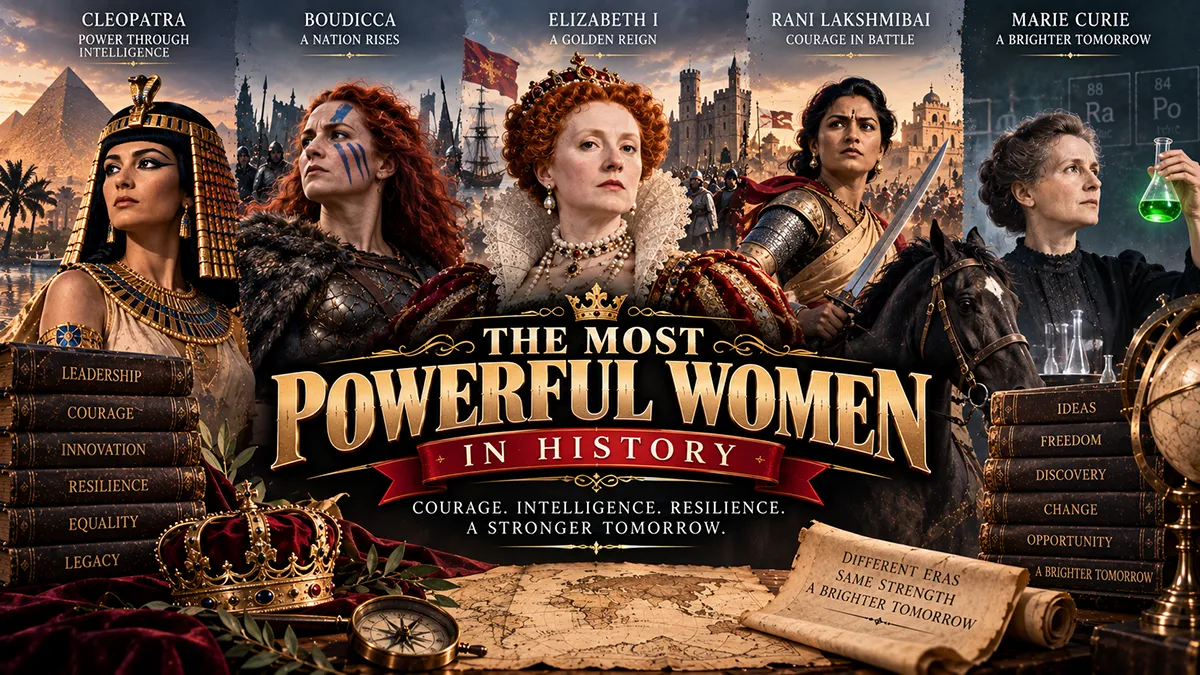
When people search for the most powerful women in history, they usually expect a short list of queens and maybe one or two scientists. The truth is far bigger than that. Historical women have ruled empires, led revolutions, rewritten science, and reshaped how entire societies think about who gets to hold power.
This guide brings together some of the most famous women in history from every era and continent, organized so you can see the different shapes power has taken over the centuries. Some of these historical figures wore crowns. Others wore lab coats, prison uniforms, or simply the quiet determination of someone refusing to back down.
TL;DR: From ancient pharaohs to modern activists, the most powerful women in history prove that influence has never belonged to one gender, one era, or one kind of title.
What Actually Makes a Woman “Powerful” in History?
Before diving into the list, it’s worth pausing on what “powerful” even means here, because it’s easy to default to just crowns and thrones. Some of the historical women below held formal titles like queen, empress, or pharaoh, and their power came from armies, treasuries, and inherited authority. Others never held political office at all, yet changed the course of history through ideas, science, or sheer moral persistence.
It also helps to know the vocabulary. An empress typically ruled an empire (or was married to an emperor), a queen regnant ruled in her own right rather than as a king’s wife, and titles like pharaoh, rani, or sultana reflect specific cultures and dynasties. These female titles of power varied wildly by region, but the underlying story is the same: women have been claiming and wielding authority for as long as recorded history exists.
Finally, a quick myth-busting note. Popular culture loves to flatten historical women into single traits — the seductress, the tyrant, the saint. Nearly every figure on this list has been oversimplified by later storytellers, so we’ve tried to stick to what’s actually documented rather than repeating dramatized legends as fact.
Ancient and Medieval Queens Who Ruled Empires
1. Cleopatra VII of Egypt
Cleopatra VII (69–30 BCE) was the last active ruler of the Ptolemaic Kingdom of Egypt, and she was far more than the romantic figure later Roman writers and Hollywood turned her into. She spoke multiple languages, managed a sophisticated court, and used shrewd political alliances with Julius Caesar and later Mark Antony to keep Egypt independent from Rome for as long as possible.
Her reputation as history’s great seductress largely comes from Roman propaganda written after her death, much of it politically motivated. What’s better documented is that she was an educated, capable administrator navigating an empire that was rapidly losing ground to Rome.
2. Hatshepsut
Hatshepsut ruled Egypt as pharaoh during the 15th century BCE, one of the few women to hold that title outright rather than as a regent or consort. She commissioned major building projects, including her mortuary temple at Deir el-Bahari, and oversaw a notably peaceful and prosperous stretch of Egyptian history.
After her death, many of her monuments were defaced or her image altered, likely by successors trying to erase a woman’s claim to the pharaoh’s role. Modern archaeology has slowly restored her place as one of ancient Egypt’s most effective rulers.
3. Wu Zetian
Wu Zetian became the only woman in Chinese history to rule as emperor in her own right, founding the short-lived Zhou dynasty in 690 CE. She rose from a concubine’s position to the top of the Tang court through political skill, and her reign saw expanded civil service exams and territorial growth.
Traditional Chinese historians, writing under later male-dominated dynasties, painted her as ruthless and scandalous. Contemporary historians generally view her as a highly effective, if hard-nosed, administrator who governed during a genuinely stable period.
4. Elizabeth I of England
Elizabeth I reigned from 1558 to 1603 and steered England through the defeat of the Spanish Armada, a flourishing of literature and theater, and decades of relative religious stability after years of turmoil. She never married, using her single status as a political tool to avoid being absorbed into a foreign alliance.
Her nickname, the “Virgin Queen,” became part of a carefully managed public image. Behind the propaganda was a genuinely sharp political mind who outmaneuvered rivals both at home and abroad for 44 years.
5. Catherine the Great
Catherine II of Russia ruled from 1762 to 1796, expanding Russian territory, reforming administration, and pulling the empire further into European intellectual life. She corresponded with Enlightenment thinkers and expanded Russia’s borders through several successful wars.
She is unfortunately best remembered today for a fabricated, salacious rumor about her death that has no historical basis whatsoever. It’s a textbook case of how a powerful woman’s real achievements can be overshadowed by invented gossip.
6. Empress Dowager Cixi
Cixi effectively controlled the Qing dynasty court from behind the throne for nearly five decades, from the 1860s until her death in 1908. She navigated the Qing dynasty through foreign invasions, the Boxer Rebellion, and enormous internal pressure to modernize.
Historians remain divided on her legacy, with some viewing her as an obstacle to reform and others as a pragmatic ruler trying to preserve a crumbling empire under impossible circumstances. Either way, she was arguably the most powerful person in China for most of her adult life.
Warriors, Rebels, and Revolutionaries
7. Boudica
Boudica led the Iceni tribe in a major uprising against Roman occupation in Britain around 60–61 CE, after Roman officials seized her land and reportedly mistreated her family. Her forces destroyed several Roman settlements before ultimately being defeated.
Much of what we know comes from Roman historians Tacitus and Cassius Dio, writing decades after the events, so some details are likely embellished. Even accounting for that, Boudica remains one of the earliest documented examples of a woman leading large-scale armed resistance.
8. Joan of Arc
Joan of Arc was a teenage peasant girl who claimed divine visions and convinced French royal forces to let her help lead troops during the Hundred Years’ War in the 1420s. Her presence helped turn the siege of Orléans and reinvigorate French morale at a critical moment.
She was eventually captured, tried, and executed in 1431 on charges that were politically motivated as much as religious. Roughly 25 years later, a posthumous retrial cleared her name, and she was canonized as a saint in 1920.
9. Rani Lakshmibai
Rani Lakshmibai of Jhansi became one of the most prominent leaders of the 1857 Indian Rebellion against British East India Company rule. She personally led troops in battle after refusing to accept the annexation of her kingdom.
She died in combat in 1858, and today she’s remembered across India as a powerful symbol of resistance to colonial rule. Statues and streets named after her can be found throughout the country.
10. Harriet Tubman
Harriet Tubman escaped slavery in Maryland in 1849 and went on to make roughly 13 dangerous return trips guiding enslaved people to freedom via the Underground Railroad. She later served as a scout and spy for Union forces during the Civil War.
She’s one of the most famous women in American history for good reason: her courage was matched by remarkable strategic skill under constant threat of capture or death. She spent her later years advocating for both civil rights and women’s suffrage.
Scientists, Thinkers, and Innovators
11. Marie Curie
Marie Curie remains the only person to win Nobel Prizes in two different sciences, physics in 1903 and chemistry in 1911, for her groundbreaking work on radioactivity, cementing her place among the smartest people in history. She discovered the elements polonium and radium and pioneered mobile X-ray units used during World War I.
She did all of this while facing significant institutional sexism in French academia, including initial exclusion from the French Academy of Sciences. Her research eventually cost her health, as the dangers of radiation exposure weren’t yet understood.
12. Ada Lovelace
Ada Lovelace worked with inventor Charles Babbage in the 1840s on his proposed Analytical Engine, an early mechanical computer that was never fully built in her lifetime. Her notes included what’s widely regarded as the first published algorithm intended for a machine.
Because of this, she’s often called history’s first computer programmer, a claim that places her among historical geniuses with the highest estimated IQs, though that title is sometimes debated among historians of technology. What’s not in dispute is that she saw computing potential in the machine that went far beyond simple calculation, decades before anyone else did.
13. Mary Wollstonecraft
Mary Wollstonecraft published “A Vindication of the Rights of Woman” in 1792, arguing that women deserved education and rational agency rather than being confined to domestic roles. The book is now considered a foundational text of feminist philosophy.
Her personal life was unconventional for her time, and she faced considerable social criticism during and after her lifetime as a result. Her daughter, Mary Shelley, went on to write “Frankenstein,” making this a family with an outsized influence on literature and philosophy alike.
14. Florence Nightingale
Florence Nightingale transformed nursing into a respected profession through her work during the Crimean War in the 1850s, where she dramatically improved sanitation and reduced hospital mortality rates. She later founded the first secular nursing school in London.
She was also a skilled statistician, developing visual data techniques to demonstrate how sanitation, not just battlefield injuries, was killing soldiers. That combination of hands-on care and data-driven advocacy still shapes public health practice today.
Activists and Champions of Change
15. Susan B. Anthony
Susan B. Anthony co-founded the National Woman Suffrage Association in 1869 and spent decades traveling, lecturing, and organizing for women’s right to vote in the United States. She was arrested in 1872 for voting illegally, a case she used to draw national attention to the cause.
She died in 1906, 14 years before the 19th Amendment granted American women the vote in 1920. Her decades of groundwork made that eventual victory possible.
16. Emmeline Pankhurst
Emmeline Pankhurst founded the Women’s Social and Political Union in Britain in 1903, adopting more confrontational tactics than earlier suffrage campaigners. Her strategy included protests, property damage, and hunger strikes among imprisoned members.
Her approach was controversial even among fellow suffragists, and historians still debate how much the militant wing versus the more moderate wing contributed to women winning the vote in the UK in 1918 and 1928. What’s clear is that she kept the issue impossible to ignore.
17. Rosa Parks
Rosa Parks refused to give up her bus seat to a white passenger in Montgomery, Alabama, in December 1955, sparking the Montgomery Bus Boycott. She’s often mischaracterized as simply a tired seamstress who acted spontaneously.
In reality, she was a trained civil rights organizer already active with the NAACP, and her act of defiance was a deliberate, informed decision. The boycott that followed lasted over a year and became a landmark moment in the American civil rights movement.
18. Eleanor Roosevelt
Eleanor Roosevelt redefined the role of U.S. First Lady between 1933 and 1945, holding press conferences, writing a syndicated newspaper column, and advocating for civil rights and labor reforms. After her husband’s death, she chaired the UN Commission on Human Rights.
She was the primary force behind drafting the Universal Declaration of Human Rights, adopted by the United Nations in 1948. Her influence extended well beyond the traditional boundaries of her official position.
19. Wangari Maathai
Wangari Maathai founded the Green Belt Movement in Kenya in 1977, mobilizing local women to plant trees and combat deforestation while also promoting community empowerment. In 2004, she became the first African woman to win the Nobel Peace Prize.
Her work connected environmental conservation directly to women’s economic independence and civic participation. That link between ecology and social justice was, at the time, a fairly novel framing for international audiences.
20. Malala Yousafzai
Malala Yousafzai began advocating for girls’ education in Pakistan as a young teenager, which led to a Taliban gunman shooting her in 2012. She survived and continued her activism, co-founding the Malala Fund to expand girls’ access to education worldwide.
In 2014, at 17, she became the youngest person ever to receive the Nobel Peace Prize. She remains one of the most recognizable young activists of the 21st century.
Modern Political and Cultural Leaders
21. Golda Meir
Golda Meir served as Israel’s fourth prime minister from 1969 to 1974, one of the first women in modern history to lead a nation as head of government. Her tenure included the Yom Kippur War in 1973, a defining crisis of her leadership.
She had already spent decades in Zionist organizing and Israeli politics before taking the top office. Her blunt, no-nonsense public style made her one of the most recognizable political figures of her era.
22. Indira Gandhi
Indira Gandhi served as Prime Minister of India across two periods, from 1966 to 1977 and again from 1980 until her assassination in 1984. Her tenure included major agricultural reforms alongside deeply controversial actions, most notably the 1975–1977 state of emergency that suspended civil liberties.
Her legacy is genuinely mixed: economic modernization and strong leadership on one hand, authoritarian overreach on the other. She’s a useful reminder that powerful women, like powerful men, deserve honest historical assessment rather than uncritical praise.
23. Margaret Thatcher
Margaret Thatcher became the United Kingdom’s first female prime minister in 1979 and held office for over a decade, longer than any other British prime minister in the 20th century. Her free-market economic reforms fundamentally reshaped British politics, for better or worse depending on who you ask.
Her nickname, the “Iron Lady,” reflected both her rhetorical style and her uncompromising approach to policy and negotiation. She remains one of the most polarizing yet undeniably influential political leaders of the modern era.
24. Queen Elizabeth II
Queen Elizabeth II reigned over the United Kingdom from 1952 until her death in 2022, making her the longest-reigning British monarch in history at over 70 years. While her role was largely ceremonial under the UK’s constitutional monarchy, she served as a steady public figure through enormous social and political change, all while standing atop one of the richest and most powerful families in history, the British royal family.
She met with 15 different British prime ministers over the course of her reign and became one of the most widely recognized public figures of the 20th and 21st centuries. Her longevity alone makes her a singular figure among modern female historical figures.
25. Frida Kahlo
Frida Kahlo was a Mexican painter whose vivid, often autobiographical work explored identity, pain, and Mexican culture throughout the mid-20th century. She lived with the lasting effects of childhood polio and a serious bus accident, both of which deeply shaped her art.
She wasn’t widely famous internationally during most of her lifetime, gaining her enormous global reputation mainly after her death in 1954. Today she’s one of the most recognizable and frequently referenced artists in the world, a genuine icon of 20th-century culture.
More Women Who Shaped History
Twenty-five entries barely scratch the surface, so it’s worth naming a few more historical women whose contributions deserve recognition. Sacagawea guided the Lewis and Clark expedition across uncharted territory in the early 1800s. Amelia Earhart broke aviation records in the 1920s and 1930s before disappearing on a 1937 flight that’s still debated by historians today.
Rosalind Franklin’s X-ray work was essential to discovering DNA’s structure, though her contribution was long undercredited compared to her male colleagues. During World War II, women like codebreaker Elizabeth Friedman and pilot Jacqueline Cochran took on roles previously closed to them, part of a broader wave of women who reshaped workplaces and militaries during the war years.
Sojourner Truth, a formerly enslaved woman turned abolitionist and women’s rights speaker, delivered some of the most quoted speeches of the 19th century. Grace Hopper helped pioneer computer programming languages in the mid-20th century, decades after Ada Lovelace’s early theoretical work. Each of these names could easily anchor a list of their own.
Why These Women Still Matter Today
What ties all of these historical figures together isn’t a shared background, personality, or even era. It’s that each one operated in a world that offered women limited formal power, and each found a way to exert influence anyway, whether through inherited titles, scientific rigor, moral clarity, or flat-out refusal to comply.
Studying these women who made history isn’t just an exercise in trivia. It reshapes how we understand power itself, revealing how often it has been distributed, contested, and exercised outside the narrow channels textbooks used to focus on.
The list above is necessarily incomplete, and that’s sort of the point. For every famous name here, there are countless lesser-known women whose contributions to science, politics, art, and resistance movements are still being uncovered by historians. Their stories remain one of history’s richest, most underexplored frontiers.
Frequently Asked Questions
Who are some of the most famous women in history?
Some of the most famous women in history include Cleopatra VII, Elizabeth I, Marie Curie, Harriet Tubman, Joan of Arc, and Rosa Parks. The full list spans queens and rulers, scientists, activists, and revolutionaries from ancient Egypt through the 21st century, reflecting how many different forms historical influence has taken.
Who is considered the most powerful woman in history?
There's no single agreed-upon answer, since "powerful" can mean military command, political authority, scientific influence, or cultural impact. Rulers like Empress Wu Zetian, Catherine the Great, and Queen Elizabeth I are frequently cited among the most powerful women in history because they held direct control over major empires for extended periods.
Were there any female dictators in history?
Genuinely dictatorial female rulers are rare in the historical record, largely because most societies historically restricted women's access to the military and political structures dictators typically rely on. Some historians point to figures like Empress Dowager Cixi or Isabel Martínez de Perón of Argentina as examples of women who wielded highly centralized, sometimes authoritarian power, though scholars debate how precisely the term "dictator" applies to each case.
Who was the first woman in history to rule a country?
It's genuinely difficult to name a definitive "first," since written records from early civilizations are incomplete and many early female rulers governed as regents rather than in their own right. Hatshepsut of ancient Egypt, who ruled as pharaoh around the 15th century BCE, is among the earliest well-documented women to hold supreme political authority outright.
What’s the difference between a queen and an empress in history?
A queen typically rules or is married to the ruler of a kingdom, while an empress rules or is married to the ruler of an empire, which usually encompasses multiple territories or peoples. A queen regnant, like Elizabeth I, ruled in her own right, while a queen consort ruled alongside a king mainly through marriage rather than direct authority.
Who is the most powerful woman in the world today?
This shifts often and depends on the measure used, whether political office, economic influence, or global visibility, so any single answer is a snapshot rather than a fixed fact. Lists like Forbes' annual ranking of powerful women typically include heads of state, central bank leaders, and major corporate executives, and the specific names change year to year.
What are some strong female names in history associated with powerful women?
Certain names recur among influential historical women, including Elizabeth, Catherine, Isabella, Victoria, and Eleanor among European royalty, and Cleopatra, Hatshepsut, and Nefertiti from ancient Egypt. If you're looking for a name that evokes strength specifically, names like Matilda (meaning "battle-mighty") or Valentina (related to "strength" and "valor") carry that meaning etymologically.

Alex Warren
Related Articles