
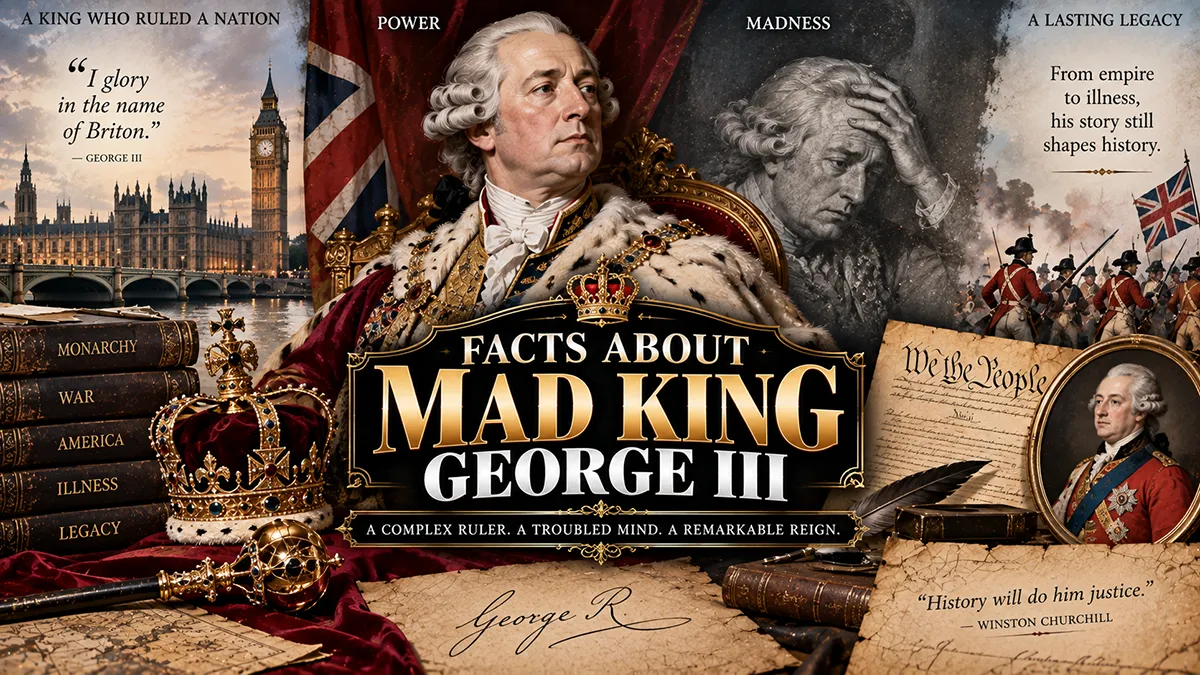
If you’ve watched Bridgerton, Hamilton, or the film The Madness of King George, you’ve probably heard him called “Mad King George.”
But how much of that reputation is grounded in real history, and how much is dramatic license? George III was a real man who ruled Great Britain for nearly six decades, lost the American colonies, supported the arts and sciences, and eventually suffered a serious and still-debated illness late in life.
This guide separates the documented facts from the myths, walking through his childhood, reign, personality, and the medical mystery that earned him his infamous nickname.
TL;DR: King George III reigned for 59 years, lost the American colonies, and suffered recurring bouts of severe illness later in life that inspired his “Mad King George” nickname — though the exact medical cause is still debated by historians and doctors today.
Who Was King George III?
George III was King of Great Britain and Ireland from 1760 until his death in 1820, making him one of the longest-reigning monarchs in British history up to that point. He was born George William Frederick, grandson of King George II, and became king at just 22 years old. Unlike his father and grandfather, he was the first Hanoverian king born in England who spoke English as his first language.
He’s remembered for several very different things: losing Britain’s American colonies during the Revolutionary War, presiding over the union that created the United Kingdom of Great Britain and Ireland, patronizing the arts and sciences, and later in life battling a severe illness that left him incapacitated — which is part of why he remains one of the most recognized historical figures from the era. That illness, more than anything else, is why he’s popularly remembered as “the mad king of England.”
King George III’s Childhood and Path to the Throne
George was born on June 4, 1738, in London, the eldest son of Frederick, Prince of Wales. His father died in 1751, when George was just 12 years old, which meant George skipped a generation and became heir directly to his grandfather, George II.
His childhood tutors and his mother, Princess Augusta, worked hard to shape him into a disciplined, morally upright future king. Contemporaries described him as a shy, studious boy who took his religious education seriously. When George II died suddenly in 1760, the 22-year-old prince inherited the throne as King George III.
25 Facts About King George III (Mad King George)
Here are the essential facts worth knowing about George III, covering his reign, his family, his illness, and the legacy that still shapes how we remember him today.
1. He became king at just 22 years old
George III ascended to the throne in October 1760 after the sudden death of his grandfather, George II. He was crowned at Westminster Abbey in September 1761, shortly before his wedding.
2. His full title was genuinely enormous
By the end of his reign, he held the title King of the United Kingdom of Great Britain and Ireland, following the 1801 Act of Union. Earlier in his reign, he was simply King of Great Britain and Ireland, ruling two separate kingdoms under one crown.
3. He was the first Hanoverian king born in Britain
George I and George II were both born in Germany and never fully mastered English. George III, by contrast, was born in London and raised speaking English as his native tongue, which helped him feel more like a genuinely British monarch to his subjects.
4. He reigned for nearly 60 years
George III’s reign lasted from 1760 to 1820, a total of 59 years and 96 days. At the time, this made him the longest-reigning king in British history, a record later broken by his granddaughter Queen Victoria.
5. He married a German princess he’d never met before their wedding day
In 1761, George married Charlotte of Mecklenburg-Strelitz. The couple met for the first time on their wedding day, which was standard practice for royal marriages arranged for political and diplomatic reasons at the time.
6. He and Queen Charlotte had 15 children
George III and Charlotte had one of the largest families in British royal history, with 15 children born between 1762 and 1783. Thirteen of them survived into adulthood, which was remarkable for the era.
7. His exact height isn’t precisely documented
People often ask how tall King George III was, but no verified medical measurement survives from his lifetime. Portraits and contemporary accounts suggest he was of average to above-average height for the era, but any specific figure circulating online should be treated as an estimate rather than a confirmed fact — the same caution that applies when sorting fact from legend among the tallest people in history.
8. He earned the nickname “Farmer George”
George III had a genuine, well-documented interest in agriculture and land management. He experimented with farming techniques on royal estates and was affectionately nicknamed “Farmer George” by the public, partly as a compliment and partly as gentle mockery of his simple tastes.
9. He founded the Royal Academy of Arts
In 1768, George III personally chartered the Royal Academy of Arts in London, which remains a major institution for art education and exhibitions today. This reflects a lesser-known side of his reign as a patron of culture and learning.
10. He lost the American colonies
The American Revolutionary War (1775–1783) unfolded during George III’s reign, and Britain’s defeat led directly to American independence. He is remembered in the United States largely as the monarch named in grievances within the Declaration of Independence.
11. He wasn’t solely to blame for the American Revolution
Historians generally agree that Parliament’s taxation policies and colonial administration played at least as large a role in provoking rebellion as George III’s personal decisions. He supported hardline responses to the colonies, but he didn’t act alone or unilaterally.
12. He oversaw the creation of the United Kingdom
The Act of Union 1800 merged the Kingdom of Great Britain and the Kingdom of Ireland into a single political entity starting January 1, 1801. This made George III the first monarch to formally hold the title “King of the United Kingdom of Great Britain and Ireland.”
13. He survived multiple assassination attempts
In 1786, a woman named Margaret Nicholson attempted to stab George III with a dessert knife outside St James’s Palace; she was later found insane and confined rather than executed. He faced other threats and public unrest during his reign as well, reflecting the political tensions of the era.
14. His first major illness struck in 1788
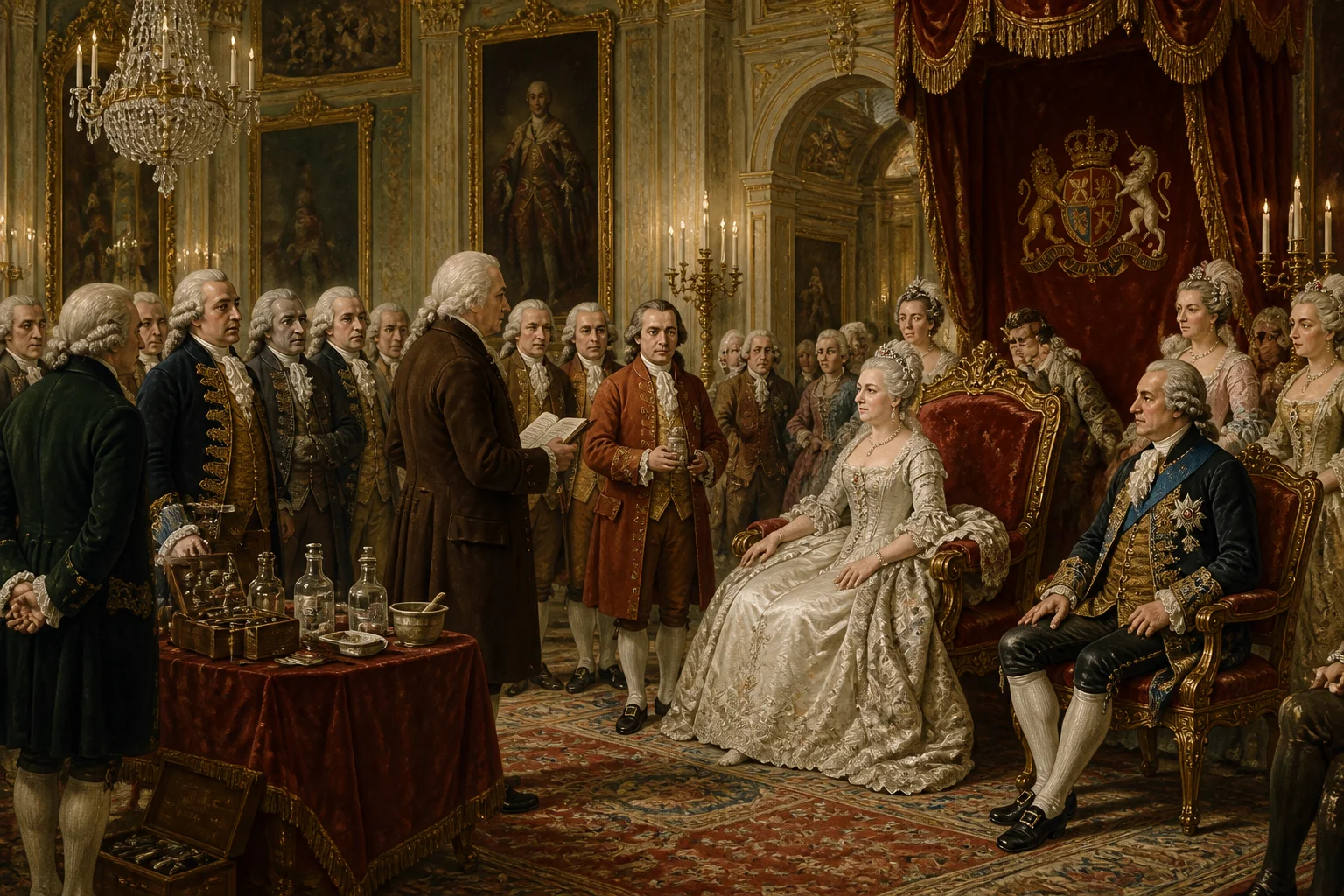
In the summer of 1788, George III began showing alarming symptoms: confusion, agitation, rambling and incoherent speech, and physical distress. This episode, which lasted into 1789, was the first widely documented sign of the illness that would define his later reputation.
15. Doctors of the time had no real understanding of his condition
Eighteenth-century medicine had no concept of modern psychiatry or the biochemical disorders now studied by doctors. His physicians tried remedies that ranged from ineffective to outright cruel by modern standards, including restraint and blistering treatments.
16. The “porphyria theory” made him famous in the 20th century
In the 1960s, researchers proposed that George III suffered from porphyria, a group of rare blood disorders that can cause symptoms resembling mental illness. This theory became widely popular and heavily influenced the 1994 film The Madness of King George.
17. The porphyria diagnosis is now seriously disputed
More recent historical and medical research has challenged the porphyria theory, with some scholars pointing instead toward bipolar disorder or another psychiatric condition as a more likely explanation. Because no verified medical records or samples exist for confirmation, the true cause of his illness remains genuinely unresolved.
18. He experienced multiple relapses, not just one
George III’s illness wasn’t a single event. He had recurring episodes throughout his later life, with a final, permanent decline beginning around 1810 that never fully lifted.
19. Parliament created a formal Regency because of his condition
The Regency Act of 1811 established George III’s eldest son, the Prince of Wales, as Prince Regent to govern in his father’s place. This arrangement lasted for the remainder of George III’s life, and the Prince Regent later became King George IV.
20. He went blind and increasingly deaf in his final years
By the 1810s, George III had lost most of his eyesight to cataracts and was also losing his hearing. Combined with his mental decline, this left him largely isolated at Windsor Castle for the last decade of his life.
21. He died in 1820 at Windsor Castle
George III passed away on January 29, 1820, at the age of 81, having lived through more political upheaval than almost any British monarch before him. By the time of his death, he had reportedly not recognized his family or surroundings for years.
22. He was a devoted family man by the standards of his era
Despite ruling during a period when royal infidelity was common and often tolerated, George III was widely regarded as a faithful husband and attentive father. This was somewhat unusual compared to several of his Hanoverian predecessors and his own sons.
23. He supported science as much as the arts
George III was a patron of the Royal Society and had a personal interest in astronomy, even owning telescopes and instruments for his own study. His support helped fund scientific work during a period of major discovery in Britain.
24. He contributed to the growth of Kew Gardens
Under George III’s patronage, the Royal Botanic Gardens at Kew expanded significantly, laying groundwork for what would become one of the world’s most important botanical research institutions. His personal curiosity about plants and agriculture fed directly into this legacy.
25. His story has been retold in film, theatre, and television
The 1994 film The Madness of King George, the hit musical Hamilton, and Netflix’s Queen Charlotte: A Bridgerton Story have all brought fictionalized or dramatized versions of George III to modern audiences. These portrayals are entertaining, but they take creative liberties, so they shouldn’t be mistaken for strict historical record.
Was King George III Really “Mad”? Separating Myth From Medical History
The short answer is: something was genuinely wrong with George III’s health later in life, but calling him simply “mad” oversimplifies a complicated medical mystery. His documented symptoms included confusion, agitation, incoherent speech, and periods of what witnesses described as manic behavior, particularly during the severe 1788–89 episode. This kind of mythmaking around larger-than-life monarchs isn’t unique to George III — similar myth-versus-fact debates surround figures like Richard the Lionheart and Joan of Arc, whose legends have also outgrown the documented record.
The porphyria theory, popularized in the 1960s, suggested a physical blood disorder was the real culprit behind symptoms that looked psychiatric on the surface. It’s a compelling story, and it shaped decades of popular understanding, including much of the sympathetic tone in The Madness of King George.
However, more recent scholarship has pushed back on porphyria as the definitive answer. Some historians and psychiatrists now argue his symptoms are more consistent with a severe mood disorder, such as bipolar disorder, especially given the recurring, episodic nature of his decline. Because George III died two centuries ago, without modern diagnostic tools or preserved biological samples suitable for confirmation, no theory can be proven with certainty.
That uncertainty is exactly why responsible historians avoid stating flatly that George III “went mad” as if it were a settled medical fact. What we do know for certain is that he suffered real, debilitating episodes of illness, that they worsened over time, and that they ultimately led to the Regency Act of 1811. The nickname “Mad King George” reflects how contemporaries and later generations perceived his condition, not a confirmed clinical diagnosis.
King George III’s Personality and Reputation
Away from the drama of his illness, contemporaries generally described George III as sincere, dutiful, and somewhat reserved. He took his role seriously and was known for personal frugality rather than the extravagance associated with some royals of the period.
He was deeply religious and valued domestic stability, which showed in his long, apparently faithful marriage to Queen Charlotte. This made him something of an unusual figure among 18th-century monarchs, many of whom were far more scandal-prone.
His critics, particularly in the American colonies, saw him very differently: as a stubborn ruler who supported harsh policies toward the colonies. Both pictures are true in their own context, and together they give a fuller sense of a genuinely complicated historical figure.
Why King George III Still Matters Today
George III’s reign matters because it bridged two very different eras of British history. He came to power as an 18th-century monarch with real political influence and left the throne as Britain moved toward a more modern constitutional monarchy, partly because his illness forced Parliament to formalize rules around royal incapacity.
His reign also coincided with enormous global change, including the loss of the American colonies, the union with Ireland, and the early rumblings of the Industrial Revolution. Few monarchs have overseen such a dramatic transformation of their country’s role in the world.
Finally, his story remains a genuinely useful lesson in how history and legend intertwine. The real George III was a complex, often sympathetic figure whose reputation as “the mad king” says as much about how illness was misunderstood in his era as it does about the man himself.
Final Thoughts
George III wasn’t simply a cartoonish “mad king” — he was a long-serving monarch whose reign shaped modern Britain, for better and worse, long before his health declined. His genuine achievements in the arts, sciences, and constitutional development often get overshadowed by the more dramatic, myth-heavy chapters of his story.
Understanding the real history behind the legend doesn’t make George III any less fascinating. If anything, the honest, more nuanced version of his story, uncertainty about his illness included, is far more interesting than the simplified myth.
Frequently Asked Questions
Who was King George III of Great Britain?
George III was King of Great Britain and Ireland from 1760 to 1820, and later King of the United Kingdom of Great Britain and Ireland after the 1801 Act of Union. He's remembered for losing the American colonies, patronizing the arts and sciences, and suffering a serious, still-debated illness later in his reign.
Was King George III actually mad?
George III did suffer real, documented episodes of severe illness involving confusion, agitation, and incoherent speech, especially from 1788 onward. Whether this amounted to 'madness' in a clinical sense is debated; historians have proposed porphyria and bipolar disorder as possible explanations, but no diagnosis has ever been confirmed with certainty.
Which King George was known as the mad king of England?
King George III is the monarch popularly known as 'the mad king of England.' The nickname comes from his recurring bouts of serious illness later in life, which led to the Regency Act of 1811 and his son ruling in his place.
When did King George III first go mad?
His first well-documented major episode occurred in the summer of 1788 and continued into early 1789. He experienced further relapses over the following decades, with a final, permanent decline beginning around 1810.
How tall was King George III?
There's no precisely verified medical record of George III's height. Based on portraits and contemporary descriptions, he's generally believed to have been of average to above-average height for his era, but any exact figure should be treated as an estimate rather than a documented fact.
What was King George III known for?
George III is best known for his nearly 60-year reign, the loss of the American colonies during the Revolutionary War, the 1800 Act of Union creating the United Kingdom, his patronage of the Royal Academy of Arts, and his later illness that inspired the 'Mad King George' nickname.
What happened to King George III at the end of his life?
By his final decade, George III was largely blind from cataracts, increasingly deaf, and suffering permanent mental decline. His son ruled as Prince Regent from 1811 onward, and George III died at Windsor Castle in January 1820 at age 81.
Was George III a good king?
Historians generally view George III as a dutiful, hardworking monarch who took his responsibilities seriously and supported the arts and sciences, though his reign also included the loss of the American colonies. Whether he was a 'good' king depends on which chapter of his long, eventful reign you're evaluating.
How is Queen Charlotte connected to King George III’s illness?
Queen Charlotte was George III's wife, and she witnessed his illness firsthand, including the severe 1788–89 episode. Popular shows like Netflix's Queen Charlotte: A Bridgerton Story dramatize what was 'wrong' with the king, but real historians still debate the true medical cause of his symptoms.
What is George III of Great Britain famous for in American history?
In American history, George III is remembered as the monarch on the throne during the American Revolution and is named directly in the grievances listed in the Declaration of Independence. He's often portrayed as the face of British rule that the American colonies fought to break away from.
How long did King George III reign?
George III reigned for 59 years, from 1760 until his death in 1820, making him one of the longest-reigning monarchs in British history at the time.

Alex Warren
Related Articles