

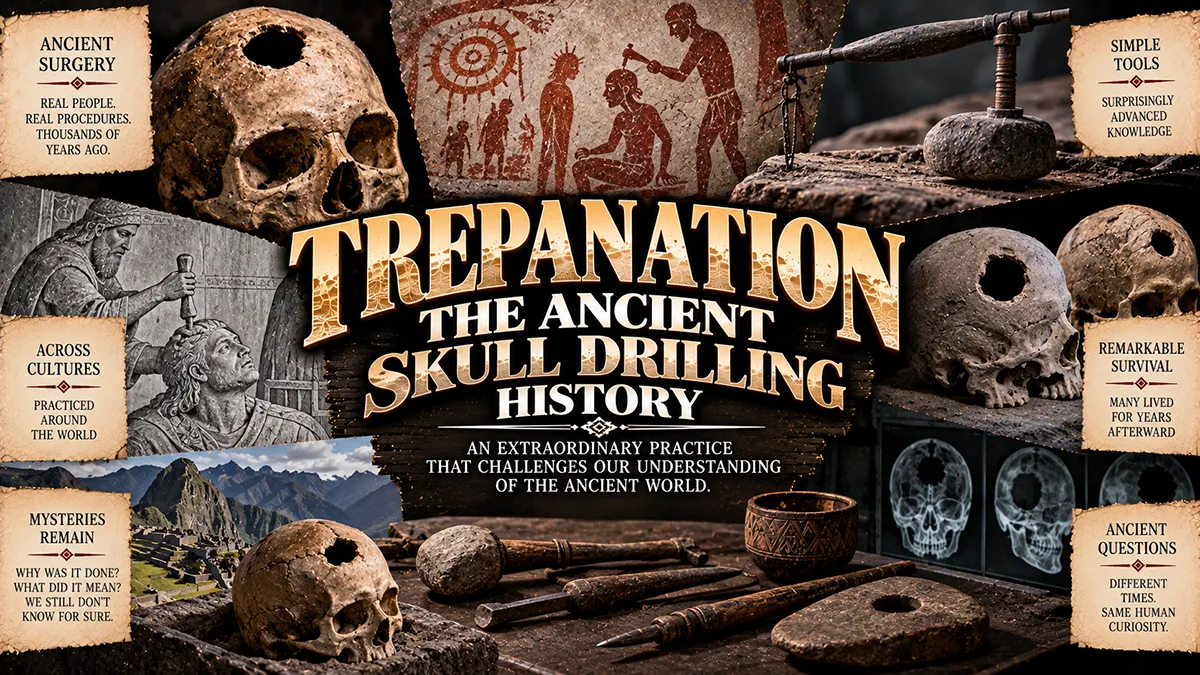
Long before anesthesia, antibiotics, or even a basic understanding of germs, healers across the ancient world were doing something that sounds almost unbelievable today: cutting or drilling a hole straight through a living person’s skull. This wasn’t torture or execution. It was medicine, or at least an attempt at it, and remarkably, many patients survived.
The practice is called trepanation, and it’s one of the oldest surgical procedures known to archaeology. It shows up on nearly every continent, across thousands of years, performed by people who had no written language yet still figured out how to keep a patient alive through brain surgery. Let’s dig into what trepanation actually was, how it was done, and why it happened so often.
TL;DR: Trepanation — drilling or scraping a hole into the skull — is one of humanity’s oldest surgeries, practiced worldwide for thousands of years to treat injuries, illness, and possibly spiritual afflictions, with surprisingly high survival rates and a strange modern afterlife among fringe enthusiasts.
What Is Trepanation, Exactly?
Trepanation, sometimes spelled trephination or trepannation, is the surgical process of removing a piece of bone from the skull to expose the dura mater, the tough membrane surrounding the brain. The goal was never to touch the brain itself. Instead, ancient practitioners created an opening in the cranium, either to relieve pressure, treat visible trauma, or address something they believed was happening inside the head.
The word comes from the Greek “trypanon,” meaning auger or borer, which hints at how it was often done. Today the related terms trephine and trephining refer more specifically to the tool and technique of cutting a circular disc of bone out of the skull. Skull trepanation and trephining skull are essentially describing the same category of procedure, just with slightly different technical emphasis.
What makes trepanation remarkable isn’t just that people did it, but that they did it successfully often enough to keep doing it for thousands of years. Archaeologists can tell when a patient survived because the bone around the hole shows signs of healing and regrowth, a process that takes weeks or months.
A Practice Older Than Writing
Evidence of trepanation stretches back further than most people expect. Neolithic skulls bearing healed trepanation holes have been found in parts of Europe dating back roughly 6,000 to 10,000 years, long before the invention of writing, wheels, or metal tools. That means this surgery predates most of what we’d call “civilization.”
It wasn’t a one-off regional oddity either. Trepanned skulls have turned up in France, across the Andes in South America, in North Africa, in the Pacific Islands, and in parts of Asia. Different cultures with no contact with one another apparently arrived at similar solutions when facing head trauma or unexplained illness.
By the time recorded history begins, trepanation had already become a well-established, if still risky, medical technique. The Greek physician Hippocrates, writing around the 5th century BCE, described head injuries and surgical approaches to the skull in his treatise on head wounds, showing that trepanation had moved from prehistoric practice into recognized medical literature.
Why Did People Drill Holes in Their Skulls?
This is the question everyone asks, and honestly, historians and archaeologists don’t have one single answer. The reasons likely varied by culture, time period, and individual case, and in many instances we’re left interpreting bones without any written explanation attached.
One strong, well-supported reason was trauma. Skull fractures from blunt weapons, falls, or accidents could cause dangerous swelling or bleeding beneath the bone. Creating an opening may have relieved pressure on the brain, something that lines up surprisingly well with modern neurosurgical logic about reducing intracranial pressure after injury.
Another plausible medical motivation was treating conditions like severe headaches, seizures, or what we’d now recognize as epilepsy or migraines. Without any concept of neurology, ancient healers may have reasoned that whatever was causing the problem needed a physical exit point.
Then there’s the more speculative territory: the idea that some trepanations were performed for spiritual or ritual reasons, to release evil spirits, treat mental illness, or mark status. This theory is popular in pop culture, but it should be treated carefully. Archaeologists can identify that a hole was cut into a skull, but they usually cannot definitively prove the belief system behind it, so framing every case as “exorcising demons” oversimplifies a genuinely uncertain picture.
The Instruments and Methodology for Cutting the Skull
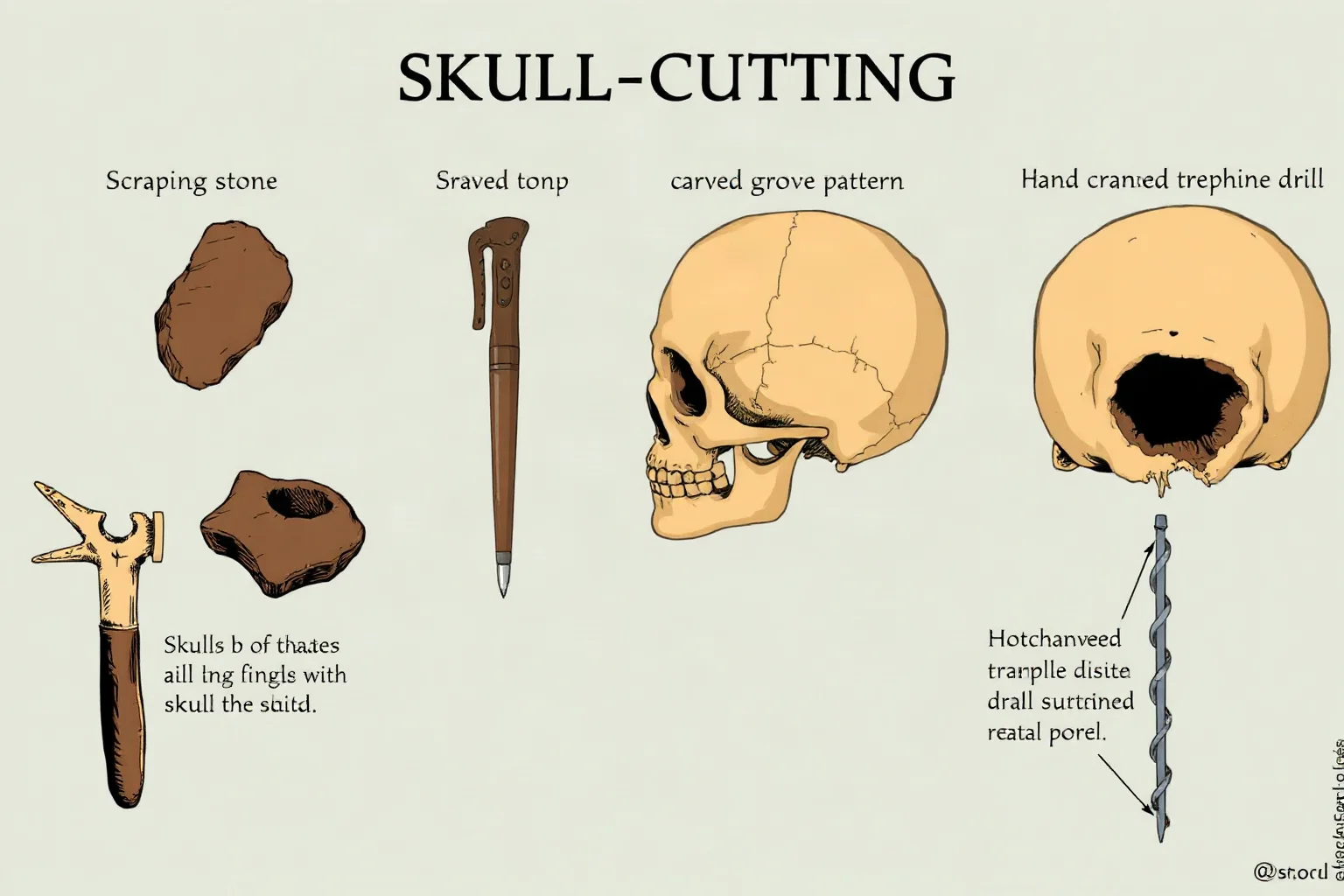
Ancient practitioners didn’t have a single standardized trepanation drill. Instead, archaeological and historical evidence points to at least four distinct methods, and the choice likely depended on region, era, and available tools.
The first and oldest method was scraping, where a sharp stone tool was used to slowly abrade the bone away layer by layer until an opening formed. This was tedious and probably the least precise, but it required only a sharpened flint or obsidian edge.
A second method involved grooving, where the surgeon carved a circular or shape-based groove into the skull repeatedly until the central piece of bone could be lifted out. This gave more control than scraping and left a distinctive, recognizable pattern that archaeologists still use to identify trepanation today.
A third technique was boring and cutting, using a series of small holes drilled in a circle, then connecting them with cuts so the bone disc between them could be removed, similar in concept to how you might cut a circle out of plywood using a drill and a saw. The fourth method, more common later in history, involved a rotating tool resembling a modern hand drill or auger, pressed and turned against the bone.
By the medieval and Renaissance periods in Europe, surgeons had developed a dedicated trephine instrument: a cylindrical, saw-toothed tool with a small centering pin, cranked by hand to cut a clean circular disc of bone. This is the closest ancestor to what people picture when they imagine a formal trepanation surgery, and it remained in surgical kits for centuries.
The Celtic Trepanation Tool Found in Poland
One of the more striking archaeological discoveries connected to this practice comes from Poland, where researchers uncovered evidence linked to Celtic communities that lived in the region during the Iron Age, over two thousand years ago. Along with skeletal remains showing signs of skull surgery, archaeologists identified tools believed to have been used for cutting into bone, offering rare physical evidence of the instruments behind the procedure rather than just its results.
Finds like this matter because most of what we know about ancient trepanation comes from the skulls themselves, not the tools that made the holes. Metal implements corrode, wooden handles rot, and many of the stone tools used in earlier eras are indistinguishable from general-purpose cutting tools. A find that can be confidently tied to trepanation practice gives historians a much clearer window into the actual methodology used by Celtic surgeons.
It’s worth noting that Celtic trepanation, like similar practices in other Iron Age European cultures, likely blended practical medical treatment with cultural or ritual beliefs we can’t fully reconstruct today. The physical evidence tells us the surgery happened and how it may have been performed, but the full reasoning behind each individual case remains genuinely uncertain.
Did People Actually Survive This?
Surprisingly often, yes. Bone is living tissue, and when a patient survives a trepanation, the edges of the hole begin to smooth and regrow over time. Archaeologists look for exactly this kind of healed bone to distinguish a surgical survivor from someone who died during or shortly after the procedure.
Some of the most compelling survival evidence comes from ancient Peru, where cultures such as the Inca performed trepanation at a scale and apparent skill level that stunned early researchers. Studies of Peruvian skulls have found survival rates that improved significantly over centuries, with some later-period samples showing recovery in the majority of cases, a level of surgical success that’s genuinely impressive given the lack of anesthesia or modern sterilization.
Even more remarkable, some skulls show evidence of multiple trepanations performed on the same individual at different points in their life, meaning the patient survived the first surgery long enough to need, or seek, another one later. That’s a strong signal that at least some ancient practitioners had real, transferable surgical skill, not just luck.
Trepanation Around the Ancient World
While Peru often gets the spotlight, trepanation was genuinely global. In Europe, Neolithic and Bronze Age communities practiced it across what is now France, Britain, and Central Europe, and France alone has yielded hundreds of trepanned prehistoric skulls.
In North Africa, evidence of the practice appears in ancient Egyptian contexts, though it seems to have been less common there than head surgery focused on trauma. In the Pacific, communities in places like New Guinea reportedly continued forms of trepanation into more recent historical periods, offering ethnographic observers a rare chance to document the procedure firsthand rather than through bones alone.
Across all these regions, the common thread isn’t a shared culture or shared belief system, since these societies had no contact with one another. It’s that human beings, faced with head trauma or unexplained neurological suffering, independently arrived at the idea that opening the skull might help, a striking example of convergent problem-solving across isolated civilizations.
From Trephining to Modern Neurosurgery
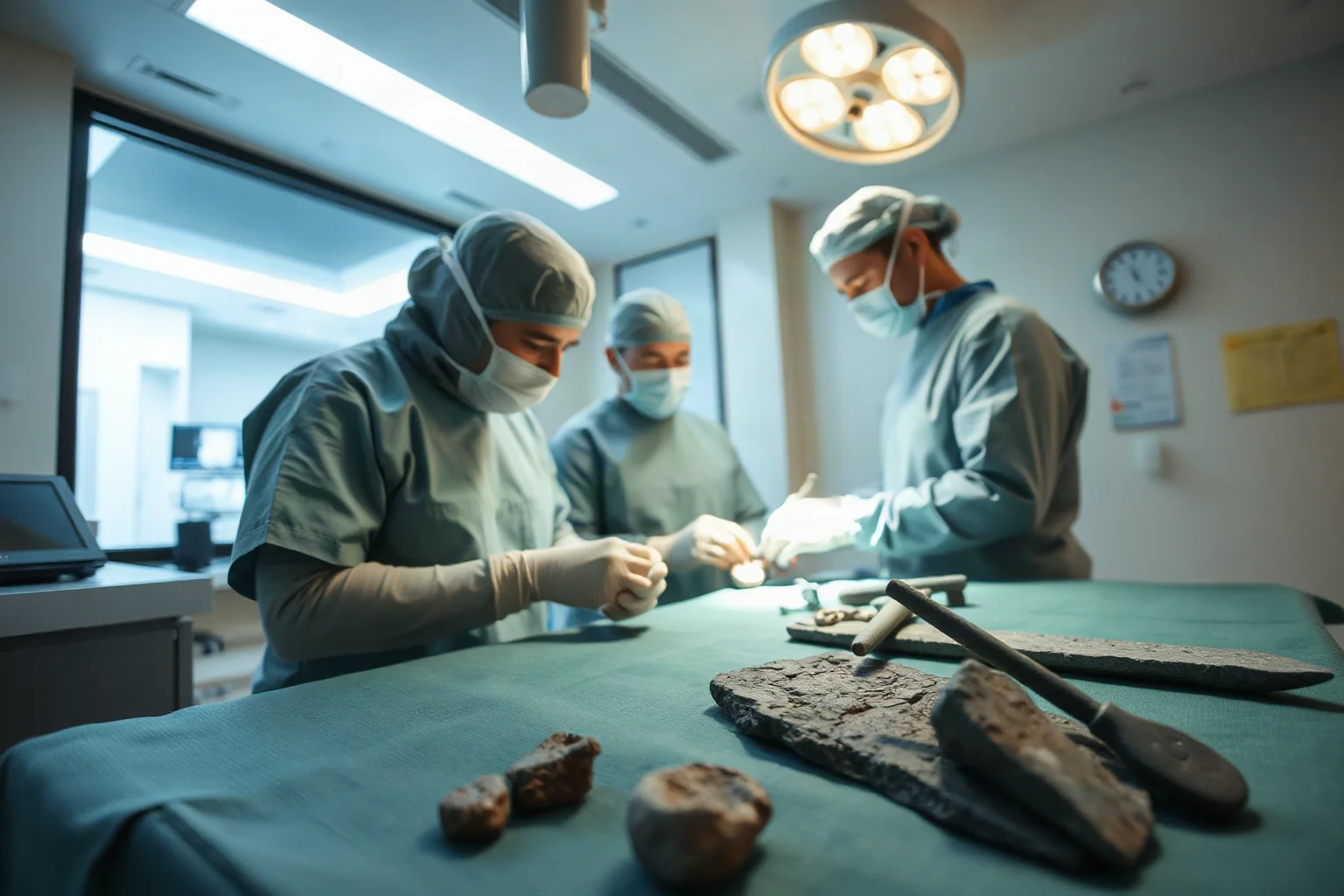
Trepanation didn’t disappear when ancient civilizations faded; it evolved. Medieval and Renaissance European surgeons continued using trephines for head injuries, and the instrument became a standard, if still dangerous, part of surgical practice well into the 18th and 19th centuries.
The real transformation came with the rise of modern medicine: anesthesia, antiseptic technique, and a genuine understanding of brain anatomy. What was once a blind, high-risk procedure became the foundation of modern neurosurgery. Today, surgeons routinely create what’s called a burr hole, a small, precise opening in the skull, to relieve pressure from bleeding, insert monitoring devices, perform biopsies, or place electrodes for treatments like deep brain stimulation.
A full craniotomy, where a larger section of bone is temporarily removed and later replaced, is the modern descendant of the more invasive ancient trepanations. The core idea, that carefully opening the skull can save a life or treat a brain condition, survived the journey from stone tools to surgical drills almost entirely intact.
Modern Trepanation and the Fringe Revival
Here’s where things get a little strange. Starting in the 1960s and 70s, a small group of self-styled experimenters, most notably Dutch libertarian thinker Bart Huges, began promoting the idea that modern adults could benefit from voluntary trepanation, claiming it increased blood flow to the brain and expanded consciousness. This claim has never been supported by credible clinical evidence.
A handful of amateur practitioners, including some who filmed or wrote about performing the procedure on themselves, kept the idea alive in niche countercultural circles for decades. Modern trepanning enthusiasts sometimes point to ancient practice as validation, but this comparison misses an important point: ancient practitioners were treating specific injuries or illnesses, not attempting to boost cognitive function in healthy people.
Mainstream medicine is unambiguous here. There is no credible scientific evidence that self-administered or elective trepanation provides any cognitive or psychological benefit, and the risks, including infection, hemorrhage, and death, are severe and well documented. Any legitimate reason to open the skull today falls under supervised neurosurgery, not DIY procedures performed outside a hospital.
Busting a Few Common Myths
It’s worth clearing up some persistent misconceptions before wrapping up. First, trepanation was not simply an act of primitive superstition performed carelessly; the healing evidence found on ancient skulls shows real surgical skill and, in many cultures, a refined methodology passed down through generations.
Second, not every ancient culture that practiced trepanation did so for the same reason, so it’s inaccurate to claim the practice was universally about “letting out evil spirits” or universally about treating physical trauma. The truth is almost certainly a mix of both, varying by time and place, and historians are honest about not having a complete answer for every discovered skull.
Third, modern trepanation enthusiasts drilling into head tissue for supposed enlightenment are not recreating a safe ancient tradition; they’re performing an unsupervised, medically unsupported procedure with serious risk. Ancient trepanation, for all its danger, was typically performed in response to an actual medical problem, by someone with at least some accumulated surgical experience within their community.
The Legacy of a Strange and Ancient Surgery
Trepanation sits in an unusual spot in medical history. It’s simultaneously one of humanity’s earliest examples of genuine surgical skill and a practice tangled up with beliefs we can no longer fully verify. Skulls from Peru, France, Poland, and beyond tell a consistent story: people were willing to cut into the most protected part of the human body when they believed it might save a life.
What’s most striking, though, is the direct line connecting a Neolithic healer scraping bone with a flint tool to a modern neurosurgeon drilling a precise burr hole under sterile conditions. The tools, the safety, and the science have changed almost beyond recognition, but the basic, audacious idea, that opening the skull can heal rather than harm, has survived for thousands of years. That’s a legacy worth understanding accurately, without either dismissing ancient practitioners as primitive or romanticizing a practice that carried very real risks.
Frequently Asked Questions
What is trepanation?
Trepanation is the surgical practice of cutting, scraping, or drilling a hole into the skull to expose the membrane surrounding the brain, without cutting into the brain itself. It's one of the oldest known surgical procedures, practiced across many ancient cultures for thousands of years, typically to treat head trauma, relieve pressure, or address illnesses that had no other visible treatment at the time.
What instrument and methodology for cutting the skull did ancient people use?
Ancient practitioners used several methods depending on era and region, including scraping the bone away with a sharp stone tool, carving a circular groove until a bone disc could be lifted out, drilling a ring of small holes and connecting them with cuts, and later using a hand-cranked trephine, a saw-toothed cylindrical tool with a centering pin. Each method left distinct patterns on bone that archaeologists still use today to identify trepanation.
Why did people drill holes in their skulls in ancient times?
The reasons likely varied by culture and time period. Strong evidence points to treating head injuries and relieving pressure from skull fractures, while some cases may have addressed severe headaches or seizures. Other instances may have had spiritual or ritual significance, though archaeologists caution that the exact belief system behind many individual cases can't be proven from bone evidence alone.
Did patients actually survive trepanation surgery?
Yes, remarkably often. Archaeologists can identify survival because the bone around a trepanation hole shows healing and regrowth over time, a process that takes weeks or months. Some ancient skulls, particularly from Peru, show evidence of multiple trepanations on the same person performed years apart, indicating the patient survived long enough to undergo the procedure more than once.
Is trepanation still practiced today?
Modern medicine uses a related technique called a burr hole, a small precise opening made in the skull during legitimate neurosurgery to relieve pressure, take biopsies, or place medical devices, always performed under anesthesia and sterile conditions. Separately, a small fringe movement has promoted self-administered 'modern trepanation' for supposed cognitive benefits, but this has no credible scientific support and carries serious medical risk.
What was the Celtic trepanation tool found in Poland?
Archaeologists excavating Iron Age sites in Poland linked to Celtic communities uncovered skeletal remains showing signs of skull surgery along with tools believed to have been used to perform it. This find is significant because most evidence of ancient trepanation comes from studying skulls alone, so recovering an actual instrument tied to the practice gives researchers a rarer, more direct look at Celtic surgical methodology.

Alex Warren
Related Articles