

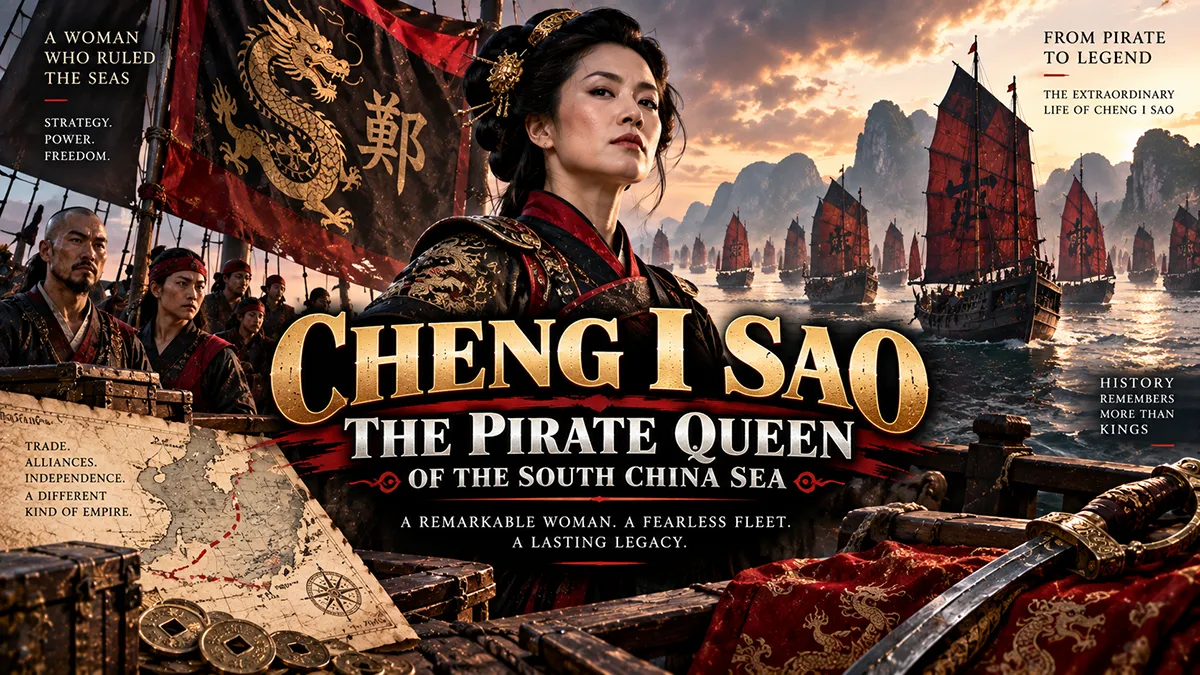
When people picture a pirate captain, they usually imagine a scruffy European man with a parrot and a peg leg. History has a much more interesting answer to that stereotype. In the early 1800s, a former sex worker from Canton took command of one of the largest pirate fleets the world has ever seen, and for a few remarkable years she made the South China Sea her own.
Her name has been rendered a dozen different ways in Western sources: Cheng I Sao, Cheng Sao, Cheng Shih, Ching Shih, Zheng Yi Sao. All of them point to the same extraordinary woman, a figure so successful that historians still argue about just how big her empire really was.
TL;DR: Cheng I Sao rose from poverty in coastal China to command a massive pirate confederation, out-maneuvering empires before negotiating her own surrender and retiring wealthy and free.
Who Was Cheng I Sao? Untangling a Legendary Name
The name “Cheng I Sao” is not actually a personal name at all. In Cantonese, it simply means “wife of Cheng I,” a title that stuck to her far more firmly than any name she was born with. This is a huge clue about how little the historical record preserves about her early life.
Some sources give her birth name as Shi Yang or Shih Xianggu, though even this is debated among historians. She is also widely known as Ching Shih or Zheng Shi, which are simply different transliterations of the same Chinese characters using different romanization systems. If you have seen her called Cheng Shih in one article and Ching Shih in another, they are talking about the same Chinese pirate queen.
She was reportedly born around 1775 in Guangdong province, in southern China, an area with a long and deep relationship with the sea. Little is confirmed about her childhood, but most accounts agree she worked in one of Canton’s floating brothels, a common and often exploitative profession for poor women in the region at the time.
From the Floating Brothels of Canton to a Pirate Marriage
Canton, now known as Guangzhou, was one of the busiest port cities in the world during this period. Its waterways were crowded with fishing boats, trading vessels, and floating brothels that catered to sailors, merchants, and pirates alike. It was in this world that the young woman who would become Cheng I Sao first crossed paths with a rising pirate leader named Cheng I.
Cheng I came from a family with generations of piracy in its blood, and by the start of the 19th century he had begun stitching together a loose alliance of pirate fleets along the southern Chinese coast. According to the accounts historians rely on, he married the young brothel worker in 1801, reportedly on the condition that she receive an equal share in his fortune and a real say in running his operations. Whether or not that specific negotiation happened exactly as described, what is clear is that she quickly became far more than a silent wife.
Together, the couple helped unite six major pirate fleets under a single banner, each identified by a different colored flag: red, black, white, blue, yellow, and green. This alliance became known as the Guangdong Pirate Confederation, and the Red Flag Fleet, led directly by Cheng I and his wife, was its most powerful branch.
The Death of Cheng I and a Widow’s Bold Gamble
In 1807, Cheng I died. Some accounts say he was killed in a storm off the coast of Vietnam, while others suggest a more violent end, but no version is confirmed beyond doubt. What happened next is the part of the story that turns a pirate’s wife into a legend in her own right.
Rather than stepping aside or losing her position, Cheng I Sao moved immediately and decisively to secure control of the Red Flag Fleet for herself. This was an almost unheard of move in a fiercely patriarchal pirate world, and it required real political skill, not just ambition. She built alliances with key subordinate commanders and, crucially, brought her late husband’s adopted son and top lieutenant, Cheung Po Tsai, firmly onto her side.
Within a short time, she had consolidated command not just of the Red Flag Fleet but effectively of much of the wider pirate confederation her husband had helped build. This makes her one of the very few pirate leaders in history, male or female, to inherit a criminal empire and then expand it rather than watch it collapse.
The Red Flag Fleet: An Empire Built on Water
Estimates of the size of Cheng I Sao’s forces vary enormously depending on the source, and this is one area where the myth-busting really matters. Some contemporary and later accounts claim she commanded somewhere between 400 and 1,800 ships and anywhere from 40,000 to 80,000 pirates. Other, more conservative modern estimates place her core Red Flag Fleet closer to a few hundred vessels.
Whatever the precise figure, there is broad agreement that she led one of the largest pirate operations in recorded history, dwarfing anything seen in the more famous Caribbean of the same era. Her fleet did not simply raid ships passing through; it effectively taxed entire coastal communities, controlling fishing rights, salt trade routes, and river traffic across much of the Pearl River Delta.
This scale of operation meant Cheng I Sao was not just a raider but something closer to a shadow government along the Chinese coast. Villages paid her fleet for protection, merchants paid tolls to sail safely, and local officials often found it easier to look the other way than to confront her directly.
Life Under the Black Flag: Rules, Discipline, and Justice

Running an organization of this size required more than raw firepower. Historical accounts describe a surprisingly detailed code of conduct that Cheng I Sao enforced across her fleet, with harsh penalties for those who broke it.
Orders from superiors had to be obeyed without hesitation, and desertion or unauthorized raids could be punished by death. Plunder was carefully recorded and divided according to fixed rules, with a portion going to the pirate who captured it, a portion to the general fund, and the rest to the crew, reducing the kind of infighting that destroyed many other pirate bands.
One of the most frequently cited rules concerned the treatment of female captives. According to several historical accounts, taking a female prisoner without permission or assaulting her was punishable by death, while consensual relationships were tolerated under specific conditions. Historians note that we should treat the finer details of these rules with some caution, since much of what survives comes from secondhand accounts, but the broad picture of a highly disciplined, almost bureaucratic pirate organization is well supported.
Taking on Empires: The Qing, the Portuguese, and the British
Cheng I Sao’s rise coincided with a period when the Qing dynasty’s navy was badly overstretched and underfunded, giving pirate fleets like hers room to grow largely unchecked. When the Qing government finally tried to crush the pirate confederation by force, the results were embarrassing for the empire.
Qing naval expeditions sent against her forces were repeatedly defeated, and in some engagements entire fleets of government ships were captured rather than destroyed, adding still more vessels to her growing armada. This forced the Qing court to look for outside help, turning to the Portuguese colonial authorities in Macau and, at times, to British forces operating in the region.
Even with this added foreign support, campaigns against the Chinese pirate queen’s forces achieved only limited success. Portuguese and British ships won some individual battles, but they could not break the confederation or capture its leadership. This pattern of failed suppression continued for several years, cementing her reputation as one of the most formidable pirate commanders in the region’s history.
Cheung Po Tsai: Adopted Son, Lieutenant, and Husband
No account of Cheng I Sao is complete without Cheung Po Tsai, a figure nearly as colorful as the pirate queen herself. According to most versions of his story, he was a fisherman’s son captured by Cheng I’s forces as a teenager and later adopted, eventually becoming one of the fleet’s most capable commanders.
After Cheng I’s death, Cheung Po Tsai and Cheng I Sao became romantic partners, and most historians believe they later married, though the timing and formality of this relationship are debated. What is not in dispute is his importance to her power base. He commanded the core of the Red Flag Fleet directly and was widely regarded as her most trusted enforcer.
Their partnership blended personal loyalty with practical strategy in a way that helped hold the fragile pirate confederation together far longer than most such alliances typically lasted. When the time eventually came to negotiate with the Qing government, this partnership would prove decisive.
The Art of the Deal: Negotiating an Amnesty
By 1810, cracks were beginning to show within the wider pirate confederation, as rivalries between fleet commanders flared into open conflict. Sensing that the balance of power was shifting and that continued warfare offered diminishing returns, Cheng I Sao made a calculated decision that few pirates in history have managed successfully: she negotiated her own surrender from a position of strength.
Rather than surrendering unconditionally, she personally approached Qing officials to negotiate terms, reportedly walking into a governor’s residence with members of her family to open talks directly. The resulting amnesty allowed the vast majority of her pirates to walk away without punishment, while she and Cheung Po Tsai were permitted to keep a substantial portion of their accumulated wealth.
Cheung Po Tsai was even given an official rank in the Qing military, a remarkable turn for a former pirate commander. This outcome stands in sharp contrast to the fate of most pirates throughout history, who typically ended their careers on the gallows or the end of a cutlass rather than at a negotiating table.
Retirement of a Pirate Queen: Life After the Sea
After accepting amnesty, Cheng I Sao largely disappears from official records for a time, which is itself telling about how thoroughly she managed her exit from piracy. Most accounts agree that she settled into a quieter, though still profitable, life using the wealth she had accumulated during her years commanding the Red Flag Fleet.
Several sources describe her running a gambling house, and possibly a brothel, in Guangzhou during her later years, a fitting bookend to a life that began in Canton’s floating brothels. This let her stay connected to the maritime trading world she knew so well, just from a much safer position on land.
She is generally believed to have died around 1844, reaching an age of roughly 69, which was a genuinely long life for the era, let alone for a former pirate leader. Few of her contemporaries in the pirate trade, in China or anywhere else, managed to die peacefully of old age after retiring wealthy.
Fact, Legend, and the Limits of the Historical Record
It’s worth pausing here to be honest about how much of Cheng I Sao’s story rests on later retellings, some of them written decades after her death by authors more interested in a good story than strict accuracy. The wildly differing estimates of her fleet size, from a few hundred ships to well over a thousand, are the clearest example of this problem.
Much of what English-language readers know about her comes from 19th-century accounts written by Western observers, translated and re-translated across multiple languages, with each pass introducing potential distortion. Chinese primary sources exist but are fragmentary, and the pirate code details often cited in modern retellings are difficult to verify against a single authoritative original text.
None of this means she wasn’t real or wasn’t remarkably successful. It simply means that responsible retellings, including this one, should present the more dramatic details as historically plausible rather than absolutely certain. The core outline of her life, a brothel worker who married into piracy, inherited command, expanded a fleet, resisted empires, and negotiated a comfortable retirement, is well supported across multiple independent sources.
Cheng I Sao’s Legacy in Pop Culture
A life story this dramatic was never going to stay confined to academic history books. Cheng I Sao has inspired characters in film, most notably an antagonist loosely based on her appearing in a major pirate-themed film franchise, though these portrayals take considerable creative liberties with the actual historical record.
She has also appeared in novels, video games, and historical documentaries exploring piracy across different cultures, often marketed as the definitive Asian pirate queen or the pirate queen of China. These portrayals vary widely in accuracy, and readers curious about her real story are better served by historical accounts than by entertainment loosely inspired by her name.
Her enduring appeal is easy to understand. She represents a genuine historical case of a woman from an exploited, marginalized background rising to command an empire that outmaneuvered three separate naval powers, earning her a lasting place among history’s most powerful women.
Why She Still Matters: History’s Most Successful Pirate
Measured by sheer scale of forces commanded, duration of successful operation, and the terms on which her career ended, Cheng I Sao has a strong claim to being the most successful pirate in recorded history, male or female. Compare this to more famous Western pirates like Blackbeard, whose entire piratical career lasted roughly two years before he was killed in battle, and the contrast becomes stark.
She commanded her forces for longer, resisted more determined suppression campaigns, and walked away from piracy alive, wealthy, and free rather than facing execution or death in combat. That combination of scale, longevity, and a successful exit is genuinely rare in the history of piracy anywhere in the world.
Her story also complicates simple narratives about piracy as purely chaotic, disorganized crime. The Red Flag Fleet under her leadership functioned more like a taxation authority and naval power than a loose band of raiders, with real administrative structure behind its operations.
Final Thoughts on China’s Legendary Pirate Queen
Cheng I Sao’s story sits at an unusual crossroads of documented history and dramatic legend, and separating the two is part of what makes her so fascinating to study. The confirmed outline of her life is already extraordinary enough without needing exaggeration: a woman who turned a forced position at the bottom of her society into command of one of the largest pirate fleets ever assembled.
Whether every detail about her pirate code or the exact size of her armada holds up to modern scrutiny, her broader legacy as a shrewd, ruthless, and ultimately successful commander is well earned. Few historical figures, pirate or otherwise, managed to build an empire, fight off multiple governments, and then retire on their own terms the way she did.
Frequently Asked Questions
Who is considered the pirate queen of China?
The title "pirate queen of China" almost always refers to Cheng I Sao, also written as Ching Shih or Zheng Yi Sao, who commanded the Red Flag Fleet in the early 1800s. She rose from working in Canton's floating brothels to leading one of the largest pirate confederations in recorded history along the South China Sea.
Is Cheng I Sao the same person as Cheng Shih or Ching Shih?
Yes. Cheng I Sao, Cheng Sao, Cheng Shih, and Ching Shih are all different English transliterations of the same Chinese name, referring to the same historical woman. The variations come from different romanization systems and regional pronunciations used to render her Cantonese name into English over the past two centuries.
How many ships did the Chinese pirate queen actually command?
Estimates vary widely and should be treated with caution, ranging from roughly 400 ships in more conservative accounts to over 1,000 in more dramatic historical retellings. Most historians agree the true figure is difficult to verify precisely, but even conservative estimates make her fleet one of the largest pirate operations ever recorded.
What happened to Cheng I Sao after she stopped being a pirate?
In 1810, she negotiated an amnesty with the Qing dynasty government, allowing her and most of her fleet to walk away without punishment while keeping much of their accumulated wealth. She reportedly lived out her later years running a gambling establishment in Guangzhou and is believed to have died around 1844.
Was Cheng I Sao a real historical figure or a legend?
She was a real historical figure documented in Chinese and Western sources from the early 19th century, though many specific details about her life have been exaggerated or altered in later retellings. Historians treat the broad outline of her life as well established while remaining cautious about more sensational specific claims.
How does Cheng I Sao compare to famous Western pirates like Blackbeard?
By most measures, Cheng I Sao's operation was significantly larger and longer-lasting than that of famous Western pirates such as Blackbeard, who was active for only about two years before being killed. She commanded a fleet for the better part of a decade and, unlike most pirates, ended her career through negotiation rather than death in battle.
Why is she sometimes called an Asian pirate queen rather than using her name?
Because her most commonly used name, Cheng I Sao, actually translates to "wife of Cheng I" rather than being a personal name, many English-language sources use broader descriptive titles like Chinese pirate queen or Asian pirate queen instead. Her actual birth name is not confirmed with certainty in the historical record.

Alex Warren
Related Articles





