

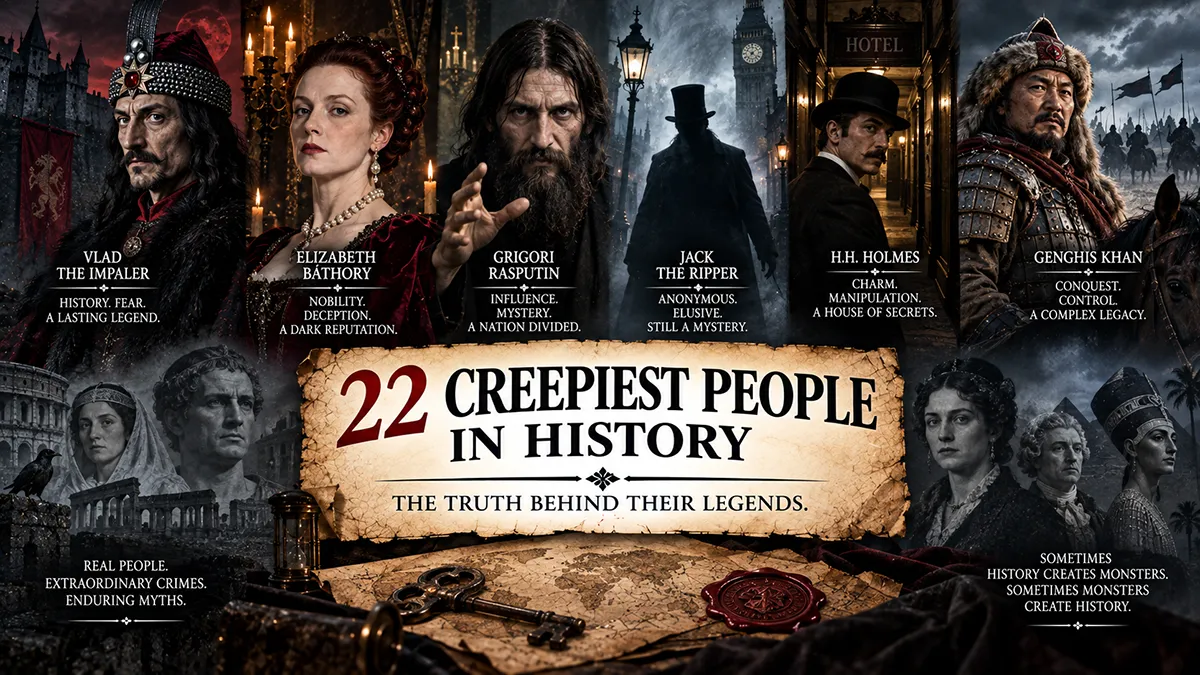
Some names have survived centuries precisely because they still make our skin crawl. Ask almost anyone to name the scariest person in the world, past or present, and you’ll likely get answers ranging from medieval tyrants to Victorian serial killers to Cold War-era mystics.
What’s interesting is that many of these reputations are a tangled mix of documented atrocity and centuries of exaggeration.
This list digs into both sides of that story. We’re covering 22 of the creepiest people in history, separating the historical record from the folklore that grew up around them, and explaining why these particular figures still haunt the popular imagination.
TL;DR: History’s scariest people range from documented mass murderers to feared rulers whose reputations were exaggerated by rivals and storytellers, and separating the two is the real key to understanding them.
What Actually Makes Someone “Creepy” in the History Books?
Before diving into the list, it’s worth asking what separates a genuinely scary historical figure from one who simply got a bad reputation.
Some people on this list committed verifiable, well-documented crimes with court records, forensic evidence, or multiple independent witnesses. Others earned their fearsome image through propaganda, political rivals, or centuries of storytellers piling on extra horror.
That distinction matters. When people search for the scariest person in the world or the most scary person in the world, they’re often picturing folklore-level monsters. The truth is usually stranger and more human than the legend, which is part of why these stories endure.
With that in mind, here are 22 of the creepiest people in history, roughly in chronological order from ancient times to the modern era.
1. Vlad the Impaler (c. 1431–1476)
Vlad III, Prince of Wallachia, earned his nickname honestly. Ottoman and Saxon chronicles describe his practice of impaling enemies, criminals, and rivals on stakes, sometimes by the thousands, as a method of terror and deterrence.
His reputation later inspired Bram Stoker’s fictional Dracula, which cemented him as one of history’s most enduring boogeymen. Historians note that some contemporary pamphlets likely inflated his body count for political propaganda, but the core practice of mass impalement is well corroborated.
2. Elizabeth Báthory (1560–1614)
This Hungarian countess was accused of torturing and killing dozens of young servant women in her castle. The most sensational claim, that she bathed in the blood of virgins to preserve her youth, appears nowhere in the original trial testimony and was added by later storytellers.
Modern historians also point out that Báthory was enormously wealthy and politically vulnerable — one of history’s most powerful women of her era — and some of the accusations against her may have been amplified by nobles who owed her money. That doesn’t clear her entirely, but it’s a good example of legend outpacing verified fact.
3. Gilles de Rais (1405–1440)
A French knight and companion of Joan of Arc, Gilles de Rais later confessed to murdering dozens of children in occult-tinged rituals. His confession came under coercive circumstances during a trial pushed by nobles who stood to inherit his estate.
Historians still debate how much of his confession reflects real crimes versus a forced admission designed to seize his land. Either way, his case remains one of the most disturbing criminal trials of the medieval period.
4. Ivan the Terrible (1530–1584)

Russia’s first tsar built a powerful centralized state, but his later years were marked by paranoid purges known as the Oprichnina, which killed thousands of nobles and commoners alike. Chroniclers also describe him killing his own son in a fit of rage, though some modern forensic reviews have questioned the traditional account.
What isn’t in dispute is that his secret police terrorized the Russian countryside for years. That legacy of state-sanctioned fear is a big reason his epithet stuck.
5. Caligula (12–41 AD)

Roman historians like Suetonius and Cassius Dio painted the emperor Caligula as cruel, erratic, and obsessed with his own divinity. Stories of forcing senators to worship him and committing acts of extreme cruelty against his own court have made him a byword for imperial madness.
Modern scholars caution that these accounts were written well after his death by writers with political reasons to blacken his reputation. Some level of embellishment is likely, but Caligula’s short, chaotic reign clearly left Rome rattled.
6. Tomás de Torquemada (1420–1498)
As Grand Inquisitor of Spain, Torquemada oversaw the Spanish Inquisition during one of its most brutal periods. Thousands were interrogated, tortured, or executed under his authority as suspected heretics, and he played a direct role in the 1492 expulsion of Jews from Spain.
His name became shorthand for religious persecution carried out with bureaucratic precision. Unlike some figures on this list, there’s no myth-busting required here; the historical record of the Inquisition’s methods is extensively documented.
7. Grigori Rasputin (1869–1916)
The Russian mystic and advisor to Tsar Nicholas II built a reputation for hypnotic charisma and scandalous behavior at the Russian court. Stories about his death, including claims he survived poisoning and multiple gunshots before finally dying, have been repeated for decades.
Historians now believe many of these dramatic survival details were embellished by his assassins in their own later accounts. Rasputin was undeniably influential and unsettling to many at court, but the superhuman resilience myth is largely just that, a myth.
8. Jack the Ripper (1888)
The unidentified killer behind the Whitechapel murders in London remains one of history’s most infamous unsolved cases. Five brutal murders in 1888 were attributed to this single perpetrator, and countless suspects have been proposed since, none confirmed.
Part of what makes this case so enduringly creepy is the mystery itself. Over a century of amateur and professional investigation still hasn’t produced a universally accepted answer.
9. H.H. Holmes (1861–1896)

Herman Webster Mudgett, better known as H.H. Holmes, built a Chicago hotel later nicknamed the “Murder Castle,” reportedly fitted with hidden passages and trap doors. He confessed to 27 murders before his execution, though historians debate how many of those confessions were accurate versus exaggerated for notoriety.
His case became one of America’s earliest widely publicized serial murder stories. It coincided with the 1893 World’s Fair, adding an eerie backdrop of crowds and anonymity to his crimes.
10. Albert Fish (1870–1936)

Albert Fish was an American serial killer whose crimes against children shocked even hardened investigators of his era. He was ultimately convicted based partly on a disturbing letter he sent to a victim’s family, and he was executed in 1936.
His case is often cited in criminology as an early, well-documented example of extreme predatory violence. It remains difficult reading even by modern true-crime standards.
11. Fritz Haarmann (1879–1925)

Known as the “Butcher of Hannover,” Fritz Haarmann murdered young men in post-World War I Germany during a period of economic desperation. Rumors that he sold human meat as food were never proven, but they attached themselves permanently to his case.
His crimes, uncovered in 1924, contributed to a wave of public anxiety in Weimar-era Germany. He was executed by guillotine in 1925.
12. Peter Kürten (1883–1931)
Dubbed the “Vampire of Düsseldorf,” Peter Kürten committed a string of murders and assaults in Germany that reportedly included drinking his victims’ blood. His trial drew intense public and psychiatric interest into the nature of sadistic compulsion.
He was executed by guillotine in 1931. His case is still referenced in criminal psychology discussions of extreme violent behavior.
13. Locusta of Gaul (1st century AD)

Locusta was a professional poisoner in ancient Rome, reportedly employed by powerful figures at court, including possibly Agrippina, to eliminate political rivals. Ancient sources link her to the deaths of Emperor Claudius and his son Britannicus, though the exact details are debated by historians.
She was eventually executed under Emperor Galba. Her story reflects how poison became a genuinely feared political tool in the ancient world.
14. La Voisin (c. 1640–1680)
Catherine Monvoisin, known as La Voisin, was a French fortune teller and poisoner at the center of the notorious “Affair of the Poisons” during Louis XIV’s reign. She was implicated in supplying poisons and performing occult rituals for members of the French aristocracy.
She was burned at the stake in 1680 after a scandal that reached uncomfortably close to the royal court. The affair exposed just how much fear surrounded poison as an untraceable murder weapon in 17th-century Europe.
15. Aleister Crowley (1875–1947)

British tabloids dubbed Aleister Crowley “The Wickedest Man in the World,” a label he reportedly enjoyed cultivating. He founded the philosophy of Thelema and became a magnet for sensational rumors about occult rituals and depraved behavior.
Most historians agree the tabloid press of his era exaggerated his crimes considerably for sales. He remains a genuinely influential and eccentric figure in occult history, even if the wildest stories about him don’t hold up.
16. The Marquis de Sade (1740–1814)
French aristocrat and writer Donatien Alphonse François, better known as the Marquis de Sade, was imprisoned repeatedly for violent sexual crimes and scandalous writing. His name eventually gave the English language the word “sadism.”
His explicit and often disturbing novels made him notorious well beyond his own lifetime. He spent a significant portion of his adult life in prisons and asylums as a result of his behavior and writings.
17. Josef Mengele (1911–1979)

Josef Mengele served as a physician at Auschwitz during the Holocaust, where he conducted lethal medical experiments on prisoners, including children and twins. His actions earned him the chilling nickname “The Angel of Death.”
Mengele evaded capture after World War II and died in Brazil in 1979 without ever facing trial. His case remains one of the starkest examples of medical ethics weaponized for atrocity.
18. Ilse Koch (1906–1967)

Known as the “Witch of Buchenwald,” Ilse Koch was the wife of a Nazi concentration camp commandant and was convicted of crimes related to the camp’s operation. Some specific allegations against her, including claims about collecting items made from prisoners’ skin, were later questioned by postwar reviewers even as her broader guilt was upheld.
She was convicted in postwar trials and remained imprisoned until her death in 1967. Her case is a reminder that even well-known historical atrocities deserve careful, source-based scrutiny.
19. Ed Gein (1906–1984)

Wisconsin farmer Ed Gein was arrested in 1957 after investigators discovered he had exhumed corpses and created objects from human remains inside his home. His crimes directly inspired fictional characters in Psycho, The Texas Chainsaw Massacre, and The Silence of the Lambs.
Gein was found legally insane and spent the rest of his life in psychiatric institutions rather than prison. His case fundamentally shaped how American pop culture imagines rural horror.
20. John Wayne Gacy (1942–1994)
Known as the “Killer Clown” for his volunteer work performing at children’s parties, John Wayne Gacy murdered at least 33 young men and boys in the 1970s, many of whom he buried on his own property. The contrast between his public persona and private crimes made his case especially disturbing to the public.
He was executed in 1994 after one of the most extensively covered serial murder investigations in American history. His case remains a frequently cited example of how ordinary a predator’s public face can appear.
21. Ted Bundy (1946–1989)
Ted Bundy murdered at least 30 women across several U.S. states in the 1970s, often using his charm and law-student image to gain victims’ trust. His ability to blend into normal society made his case a landmark in criminal profiling.
He was executed in 1989 after escaping custody multiple times during his trials. Bundy’s case reshaped public understanding of how deceptive a seemingly ordinary predator could be.
22. Genghis Khan (1162–1227)

The founder of the Mongol Empire led military campaigns that killed enormous numbers of people across Asia and Europe, with historians offering a wide range of estimates due to limited records. His conquests were driven by both brutal tactics and sophisticated strategy, and his empire also connected trade routes across the ancient world.
That complexity is part of why he’s remembered differently depending on the region and source, though he still ranks among the most recognized historical figures of all time. To many of the people his armies conquered, though, he was simply the most feared man alive.
Fact, Folklore, and Why These Stories Still Haunt Us
Looking back across this list, a pattern emerges. The scariest people in history usually combine a real, documented core of cruelty with layers of storytelling added by rivals, tabloids, or later generations looking for a better tale.
That doesn’t make figures like Ted Bundy, Josef Mengele, or Vlad the Impaler any less disturbing, and several of them also turn up on our list of the worst people who ever lived. It just means a responsible look at history separates the verified record from the campfire version.
If there’s one takeaway from this list of creepy people in history, it’s that the truth rarely needs much embellishment. Even without exaggeration, these are some of the darkest chapters human history has produced.
Frequently Asked Questions
Who is considered the most scary person in the world in history?
There's no single agreed-upon answer, since "scariest" depends on whether you mean body count, cruelty, mystery, or cultural impact. Historical figures commonly named include Vlad the Impaler, Ivan the Terrible, Elizabeth Báthory, and 20th-century serial killers like Ted Bundy and John Wayne Gacy, each fearsome for different, well-documented reasons.
Who is the scariest person in history based on verified historical records?
Among figures with strong documentary evidence, Vlad the Impaler's mass impalements, Josef Mengele's medical experiments at Auschwitz, and Tomás de Torquemada's role in the Spanish Inquisition stand out as well-corroborated examples of historical cruelty, rather than relying mainly on legend or folklore.
Was Elizabeth Báthory’s legend of bathing in blood actually true?
No verified historical source supports the claim that Elizabeth Báthory bathed in the blood of virgins. That detail appears to have been added by writers long after her 1611 trial, though she was still convicted based on testimony about the abuse of servants in her household.
Who is the creepiest person in the world today, historically speaking?
This list focuses on historical figures rather than living people, since ongoing legal cases involving contemporary individuals require a different level of caution. Historically, figures like Ed Gein, H.H. Holmes, and Peter Kürten are frequently cited as some of the creepiest documented cases.
Is there an actual scariest looking person in the world on record?
There's no verified, objective record of a single "scariest looking" person, since appearance-based fear is subjective and culturally influenced. Many historical figures gained frightening reputations more from their actions and the stories told about them than from any documented physical appearance.
Why do people still search for the world’s scariest person?
Curiosity about history's most feared figures reflects genuine interest in true crime, psychology, and how societies remember cruelty. Studying these cases carefully, rather than relying only on exaggerated legend, helps separate real historical lessons from entertainment-driven myth.

Alex Warren
Related Articles





