

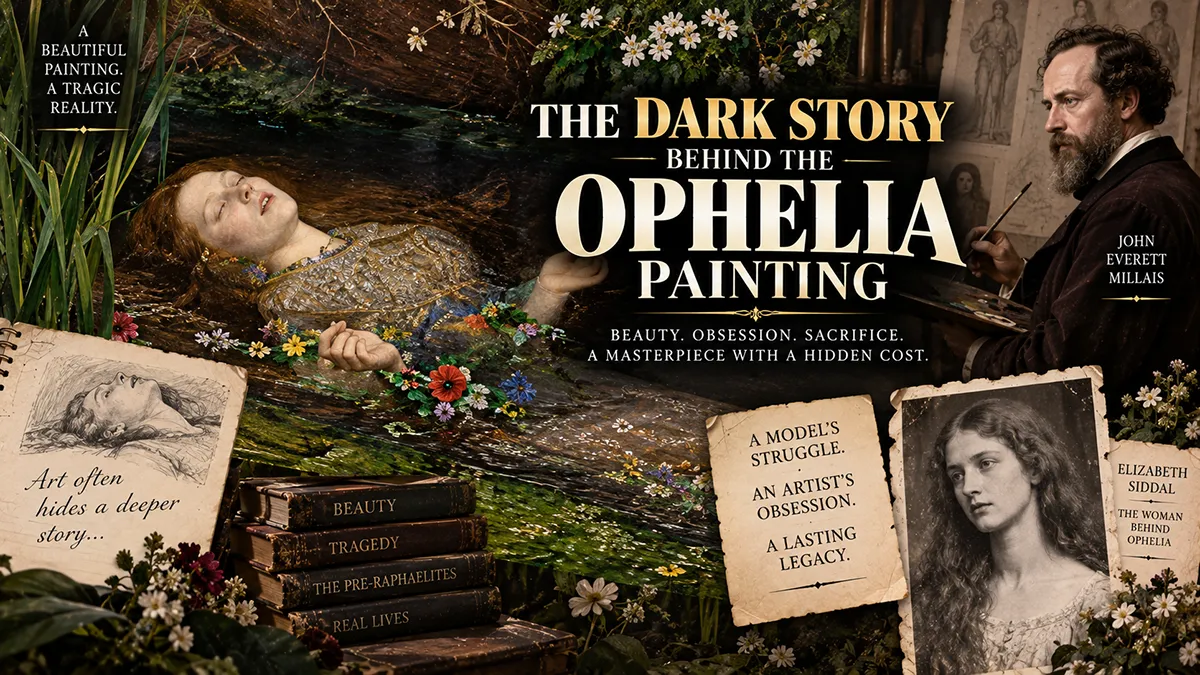
Few images in the history of art feel as hauntingly beautiful as a young woman floating in a river, surrounded by flowers, her face caught somewhere between peace and death.
That image belongs to Ophelia, and it has been painted, photographed, and referenced so many times that most people recognize it even if they’ve never read a word of Shakespeare. But behind the most famous version of this scene lies a story almost as strange and troubling as the painting itself.
The tale involves a freezing bathtub, a Victorian painter obsessed with botanical accuracy, a model who nearly died for her art, and a Shakespearean character whose real-world origins are far murkier than most people assume.
This post digs into the true history behind the painting, the play that inspired it, and the question everyone eventually asks: was Ophelia ever a real person at all?
TL;DR: John Everett Millais’s 1851–52 painting Ophelia immortalized a fictional Shakespearean death scene using a model who nearly died posing for it, and the artwork now hangs in London’s Tate Britain as one of art history’s most famous depictions of tragedy.
What Is the Famous Ophelia Painting?
When people talk about “the” Ophelia painting, they are almost always referring to the 1851–52 oil painting by British artist John Everett Millais.
It shows Ophelia, a character from William Shakespeare’s Hamlet, floating on her back in a river moments before she drowns. Her arms are spread, her mouth is slightly open as if she’s singing, and she’s surrounded by an almost obsessively detailed tangle of wildflowers and foliage.
Millais was a founding member of the Pre-Raphaelite Brotherhood, a group of young British artists who rejected the polished, idealized style of academic painting in favor of intense realism, vivid color, and literary or moral subject matter.
This particular painting became one of the movement’s defining works. It’s now housed at Tate Britain in London, where it remains one of the gallery’s most visited and most reproduced paintings.
The Death of Ophelia Painting: What Scene Does It Actually Show?
The death of Ophelia painting doesn’t show a violent or graphic moment. Instead, it captures something stranger: the quiet, almost dreamlike instant before death, based on a scene that is only described secondhand in Shakespeare’s play. In Hamlet, Ophelia never actually drowns on stage.
Instead, Queen Gertrude reports her death to the other characters in Act 4, describing how Ophelia fell into a brook while gathering flowers, her clothes pulling her under as she sang fragments of old songs.
Millais took that verbal description and turned it into a fully realized visual moment, which is part of why the painting feels so eerily specific despite depicting something Shakespeare himself left offstage.
This is one of the more overlooked details in the ophelia painting story: the artist wasn’t illustrating something Shakespeare showed the audience. He was imagining something Shakespeare only had a messenger describe.
Was Ophelia a Real Person?
This is one of the most searched questions about the painting, and the honest answer is that Ophelia was not a real historical person. She is a fictional character created by William Shakespeare for his tragedy Hamlet, believed to have been written around 1600–1601.
There’s no verified historical record of an actual noblewoman named Ophelia connected to the Danish royal court the play is set in.
That said, some literary historians have floated theories about possible inspirations. One frequently cited, though unproven, theory points to a real drowning recorded near Shakespeare’s hometown of Stratford-upon-Avon.
Court records from 1579 describe the death of a young woman named Katherine Hamlett, who drowned in the River Avon under circumstances debated at the time as either accident or suicide.
Some scholars have speculated Shakespeare, who would have been a teenager living nearby, may have heard about this case and drawn on it later. This connection is speculative and not something historians treat as confirmed fact, so it’s best understood as an interesting possibility rather than a settled origin story.
Questions like this crop up again and again around legendary figures — people ask much the same thing about whether Robin Hood was ever a real person or how much of the real Saint Patrick actually matches the legends built up around him.
Is Ophelia Real in Any Other Sense?
Beyond the direct “was she a real woman” question, it’s worth noting that Ophelia has become real in a cultural sense. Her name, her flower symbolism, and her tragic drowning have been referenced across centuries of art, poetry, psychology, and even feminist literary criticism.
Writers have used her as shorthand for female suffering, silenced women, and mental health struggles under patriarchal pressure.
So while she never existed as a documented historical figure, “is Ophelia real” has almost a second meaning today. She’s real in the sense that her image and story have taken on a life far beyond Shakespeare’s original text.
It’s a curious mirror image of what happens to genuinely historical women whose real lives get flattened into myth over time, as with the real story behind Pocahontas, where a fictional character absorbs the emotional weight usually reserved for a documented life.
The Dark Story Behind the Model: Elizabeth Siddal’s Freezing Ordeal
Here’s where the painting’s darker history really begins, and it has nothing to do with Shakespeare. Millais needed a live model to pose as the drowning Ophelia, and he chose Elizabeth Siddal, a milliner’s assistant who became one of the most iconic Pre-Raphaelite muses and, later, a painter and poet in her own right.
To capture the pose accurately, Siddal was asked to lie fully clothed in a bathtub filled with water inside Millais’s London studio. Oil lamps were placed underneath the tub to keep the water warm during the long posing sessions required for such a detailed painting.
According to accounts that have circulated since the Victorian era, the lamps went out at some point without Millais noticing, and Siddal lay in increasingly cold water for an extended period rather than interrupt his concentration.
Siddal reportedly became severely ill afterward, and her father is said to have sent Millais an angry letter demanding payment for the doctor’s bills.
This anecdote has been repeated so often that it’s become inseparable from the painting’s legacy, though as with many colorful artist-and-muse stories from this period, the exact details come mostly from secondhand accounts rather than an abundance of primary documentation.
Still, it’s widely accepted among art historians that Siddal did suffer a serious illness connected to the sitting.
Painting Hamlet: How Shakespeare’s Play Sparked a Visual Obsession
Millais wasn’t the only artist drawn to painting Hamlet’s world. The play’s themes of madness, betrayal, grief, and death made it irresistible to painters across Europe throughout the 18th and 19th centuries.
Ophelia’s drowning became one of the single most popular scenes to depict, partly because it offered something rare: a beautiful, passive tragedy that could be rendered almost like a still life of a woman among flowers.
This is also why the broader “hamlet and ophelia painting” tradition includes far more than just Millais’s version. Artists were drawn to the moment specifically because of its unusual combination of horror and serenity.
It let painters explore death without violence, and grief without gore, which suited the romantic and later Pre-Raphaelite sensibilities of the era.
Symbolism Hidden in the Ophelia Painting
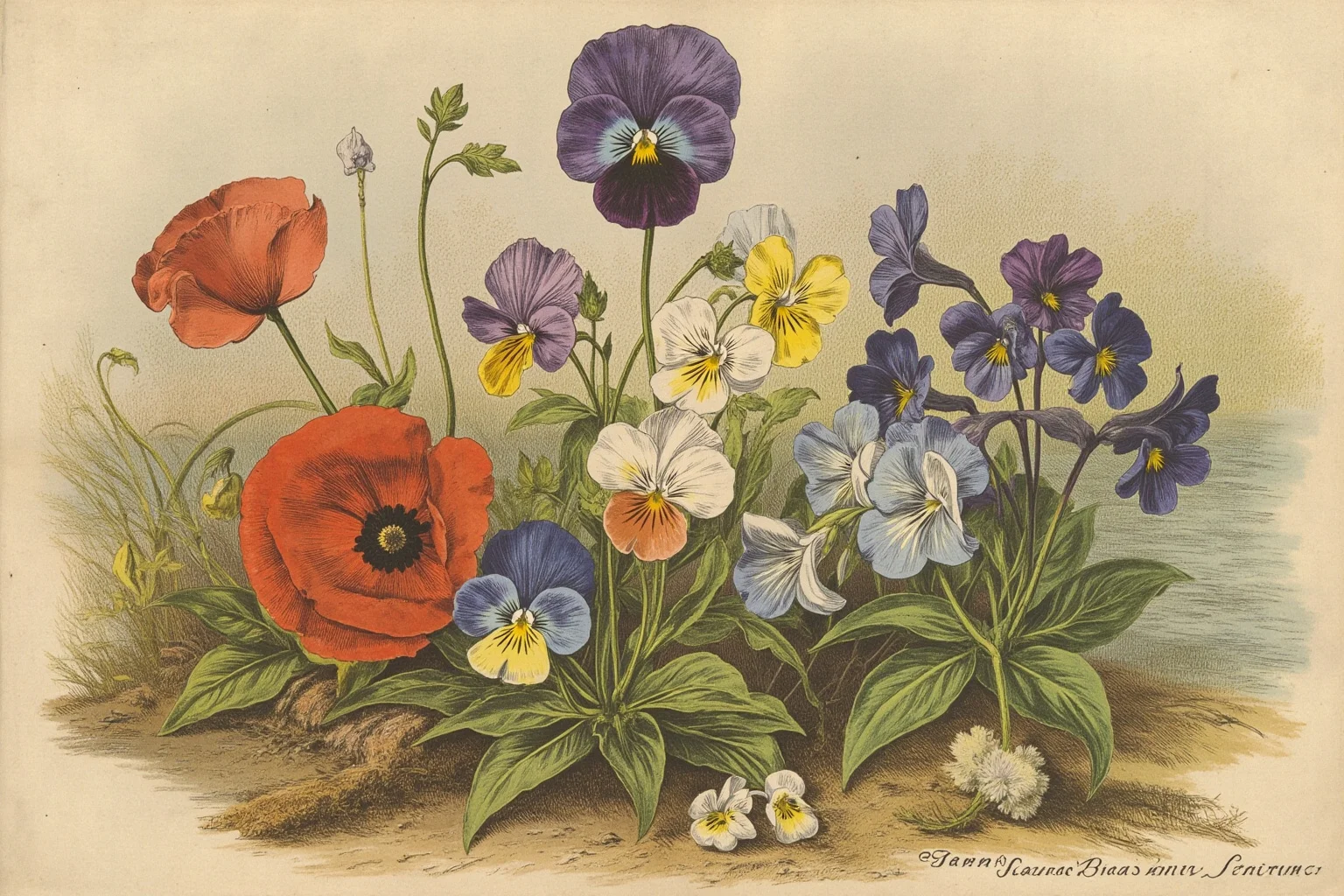
Millais was famous for his painstaking realism, and the flowers surrounding Ophelia in the painting aren’t just decorative. Many of them are specific species mentioned in the original play or tied to traditional Victorian flower symbolism, sometimes called the language of flowers.
Poppies, for instance, were associated with death and sleep. Violets, which appear near Ophelia’s neck, were linked to faithfulness and, according to the flower’s traditional meaning, early death.
Pansies referenced thought and remembrance, tying directly back to a line in the play where Ophelia herself hands out flowers and says, “there’s pansies, that’s for thoughts.”
Millais reportedly spent months painting the riverbank setting outdoors near the Hogsmill River in Surrey, working from direct observation before adding Siddal’s figure later in his London studio.
This level of botanical accuracy was part of what made the Pre-Raphaelites so distinctive, and it’s a big reason the painting still feels so vividly real more than 170 years later.
Other Famous Paintings of Ophelia’s Death
Millais’s version is the most famous, but it’s far from the only one. Paintings of Ophelia’s death span multiple countries and decades, each interpreting the scene through a different artistic lens.
Eugène Delacroix’s Ophelia
The French Romantic painter Eugène Delacroix painted his own version of Ophelia’s death in the 1830s and 1840s, decades before Millais. His interpretation leaned into dramatic, loose brushwork and emotional intensity rather than Millais’s precise detail, reflecting the broader Romantic movement’s fascination with passion and mortality.
John William Waterhouse’s Multiple Ophelias
The British painter John William Waterhouse returned to Ophelia as a subject several times between the late 1880s and early 1900s. His versions often show her sitting or reclining near water just before her death, rather than in the water itself, offering a quieter, more contemplative take on the same tragic figure.
Arthur Hughes’s Ophelia
Fellow Pre-Raphaelite associate Arthur Hughes painted his own Ophelia around the same time as Millais, exhibited in 1852. His version shows a smaller, more shadowed figure crouched by the water’s edge, offering a very different mood from Millais’s brightly lit, flower-strewn composition.
Later and Modern Interpretations
Ophelia has continued to inspire artists well beyond the 19th century, sometimes appearing under the Spanish or Portuguese spelling “Ofelia” in international art and literature.
Photographers, filmmakers, and even fashion editorials have restaged Millais’s exact pose for more than a century, which shows just how deeply this single composition embedded itself in visual culture.
The Fate of the Ophelia Painting: Where Is It Today?
So what actually happened to the painting after Millais finished it? The fate of the Ophelia painting is, thankfully, a much happier story than its subject matter.
It was first exhibited at the Royal Academy in London in 1852, where it received mixed but attention-grabbing reviews, with critics divided over its unusual realism and unconventional composition.
The painting passed through a few private collectors before art patron Sir Henry Tate acquired it. In 1894, Tate gifted his collection, including Ophelia, to the British nation, which helped establish what is now known as Tate Britain. The painting has remained in the Tate’s collection ever since and is one of the gallery’s most consistently displayed and requested works.
Today, it hangs as a centerpiece of Tate Britain’s Victorian and Pre-Raphaelite galleries in London. It regularly travels for temporary exhibitions around the world, but its permanent home remains the same institution that has cared for it since the late 19th century.
Why This Ophelia Painting Still Haunts Us
Part of what keeps this famous Ophelia painting so culturally sticky is the unsettling tension between its beauty and its subject. Millais painted a death scene that looks almost peaceful, filled with vivid color and natural detail, which creates a strange emotional pull that photographs of real tragedy rarely achieve.
It also helps that the story behind its creation, particularly Elizabeth Siddal’s ordeal in that cold bathtub, adds a layer of real-world discomfort to a fictional scene.
Knowing that a real woman suffered physically to help create this image of a fictional woman’s death gives the painting an extra, uncomfortable dimension that many viewers find hard to shake.
The painting has gone on to influence countless creative works, from song titles and album art to film scenes and fashion photography.
Whenever you see a woman floating serenely in water, surrounded by flowers, in a music video or magazine spread, there’s a strong chance the image is quietly borrowing from Millais’s 1852 canvas.
In terms of sheer staying power, a fictional character like Ophelia has managed to rival even some of the most recognized historical figures of all time, despite never having existed at all.
Final Thoughts on the Ophelia Painting Story
The ophelia painting story turns out to be a layered one, weaving together a fictional Shakespearean tragedy, a real Victorian model’s physical suffering, and more than a century of artists reworking the same haunting scene.
Ophelia herself was never a real historical figure, but the emotions her story channels, grief, madness, and the fragility of a young life, clearly struck something universal.
That’s likely why Millais’s painting, along with the many other paintings of Ophelia’s death that followed it, still resonates today. It’s a reminder that even fictional tragedies, rendered with enough craft and care, can leave a very real mark on how we see beauty, sorrow, and mortality all at once.
Frequently Asked Questions
What is the fate of the Ophelia painting today?
The fate of the Ophelia painting is a well-documented one: after John Everett Millais exhibited it in 1852, it passed through private hands before art patron Sir Henry Tate acquired it. Tate gifted his collection to Britain in 1894, and the painting has remained at what is now Tate Britain in London ever since, where it's on public display.
Was Ophelia a real person?
No, Ophelia was not a real historical person. She is a fictional character created by William Shakespeare for his tragedy Hamlet, though some scholars have speculated, without firm proof, that a real 1579 drowning near Shakespeare's hometown may have influenced the character.
Who painted the most famous Ophelia painting?
The most famous version was painted by British artist John Everett Millais between 1851 and 1852. He was a founding member of the Pre-Raphaelite Brotherhood, and the painting is now considered one of that movement's defining works.
Who was the model for the dead Ophelia painting?
The model was Elizabeth Siddal, a milliner's assistant who became a prominent Pre-Raphaelite muse and later a painter and poet herself. She reportedly became seriously ill after posing for extended periods in a cooling bathtub during the painting's creation.
Does Ophelia actually drown on stage in Hamlet?
No. Ophelia's death happens offstage in Shakespeare's play, and it's only described secondhand by Queen Gertrude in Act 4. Millais's painting visualizes that reported scene rather than an event Shakespeare's audience actually witnessed.
Why are there so many different paintings of Ophelia’s death?
Ophelia's drowning became a popular subject because it let artists explore themes of death, madness, and beauty without depicting violence. Painters including Eugène Delacroix, John William Waterhouse, and Arthur Hughes all created their own well-known interpretations of the scene.
Is ‘Ofelia painting’ just a different spelling of the same artwork?
Yes, 'Ofelia' is simply the Spanish and Portuguese spelling of Ophelia's name, and it refers to the same character and often the same body of artwork inspired by her death scene in Hamlet.

Alex Warren
Related Articles





