

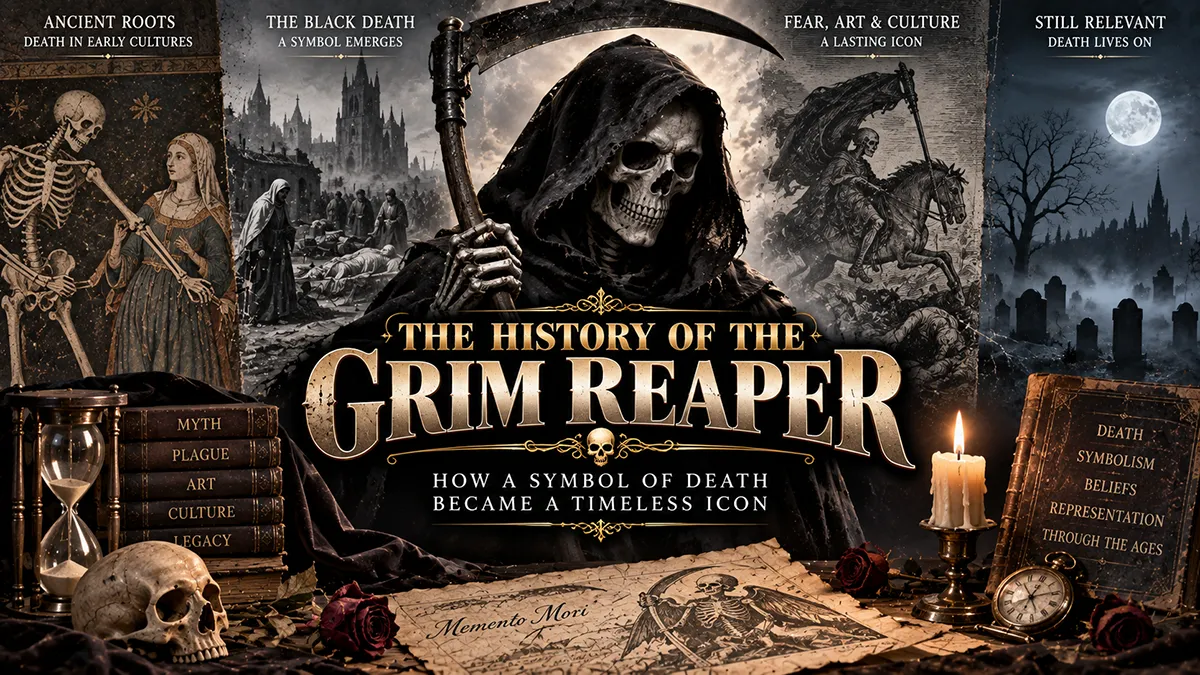
Few figures in human culture are as instantly recognizable as the Grim Reaper. The hooded robe, the bony hand, the long-handled scythe glinting in the moonlight — it’s an image so familiar that most of us never stop to ask where it actually came from. Was there a real “grim reaper,” or is this simply humanity’s favorite way of putting a face on the unknown?
As it turns out, the Grim Reaper isn’t one single legend but a patchwork of mythology, medieval trauma, art history, and folklore stitched together over centuries. This guide walks through that whole story: where the image originated, what he’s actually holding, why the scythe became his signature weapon, and whether any version of this figure is considered “real” in a historical or religious sense.
TL;DR: The Grim Reaper isn’t a single ancient myth but a symbol that evolved over centuries — blending Greek and Roman death gods, medieval plague-era art, and Father Time imagery into the scythe-wielding skeleton we know today.
What Is the Grim Reaper? A Working Definition
At its core, the Grim Reaper is a personification — a way of giving a human (or human-like) shape to something abstract. In this case, that abstract thing is death itself. The grim reaper meaning, in most dictionaries, boils down to “death represented as a skeletal figure in a hooded robe, carrying a scythe to cut down the living.”
He isn’t tied to one religion or mythology. Instead, the Grim Reaper functions more like a cultural shorthand, a widely understood symbol that shows up in everything from Renaissance paintings to horror movies. If you define grim reaper strictly, he’s an allegorical character rather than a deity, spirit, or historical person.
Importantly, the Grim Reaper is usually depicted as a collector rather than a killer. In most folklore and art, he doesn’t decide who dies — he simply arrives afterward to guide the soul onward, much like a psychopomp in older mythologies.
Who Is the Grim Reaper, Really?
So who is the Grim Reaper, exactly? The honest answer is that he isn’t any one person or single mythological being. He’s better understood as a composite character, built from older death gods and folk imagery layered together over roughly two thousand years.
The Greeks had Thanatos, a winged god of peaceful death, and the Romans had Mors, his equivalent. Neither of these figures carried a scythe or wore a hooded robe — those details came much later. What they contributed was the basic idea that death could be imagined as an individual figure who physically comes to collect a person.
The skeletal, robed appearance we associate with the Grim Reaper today is a much later addition, arriving during the medieval period. So while ancient cultures gave us the concept of “Death as a character,” medieval Europe gave us his actual look.
The Origins of the Grim Reaper: Where Did the Legend Come From?
Tracing the grim reaper origin means looking at several overlapping threads rather than one clean timeline. The concept of death as a mythological figure is genuinely ancient, showing up in Greek, Roman, Norse, and Egyptian traditions in different forms. None of these early versions, however, matches the image most people picture today.
The distinctly skeletal, scythe-carrying figure is largely a product of medieval and early Renaissance Europe. It developed gradually through religious art, folk storytelling, and a very real historical catastrophe that reshaped how Europeans thought about mortality.
So where did the Grim Reaper come from in the specific sense of “the guy with the scythe”? Most historians point to the 14th century, when a devastating pandemic forced death into the center of everyday life and art.
The Black Death and the Rise of the Skeletal Figure
The Black Death swept through Europe starting around 1347, killing an estimated one-third to one-half of the population in affected regions over just a few years. Death stopped being an occasional, private event and became a constant, visible presence in towns and villages. This context matters enormously for understanding the medieval grim reaper imagery that followed.
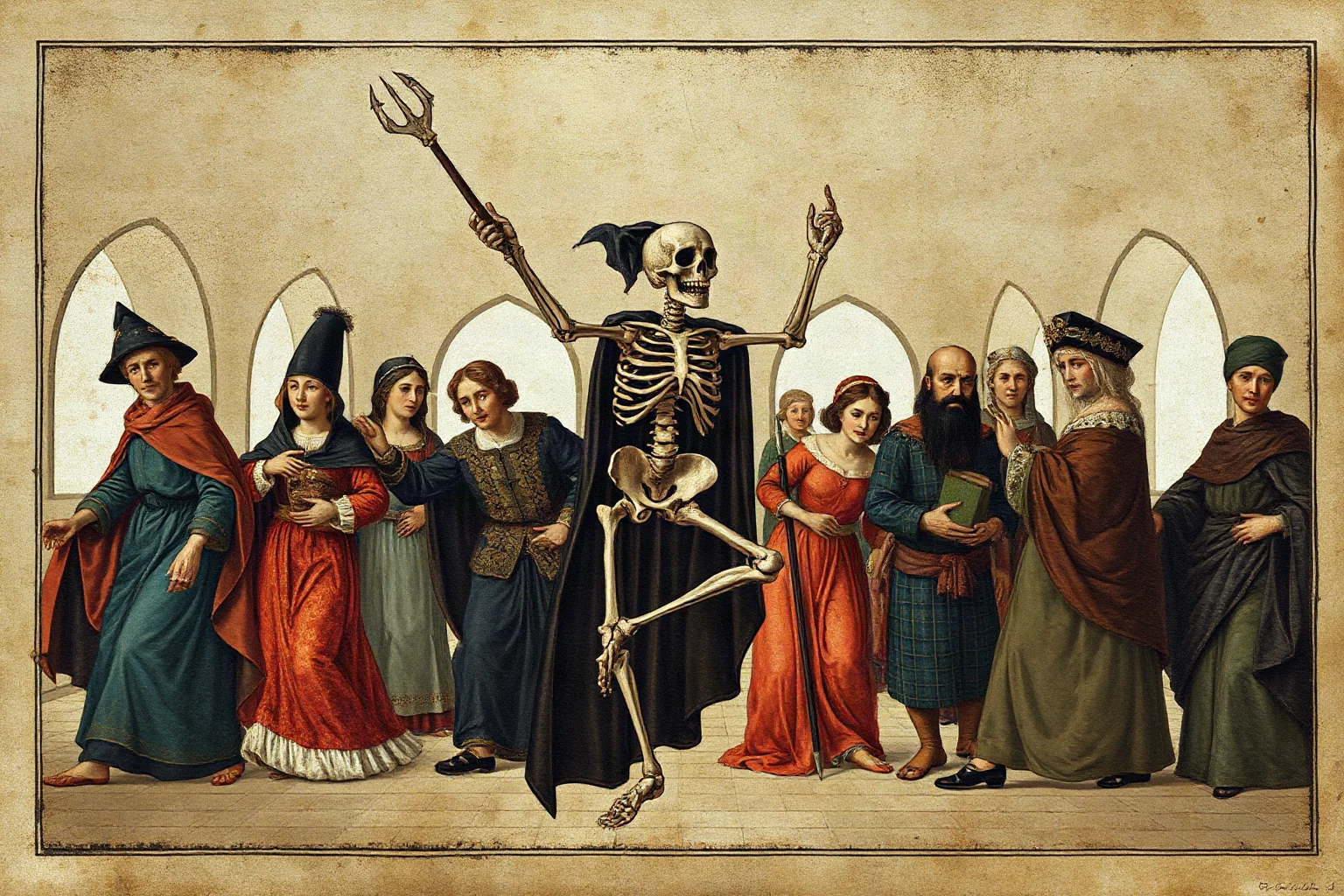
Out of this trauma came the “Danse Macabre,” or Dance of Death — a popular art and literary motif showing skeletons leading people from every social class (kings, peasants, priests, children) in a procession toward the grave. The message was blunt: death comes for everyone, regardless of wealth or status. This same obsession with mortality, faith, and fate would later shape figures like Joan of Arc, whose story blended religious conviction and legend in the century that followed.
Around the same period, the “Ars Moriendi” (Art of Dying) texts and memento mori artwork reinforced skeletal imagery as a visual reminder of mortality. These weren’t fringe curiosities — they were mainstream religious and moral art, meant to encourage people to live virtuously because death could arrive at any moment.
This is the true grim reaper history that most casual retellings skip: he wasn’t invented for spooky entertainment. He emerged from genuine mass grief and an urgent cultural need to process it.
From Father Time to the Reaper: Where the Scythe Came In
The scythe itself has an interesting backstory that predates the skeletal death figure entirely. In Greek mythology, the Titan Cronus carried a sickle-like blade, a detail that later got tangled up with the Roman god Saturn, who was associated with the harvest and agriculture.
During the Renaissance, Saturn’s harvesting tool became linked with “Father Time,” an old bearded figure representing the passage of time and its power to “cut down” all things eventually. Because harvest imagery was already tied to endings, cycles, and mortality, it was a natural visual fit for the emerging death figure.
Over time, artists began giving their skeletal death figures the same tool Father Time carried. By the late medieval and early modern period, the scythe grim reaper combination had become standard, merging the harvest symbolism of Father Time with the skeletal imagery from plague-era art.
What Does the Grim Reaper Carry? The Scythe, Explained
This is one of the most common questions people ask, and the answer is fairly consistent across art history: the grim reaper weapon name is the scythe. What does the grim reaper carry, specifically? A long-handled farming tool with a curved blade, traditionally used by farmers to harvest wheat and other grain crops close to the ground.
That agricultural connection is exactly the point. Just as a farmer cuts down stalks of wheat at the end of their growing cycle, the Reaper “harvests” souls at the end of a person’s life. What does the grim reaper hold, then, is essentially a tool of the harvest repurposed as a tool of mortality — a metaphor turned into physical object.
It’s worth noting the difference between a scythe and a sickle, since the two get mixed up constantly. A sickle is short-handled and used with one hand, while a scythe is long-handled and swung with both hands in a wide arc. Death with sickle imagery does appear in some older and regional artwork, but the long-handled scythe grim reaper is by far the more common and enduring depiction in Western art.
Does the Grim Reaper Always Carry a Scythe?
Not always — and this is where things get more interesting. While the scythe is the most iconic answer to what is the grim reaper’s weapon, historical and cultural depictions have shown Death holding other objects entirely.
In some medieval and Renaissance artwork, Death carries an hourglass instead of or alongside his scythe, representing time running out for the person he’s come to collect. In other depictions, particularly earlier ones influenced by the biblical “Four Horsemen of the Apocalypse,” Death is shown carrying a sword or bow rather than a farming tool.
A grim reaper with sword appears in some apocalyptic and religious art, symbolizing more violent or sudden death rather than a peaceful harvest. So while the scythe is the answer most people expect and the one that has become culturally dominant, it isn’t the only tool historically associated with the personification of death.
Why Does the Grim Reaper Have a Scythe? The Symbolism Explained
Understanding scythe symbolism helps explain why this particular tool won out over swords, arrows, or other options. A scythe doesn’t discriminate between individual stalks of wheat — it sweeps through an entire field indiscriminately. That mirrors exactly how medieval communities experienced the plague: death didn’t seem to select victims by merit or status, it simply took whoever was in its path.
The swinging, sweeping motion of a scythe also visually suggests something being “gathered” rather than violently destroyed. Grim reaper symbolism generally leans toward death as an inevitable, natural conclusion rather than a violent punishment, and the harvesting tool captures that idea perfectly.
So why does death have a scythe rather than something more obviously weapon-like? Because the original message wasn’t about violence at all — it was about the natural, unavoidable cycle of life reaching its end, the same way crops are harvested once they’ve matured.
What Does the Grim Reaper Look Like? The Classic Description
The standard grim reaper description has stayed remarkably consistent since the late medieval period. He’s typically shown as a skeleton, sometimes with visible bone and sometimes obscured in shadow beneath his hood. A dark, hooded robe covers most of his body, often compared to the robes worn by monks of certain religious orders.
His face, when visible at all, is usually a bare skull, sometimes with glowing eyes added in more modern pop-culture depictions. What does a grim reaper look like in his hands is just as important as his face: bony fingers gripping the long shaft of his scythe, ready to swing.
This look wasn’t designed by one single artist. It developed gradually across centuries of paintings, woodcuts, and church art, eventually solidifying into the version most people would recognize instantly today.
Is the Grim Reaper Real? Separating Myth From Belief
The honest, myth-busting answer is that there’s no historical or scientific evidence that the Grim Reaper is a real being. Is the grim reaper real in the sense of an actual entity that appears to people? No mainstream religion, scientific field, or historical record supports that claim.
What is real is the widespread human tendency to personify death across nearly every culture and era. The grim reaper is real only in the sense that he’s a real, enduring cultural symbol — not a documented supernatural figure with verified sightings or origins.
That said, personal accounts of near-death experiences sometimes describe encountering a dark, hooded figure, and these reports are worth acknowledging without treating them as proof. They’re subjective experiences, often shaped by the very cultural imagery this article is describing, rather than independently verifiable events. Real-world records of extreme human longevity, like the oldest verified people in history, are a useful reminder that the boundary between life and death is far more variable in reality than in any myth.
The Grim Reaper Around the World
While the hooded, scythe-carrying figure is a distinctly Western European invention, the underlying idea — death as a character rather than just an event — shows up almost everywhere. Ancient Egypt had Anubis, a jackal-headed god who guided souls through the underworld rather than harvesting them. Hindu tradition has Yama, a god of death and justice who judges souls rather than simply collecting them with a blade.
Norse mythology gave the dead to Hel and to Valkyries who chose who died in battle, a very different mechanism from the passive, harvesting Reaper of European art. Mexican folk tradition includes La Santa Muerte, a skeletal folk saint venerated by some as a protector rather than feared purely as an ender of life.
These figures aren’t the same character wearing different cultural clothing — they’re independent traditions that each answer the same universal question in their own way. The Grim Reaper as we know him remains a specifically European export that later spread worldwide through art, literature, and film.
The Grim Reaper in Art, Literature, and Pop Culture
After the medieval period, the Reaper didn’t fade away — he became a fixture of Western storytelling. Renaissance painters continued using skeletal death figures in religious allegory, and by the 19th century, the exact phrase “Grim Reaper” had entered common English usage in print, even though the imagery behind it was already centuries old.
Literature embraced him too, most famously in works where Death appears as a character who converses with mortals, plays games for souls, or simply narrates human tragedy from the sidelines. This narrative device — giving death a voice and personality — has remained a popular storytelling tool well into modern fiction.
Modern pop culture has run wild with the character, from animated sitcoms to video games to horror franchises. These portrayals often add sunglasses, humor, or entirely new personalities, but nearly all of them keep the two core visual elements intact: the hooded robe and the scythe.
How Old Is the Grim Reaper? A Rough Timeline
People often ask how old is the grim reaper expecting a single clean number, but the honest answer depends on which part of him you’re measuring. The underlying concept of personified death stretches back well over 2,000 years to Greek and Roman mythology. The specific skeletal, robed look, however, is much younger, taking shape mainly during and after the Black Death in the 1300s.
The scythe as his signature weapon solidified even later, gaining popularity through Renaissance-era Father Time imagery in the 1400s and 1500s. When was the grim reaper created as the complete, recognizable package we know today? Most art historians would point to sometime between the 14th and 16th centuries, when all these separate elements finally merged.
The exact English phrase “Grim Reaper” is younger still, generally traced to written sources from the 1800s, even though the visual imagery it describes had already existed for centuries by that point.
A Note on Spelling: Grim Reaper, Grim Reeper, and Other Variants
If you’ve ever typed this into a search bar, you’ve probably seen your fair share of typos and alternate spellings — grim reeper, grim reper, grim repear, grim reapper, gim reaper, and grim reape all refer to the exact same figure. There’s only one correct spelling, “Grim Reaper,” but the phonetic spelling errors are common enough that they’re worth clearing up.
The word “grim” describes his fearsome, joyless demeanor, while “reaper” refers directly to his harvesting role and his signature tool. Even sources like a grim reaper Wikipedia entry will confirm this is the standard spelling used across dictionaries, encyclopedias, and historical texts.
What Does the Grim Reaper Represent?
Beyond the visual details, it’s worth asking what does the grim reaper represent on a deeper level. Mostly, he represents inevitability — the idea that death comes for absolutely everyone, regardless of wealth, power, or personal goodness, echoing the leveling message of the medieval Dance of Death.
He also represents transition rather than pure destruction. In most traditional depictions, he’s not the cause of death so much as the figure who arrives afterward to guide a soul onward, similar to older psychopomp figures in Greek and Egyptian mythology.
Finally, he represents humanity’s long-running attempt to make sense of something we can’t fully understand. Giving death a face, a robe, and a tool turns an abstract fear into a character we can at least picture, discuss, and even occasionally joke about.
The Grim Reaper’s Legacy Today
Centuries after his medieval origins, the Grim Reaper remains one of the most recognizable symbols in the world, instantly understood across languages and cultures. He appears in everything from Halloween costumes to safety warning signs, where a scythe-wielding silhouette is used to signal serious danger.
He’s proof that a well-designed symbol can outlive the specific historical crisis that created it, joining the ranks of some of the most recognized historical figures whose images have long outlasted the eras that produced them. What began as plague-era religious art meant to encourage moral reflection has become a piece of shared global visual language, instantly recognized even by people who’ve never heard of the Black Death or the Danse Macabre.
Understanding his real history doesn’t make him any less compelling — if anything, it makes him more interesting. He’s not a random spooky invention, but a genuinely layered piece of cultural history built from mythology, tragedy, art, and centuries of storytelling.
Frequently Asked Questions
What does the Grim Reaper carry?
The Grim Reaper is most famously depicted carrying a scythe, a long-handled farming tool traditionally used to harvest grain. The imagery compares the ending of a human life to the harvesting of a crop. Some historical and religious artwork also shows Death carrying an hourglass, a sword, or a bow instead, but the scythe remains the standard and most widely recognized version.
What is the Grim Reaper’s weapon called?
His signature weapon is called a scythe, not a sickle, though the two are often confused. A scythe has a long handle meant to be swung with both hands, while a sickle is a smaller, short-handled blade. The long-handled scythe became the standard tool associated with the Grim Reaper by the late medieval and Renaissance periods.
Is the Grim Reaper real?
There's no historical, scientific, or religious evidence confirming the Grim Reaper as an actual entity. He's best understood as a cultural personification of death rather than a documented supernatural being. The image is real as a symbol with a genuine historical origin, even though the figure himself isn't considered a literal, verified entity.
What does Grim Reaper mean?
The name combines "grim," describing his fearsome and joyless nature, with "reaper," referencing his role as a harvester of souls using a scythe. Together, the term describes death personified as a solemn figure who collects the deceased much like a farmer harvesting a field.
Where did the Grim Reaper come from?
The Grim Reaper developed gradually rather than being invented by one source. Ancient Greek and Roman death gods contributed the idea of death as a character, while the skeletal, robed appearance emerged from medieval European art during and after the Black Death in the 1300s. The scythe was added later, borrowed from Renaissance-era Father Time imagery.
How old is the Grim Reaper?
It depends on which element you're measuring. The concept of personified death is over 2,000 years old, tracing back to Greek and Roman mythology, but the skeletal, scythe-carrying figure most people picture today took shape between the 14th and 16th centuries in Europe.
What does the Grim Reaper represent?
The Grim Reaper represents the inevitability of death, showing that it comes for everyone regardless of wealth or status, an idea rooted in the medieval Dance of Death art tradition. He also represents transition rather than violent destruction, typically shown guiding souls onward rather than causing death himself.
Why does the Grim Reaper have a scythe instead of a sword?
The scythe was chosen because it symbolizes an indiscriminate, natural harvesting process rather than a violent attack. Just as a scythe sweeps through a field cutting down every stalk of wheat regardless of individual merit, the Reaper's scythe suggests death arrives for everyone equally, without picking favorites.

Alex Warren
Related Articles