

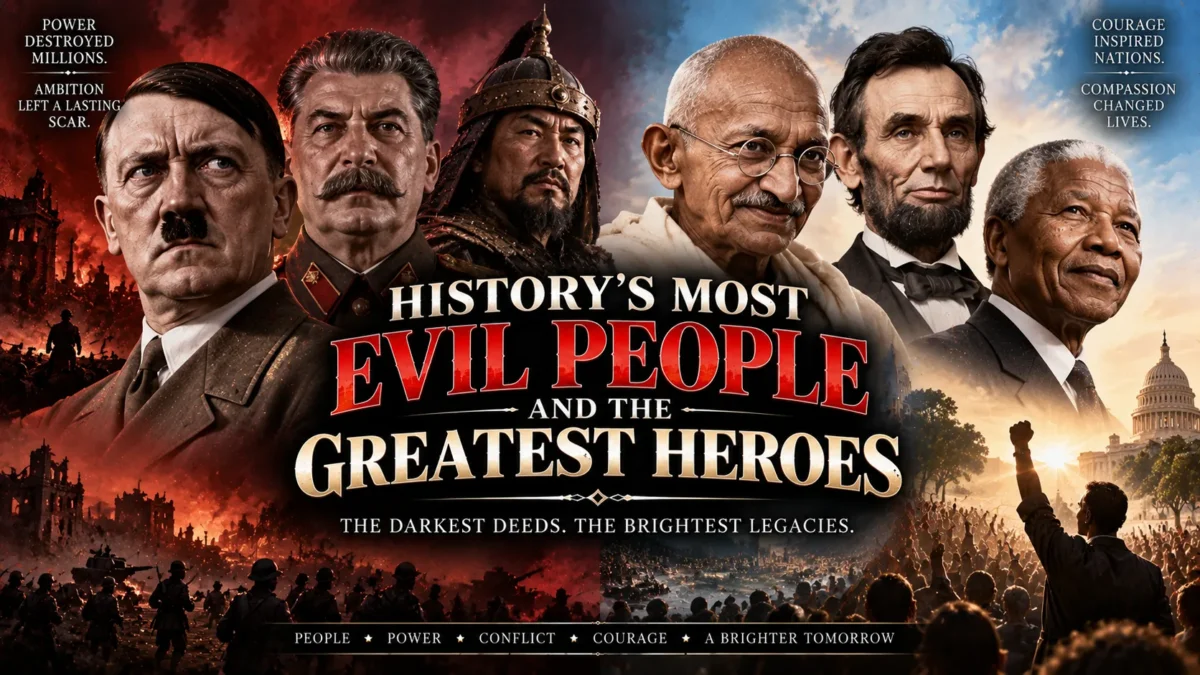
Human history is full of extremes. For every tyrant who left a trail of destruction, there’s someone who risked everything to protect a stranger, challenge injustice, or heal the sick. Looking at both sides isn’t just morbid curiosity — it’s a way of understanding what humans are actually capable of, in both directions.
This post rounds up 10 of history’s most notorious villains alongside 10 of its most celebrated heroes — many of whom also appear among history’s most recognized figures. We’ve tried to separate documented fact from exaggeration and legend, because plenty of “famous evil people” have had their reputations inflated by propaganda, folklore, or centuries of retelling.
TL;DR: History’s worst tyrants caused suffering on a massive, documented scale, while its greatest heroes proved that courage and compassion can push back against that darkness — and separating fact from legend matters for both.
Why Ranking “Most Evil” Is Trickier Than It Looks
There’s no scientific formula for measuring evil, no verified “evil people in history tier list” that historians actually endorse. Death tolls, cruelty, intent, and historical context all matter, and they don’t compare neatly across centuries or cultures.
Ancient sources make this even messier. Much of what we “know” about Roman emperors like Caligula and Nero comes from writers who had political reasons to trash their reputations after they died. That doesn’t mean these men were secretly nice — but it does mean some specific stories should be read with a raised eyebrow.
With that caveat in place, here are 10 historical figures who are consistently named among the most evil people of all time, based on well-documented actions rather than rumor alone.
10 of History’s Most Evil People
1. Adolf Hitler
As leader of Nazi Germany from 1933 to 1945, Adolf Hitler orchestrated the Holocaust, the systematic murder of approximately six million Jews along with Roma, disabled people, political dissidents, and other targeted groups. His invasion of Poland in 1939 triggered World War II, a conflict that killed tens of millions worldwide.
Hitler died by suicide in his Berlin bunker in April 1945 as Allied forces closed in. For most historians and much of the public, he remains the default answer to “who is the most evil man in history.”
2. Joseph Stalin
As leader of the Soviet Union from the late 1920s until his death in 1953, Joseph Stalin oversaw forced agricultural collectivization that triggered devastating famines, including the Holodomor in Ukraine. Millions died from starvation, execution, or imprisonment in the Gulag labor camp system.
The Great Purge of the late 1930s saw Stalin eliminate perceived rivals within his own party and military through show trials and mass executions. Historians still debate exact death tolls, but nearly all estimates run into the millions.
3. Pol Pot

Pol Pot led the Khmer Rouge regime that controlled Cambodia from 1975 to 1979, attempting to force the country into an agrarian utopia through brutal means. His government emptied cities, abolished currency, and executed intellectuals, professionals, and anyone seen as a threat to the revolution.
The “Killing Fields” became a lasting symbol of this era, with an estimated 1.5 to 2 million Cambodians dying from execution, overwork, or starvation. That was roughly a quarter of the country’s population at the time.
4. Vlad the Impaler
Vlad III, Voivode of Wallachia in the 15th century, earned his nickname through his preferred method of execution: impalement of enemies, criminals, and captured soldiers on large stakes. He used terror deliberately as a political weapon against invading Ottoman forces and internal rivals alike.
Much of his fearsome reputation comes from hostile German pamphlets and Russian chronicles written after his death, which historians believe exaggerated some accounts for political effect. Vlad later inspired Bram Stoker’s Dracula, cementing his place in pop culture far beyond Wallachian history.
5. Ivan the Terrible
Ivan IV, Russia’s first crowned Tsar, created the Oprichnina, a private police force that terrorized nobles and ordinary citizens through torture, land seizures, and mass executions. The 1570 Massacre of Novgorod alone is estimated to have killed thousands of residents.
A long-standing story claims Ivan killed his own son in a fit of rage, an event immortalized in a famous Russian painting. Some historians have questioned parts of this account in recent years, though Ivan’s broader record of state violence is well documented.
6. Elizabeth Báthory

The Hungarian countess Elizabeth Báthory was tried in 1611 on accusations of torturing and killing dozens of young women, with some legends inflating the number into the hundreds. Popular folklore even claims she bathed in the blood of victims to preserve her youth.
Modern historians note that Báthory’s trial happened amid political disputes over her family’s wealth and land, which may have shaped how the accusations were recorded. Some cruelty appears well supported by testimony, but the more sensational blood-bathing claims are considered unverified legend rather than fact.
7. Caligula

Roman Emperor Caligula ruled from 37 to 41 AD and was later described by ancient historians like Suetonius as cruel, erratic, and even convinced of his own divinity. Stories include forcing senators to humiliate themselves and squandering the imperial treasury on personal excess.
Because these accounts were written decades after his assassination by writers with their own agendas, historians treat some specifics with caution. Even with that caveat, enough was recorded by contemporaries to support his reputation as one of ancient Rome’s most feared rulers.
8. Nero
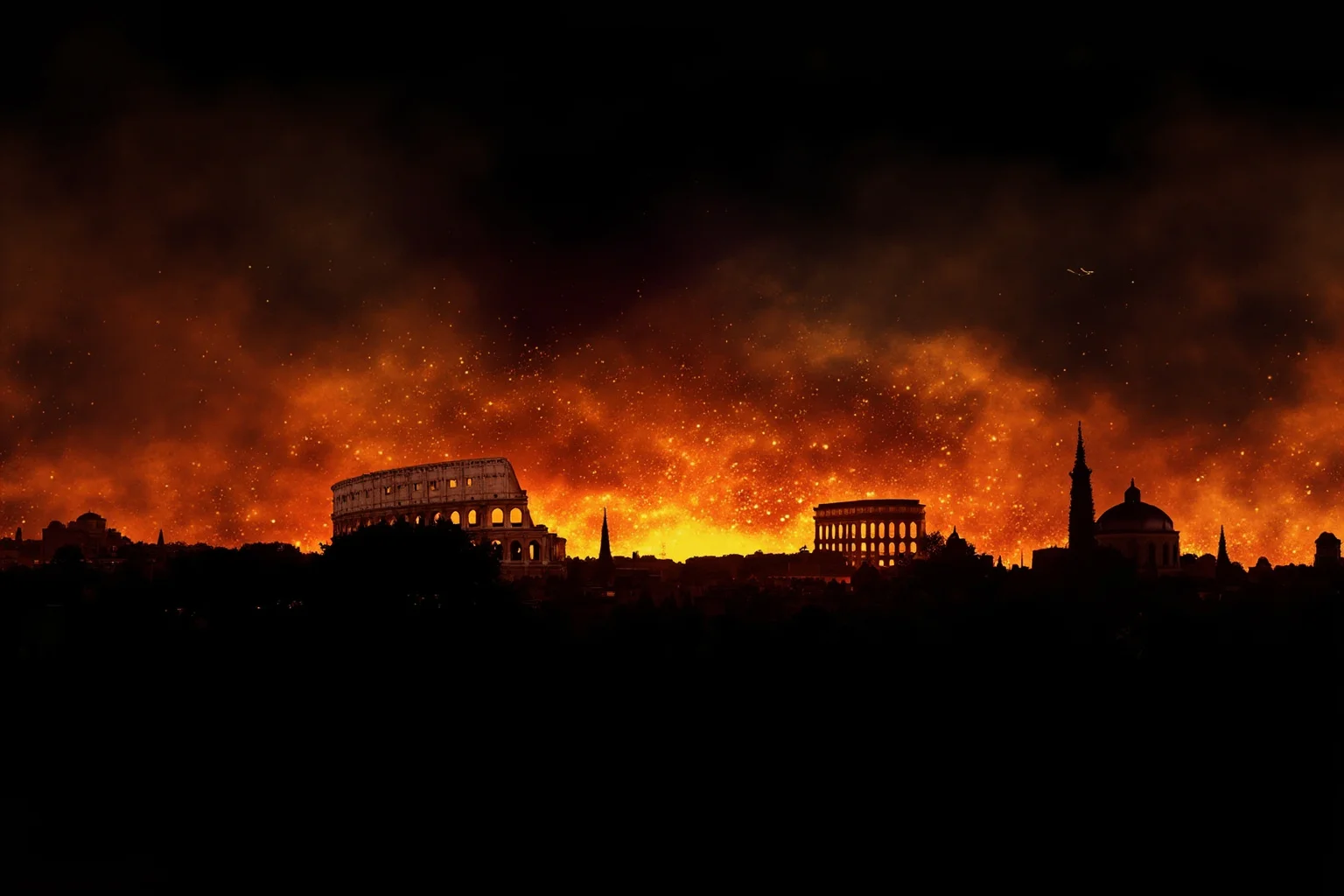
Emperor Nero ruled Rome from 54 to 68 AD and is remembered for the Great Fire of Rome in 64 AD, which he was rumored to have either started or ignored while blaming Christians for it. That blame led to brutal persecutions, including executions described in gruesome detail by ancient writers.
Nero is also documented as having his own mother, Agrippina, killed after a power struggle. Like other Roman emperors on this list, some anecdotes come from politically hostile sources, but his cruelty toward perceived enemies is well attested.
9. Idi Amin

Idi Amin ruled Uganda as a military dictator from 1971 to 1979, a period marked by mass killings of political opponents, ethnic persecution, and the forced expulsion of the country’s Asian minority. Estimates of deaths under his regime range from 100,000 to as many as 500,000 people.
Amin was known for his erratic public behavior and self-granted titles, which sometimes overshadowed the scale of violence in international coverage at the time. He eventually fled into exile in 1979 and died in Saudi Arabia in 2003.
10. Genghis Khan
Genghis Khan founded the Mongol Empire in the 13th century through military campaigns that killed millions across Asia and Europe, making him a fixture on lists of the most evil people in ancient and medieval history. Entire cities were destroyed when they resisted Mongol demands for surrender.
Historians increasingly note this isn’t the whole picture. Genghis Khan also established a unified legal code, promoted religious tolerance across his empire, and helped connect trade along the Silk Road — a reminder that historical “evil” rankings often flatten genuinely complicated legacies.
What About Fiction’s Most Evil Villains?
People searching for “who is the most evil person in fiction” usually land on names like Sauron, Voldemort, or Anton Chigurh, and honestly, the debate is endless because fictional evil is designed to be memorable rather than historically accurate. Writers can make villains purely, uncomplicatedly evil in a way real historical figures rarely are.
That’s actually part of why real history is more unsettling. Tyrants like Stalin or Pol Pot weren’t cartoonish monsters twirling mustaches; they were often seen by supporters as reasonable, even visionary, which is exactly how atrocities get carried out at scale.
This overlap between fiction and history also explains searches for “history’s most attractive bad guy.” Pop culture often romanticizes charismatic villains, and that halo effect can bleed into how real historical figures get portrayed in movies and TV. It’s worth remembering that charisma and charm have never been reliable indicators of morality, on screen or in the historical record.
10 Historical Heroes Who Prove Humanity Can Be Great
After a list like that, it helps to remember the other side of the human story. These 10 figures faced enormous risk, and in many cases genuine danger to their own lives, to help others or push society toward justice.
1. Mahatma Gandhi
Mahatma Gandhi led India’s independence movement against British rule through a strategy of nonviolent civil disobedience, inspiring similar movements across the globe. His approach proved that mass political change didn’t require armed uprising to succeed.
Gandhi was assassinated in January 1948, just months after India achieved independence. His philosophy of nonviolent resistance went on to directly influence later leaders like Martin Luther King Jr.
2. Nelson Mandela
Nelson Mandela spent 27 years in prison for his opposition to South Africa’s apartheid regime before being released in 1990. Rather than pursuing revenge, he worked toward reconciliation and became the country’s first Black president in 1994.
His leadership during South Africa’s transition away from apartheid is widely credited with helping the country avoid a far bloodier outcome. Mandela remained a global symbol of forgiveness and justice until his death in 2013.
3. Martin Luther King Jr.
Martin Luther King Jr. became the most prominent leader of the American civil rights movement in the 1950s and 1960s, championing nonviolent protest against racial segregation and discrimination. His 1963 “I Have a Dream” speech remains one of the most quoted addresses in American history.
King helped push through landmark legislation, including the Civil Rights Act of 1964 and the Voting Rights Act of 1965. He was assassinated in Memphis in 1968, but his influence on civil rights movements worldwide continued long after his death.
4. Harriet Tubman

Born into slavery in Maryland, Harriet Tubman escaped to freedom in 1849 and then returned repeatedly to the South to guide dozens of enslaved people to freedom via the Underground Railroad. She undertook these missions at enormous personal risk, since capture could have meant death.
During the Civil War, Tubman also served the Union Army as a scout and spy, and she helped lead an armed raid that freed more than 700 enslaved people. She later became an advocate for women’s suffrage until her death in 1913, securing her place among history’s most powerful women.
5. Florence Nightingale
Florence Nightingale transformed the field of nursing during the Crimean War in the 1850s by introducing rigorous sanitation practices in military hospitals. Her reforms dramatically reduced death rates among wounded soldiers.
After the war, Nightingale used her research to push for systemic healthcare reform across Britain and founded a nursing school that shaped professional standards for generations. She’s widely regarded as the founder of modern nursing.
6. Oskar Schindler
Oskar Schindler was a German industrialist who saved an estimated 1,200 Jewish employees from deportation to concentration camps during the Holocaust by employing them in his factories. He spent much of his personal fortune bribing officials and protecting his workers.
Schindler’s actions were largely unrecognized during his lifetime and only became widely known decades later. His story was popularized globally by Steven Spielberg’s 1993 film “Schindler’s List.”
7. Abraham Lincoln

Abraham Lincoln led the United States through the Civil War as its 16th president, working to preserve the Union while pushing the country toward ending slavery. His Emancipation Proclamation in 1863 declared enslaved people in Confederate states to be free.
Lincoln was assassinated in April 1865, just days after the Confederacy’s surrender effectively ended the war. He’s remembered as one of the most consequential leaders in American history.
8. Marie Curie

Marie Curie pioneered research into radioactivity, becoming the first woman to win a Nobel Prize and the only person to win Nobel Prizes in two different scientific fields, physics and chemistry, a feat that places her among history’s smartest people. Her discoveries laid groundwork for cancer treatment and medical imaging still used today.
During World War I, Curie developed mobile X-ray units to help treat wounded soldiers near the front lines. She died in 1934 from complications linked to her long-term radiation exposure, a poignant reminder of the personal cost of her groundbreaking work.
9. Sophie Scholl
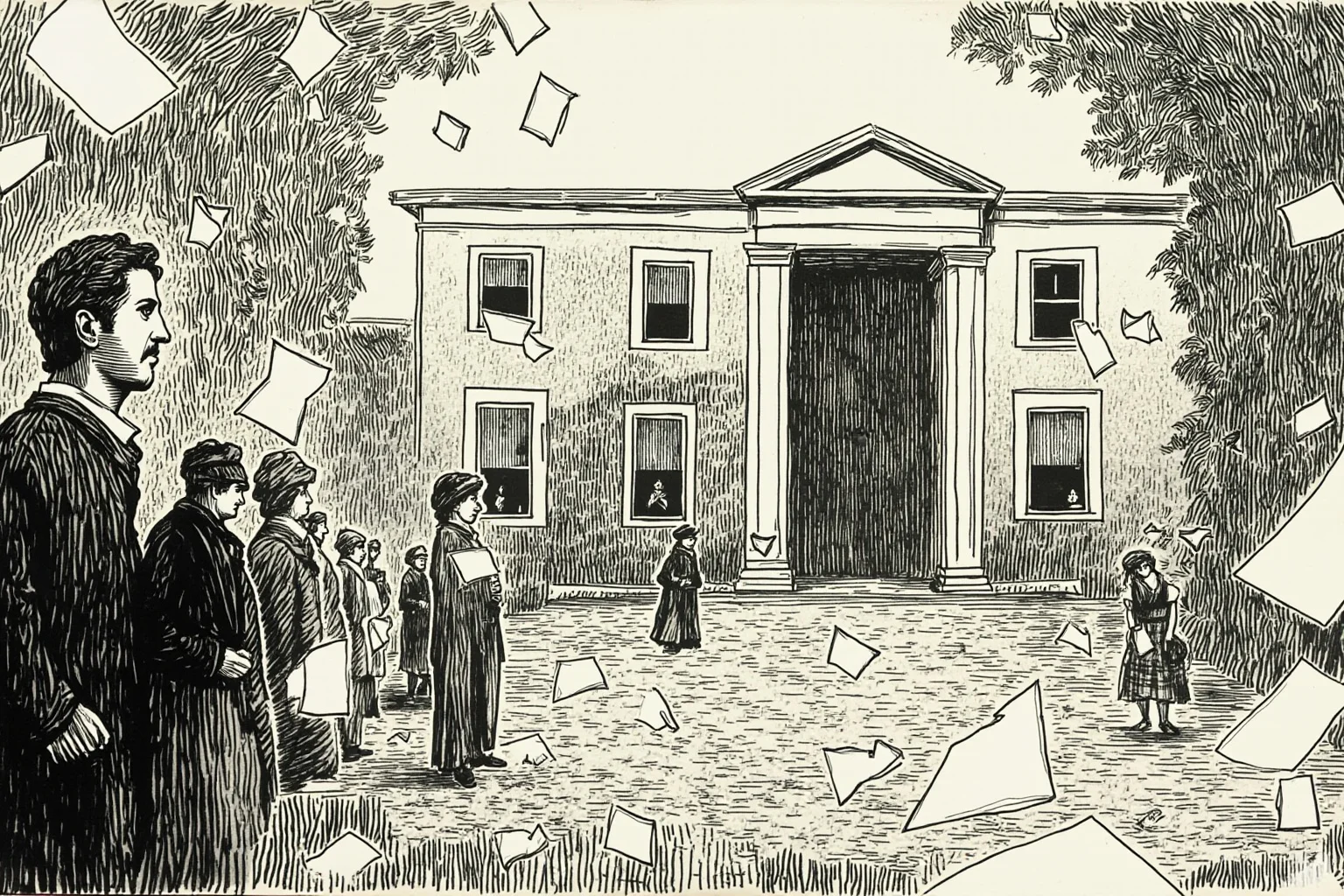
Sophie Scholl was a German university student who joined the White Rose, a nonviolent resistance group that distributed anti-Nazi leaflets calling for opposition to Hitler’s regime. She and her fellow members risked execution simply for spreading these written appeals for resistance.
Scholl was arrested in 1943 for distributing leaflets at the University of Munich and was executed by guillotine days later, at just 21 years old. Her courage in the face of certain death has made her a lasting symbol of moral resistance against tyranny.
10. Irena Sendler
Irena Sendler was a Polish social worker who used her access to the Warsaw Ghetto during World War II to smuggle an estimated 2,500 Jewish children to safety. She hid children in ambulances, toolboxes, and coffins, and kept coded records of their real identities so families could potentially be reunited later.
Sendler was eventually captured and tortured by the Gestapo but refused to reveal the names of her collaborators. She survived the war and lived until 2008, her story only gaining wider recognition decades after the events themselves.
What This Contrast Actually Teaches Us
Looking at these two lists side by side, a pattern emerges that’s worth sitting with. The people remembered as most evil almost always gained and held power through fear, propaganda, and the dehumanization of specific groups of people.
The people remembered as heroes usually did the opposite: they extended empathy toward people society had cast aside, often at serious personal cost. That’s not a coincidence — it’s close to the actual mechanism by which both atrocity and heroism happen throughout history.
It’s also worth remembering that history isn’t only made of extremes. Most people who lived through the eras covered here were neither infamous villains nor celebrated heroes, just ordinary individuals navigating extraordinary circumstances as best they could.
Final Thoughts
There’s no definitive, universally agreed-upon ranking of the most evil person of all time, and there probably never will be, since evil isn’t something historians can measure with a spreadsheet. What we can do is look honestly at documented actions, question sensationalized claims, and resist the urge to treat legend as fact.
The flip side matters just as much. The heroes on this list remind us that courage, compassion, and stubborn decency have always existed alongside history’s worst chapters, often in the same decades and even the same cities as its darkest events.
Frequently Asked Questions
Who are considered the most infamous bad guys in history?
Names that consistently come up include Adolf Hitler, Joseph Stalin, Pol Pot, Genghis Khan, and Idi Amin, largely because of well-documented mass casualties tied to their actions. Ancient figures like Caligula and Nero are also frequently cited, though some specific stories about them come from politically hostile ancient sources and should be read with some caution.
Who is considered the most evil person of all time?
There's no official ranking, but Adolf Hitler is the most commonly cited answer due to his role in orchestrating the Holocaust and starting World War II. Other names like Stalin and Pol Pot are frequently mentioned alongside him because of comparably massive death tolls under their regimes.
Is there an official ‘evil people in history’ tier list?
No, there's no scientific or historian-endorsed tier list ranking evil, since factors like death toll, intent, and historical context don't compare neatly across different eras. Most rankings you'll find online, including this post, reflect general consensus and documented actions rather than a definitive scale.
Who is the most evil person in fiction?
This is genuinely debated among fans, with characters like Sauron, Voldemort, and Anton Chigurh frequently mentioned as some of fiction's most evil villains. Unlike real historical figures, fictional villains are often written to be purely evil without the moral complexity that real people actually have.
Are stories about figures like Vlad the Impaler and Elizabeth Báthory completely true?
Not entirely. While both figures were documented as genuinely cruel by the standards of their time, some of the more extreme legends, like Báthory bathing in blood, are considered exaggerated or unverified by historians. Political rivals and propagandists often had reasons to inflate these reputations further after the fact.
Is Genghis Khan really one of history’s most evil people?
Genghis Khan's military campaigns killed millions of people, which is why he regularly appears on lists of history's most evil people in ancient and medieval times. However, historians also point out he established religious tolerance and a unified legal code across his empire, making his full legacy more complicated than a simple villain label suggests.
What does it mean if someone searches ‘I am an evil person’?
This is usually a sign of anxious self-reflection rather than an accurate self-assessment, and truly harmful people rarely worry this much about their own morality. If these thoughts are persistent or distressing, talking to a mental health professional is a much better step than trying to self-diagnose based on historical comparisons.
Who is known as history’s most attractive bad guy?
This phrase usually points to how pop culture romanticizes charismatic villains, sometimes blurring the line between real historical figures and their fictionalized, more glamorous portrayals in film and TV. Charisma has never been a reliable sign of good character, and historical charm shouldn't be mistaken for historical innocence.

Alex Warren
Related Articles





