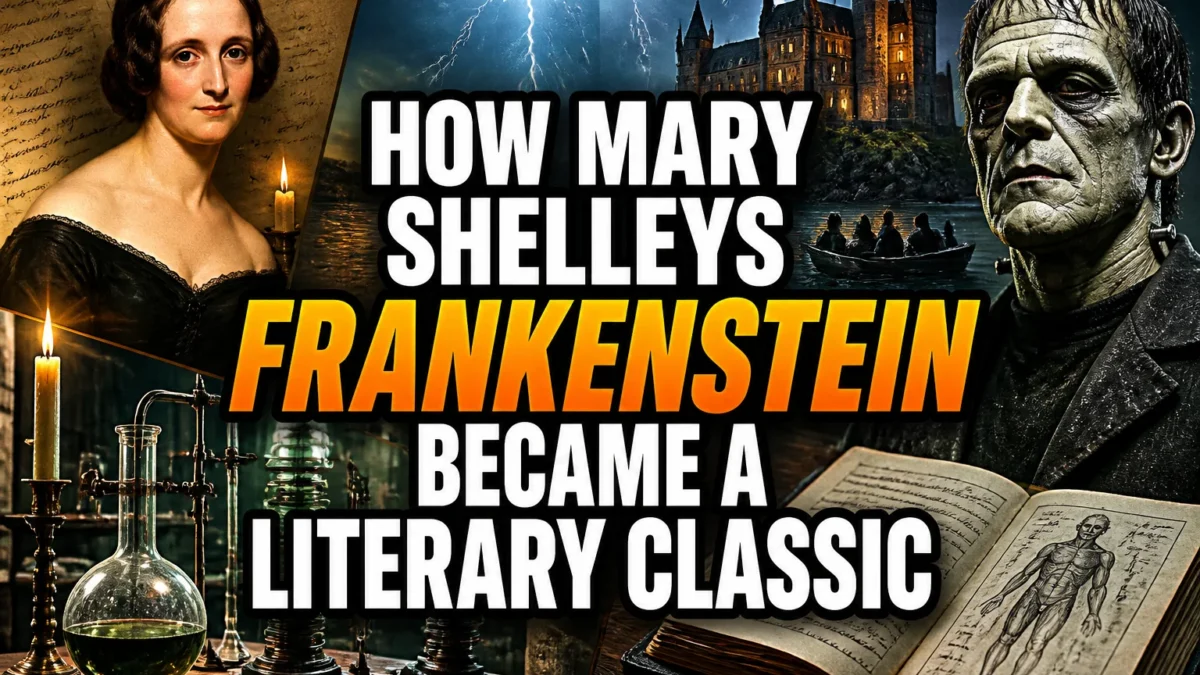
Mary Shelley was eighteen years old when she began writing the book that would become one of the most recognizable stories on earth. She had no way of knowing that a rainy summer challenge would eventually produce a novel studied in classrooms, adapted across dozens of films, and debated by literary scholars for more than two centuries. The road from private ghost story to public classic was stranger and more gradual than popular legend suggests.
Most people know the name Frankenstein before they ever open the book. What they often meet is a patchwork of movie images, Halloween costumes, and half-remembered plot points rather than Shelley’s actual novel. That gap between the myth and the text is part of why the book has never lost its grip on readers.
TL;DR: Mary Shelley’s Frankenstein became a classic because it fused Gothic dread, Romantic ambition, and early scientific speculation into a philosophical story about creation, responsibility, and belonging that still unsettles readers today.
A Ghost Story Contest That Changed Literary History
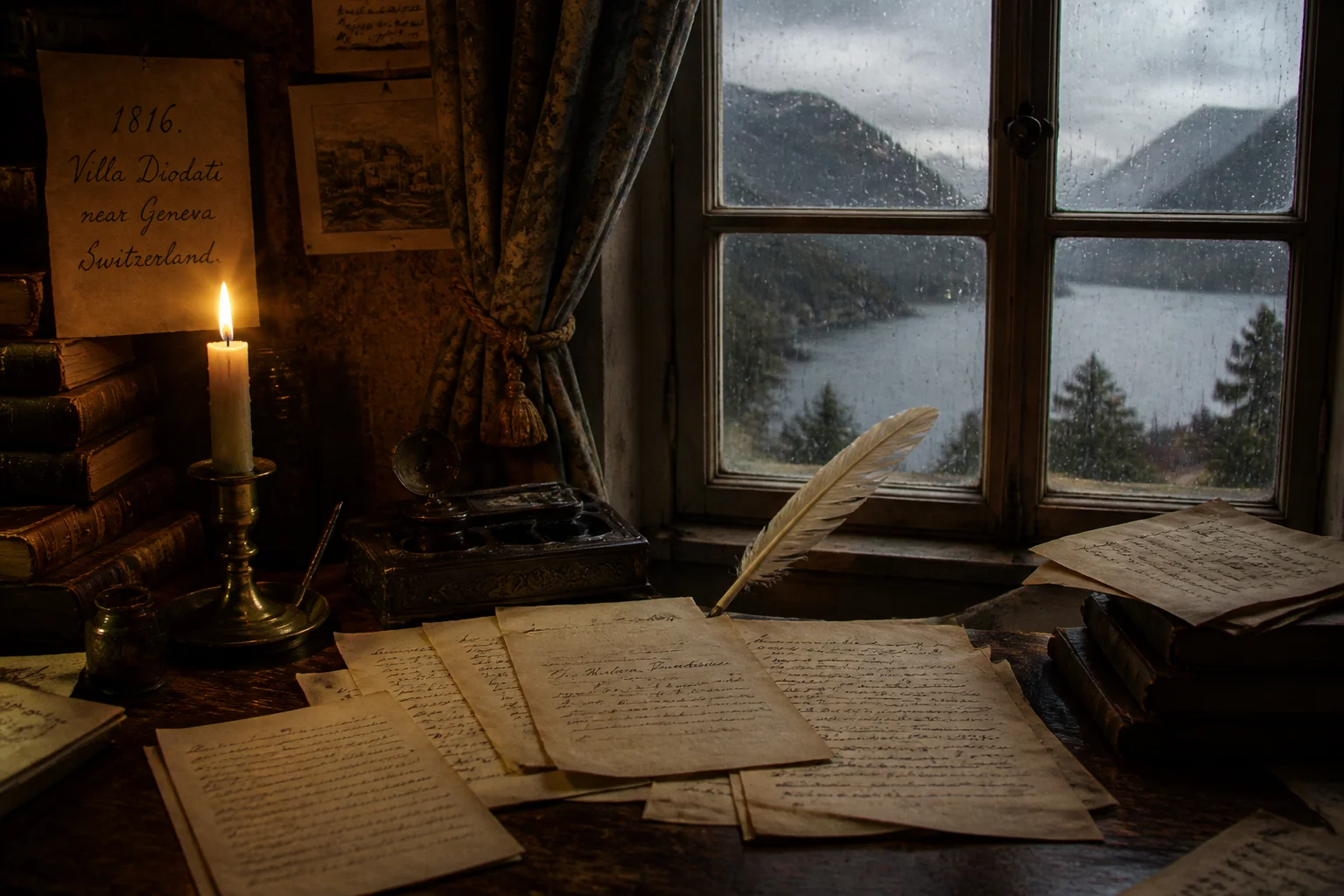
In June 1816, Mary Godwin, Percy Shelley, Lord Byron, and others gathered at the Villa Diodati near Lake Geneva. The summer was cold and gloomy because of the 1815 eruption of Mount Tambora, which had thrown volcanic ash into the atmosphere. Stuck indoors, the group read aloud from a French collection of German horror tales called Fantasmagoriana.
Byron suggested that each person write a ghost story. Most of the group produced fragments, but Mary produced the seed of a novel. She later described a waking dream in which she saw a pale student kneeling beside the hideous thing he had assembled.
The precise details of that evening come mainly from later recollections, especially Mary’s 1831 introduction. What is certain is that the contest gave her the pressure and permission to start writing seriously. The result was not a quick sketch but a sustained work of imagination.
From Anonymous Debut to Bestseller Myth
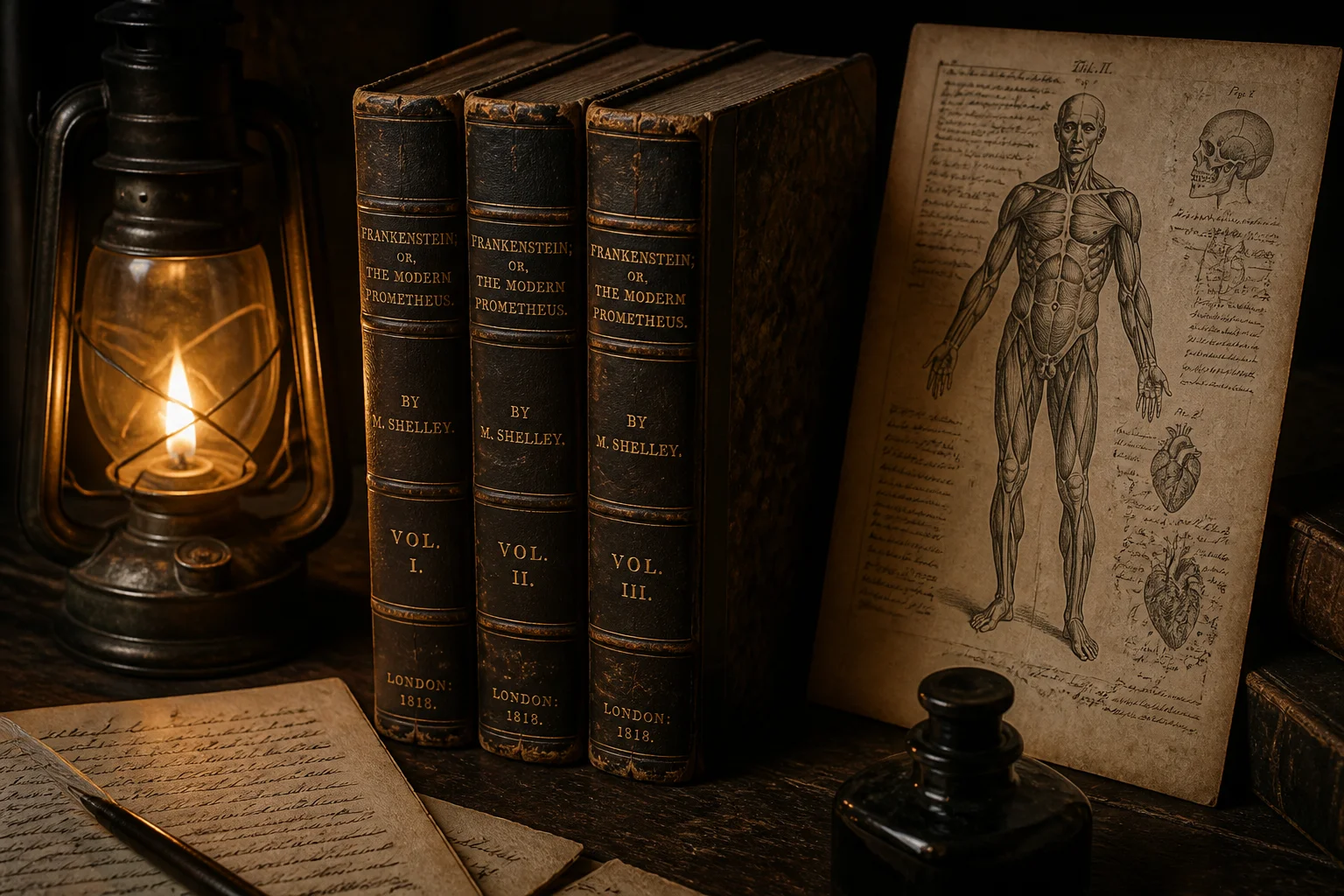
Frankenstein was first published on January 1, 1818, by the London firm Lackington, Hughes, Harding, Mavor & Jones. It appeared in three volumes, a common format for novels at the time, and it was published anonymously. The title page did not name Mary Shelley.
The book was dedicated to William Godwin, Mary’s father, and its preface was written by Percy Shelley. Some early readers assumed Percy was the author, partly because of that preface and partly because they doubted a young woman could write such a philosophical novel. That assumption shaped early criticism and later myths.
The first edition likely had a print run of only 500 copies. It did not become an instant bestseller in the modern sense, though it attracted attention through reviews and stage adaptations. The idea that it was an overnight phenomenon is one of the first myths worth setting aside.
Early Reviews Were Brutal—and Sometimes Snobbish
The Quarterly Review published a famously hostile notice that called the novel disgusting and absurd. Other outlets worried that the subject matter was too gruesome for polite readers. Such reviews reveal more about early nineteenth-century literary gatekeeping than about the book’s lasting worth.
Walter Scott reviewed the novel and credited the author with unusual imaginative power, even while noting flaws in the plot. The mixture of harsh dismissal and cautious praise meant the book was noticed, but not universally celebrated. For a new novel by an anonymous writer, that was a better outcome than silence.
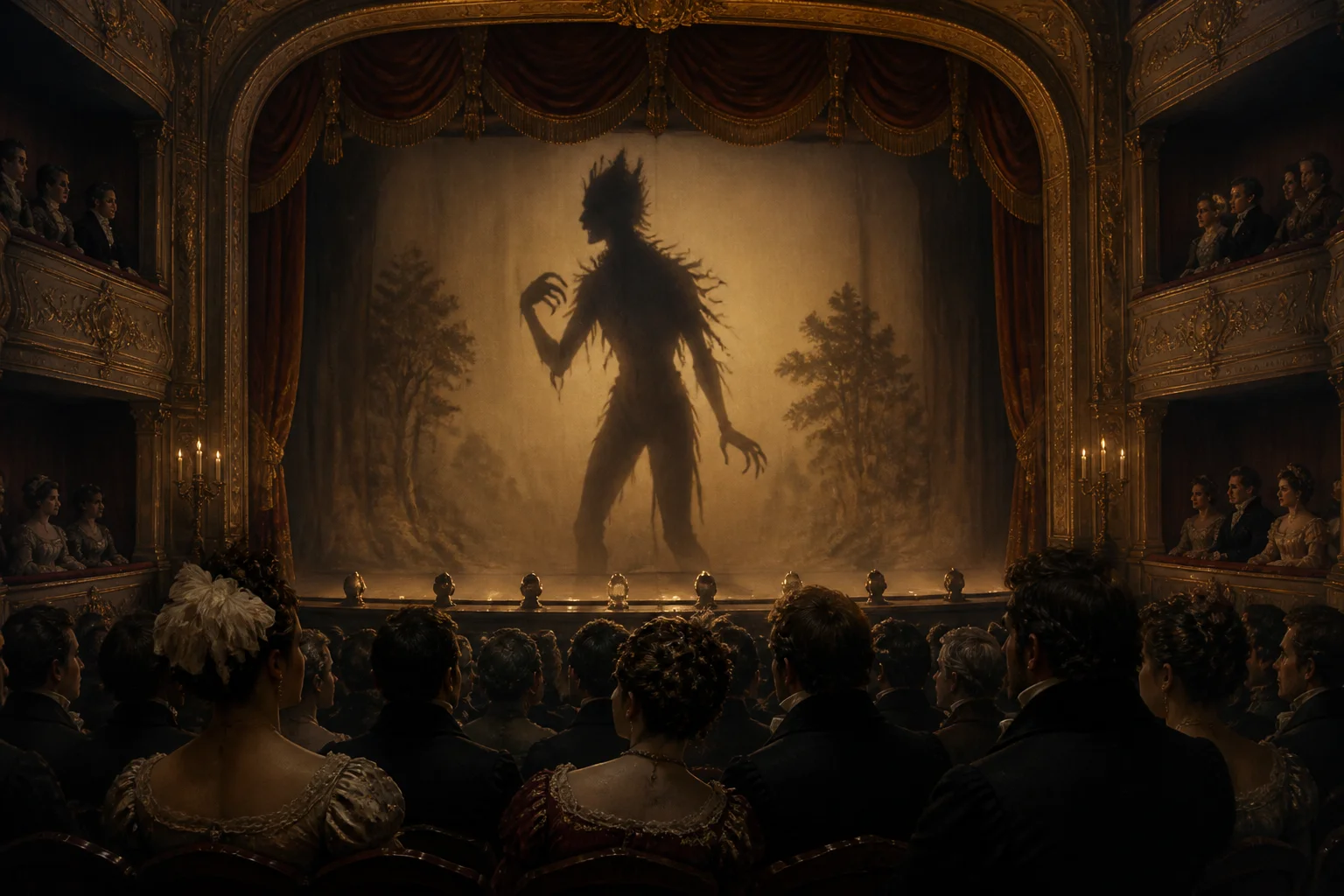
The novel survived bad reviews in part because stage adaptations began appearing within a few years. These plays kept the story in public view even when the book itself was not widely read. In 1823, Richard Brinsley Peake’s Presumption; or, the Fate of Frankenstein became a hit in London.
The Stage Made the Story Famous—and Changed It
Mary Shelley attended a performance of Peake’s play and wrote to a friend that the production had made her famous. The stage version transformed her philosophical creature into a more physical, less articulate figure. That theatrical choice would shape public memory far more than most readers realize.
Stage versions often stripped the creature of his eloquent speech. In Peake’s play, the creature was played largely as a physical menace, and that visual shorthand stuck. Later films, especially the 1931 Universal picture, cemented the bolt-necked, inarticulate monster in popular culture.
The popularity of the stage meant the story reached audiences who never read the novel. That double life, as both literary text and popular spectacle, helped push it toward classic status. It also created the persistent confusion between the name Frankenstein and the creature.
The 1831 Revision and Mary Shelley’s Retrospective Voice
In 1831, a revised edition appeared in a single volume, published by Henry Colburn and Richard Bentley. Mary Shelley made hundreds of changes, smoothing prose and altering characters. The darker 1818 text often feels more radical, while the 1831 text is more polished and sometimes more fatalistic.
The 1831 edition also added Mary’s introduction, in which she explained how the novel began. It is a personal and sometimes dramatic account, but scholars treat it with care because it was written years after the events and with her own later reputation in mind.
Most readers today encounter the 1831 text, which became the standard classroom edition. The publication history matters because it shows that a classic is not a fixed object. Frankenstein evolved in response to critics, audiences, and its author.
The Frankenstein Genre Problem: Gothic, Romantic, or Early Science Fiction?
The genre of Frankenstein has never been simple to label. It draws on Gothic conventions such as dark settings, pursued heroines, and supernatural dread, but it replaces magic with a scientific experiment at the core of the plot. That combination makes it a bridge between older Gothic fiction and newer scientific romance.
Many scholars call the book one of the first works of science fiction, but that claim is debated. Brian Aldiss famously argued that Frankenstein was the first true science fiction novel because it centers on human invention rather than divine or supernatural creation. Other scholars point to earlier lunar voyages, utopian tales, and automata stories to argue the genre has many beginnings.
The most accurate description is usually a blend: Gothic novel, Romantic philosophical fiction, and proto-science fiction. Calling it only horror misses the philosophical voices, while calling it only science fiction underplays its debt to sentimental and Gothic traditions. Its mixed identity is one reason the Frankenstein genre still generates discussion.
The Scientific Context: Galvanism and the Limits of Knowledge
In the early nineteenth century, scientists and audiences were fascinated by electricity and the possibility of animating matter. Mary Shelley’s 1831 introduction mentions galvanism as one of the ideas discussed at the Villa Diodati, though the 1818 novel itself is deliberately vague about Victor’s method. That vagueness is important.
Victor refuses to tell Walton the exact secret of reanimation, warning him against repeating the mistake. The novel focuses less on a plausible laboratory procedure and more on the moral consequences of discovery. That choice keeps the story timeless rather than tied to outdated science.
Because the book is not a technical manual, it can absorb new scientific debates in every generation. Readers today connect it to genetic engineering and artificial intelligence just as earlier readers connected it to vivisection and electricity. This flexibility is a major part of its classic endurance.
Is Frankenstein a Classic? The Case for Its Staying Power
Ask almost any literature professor whether Frankenstein is a classic and the answer is likely yes, but the reasons vary. Some point to the creature’s eloquence, others to Victor’s ambition, and still others to the novel’s early engagement with what we now call scientific ethics. A classic typically earns that label because it rewards rereading and supports many interpretations.
The novel has been translated into dozens of languages and appears regularly on high school and university syllabi. It has remained a fixture in print culture for generations and has been studied by historians, philosophers, feminist scholars, and scientists. That wide reach is a practical sign of its canonical status.
The theme of abandonment speaks to readers across generations. The creature is not born evil; he becomes violent after rejection by his creator and society. That tragedy gives the novel an emotional core that sits alongside its ideas.
Myth-Busting the Famous Monster
In Shelley’s novel, the creature is not named Frankenstein. He is called “the creature,” “the daemon,” “the wretch,” and other terms, but never Frankenstein. Victor Frankenstein is the young scientist who builds the body and then runs away.
The green skin, flat head, and neck bolts come from later visual adaptations, especially the 1931 Universal film. The novel describes the creature as eight feet tall and hideous, but it does not give him those iconic movie features. The famous line “It’s alive!” also belongs to the film tradition, not to Shelley’s text.
Understanding this gap does not make the adaptations wrong; they created their own version of the story. But collapsing the book into its film image can hide Shelley’s central concern with parental responsibility and prejudice. The novel is more disturbing than the costume because the monster speaks.
The Creature Speaks: The Monster’s Eloquence and Interior Life
The most surprising thing for many first-time readers is that the creature tells his own story in polished, passionate language. He describes watching the De Lacey family and learning to read from books such as Paradise Lost, Plutarch’s Lives, and The Sorrows of Young Werther. Those books shape his sense of justice and his pain.
Shelley gave the creature a voice because the novel is not really about a monster. It is about what happens when a thinking, feeling being is treated as a monster. The creature’s account makes the reader sit inside his loneliness rather than simply gawk at him.
This interior life is exactly what many adaptations remove. The book’s power comes from hearing him argue, mourn, and accuse. Without that voice, Frankenstein becomes a simple horror story instead of a moral tragedy.
Victor Frankenstein as Prometheus: The Double-Edged Name
The novel’s subtitle, “The Modern Prometheus,” points to the Greek myth of the Titan who stole fire from the gods. Prometheus was punished for overreaching, and Victor suffers a similar chain of consequences. But Shelley does not reduce Victor to a simple villain.
Victor is ambitious, curious, and sometimes sympathetic, yet he also refuses to accept responsibility for the creature. His failure is less about creating life and more about abandoning it. That moral distinction is central to the novel’s staying power.
Reading Frankenstein as a Promethean story helps explain why it remains a classic. It asks readers to weigh the value of discovery against the duty of care. That question cannot be answered once and then closed.
Why First-Time Readers Are Surprised by the Book
Many readers come to Frankenstein expecting a fast-paced monster story and find an epistolary novel framed by letters from an Arctic explorer named Robert Walton. The story moves through Walton’s perspective, Victor’s confession, and the creature’s first-person account. That nested structure is more complex than the film image suggests.
The landscape writing is also surprisingly Romantic and detailed. Shelley spends time on the Alps, the frozen sea, and the emotional states of her narrators. The novel is a work of atmosphere as much as action.
This structural complexity is one reason scholars keep returning to the text. A classic usually rewards readers who dig into its form, not just its plot. Frankenstein does that on almost every page.
Why the Book Still Feels Modern
Frankenstein asks what happens when a creator refuses to take responsibility for what he has made. That question now applies to technology, artificial intelligence, genetic engineering, and environmental change. The novel is not a prediction of any specific technology, but it is a durable ethical fable about power and care.
The creature’s loneliness gives the story a psychological dimension that feels contemporary. He learns language by observing a family and reading books, then confronts Victor with the pain of being utterly alone. Students often find the creature more sympathetic than the scientist.
The novel also works as a Romantic critique of obsessive ambition. Victor’s failure is not that he asks big questions, but that he abandons the result in horror. That failure turns a scientific experiment into a tragedy.
How Pop Culture Made It Immortal—and Misleading
The story achieved global recognition through plays, films, cartoons, comic books, and parodies. Each retelling reshaped the material, often emphasizing the horror while muting the politics and philosophy. The word “Frankenstein” became shorthand for a monster or a dangerous invention.
The 1931 Universal film fixed the creature’s look in the public imagination. Later comedies and Halloween imagery doubled down on the bolts and groans. These versions are culturally important, but they should not be confused with Shelley’s novel.
The gap between the literary work and its pop culture afterlife is actually useful for teaching. It lets readers compare the articulate, tragic creature of the book with the mute screen monster. That comparison is one more reason the original remains alive.
The Romantic Circle and the Novel’s Radical Inheritance
Mary Shelley was surrounded by radical thinkers. Her mother, Mary Wollstonecraft, wrote A Vindication of the Rights of Woman, and her father, William Godwin, wrote political philosophy. Percy Shelley and Lord Byron were central figures in English Romanticism, and the novel grew out of that intellectual ferment.
Frankenstein contains ideas about education, justice, and sympathy that echo Godwin and Wollstonecraft. The creature is not inherently evil; society teaches him cruelty through rejection. That argument was radical for 1818 and remains a major reading of the text.
The novel also reflects Romantic unease about unchecked ambition and the limits of human knowledge. Victor is both a Promethean hero and a cautionary example. His tragedy is not simply that he creates life, but that he cannot love what he has made.
The Creature as Outcast: Sympathy, Prejudice, and Social Failure
The creature begins with a desire to help the De Lacey family, but they react to his appearance with fear and violence. That rejection turns his need for connection into fury. Shelley makes the point that cruelty is often taught rather than innate.
Some readers see the novel as a warning about prejudging people by appearance or origin. The creature is dangerous only after he is denied every social bond. That reading has made the book a touchstone in discussions of justice and belonging.
This social dimension distinguishes Frankenstein from a simple horror story. It asks readers to consider who the real monster is. The answer depends on which voice the reader trusts.
The Feminist and Philosophical Readings That Cemented Its Canonical Status
From the mid-twentieth century onward, scholars began to read Frankenstein as a conversation with Mary Shelley’s feminist inheritance. Critics examined the novel’s depiction of birth, creation, and the exclusion of women from Victor’s experiment. That lens helped move the book from popular entertainment into serious literary study.
Other readers emphasized the novel’s political and philosophical questions about education, justice, and prejudice. The creature’s transformation from innocent observer to vengeful outcast became a key focus. Those debates connected the book to larger ideas about society and inequality.
The rise of science fiction studies also gave Frankenstein a new home in universities. Even though the genre of Frankenstein is still debated, that very debate made the book useful for courses on Gothic fiction, Romanticism, and science fiction. It now occupies a rare position across multiple traditions.
Classics Are Made by Readers: Frankenstein’s Classroom Revival
The book became a classroom staple in the twentieth century, especially after cheap paperback editions made it easy to assign. Teachers found that the novel could spark discussions about science, responsibility, and empathy. It also appealed to students who saw the creature as a misunderstood outsider.
The 1931 film and its sequels had already made the story familiar, which actually helped classroom readings. Students arrived with strong images and then discovered the book was different. Comparing the two versions became a reliable teaching strategy.
Today, Frankenstein appears in courses on literature, ethics, bioethics, gender studies, and history of science. That academic attention has reinforced its classic status for new generations. The book is now read as both a cultural object and a living argument.
Legacy: Why Frankenstein Still Matters
Mary Shelley’s novel endures because it refuses to offer easy answers. It treats creation as serious, abandonment as catastrophic, and sympathy as a form of justice. Readers can disagree about who is most at fault, and those disagreements are the book’s gift.
The story has become a frame for modern debates about science, technology, and responsibility. It is also a reminder that a classic can begin as an anonymous three-volume novel published by a small London firm. Reputation is not always instant, and influence is not always obvious at first.
The next time someone mixes up the doctor and the monster, the confusion is worth a conversation. That mix-up is a sign of how far the story has traveled from its rainy Swiss origin. It is also a sign that a true classic never belongs entirely to its text—it lives in every retelling, argument, and reader.
Frequently Asked Questions
Is Frankenstein a classic?
Yes. Mary Shelley’s Frankenstein is widely taught in schools and universities, has been translated into dozens of languages, and remains a major point of reference in literature, science ethics, and popular culture. Its themes of creation, abandonment, and responsibility have kept it relevant for more than two centuries.
What is the genre of Frankenstein?
The novel blends several traditions. It is usually described as a Gothic novel with strong Romantic and philosophical elements, and it is often called an early work of science fiction or proto-science fiction. That mixed identity is one reason the genre of Frankenstein still invites debate.
Why is Frankenstein considered a classic?
It is considered a classic because it supports deep, varied readings about scientific responsibility, parental obligation, prejudice, and belonging. It also introduced a lasting story shape that still influences books, films, and ethical debates.
Is Frankenstein the first science fiction novel?
That is debated. Brian Aldiss famously argued that it is, but other scholars point to earlier works with scientific or speculative elements. Many critics prefer to call it proto-science fiction rather than the single starting point of the genre.
Why do people call the monster Frankenstein?
In Shelley’s novel, Frankenstein is the scientist, not the creature. Later stage and film adaptations simplified the story and made the name stick to the monster, so the mix-up comes from pop culture rather than the book.

Alex Warren
Related Articles