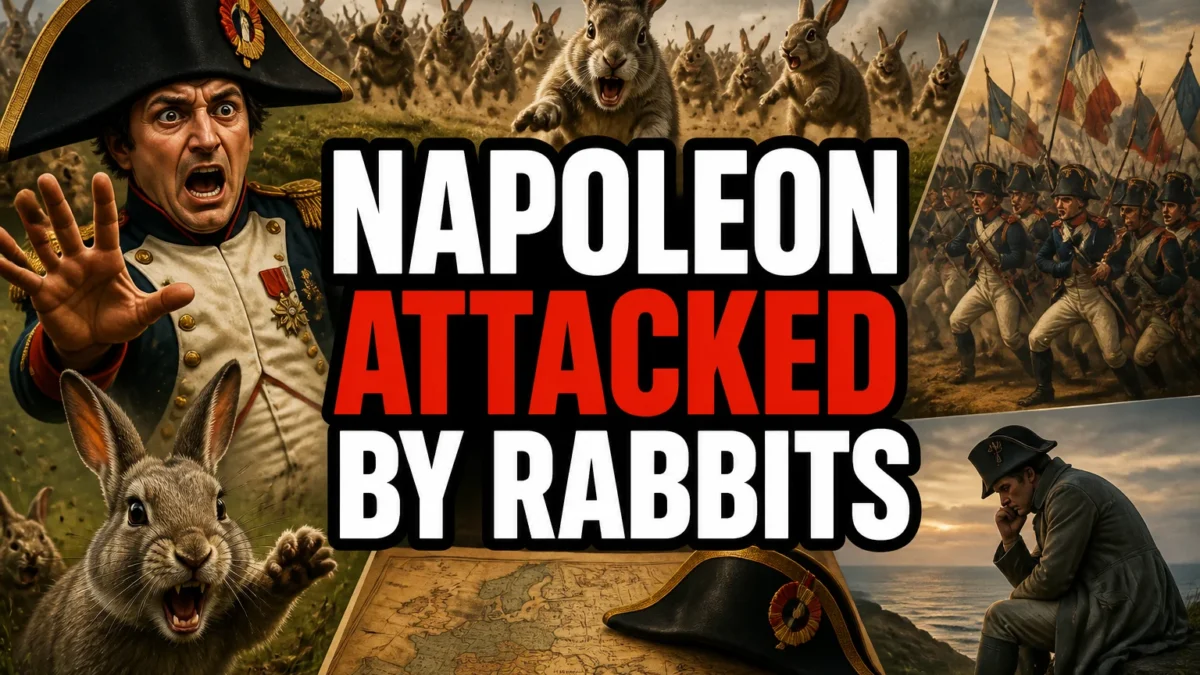
History is full of dignified moments: treaties signed, battles won, empires declared. Then there is the image of Napoleon Bonaparte, one of the most feared commanders in Europe, retreating from a wave of hungry bunnies. That image is not a modern meme; it comes from a story about the Napoleon rabbit hunt that has circulated for generations.
The tale sounds like a joke at the emperor’s expense, but it raises a real historical question. Did Napoleon get attacked by rabbits, or did a minor mishap grow into legend? This article digs into the origins, the plausibility, and the context behind one of history’s strangest animal stories.
TL;DR: The Napoleon attacked by rabbits story is a widely repeated anecdote with a kernel of possible truth, but it relies on shaky sourcing, tame rabbits behaving predictably, and a lot of later embellishment.
The Napoleon Rabbit Attack Story, in Brief
The basic account usually goes like this. In July 1807, after the Treaty of Tilsit, Napoleon wanted to celebrate with a hunt. His chief of staff, Louis-Alexandre Berthier, arranged the event and reportedly gathered hundreds of rabbits for the emperor and his guests.
When the rabbits were released, they did not scatter like wild game. Instead, the animals—supposedly tame or hungry—swarmed toward Napoleon and his party, hopping up onto his legs and coat. Napoleon tried to shoo them away, but the rabbits kept coming.
According to the most colorful versions, he was forced to retreat into his carriage while attendants beat the animals back with sticks and whips. That scene is often described as an “attack,” though the rabbits were more likely begging for food than trying to conquer an emperor.
Did Napoleon Get Attacked by Rabbits? The Evidence Problem
The first problem with the Napoleon rabbit attack is that it does not appear in Napoleon’s own correspondence, at least not in any reliably cited form. Memoirs from people present at Tilsit or in Napoleon’s entourage do not clearly describe a rabbit swarm. The story appears in later biographies and popular histories, often without a primary source attached.
That absence does not prove it never happened, but it does mean the claim rests on weak foundations. Historians generally treat the tale as anecdotal or apocryphal rather than confirmed fact. It is best described as a colorful story that may contain a small kernel of truth.
Where Did the Napoleon Rabbit Hunt Story Come From?
The anecdote is often traced to the period after the Treaty of Tilsit, signed between France, Russia, and Prussia in July 1807. The treaty was a high point for Napoleon, and a celebratory hunt would have fit the customs of European courts. Berthier, Napoleon’s major-général, was known for organizing logistics on a grand scale.
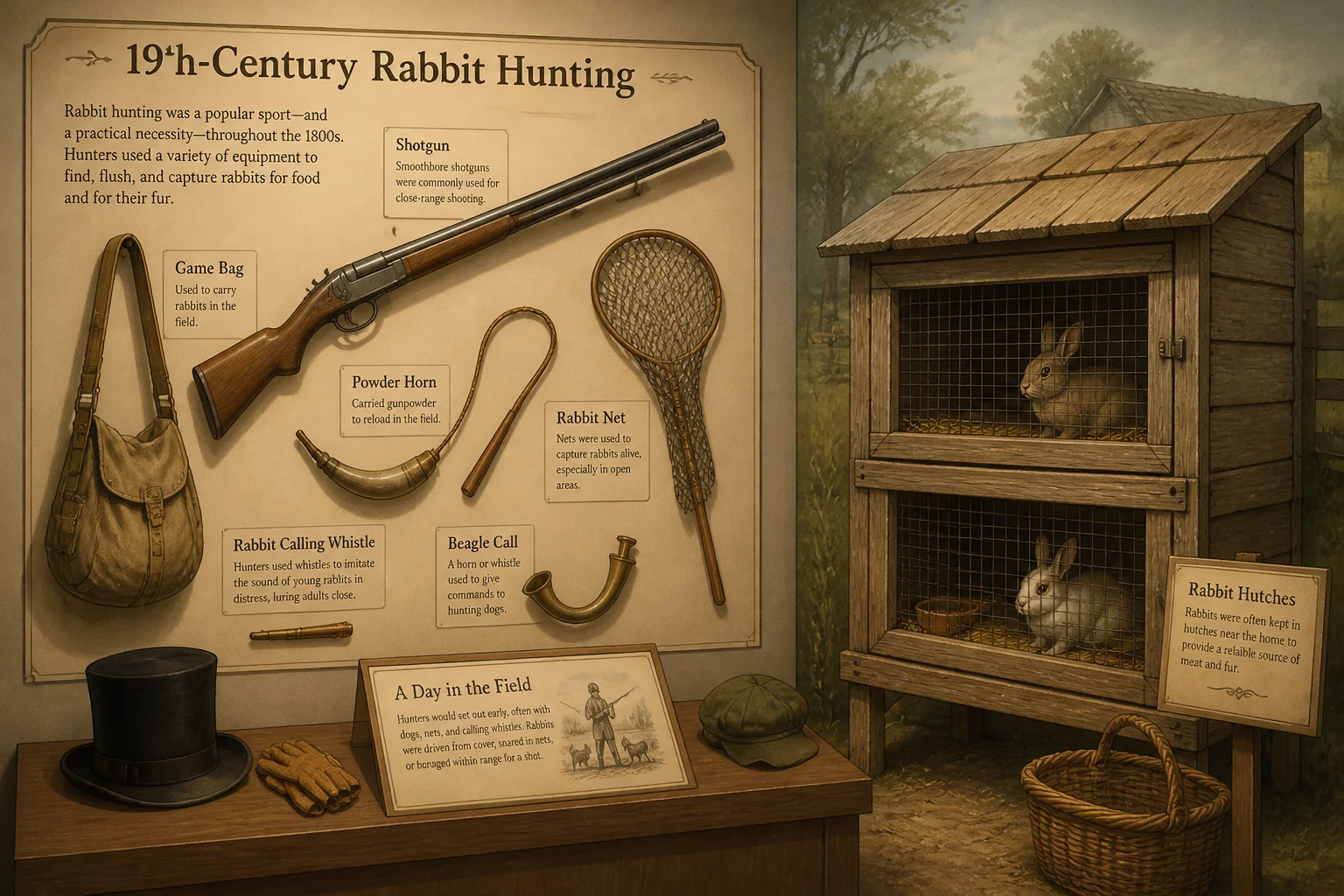
In the story, his attempt to supply wild game went wrong because he sourced domestic rabbits instead of wild hares. Domestic rabbits, unlike wild hares, do not flee humans. Many versions say the rabbits had been kept in hutches or pens and were released before the hunt, expecting food rather than escape.
This detail is plausible enough: tame rabbits will approach people, especially if they associate humans with feeding. The story may have begun as an embarrassing mishap that was later exaggerated into an “attack.”
What Tame Rabbits Would Actually Do
Zoologically, the behavior in the story is less absurd than it first sounds. Domestic rabbits that are used to being fed by people can cluster around legs, stand on hind legs, and even nudge or scratch for attention. A large group of tame bunnies released into a field with a crowd might indeed move toward the people rather than bolt.
However, rabbits are not aggressive predators, and the word “attack” is misleading. They do not swarm to injure; they swarm to investigate or beg for food. So the Napoleon bunnies may have been more of a nuisance than a military threat. That gap between nuisance and attack is exactly where historical embellishment thrives.
Was Napoleon Bonaparte Once Attacked by a Swarm of Rabbits? What the Sources Say
No definitive primary source has emerged that proves Napoleon Bonaparte was once attacked by a swarm of rabbits. The tale often appears as a passing anecdote in books about Napoleon’s life, but it is rarely footnoted to a diary, letter, or official report from 1807. Some retellings name Berthier as the organizer, which is historically reasonable because Berthier managed imperial logistics.
Yet naming a real person does not convert a story into documented fact. The strongest version of the claim says the rabbits were not wild but were collected from local farms or even from kitchens and game stocks. If that is true, the incident would have been humiliating but minor.
By contrast, the wilder version—that Napoleon was actually attacked by rabbits and forced to flee—reflects later storytelling. It flips the narrative of a powerful emperor into a comedy.
Three Historical Facts Behind the Napoleon Rabbit Attack
Three historical facts give the story just enough texture to survive. The first is that the Treaty of Tilsit was signed in July 1807, and it really was a moment of triumph for Napoleon. A celebratory hunt would have been completely normal for a European ruler after such a diplomatic victory.
The second fact is that Louis-Alexandre Berthier served as Napoleon’s chief of staff and handled large logistical operations. If anyone in Napoleon’s circle could have assembled hundreds of animals for a hunt, Berthier was that person. His reputation for organization makes the story feel plausible even without a direct source.
The third fact is that domestic rabbits and wild hares behave very differently around people. A hunt required wild game that would run, but tame rabbits raised near humans would approach instead of flee. That basic animal behavior is the engine that drives the whole anecdote.
These 3 historical facts do not prove the incident happened. They explain why the story sounds believable even to careful readers. In history, a plausible setting and plausible behavior can keep an uncorroborated tale alive for centuries.
The Treaty of Tilsit and the Imperial Hunt Tradition
The Treaty of Tilsit, signed after Napoleon’s victory over Russia and Prussia, reshaped the map of Europe. It was the kind of moment that called for ceremony, and hunting was a common aristocratic pastime. In imperial France, a hunt could be both entertainment and a display of power.
Napoleon was not an enthusiastic hunter in the way some Bourbon kings had been, but he did participate in hunts expected of a head of state. A post-treaty rabbit hunt would have been a casual affair compared with formal stag hunts. Berthier would have been responsible for the practical details: acquiring game, arranging beaters, and positioning guests.
If he or his staff substituted tame rabbits for wild hares, it would have been a logistical blunder rather than an impossible event. That kind of blunder is common enough in real history. Servants and aides often cut corners, especially when ordered to produce a large spectacle on short notice.
Hunting Culture in Napoleon’s France
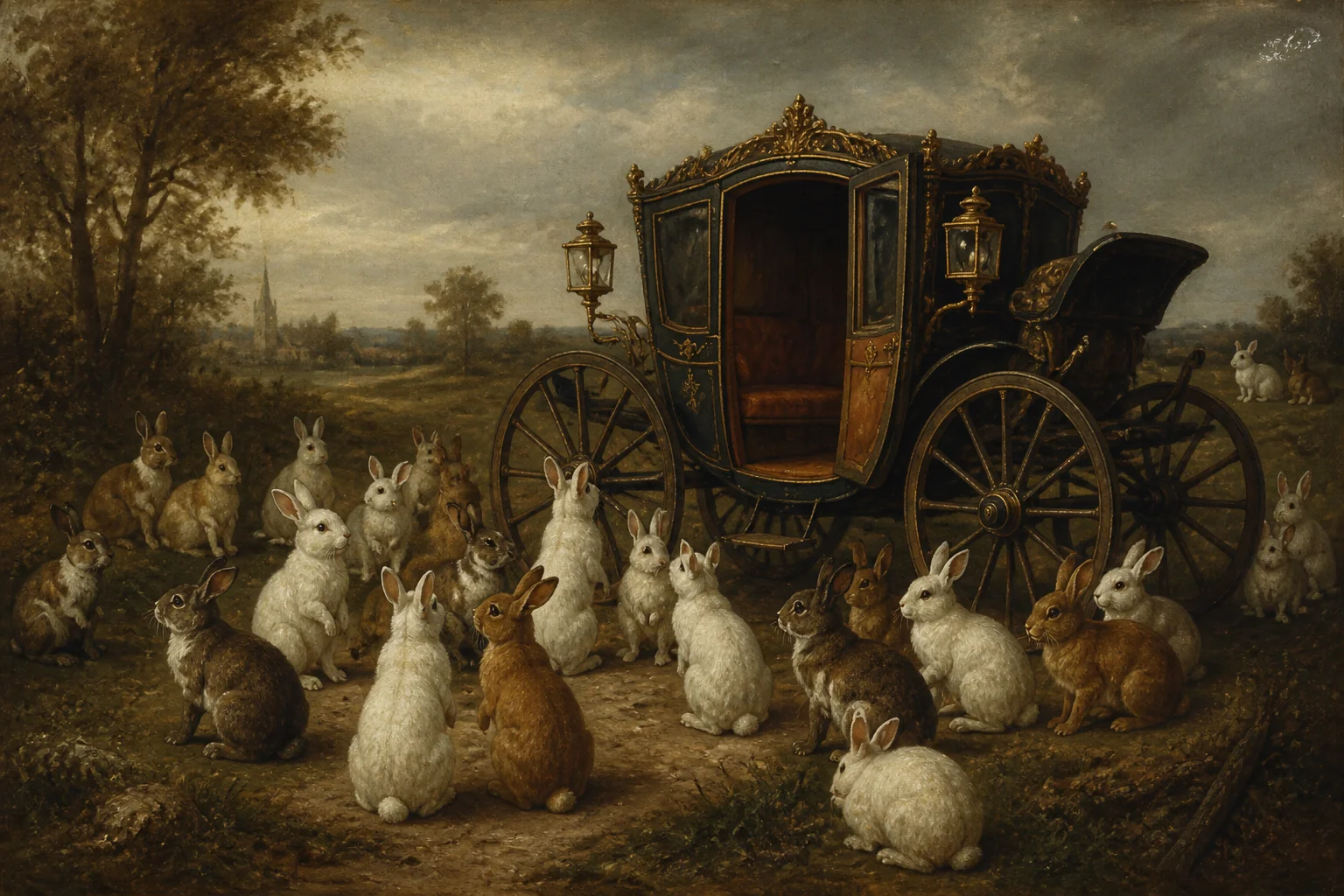
The French Revolution had disrupted aristocratic hunting traditions, but Napoleon revived court ceremony as he consolidated power. Hunting was part of the image of a sovereign, connecting him to older royal customs. A hunt after Tilsit would have advertised Napoleon’s status as an equal to the crowned heads of Europe.
In that setting, a failed hunt would have been an embarrassing spectacle. Courtiers and aides would have wanted to downplay it rather than record it in detail. That may help explain why a primary account is hard to find, if the event ever occurred.
Why the Tame-Rabbit Explanation Matters
The core of the story depends on a simple mistake: confusing domestic rabbits with wild hares. In French and English alike, people sometimes blur the line between rabbits and hares, which have very different behaviors. Domestic rabbits can be kept in hutches, transported, and released; wild hares cannot easily be gathered without a gamekeeper.
If Berthier’s staff needed hundreds of animals quickly, buying domestic rabbits from locals would have been easier. That practical shortcut is exactly the kind of detail that could have caused a real mishap. The hunt would have become a farce as the tame animals approached the guests instead of fleeing.
What the Term “Attack” Gets Wrong
Calling the incident an “attack” frames the rabbits as aggressors with intent. Real rabbit behavior is driven by hunger or curiosity, not by a desire to harm a person. Journalists and social media accounts prefer “attack” because it creates surprise.
The phrase Napoleon attacked by rabbits is far more shareable than “Napoleon briefly inconvenienced by tame rabbits.” A swarm of animals can be frightening or chaotic without being an intentional attack. That distinction is small but important for honest history writing.
Could a Swarm of Rabbits Really Force Napoleon to Retreat?
A healthy domestic rabbit weighs between two and six kilograms, depending on breed. One rabbit is harmless, but a crowd of several hundred can be overwhelming simply through numbers, weight, and movement. Rabbits can scratch with their hind claws if they climb onto a person, and their teeth can nip.
Still, they are not dangerous in the way predators or large herbivores are. The most realistic version of the story has Napoleon retreating to his carriage because he was annoyed or startled, not because his life was in danger. An emperor surrounded by clamoring animals might have found the situation undignified and chaotic.
Attendants beating the rabbits back with sticks would have added to the noise and confusion. That image is comical, and comedy is exactly what makes the story stick in popular memory.
Napoleon Bunnies and the Power of a Funny Image
The phrase “Napoleon bunnies” sounds modern because the story reads like an early meme. It takes a figure associated with conquest and discipline and drops him into an absurd, harmless predicament. Humor is a powerful engine for historical misinformation.
People repeat funny anecdotes more readily than careful, nuanced accounts, and they rarely ask for a source when the story is entertaining. That does not mean the rabbit tale is entirely false. It means the story’s survival owes as much to its comedic value as to its historical accuracy.
Other Animal Stories Attached to Napoleon
Napoleon’s legend includes several animal-related anecdotes, some better documented than others. He is famously associated with his horse Marengo, named after the 1800 battle, and with a dog named Fortune in some accounts. The rabbit story is the most absurd of the animal tales, but it is not the only one that has been questioned.
Stories about Napoleon’s fear of cats, for example, circulate without strong contemporary evidence. These questions reveal a pattern: people like to humanize powerful figures by giving them relatable fears, pets, or embarrassments. A Napoleon who flees from bunnies is easier to talk about than a Napoleon who orders armies into battle.
What Historians Actually Say
Most academic biographies of Napoleon either omit the rabbit incident or mention it only in passing as an unverified story. Works that cover Napoleon’s daily life and court culture tend to treat the tale as folklore rather than documented history. The absence of a primary account is telling because Napoleon’s entourage produced diaries and memoirs covering even trivial moments.
If the emperor had been chased into his carriage by rabbits, someone present would likely have recorded it. At the same time, the absence of evidence is not the same as proof the event never happened. Minor embarrassments can be left out of official records, especially when they reflect poorly on an imperial court.
The fairest conclusion is that the Napoleon rabbit attack is historically uncertain. It is a good story that may preserve a distorted memory of a real logistics failure.
Why the Date Usually Given Is 1807
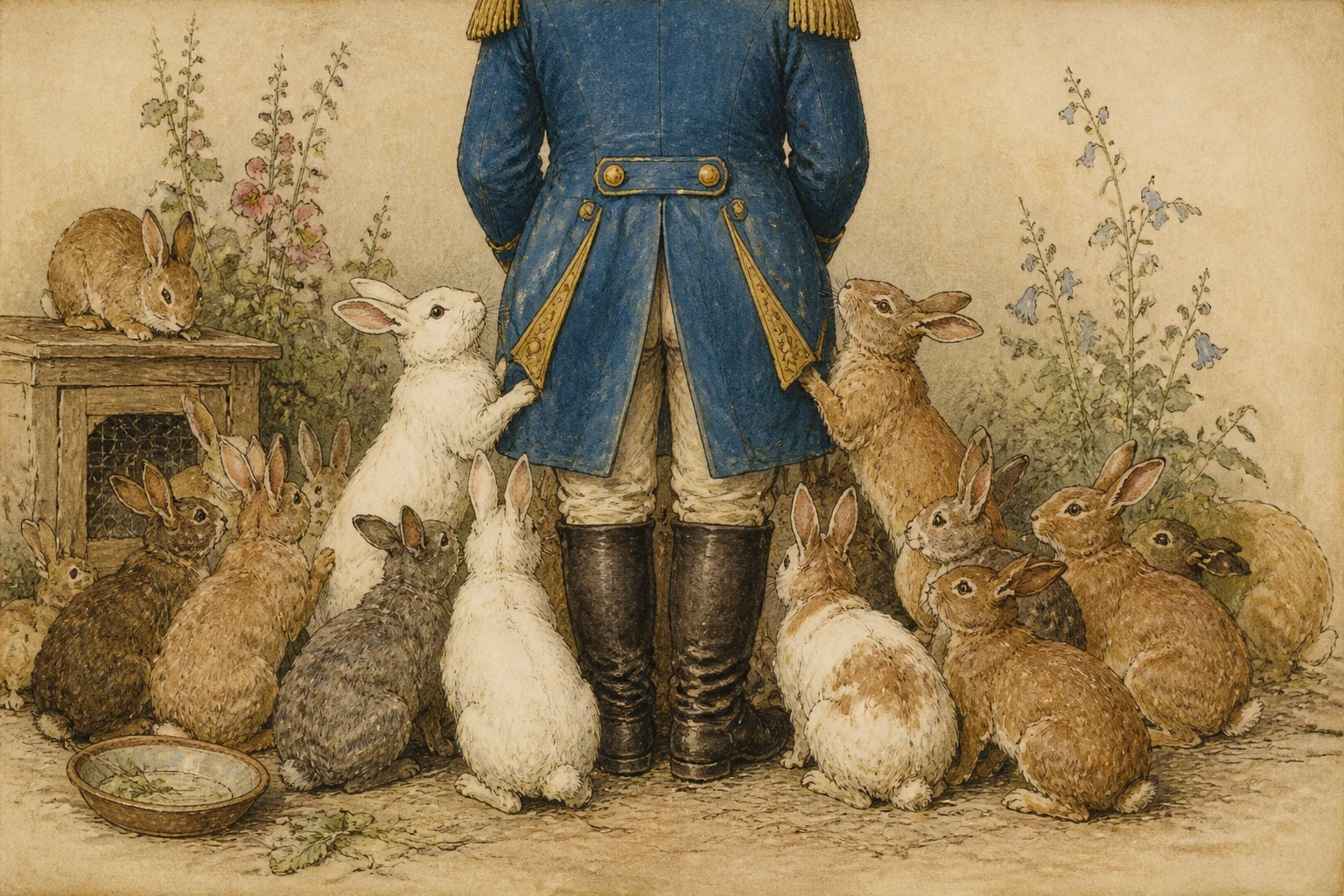
Most retellings place the rabbit hunt in July 1807, shortly after the Treaty of Tilsit. That date fits because Napoleon was at the height of his power and had just concluded a major diplomatic settlement. A celebration would have been expected, and his court was traveling through the region where the treaty was signed.
However, the specific date and place of the alleged hunt are rarely pinned down in retellings. That vagueness is another sign that the story was not preserved as a precise historical record. If the incident did happen, it took place amid a busy period of political meetings, troop movements, and celebrations. A small animal mishap could easily have been forgotten or deliberately omitted.
Could Berthier Really Have Made That Mistake?
Louis-Alexandre Berthier was a skilled military administrator, but his talents were in organization, not hunting. He managed Napoleon’s staff, prepared maps, and coordinated logistics for campaigns. In the story, Berthier is blamed for buying or gathering domestic rabbits instead of wild game.
That kind of error is plausible for a man juggling a thousand details during a diplomatic summit. Still, no Berthier memoir or staff report describes the blunder. The story may simply be an invented joke about the limitations of a bureaucrat trying to stage a hunt.
Blaming Berthier also protects Napoleon from direct fault: the emperor is the victim, while a subordinate becomes the punchline. That dynamic is common in anecdotes about powerful leaders.
Common Retellings vs. Likely Reality
In common retellings, Napoleon is “attacked” by an army of rabbits that leap at him like soldiers. The likely reality, if anything happened, is much smaller: a group of tame rabbits approached the hunting party and made the situation ridiculous. The word “attack” transforms passive animal behavior into an intentional assault.
That word choice is the main reason the story circulates as an astonishing fact rather than a minor anecdote. If you read contemporary hunting manuals, you find that organizers valued wild hares precisely because they ran. Tame rabbits would have been useless for sport, so any experienced hunt master would have avoided them.
The story may therefore reflect a very real complaint by Napoleon that the hunt was badly prepared. Over time, “badly prepared hunt” became “Napoleon was attacked by rabbits.”
3 Facts About History This Story Teaches Us
The Napoleon rabbit tale is one of those 3 facts about history that show how memory works. The first lesson is that a story does not need primary-source proof to be repeated widely. The second is that plausible details, such as tame rabbit behavior, can do more persuasive work than documentation.
The third lesson is that humor preserves anecdotes while accuracy erodes. People remember the emperor and the bunnies, not the missing footnote. These patterns apply far beyond Napoleon: they explain how many historical myths survive.
How the Story Spread in Popular History
The rabbit tale seems to have gained traction in popular biographies and trivia collections rather than scholarly monographs. It fits the format of a short, amusing aside in a larger life story. Once a story appears in a few widely read books, later authors repeat it without checking primary evidence.
This is how anecdotes become “facts” through repetition rather than verification. The internet accelerated the process: the Napoleon rabbit attack is now a staple of list articles and history meme accounts. Searches for “did Napoleon get attacked by rabbits” show that readers are starting to ask for proof, which is a healthy sign.
Why a Primary Source Would Be Hard to Find
If the incident happened, it may have been considered too trivial for official records. Imperial bulletins and diplomatic correspondence focused on grand events, not a poorly organized hunt. Eyewitnesses might have described the scene in private letters, but such letters may not survive or may not have been translated.
For a story this vivid, one would expect at least one strong memoir reference. The lack of such a reference is the main reason historians remain cautious. Absence of evidence, however, is not the same as evidence of absence.
Could the Napoleon Rabbit Attack Have Been Satire?
Some scholars and writers suspect the story may have begun as satire or political mockery. A defeated or humiliated Napoleon being swarmed by rabbits would have delighted his enemies. Satirical prints of the era often used animals to make political points.
A rabbit swarm could symbolize smaller powers or unruly subjects overcoming a tyrant. If the tale originated as satire, later writers might have mistaken it for reportage. That happens frequently with stories about famous figures.
Similar Myths About Napoleon’s Height and Temper
Napoleon’s historical image is already full of distortions. The idea that he was unusually short, for example, relies partly on British propaganda and a misunderstanding of French measurements. Stories about his temper, his alleged superstitions, and his supposed fear of cats also blur fact and legend.
The rabbit story belongs to this same cluster of humanizing anecdotes. Recognizing the pattern helps readers understand that even famous historical figures—from Joan of Arc to Richard the Lionheart—are surrounded by narrative fog. Critical reading is not about rejecting every colorful story, whether it’s the Napoleon rabbit hunt or the real story of Pocahontas, but about refusing to treat them all as proven events.
What Would Have Happened to the Rabbits Afterward?
In a normal hunt, game animals are killed for the table or left in the field. In the rabbit anecdote, the animals were tame and apparently useless as sport. Some retellings say the rabbits were eventually gathered up and returned to their owners or hutches.
Others omit their fate entirely, which is another sign of the story’s folkloric quality. If the rabbits had been butchered after the fiasco, no one in the story would have cared. The detail that matters is the emperor’s embarrassment, not the animals’ outcome.
What Modern Animal Experts Say
Animal behavior experts generally agree that a large group of hungry domestic rabbits could swarm a person for food. The physical behavior is plausible; the historical documentation is the weak part. Modern rabbit owners often describe being mobbed by their pets at feeding time.
That everyday experience makes the Napoleon bunnies story feel believable even to people who know nothing about 1807. But modern plausibility is not historical proof. Many legends survive precisely because they are plausible enough to escape disbelief.
How to Talk About the Napoleon Rabbit Attack Without Spreading Myth
When you retell the Napoleon rabbit attack, use phrases like “according to tradition” or “the story says” rather than stating it as settled fact. That small framing change keeps the humor intact without turning an unverified anecdote into a false historical claim. You can also point out that no primary source clearly documents the event.
Because the story is so memorable, it often appears in listicles of strange history. Adding a note about sourcing makes your version more responsible than most. The story stays fun and honest at the same time.
How to Read Trivia-Style History Claims
When you encounter a surprising history fact online, check whether it names a specific date, place, and primary source. The Napoleon rabbit story usually offers only the broad setting of Tilsit in 1807. Surprising claims often gain authority through repetition and vivid detail.
The more specific a story sounds, the more likely readers are to accept it without checking. In this case, the vivid detail is the swarm of tame rabbits, not the documentation. A healthy response is to enjoy the anecdote while noting that it remains unverified.
What We Can Say With Confidence
Napoleon did attend celebrations after the Treaty of Tilsit, and hunting was a common court activity. Louis-Alexandre Berthier did serve as his chief of staff and managed logistics for the emperor. Domestic rabbits do approach humans, especially when conditioned to expect food.
A hunt that accidentally used tame rabbits would have been a confusing and embarrassing event. What we cannot say with confidence is that Napoleon was literally attacked by rabbits or forced to flee. The story’s most dramatic elements are the least supported by evidence.
Verdict: Did Napoleon Get Attacked by Rabbits?
So, did Napoleon get attacked by rabbits? The most honest answer is: maybe, but probably not in the dramatic way the legend suggests. It is plausible that a poorly planned post-Tilsit hunt ended with tame rabbits swarming the party. It is much less certain that Napoleon was truly “attacked” or forced into his carriage.
Without a contemporary source, the story cannot be treated as established fact. It sits in the gray zone of historical anecdotes: too specific to dismiss entirely, too unsourced to accept fully. That gray zone is often where the best historical thinking happens.
Instead of choosing between “true” and “fake,” ask why the story was told and what real details it might preserve. That question is more valuable than a simple yes or no.
The Last Word on Napoleon and the Bunnies
The Napoleon rabbit attack is an excellent reminder that history is not just a record of events; it is also a collection of stories people choose to repeat. A fierce emperor retreating from a horde of bunnies is too good an image to disappear. But “too good to disappear” is not the same as “too well documented to doubt.”
The story survives because it is funny, not because it is verified. Next time you see Napoleon attacked by rabbits listed among historical facts, share the stronger version: the event is disputed, the sourcing is thin, and the real lesson is about how easily a minor mishap becomes a legend.
Frequently Asked Questions
Was Napoleon attacked by rabbits?
The story is widely repeated but not well documented. It claims that after the Treaty of Tilsit in 1807, tame rabbits released for a hunt swarmed Napoleon, but no strong primary source confirms the event. Most historians treat it as a plausible but unverified anecdote.
Did Napoleon get attacked by rabbits during a hunt?
According to the anecdote, Napoleon was swarmed by rabbits during a hunt arranged by his chief of staff, Louis-Alexandre Berthier. The rabbits were said to be tame or hungry and approached instead of fleeing. The incident is often placed in July 1807, shortly after the Treaty of Tilsit.
Why did the rabbits attack Napoleon?
They probably did not attack him in the intentional sense. If the event happened, the rabbits were likely domestic animals that associated humans with food, so they approached the hunting party expecting to be fed. That behavior is common in tame rabbits.
Is the Napoleon rabbit attack true?
It is best described as unverified rather than confirmed. The story appears in later histories but lacks a clear contemporary primary source. It likely preserves a distorted memory of a minor hunting mishap.
What mistake did Berthier make in the Napoleon rabbit hunt?
In the popular story, Berthier supposedly gathered domestic rabbits instead of wild hares for a post-Tilsit hunt. Because tame rabbits do not flee from people, the hunt became chaotic. There is no strong documentary evidence that this specific blunder occurred.

Alex Warren
Related Articles