

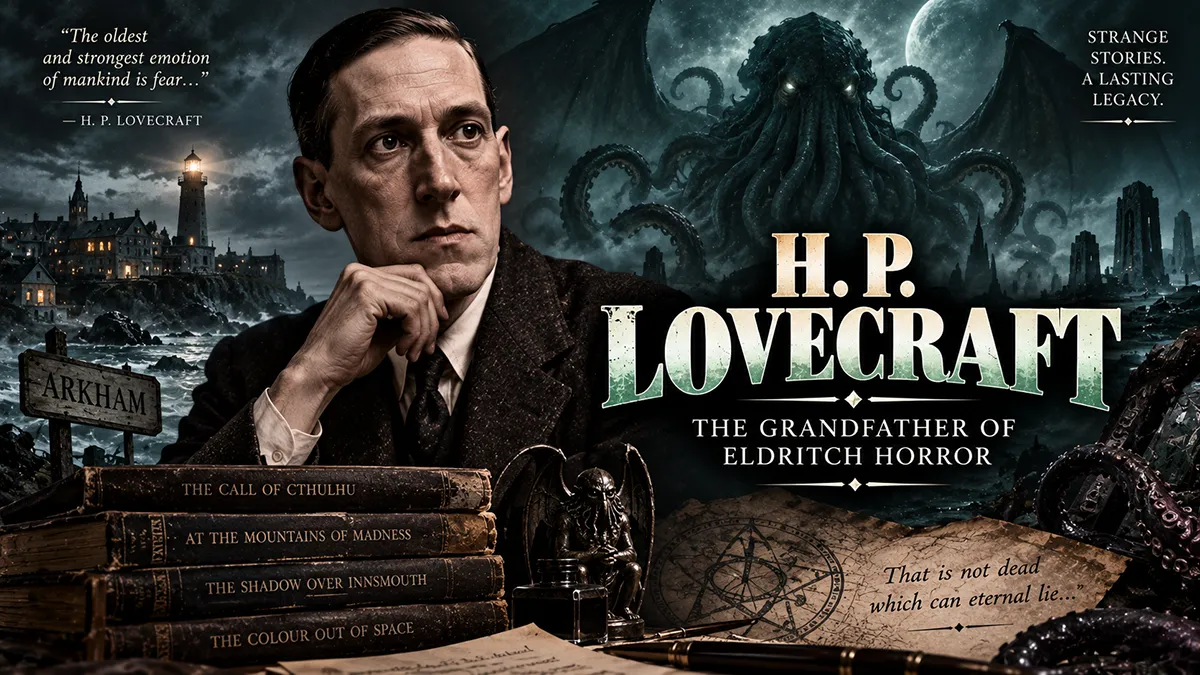
If you’ve ever heard someone describe a monster as “eldritch” or call a story “Lovecraftian,” you’ve brushed up against one of the strangest and most influential corners of horror history.
The word conjures tentacled gods, forbidden books, and the creeping sense that humanity is a very small, very fragile thing in an indifferent universe.
Almost all of that vocabulary traces back to one sickly, reclusive writer from Providence, Rhode Island, who died in obscurity and poverty but ended up reshaping horror fiction forever.
His name was Howard Phillips Lovecraft, and though he never used the word “Lovecraftian” himself, later readers and writers coined it to describe the specific brand of dread he perfected. This post digs into who he really was, what “eldritch horror” actually means, and why his fingerprints are still all over books, games, and movies a century later.
TL;DR: H.P. Lovecraft, a little-known pulp writer who died in 1937, gave the world “eldritch horror” — a genre built on cosmic indifference, unknowable monsters, and humanity’s insignificance — and his influence, however complicated by his personal prejudices, still defines horror fiction today.
Who Was H.P. Lovecraft?
Howard Phillips Lovecraft was born in Providence, Rhode Island, in 1890, into a family whose fortunes were already fading. His father was institutionalized when Lovecraft was a young child, and his mother raised him in a household marked by illness, financial anxiety, and social isolation. He was a bookish, sickly child who read voraciously and developed an early fascination with astronomy, ancient history, and gothic fiction.
Lovecraft never attended college, largely due to poor health and a nervous breakdown in his late teens, a fact that seems to have haunted him with a sense of failure for the rest of his life.
He spent much of his adulthood in genteel poverty, writing for pulp magazines like Weird Tales, ghostwriting for other authors, and corresponding obsessively with a wide circle of fellow writers through letters.
He died in 1937 at just 46 years old, from intestinal cancer, having never achieved financial success or mainstream literary recognition during his lifetime.
It’s worth pausing on that timeline, because it matters for understanding his legacy. Lovecraft was not a bestselling celebrity author like his contemporaries in detective or adventure fiction, nor did he run in the same literary circles as the Lost Generation writers who were defining serious American fiction in those same decades.
He was, by most measures, a commercial failure who published in cheap magazines and relied on friends and devoted correspondents to keep his work circulating.
What Is Eldritch Horror? A Working Definition
So what is eldritch horror, exactly? At its core, “eldritch” is an old English-derived adjective meaning weird, sinister, or otherworldly in an unsettling way. It’s a word that predates Lovecraft by centuries, showing up in Scottish and English writing as far back as the 16th century to describe things that felt uncanny or unnatural.
The eldritch horror meaning that most people use today, however, is inseparable from Lovecraft’s fiction. In this modern sense, eldritch horror describes a story or creature that feels ancient, alien, and fundamentally beyond human comprehension.
It’s not just “scary” in the jump-scare sense; it’s disturbing because it suggests that reality itself is stranger and more hostile than we’re built to understand.
A useful eldritch horror definition, then, has three ingredients. First, there’s scale: the threat is cosmic, not personal, often older than humanity or even the solar system.
Second, there’s unknowability: the horror can’t be fully explained, described, or defeated through ordinary means. Third, there’s insignificance: human beings are incidental, not the center of the universe’s story, which is itself the most unsettling idea of all.
This is different from a haunted house story or a slasher film, where the threat is usually explainable and can, in theory, be fought or fled. Eldritch horror instead asks readers to sit with the discomfort of not knowing, and of realizing that not-knowing might be the safest state to remain in.
Where the Word “Eldritch” Comes From
Before Lovecraft, “eldritch” was a fairly obscure literary word most associated with Scottish poetry and ballads, including some of Robert Burns’ writing in the 18th century. It described things like ghostly moors, strange lights, or uncanny figures glimpsed at a distance.
The word likely derives from Old English roots related to “elf” or “other realm,” tying it to older folklore about fairies and otherworldly beings. It’s the kind of quiet etymological surprise that shows up again and again in the history of language, not unlike the true origin story behind “eureka”, another everyday word whose real backstory most people never learn.
Lovecraft didn’t invent the word, but he gave it a second life by using it, along with words like “cyclopean,” “non-Euclidean,” and “unnameable,” to describe his cosmic entities and ancient ruins.
Over decades of reprints, adaptations, and fan discussion, “eldritch” became so tightly associated with his particular flavor of horror that many readers today assume it’s a Lovecraft coinage. It isn’t, but the confusion is understandable given how thoroughly he colonized the word’s modern usage.
Cosmicism: The Philosophy Behind the Horror
Lovecraft’s fiction wasn’t just about monsters; it was built on a specific worldview he sometimes called “cosmicism” or “cosmic indifferentism,” a set of ideas that, in its own pulp-fiction way, wrestles with the same questions about humanity’s place in the universe that have occupied history’s most renowned philosophers for centuries.
The central idea is that the universe is vast, ancient, and utterly indifferent to human existence, morality, or meaning. Humans aren’t villains or heroes in some cosmic drama; they’re simply too small and too recent to matter to the forces that actually shape reality.
This philosophy shows up again and again in his stories. Characters who uncover the truth about the universe don’t triumph over evil; they go mad, or die, or spend the rest of their lives trying to forget what they learned. Knowledge itself becomes dangerous, because understanding your true, insignificant place in the cosmos is presented as more destabilizing than any physical threat.
This is a meaningful departure from earlier gothic horror, which usually centered on personal guilt, supernatural curses, or moral consequences. Lovecraft’s monsters, like Cthulhu or the Great Old Ones, aren’t punishing anyone for sin. They simply exist, the way a hurricane or a black hole exists, without malice or interest in humanity at all.
Lovecraft’s Most Influential Eldritch Tales
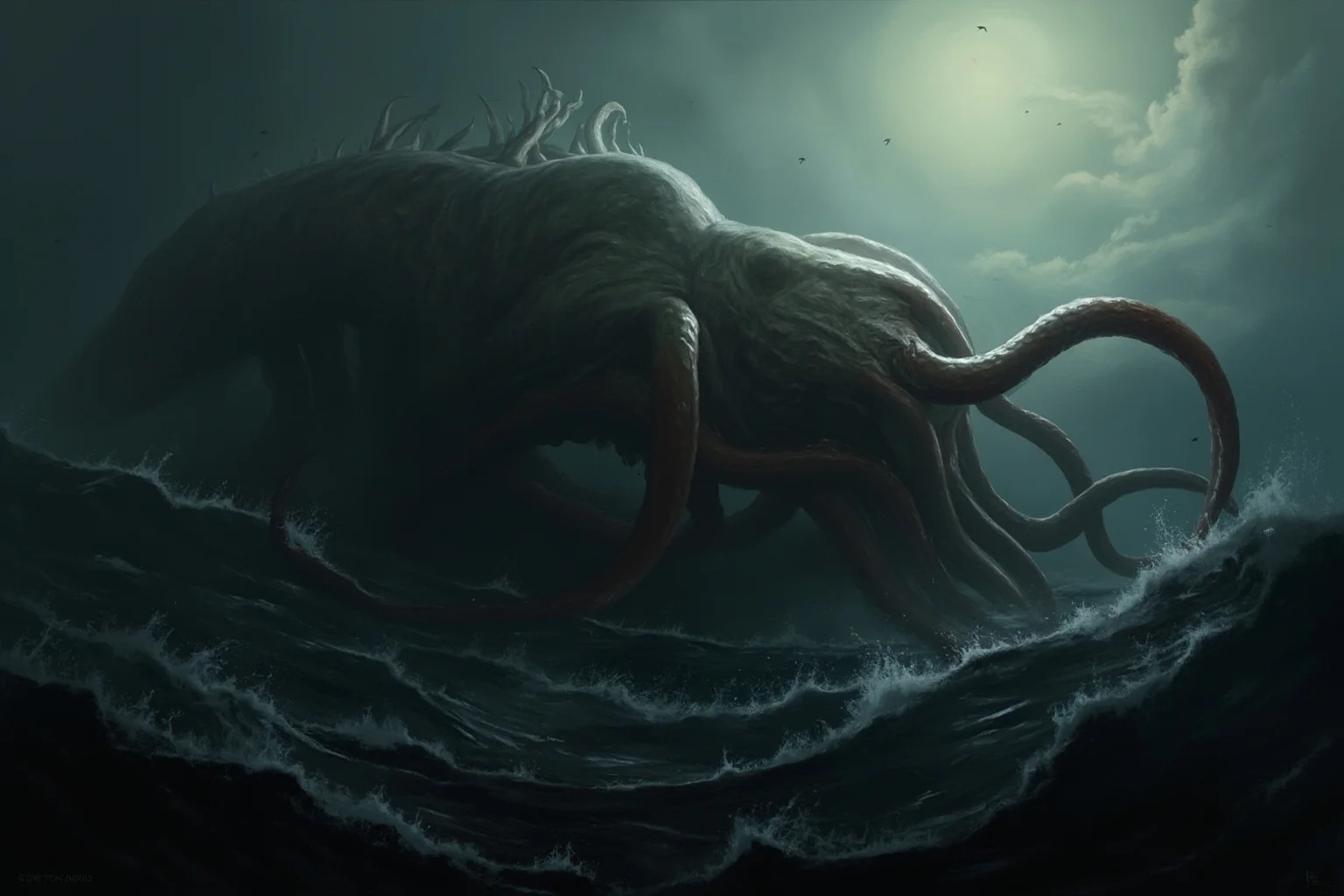
Lovecraft wrote dozens of short stories and novellas, many of which are now considered foundational eldritch tales in the horror canon. “The Call of Cthulhu,” published in 1928, introduced his most famous creation: a colossal, ancient entity slumbering beneath the Pacific Ocean, worshipped by cults across the globe. The story’s structure, built from fragmented documents and secondhand accounts, became a hallmark of how eldritch horror is often told.
“At the Mountains of Madness,” written in 1931, follows an Antarctic expedition that uncovers the ruins of an impossibly old alien civilization. It expanded Lovecraft’s mythology to include the Elder Things and hinted at a history of Earth far stranger than conventional science suggested. The novella is often cited as one of his most fully realized works of cosmic horror.
“The Shadow Over Innsmouth,” from 1931, takes a different approach, focusing on a decaying New England fishing town and the disturbing secret its residents share. It’s frequently read today alongside discussions of Lovecraft’s xenophobia, since the story’s fear of “impure” bloodlines maps uncomfortably onto his real-world prejudices.
“The Dunwich Horror,” published in 1929, and “The Colour Out of Space,” from 1927, round out a short list of his most anthologized work. Together, these stories form the backbone of what most readers mean when they talk about eldritch tales, and they remain in print in countless collections nearly a century later.
The Cthulhu Mythos and Shared Universe
One of Lovecraft’s most lasting contributions wasn’t a single story but a shared fictional framework now called the Cthulhu Mythos. It includes recurring entities like Cthulhu, Yog-Sothoth, and Nyarlathotep, along with the fictional Necronomicon, a forbidden book of forbidden knowledge that appears across multiple tales. Lovecraft treated these elements loosely and inconsistently, more as a toolkit than a rigid canon.
Crucially, Lovecraft actively encouraged other writers in his circle to borrow and expand on these ideas, a practice almost unheard of in pulp fiction at the time. Writers like Clark Ashton Smith, Robert E. Howard (creator of Conan the Barbarian), and later August Derleth all contributed to and helped popularize the shared mythos. This collaborative approach is a big part of why Lovecraft’s ideas outlived him instead of fading into pulp obscurity like so much of the era’s fiction.
Eldritch Horror Authors Before and Alongside Lovecraft
Lovecraft is often credited as the “grandfather” of eldritch horror, but he built on earlier writers and worked alongside contemporaries who shaped the genre too. Arthur Machen, a Welsh author writing in the 1890s, explored themes of hidden ancient evils lurking beneath modern civilization, and Lovecraft openly admired his work. Algernon Blackwood’s nature-based horror, and the supernatural fiction of Lord Dunsany, also left clear marks on Lovecraft’s style and subject matter.
Within his own lifetime, Lovecraft corresponded extensively with fellow pulp writers, forming an informal network sometimes called the “Lovecraft Circle.” This group, including Clark Ashton Smith, Frank Belknap Long, and Robert E. Howard, traded ideas, story elements, and encouragement through letters, since Lovecraft rarely traveled and lived much of his life through correspondence. These relationships helped keep his work circulating even during years when it found little mainstream success.
A Complicated Legacy: Lovecraft’s Racism and Xenophobia
No honest account of Lovecraft can skip over his well-documented racism and xenophobia, both in his personal letters and, more subtly, embedded in his fiction.
Scholars and biographers, including S.T. Joshi, one of the foremost Lovecraft researchers, have extensively documented these prejudices using Lovecraft’s own letters and writings. This isn’t a matter of modern readers projecting present-day values backward; it’s a pattern Lovecraft’s contemporaries sometimes noted as extreme even by the standards of his time.
This matters for understanding eldritch horror as a genre because Lovecraft’s fear of the “unknown other” often overlapped uncomfortably with his fear of immigrants, foreign cultures, and racial mixing.
Stories like “The Shadow Over Innsmouth” carry undertones that many contemporary critics and authors have openly grappled with. The World Fantasy Award, which once used a bust of Lovecraft as its trophy, was redesigned in 2016 partly in response to renewed conversations about this legacy.
None of this erases his influence on horror fiction, but a myth-busting look at Lovecraft has to hold both truths at once: he was genuinely innovative, and he held genuinely repugnant views that shaped some of his work.
Modern eldritch horror authors and readers largely engage with his ideas while consciously separating the cosmic concepts from the prejudice that sometimes rode alongside them.
From Obscurity to Icon: How Lovecraft’s Reputation Grew
Lovecraft died in 1937 largely unknown outside pulp fandom circles, and by his own account, he considered himself a failure. It was his friend and fellow writer August Derleth who did much of the work of preserving his legacy, co-founding Arkham House publishing specifically to keep Lovecraft’s stories in print after his death.
Without that effort, it’s plausible much of his work could have simply faded away with the pulp magazines that first published it.
Through the mid-20th century, Lovecraft’s reputation grew slowly through small press editions, horror anthologies, and word of mouth among writers and academics.
By the 1970s and 1980s, his influence was visible in the work of Stephen King, who has openly cited Lovecraft as a major influence, and in the growing academic interest in weird fiction as a serious literary category.
Today, university courses, critical biographies, and annotated editions treat Lovecraft as a significant, if deeply flawed, figure in American literary history.
Lovecraftian Eldritch Horrors in Modern Pop Culture
The reach of Lovecraftian eldritch horrors today extends far beyond literature into games, film, and television. Tabletop games like Call of Cthulhu, board games like Eldritch Horror and Arkham Horror, and video games like Bloodborne and the Sunless Sea series all draw directly on his mythology and mood. These adaptations often keep the cosmic dread and ancient-entity themes while deliberately stripping out the racial anxieties that marred some of the source material.
Film and television have embraced the aesthetic too, from John Carpenter’s “The Thing” and “In the Mouth of Madness” to more recent works like “Color Out of Space” and HBO’s “Lovecraft Country,” the latter directly confronting Lovecraft’s racism by centering Black protagonists navigating both eldritch monsters and real-world racism.
Even franchises that never mention Lovecraft by name, like “Stranger Things” or the “Alien” series, borrow heavily from his template of ancient, incomprehensible threats.
This widespread adaptation is part of why “eldritch” has become such a common word in casual conversation, gaming forums, and internet culture generally. People use it to describe anything unsettling, alien, or beyond ordinary explanation, often without knowing they’re echoing a pulp writer from 1920s Providence.
Why Eldritch Horror Still Resonates Today
Part of the enduring appeal of eldritch horror is that its central fear isn’t tied to any specific era or technology. The anxiety of being small, insignificant, and unable to fully understand the forces shaping our lives feels just as relevant in an age of climate change, pandemics, and algorithmic decision-making as it did in the 1920s and 1930s.
Lovecraft’s monsters were often metaphors, consciously or not, for his own anxieties about a changing, industrializing, increasingly interconnected world.
Modern audiences bring their own anxieties to the genre, whether that’s fear of artificial intelligence, distrust of institutions, or simple existential dread about humanity’s place in an indifferent universe.
The eldritch horror framework is flexible enough to absorb all of these fears without needing an update, which is a big part of why it has outlasted so many other early 20th-century horror trends. Few pulp writers from that era are still shaping blockbuster games and prestige television nearly a hundred years later.
Closing Thoughts on Lovecraft’s Legacy
H.P. Lovecraft’s life was, by most conventional measures, a story of failure: poor health, financial struggle, limited recognition, and an early death.
Yet the ideas he put into cheap pulp magazines, largely for a few cents a word, ended up reshaping an entire genre and giving English a new way to talk about the unknowable. That’s a strange kind of legacy for someone who died convinced his writing would be forgotten.
Understanding Lovecraft today means holding two things at once: appreciating his genuine innovation in cosmic horror, and being honest about the racism and xenophobia that shaped parts of his life and work.
The best modern eldritch horror authors and creators tend to do exactly that, borrowing his sense of cosmic scale and dread while leaving behind the prejudice that limited his vision. In that sense, the eldritch horror genre has outgrown its grandfather, even as it still carries his name.
Frequently Asked Questions
What is eldritch horror?
Eldritch horror is a style of horror fiction built around ancient, alien, and fundamentally incomprehensible forces that make humanity feel small and insignificant. Rather than relying on jump scares or explainable monsters, it draws its fear from cosmic scale, unknowability, and the idea that the universe is indifferent to human existence. The term is closely associated with H.P. Lovecraft, whose early 20th-century stories popularized this specific flavor of dread.
What does ‘eldritch’ actually mean?
'Eldritch' is an old word, likely derived from Old English roots related to 'elf' or otherworldly realms, that traditionally meant weird, sinister, or uncanny. It appeared in Scottish and English literature centuries before H.P. Lovecraft, including in some of Robert Burns' poetry, but Lovecraft's frequent use of the word in his cosmic horror stories cemented its modern association with his brand of fiction.
Did H.P. Lovecraft invent the term ‘eldritch horror’?
No, Lovecraft did not invent either the word 'eldritch' or the phrase 'eldritch horror,' both of which have older or later origins. However, his extensive use of 'eldritch' to describe ancient, cosmic entities in his fiction is why the word became so tightly linked to his specific style of horror in modern usage.
Why is Lovecraft called the grandfather of eldritch horror?
Lovecraft earned this title because his short stories and novellas, written mostly in the 1920s and 1930s, established the core conventions of cosmic horror: ancient, unknowable entities, human insignificance, and dangerous forbidden knowledge. Later writers, filmmakers, and game designers built directly on this template, making him the foundational figure of the genre even though he died in relative obscurity in 1937.
Was H.P. Lovecraft racist, and does that affect his work?
Yes, Lovecraft's personal letters and, at times, his fiction reflect documented racism and xenophobia that biographers like S.T. Joshi have extensively researched using his own writings. This has led to ongoing critical conversations about how to engage with his work today, including the 2016 redesign of the World Fantasy Award trophy, which had previously used his likeness.
Who are other important eldritch horror authors?
Writers like Arthur Machen, Algernon Blackwood, and Lord Dunsany influenced Lovecraft and explored similar themes before him, while contemporaries like Clark Ashton Smith and Robert E. Howard collaborated with him on shared mythos elements. After Lovecraft's death, August Derleth helped preserve and expand his work, and modern authors continue to write new eldritch tales inspired by his cosmic horror framework.
What are some famous examples of Lovecraftian eldritch horrors in pop culture?
Well-known examples include the board and video games Eldritch Horror, Arkham Horror, Call of Cthulhu, and Bloodborne, as well as films like 'The Thing' and 'Color Out of Space.' The HBO series 'Lovecraft Country' directly engages with both the cosmic horror genre and Lovecraft's own racism, making it a notable modern response to his legacy.

Alex Warren
Related Articles





