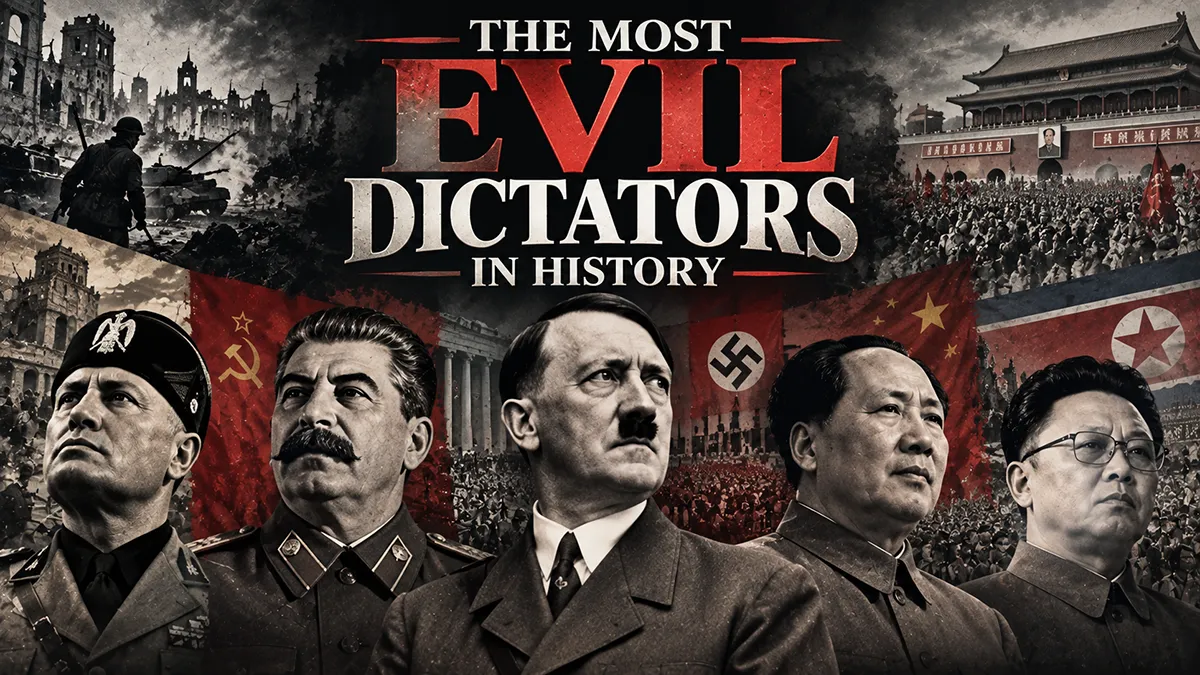
Few words carry as much dread as “dictator.” It conjures images of goose-stepping soldiers, secret police knocking on doors at midnight, and portraits of a single face plastered on every building in a city. But the reality of dictatorship is more varied, and in some ways more disturbing, than the caricature suggests.
Throughout history, dictators have come from every continent, every ideology, and every era, from ancient Rome’s emergency magistrates to the authoritarian presidents ruling today.
Some seized power through bloody coups. Others were voted in and simply refused to let go. This guide walks through the most notorious dictators in history, what actually made a ruler a “dictator” rather than just an unpopular leader, and why the debate over whether any dictator can be called “good” is far messier than it looks.
TL;DR: From Hitler and Stalin to today’s ruling strongmen, history’s most evil dictators share common tactics — propaganda, fear, and the crushing of dissent — even though their ideologies and body counts varied enormously.
What Actually Makes Someone a Dictator?
The word “dictator” originally described a temporary, legally appointed Roman magistrate given emergency powers during a crisis. That’s a far cry from the modern meaning, which refers to a ruler who holds unchecked, often unelected or fraudulently elected, power over a state.
Modern dictators typically share a few traits: they concentrate power in one person or a tiny inner circle, suppress independent media and courts, eliminate political rivals, and rely on a security apparatus willing to use violence against their own citizens. Not every authoritarian leader is remembered as “evil” in the same way, but the common thread across nearly every entry on this list is the deliberate removal of any check on personal power.
It’s also worth noting that dictators aren’t a single ideological group. This list includes fascists, communists, monarchists, and military strongmen who claimed no ideology beyond staying in power. What united them was method, not politics.
How We Chose This List of Dictators
There is no single, universally agreed “tier list” ranking the worst dictators in history, and any such ranking involves judgment calls about death tolls, duration of rule, and severity of repression. This list draws on well-documented historical records, mainstream historical consensus, and the scale of documented atrocities, while acknowledging that exact casualty figures for events like the Holodomor or the Great Leap Forward remain debated among historians.
The following 20 names represent some of the most infamous dictators from history and the present day, spanning Europe, Asia, Africa, and Latin America. They’re presented roughly by historical prominence and impact rather than a strict, scientific ranking.
1. Adolf Hitler — Nazi Germany (1933–1945)
Adolf Hitler rose from a failed painter and WWI veteran to absolute ruler of Germany, using propaganda, economic desperation, and paramilitary violence to dismantle the Weimar Republic’s democracy. As Führer, he pursued a war of conquest across Europe and orchestrated the Holocaust, the systematic murder of six million Jews along with Roma, disabled people, and other groups.
His regime remains the historical benchmark against which “evil dictator” is most often measured, and Hitler himself remains one of the most recognized historical figures of the 20th century for exactly that reason. World War II, which his aggression triggered, killed an estimated 70–85 million people worldwide.
2. Joseph Stalin — Soviet Union (1924–1953)
Joseph Stalin transformed the USSR into an industrial superpower through forced collectivization, five-year plans, and a sprawling network of Gulag labor camps. Millions died from engineered famines, most notably the Holodomor in Ukraine, and from mass executions during the Great Purge of the 1930s.
Historians continue to debate exact death tolls, with estimates for Stalin-era deaths ranging widely into the tens of millions. His use of secret police, show trials, and a personality cult became a template later dictators would copy.
3. Mao Zedong — People’s Republic of China (1949–1976)
Mao Zedong founded the People’s Republic of China and led it through decades of radical social engineering. His Great Leap Forward, intended to rapidly industrialize China, instead caused a famine historians estimate killed tens of millions between 1959 and 1961.
The Cultural Revolution that followed unleashed chaos, purges, and public humiliation campaigns against perceived enemies of the state. Mao remains one of the most famous dictators in Asian history, and his legacy in China today is still officially treated with far more reverence than Stalin’s in Russia.
4. Pol Pot — Khmer Rouge Cambodia (1975–1979)
Pol Pot led the Khmer Rouge in an attempt to create an agrarian communist utopia, emptying cities and forcing millions into labor camps. The resulting Cambodian genocide killed an estimated 1.5 to 2 million people, roughly a quarter of the country’s population, through execution, starvation, and disease.
His brief but catastrophic rule is often cited as one of the deadliest dictatorships relative to population size in modern history. Pol Pot died in 1998 without ever facing an international tribunal.
5. Kim Il-sung — North Korea (1948–1994)
Kim Il-sung founded the world’s only communist hereditary dictatorship, building a personality cult so intense that he is still officially referred to as North Korea’s “Eternal President.” His regime combined Stalinist economics with intense nationalism and total information control.
He established the political structure his son and grandson would later inherit, making the Kim family one of the most enduring and powerful ruling families of the 20th and 21st centuries. North Korea under his rule became a defining example of a closed, totalitarian Asian dictatorship.
6. Idi Amin — Uganda (1971–1979)
Idi Amin seized power in a military coup and ruled Uganda through terror, expelling the country’s Asian minority and allegedly ordering the deaths of an estimated 100,000 to 500,000 opponents, though precise figures are difficult to verify. His erratic public behavior and grandiose self-titling made him internationally notorious.
His nickname, the “Butcher of Uganda,” reflects both the brutality of his security forces and the fear he instilled domestically. Amin fled into exile in 1979 and died in Saudi Arabia in 2003.
7. Saddam Hussein — Iraq (1979–2003)
Saddam Hussein ruled Iraq through the Ba’ath Party, using chemical weapons against Kurdish civilians in the 1988 Halabja attack and brutally suppressing political dissent through his secret police. He launched costly wars against Iran and Kuwait that devastated the region.
His regime combined secular Arab nationalism with a cult of personality reflected in countless statues and portraits. Captured by U.S. forces in 2003, he was tried by an Iraqi tribunal and executed in 2006.
8. Benito Mussolini — Fascist Italy (1922–1943)
Benito Mussolini’s National Fascist Party gave the world the term “fascism,” and his March on Rome became a model other authoritarian movements later imitated. He allied Italy with Nazi Germany and pursued brutal colonial campaigns in Ethiopia and Libya.
Mussolini is often remembered today partly through pop-culture caricature, but his regime’s censorship, secret police, and colonial violence were genuinely severe. He was captured and executed by Italian partisans in 1945 as the war collapsed around him.
9. Francisco Franco — Spain (1939–1975)
Francisco Franco won the brutal Spanish Civil War with support from Hitler and Mussolini, then ruled Spain as a authoritarian nationalist state for nearly four decades. His regime imprisoned and executed tens of thousands of political opponents and suppressed regional languages and identities.
Unlike some contemporaries, Franco died of natural causes in 1975 while still in power, and Spain transitioned to democracy shortly afterward. He remains one of the defining European dictators of the 20th century.
10. Nicolae Ceaușescu — Romania (1965–1989)
Nicolae Ceaușescu ruled communist Romania through the Securitate secret police while building an extravagant personal cult, including massive palaces built during a period of severe food shortages for ordinary citizens. His pronatalist policies and surveillance state made daily life for Romanians deeply oppressive.
He was overthrown in the violent Romanian Revolution of 1989 and executed alongside his wife, Elena, after a hastily convened tribunal. Their fall remains one of the most dramatic dictator downfalls of the Cold War’s end.
11. Muammar Gaddafi — Libya (1969–2011)
Muammar Gaddafi ruled Libya for 42 years after a military coup, blending eccentric political theory with oil wealth and a pervasive internal security apparatus. His government was linked to international terrorism, including the 1988 Lockerbie bombing.
Gaddafi was killed in 2011 during the Libyan civil war that grew out of the wider Arab Spring uprisings. His fall left a power vacuum that has destabilized Libya for years since.
12. Augusto Pinochet — Chile (1973–1990)
Augusto Pinochet took power in a U.S.-backed coup against elected president Salvador Allende and ruled Chile under a military junta known for “disappearing” thousands of political opponents. Human rights investigations later documented widespread torture and extrajudicial killings under his DINA secret police.
His economic policies are still debated by economists and historians, but the human cost of his repression is well documented in Chile’s national truth commissions. Pinochet stepped down after losing a 1988 referendum, a rare instance of a dictator relinquishing power through a vote he called himself.
13. Rafael Trujillo — Dominican Republic (1930–1961)
Rafael Trujillo ruled the Dominican Republic for three decades through one of Latin America’s most personality-driven dictatorships, renaming the capital city after himself and requiring public displays of loyalty. His regime ordered the 1937 Parsley Massacre of Haitian civilians near the border.
His secret police monitored virtually every aspect of citizens’ lives. Trujillo was assassinated in 1961 by conspirators, many of whom had personally suffered under his rule.
14. Jean-Bédel Bokassa — Central African Republic (1966–1979)
Jean-Bédel Bokassa seized power in a coup and later declared himself Emperor of the Central African Empire in an extravagant 1977 coronation modeled loosely on Napoleon’s. His rule combined bizarre personal excess with credible allegations of extreme brutality against critics and students.
He was overthrown in 1979 with French military assistance. Bokassa was later convicted of crimes including murder by a Central African court, though he was eventually granted amnesty.
15. Slobodan Milošević — Yugoslavia/Serbia (1989–2000)
Slobodan Milošević presided over the violent breakup of Yugoslavia, and his nationalist policies fueled wars in Croatia, Bosnia, and Kosovo during the 1990s. He was the first sitting head of state charged with genocide by an international tribunal.
Milošević was extradited to the International Criminal Tribunal for the former Yugoslavia in 2001 but died in custody in 2006 before a verdict was reached. His rule is a stark reminder that dictatorships in history aren’t confined to the distant past.
16. Ferdinand Marcos — Philippines (1965–1986)
Ferdinand Marcos declared martial law in 1972 and ruled the Philippines through cronyism, censorship, and a security apparatus responsible for thousands of documented human rights abuses. He and his wife Imelda became infamous, alongside other richest and most powerful families in history, for lavish personal spending amid widespread poverty.
Massive peaceful protests known as the People Power Revolution forced Marcos into exile in 1986. His family’s return to political prominence in recent years shows how the legacy of a dictatorship can outlast the dictator himself.
17. Kim Jong-il and Kim Jong-un — North Korea (1994–Present)
Kim Jong-il inherited North Korea’s dictatorship from his father and deepened its isolation, presiding over a devastating famine in the 1990s while continuing to develop nuclear weapons. His son, Kim Jong-un, has ruled since 2011 and remains one of the most closely watched current dictators in the world.
Under both men, North Korea has remained one of the least free countries on Earth according to independent monitoring groups. It’s frequently cited as the clearest surviving example of a totalitarian dictatorship among dictators of today.
18. Bashar al-Assad — Syria (2000–2024)
Bashar al-Assad inherited Syria’s presidency from his father, Hafez al-Assad, and responded to 2011 pro-democracy protests with a brutal crackdown that spiraled into a devastating civil war. Human rights organizations and the United Nations documented the use of chemical weapons and mass detention under his government.
His government’s fall in late 2024, after more than five decades of Assad family rule, marked one of the more dramatic recent endings among the world’s dictators. The country’s transition since has remained fragile and closely watched.
19. Omar al-Bashir — Sudan (1989–2019)
Omar al-Bashir seized power in a military coup and ruled Sudan for 30 years, during which the International Criminal Court issued arrest warrants against him for genocide and war crimes connected to the Darfur conflict. His government is estimated to have contributed to hundreds of thousands of deaths and mass displacement in Darfur alone.
Al-Bashir was ousted by his own military amid mass protests in 2019. He remains one of the few former heads of state formally indicted for genocide by an international court.
20. Robert Mugabe — Zimbabwe (1980–2017)
Robert Mugabe helped lead Zimbabwe to independence and was initially celebrated internationally, but he gradually transformed into an authoritarian ruler who violently suppressed opposition for nearly four decades. Land reform policies and economic mismanagement under his rule contributed to hyperinflation and severe poverty.
His security forces were repeatedly linked to violence against opposition supporters, most notably during the Gukurahundi massacres in the 1980s. Mugabe was finally removed by his own party and military in a 2017 coup.
Is There Such a Thing as a “Good Dictator”?
This is one of the most searched questions about dictatorships, and the honest answer is: it’s genuinely contested among historians and political scientists. A small number of authoritarian leaders are sometimes cited as “benevolent dictators” because they presided over rapid economic development, such as Lee Kuan Yew in Singapore, who ruled with tight restrictions on political dissent and press freedom while overseeing dramatic prosperity gains.
Others point to figures like Josip Broz Tito in Yugoslavia, who avoided some of the worst excesses of his communist contemporaries while still running a one-party state with political prisoners. The trouble with the “good dictator” framing is that it tends to minimize the loss of basic freedoms and due process that came with these regimes, even when economic outcomes looked positive on paper.
Most political scientists caution against treating any dictatorship as unambiguously “good,” since the absence of accountability that defines dictatorship makes abuse a persistent risk regardless of a leader’s stated intentions. It’s less a question of whether some dictators are considered good, and more a question of what trade-offs a society was forced to accept without a real choice in the matter.
Female Dictators in History: A Smaller but Real Category
Outright female dictators are rarer in the historical record, largely because women were systematically excluded from the militaries and political structures that produced most authoritarian seizures of power. Still, a few women wielded genuinely autocratic authority.
Empress Wu Zetian ruled China with near-absolute power during the Tang dynasty and later founded her own short-lived dynasty, using purges and a secret police-like network of informants to hold onto control. Elena Ceaușescu effectively co-ruled Romania alongside her husband Nicolae, holding significant formal political power rather than a purely ceremonial role.
Other women, like Imelda Marcos in the Philippines, wielded enormous influence within a dictatorship without technically holding the top title themselves. These examples show that dictatorship’s brutality wasn’t an exclusively male phenomenon, even if it was overwhelmingly so.
Dictators of Today: Who’s Still Ruling?
Beyond Kim Jong-un, several other current-day dictators or highly authoritarian leaders continue to draw international scrutiny. Alexander Lukashenko has ruled Belarus since 1994 through disputed elections and crackdowns on protesters, earning Belarus the nickname “Europe’s last dictatorship.”
In Africa, Teodoro Obiang Nguema has ruled Equatorial Guinea since 1979, making him one of the longest-serving current heads of state in the world. Isaias Afwerki has similarly ruled Eritrea since its 1993 independence without holding a national election.
Watchdog organizations like Freedom House and the Economist Intelligence Unit publish annual assessments tracking which countries are governed by authoritarian or dictatorial systems today. These reports consistently show that outright dictatorship, while less common than during the Cold War, remains a persistent feature of the modern world rather than a relic of the past.
Fictional Dictators Worth Knowing
Pop culture has produced its own gallery of tyrannical rulers that helped shape how audiences recognize real-world warning signs. Big Brother in George Orwell’s “Nineteen Eighty-Four” became shorthand for total surveillance states, while Adenoid Hynkel in Charlie Chaplin’s 1940 satire “The Great Dictator” mocked fascist theatrics at a time when doing so took real courage.
President Snow in “The Hunger Games” and the Emperor in “Star Wars” both draw on real historical patterns of propaganda and manufactured loyalty. These fictional dictatorships endure in popular imagination because they distill real historical tactics, from personality cults to engineered scarcity, into recognizable, cautionary archetypes.
Common Traits and Tactics of Dictators
Looking across this list, several tactics repeat again and again regardless of country or era. Nearly every regime relied on a controlled media environment, a loyal security or secret police force, and the elimination of independent courts that might otherwise check executive power.
Personality cults were another near-universal tool, whether through the ever-present portraits of Stalin and Mao or Trujillo renaming a capital city after himself. Many dictators also relied on manufactured external threats or internal scapegoats to justify emergency powers and silence critics who might otherwise gain public sympathy.
Finally, most dictatorships eventually collapsed through some combination of economic failure, popular uprising, military betrayal, or the ruler’s death, rather than voluntary reform. That pattern offers a sobering lesson: unchecked power tends to be given up only when it is forcibly taken away.
Why These Stories Still Matter
Studying history’s dictators isn’t about morbid fascination with cruelty for its own sake. It’s about recognizing the early warning signs, attacks on press freedom, the demonization of minorities, the erosion of independent courts, before they escalate into full-blown authoritarian rule.
The names on this list span nearly a century and every inhabited continent, a reminder that no culture or political system is inherently immune to producing tyrants. Whether ancient, 20th-century, or currently in power, the world’s dictators tend to follow strikingly similar playbooks, which is exactly why their histories are worth understanding in detail.
Frequently Asked Questions
Who are considered the worst dictators in history?
Historians and researchers most commonly cite Adolf Hitler, Joseph Stalin, Mao Zedong, and Pol Pot as among the worst dictators in history, largely due to the scale of death and suffering documented under their regimes. Exact death toll comparisons remain debated among historians, but all four presided over mass killings, forced famines, or genocide affecting millions of people.
Are all dictators considered bad or evil?
Not every historian frames every dictator identically, since regimes varied enormously in brutality and outcomes, but the removal of accountability and free elections inherent to dictatorship carries a consistently high risk of abuse. Even leaders sometimes labeled 'benevolent dictators' typically restricted press freedom and political dissent, which is why most political scientists avoid calling any dictatorship straightforwardly 'good.'
What dictators are considered good or benevolent by some historians?
Lee Kuan Yew of Singapore and Josip Broz Tito of Yugoslavia are the names most often raised in the 'benevolent dictator' debate, largely because of rapid economic development or relative internal stability under their rule. This framing remains controversial, since both leaders also restricted political freedoms and jailed political opponents.
Who are some famous dictators from Asia?
Mao Zedong in China, Pol Pot in Cambodia, and the Kim family dynasty in North Korea (Kim Il-sung, Kim Jong-il, and Kim Jong-un) are among the most famous dictators in Asian history. Ferdinand Marcos in the Philippines is another widely cited example.
Who are the current dictators still ruling in the world today?
As of the mid-2020s, widely cited examples of current authoritarian rulers include Kim Jong-un of North Korea, Alexander Lukashenko of Belarus, Teodoro Obiang Nguema of Equatorial Guinea, and Isaias Afwerki of Eritrea. Watchdog groups like Freedom House publish annual reports tracking which governments are classified as authoritarian.
What’s the difference between a dictator and a tyrant?
The terms overlap heavily in modern usage, but 'tyrant' originally described any ruler, even a capable one, who held power outside normal hereditary or constitutional succession in ancient Greece. Today, 'dictator' more specifically refers to a modern head of state with unchecked, unaccountable political power, while 'tyrant' is often used more loosely to emphasize a ruler's cruelty.
Have any dictators voluntarily given up power?
It's rare, but it has happened. Augusto Pinochet of Chile stepped down after losing a 1988 referendum he had called himself, and Francisco Franco's Spain transitioned to democracy shortly after his natural death in 1975 under a plan set in motion before he died.

Alex Warren
Related Articles