

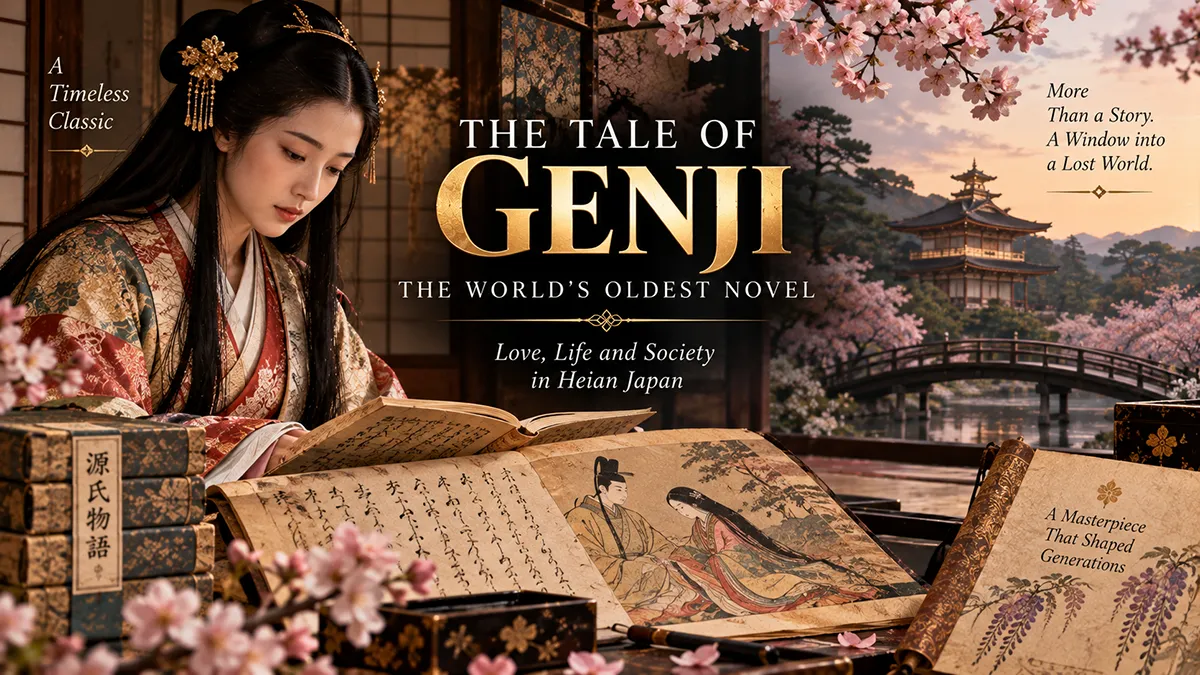
Long before printing presses, paperback bestsellers, or even the concept of “the novel” as we know it, a noblewoman in the imperial court of Japan was quietly writing one of the most sophisticated works of fiction the world had ever seen.
Her name was Murasaki Shikibu, and her sprawling tale of a fictional prince’s loves, losses, and political maneuvering would go on to earn a title that still sparks debate among literary historians: the world’s first novel.
But is that claim actually true, or has it become one of those “facts” repeated so often that nobody stops to check it? The real story of the Tale of Genji is even more interesting than the legend, and it says as much about Heian-era Japan as it does about the origins of storytelling itself.
TL;DR: The Tale of Genji, written by the Japanese court lady Murasaki Shikibu around the early 11th century, is widely regarded as the world’s first psychological novel, though calling it the literal “first novel ever written” oversimplifies a much richer literary history.
What Is The Tale of Genji, Exactly?
The Tale of Genji, known in Japanese as Genji Monogatari, is a lengthy work of prose fiction from Japan’s Heian period. It follows the life of Hikaru Genji, a fictional prince navigating the intricate social, romantic, and political world of the imperial court. The genji book, as some readers casually call it today, spans decades of the character’s life and even continues into the lives of his descendants after his death.
Unlike shorter poetic diaries or historical chronicles common in early Japanese writing, this genji monogatari book reads like an extended character study. It follows people across years, tracks their emotional development, and weaves subplots together with a level of narrative complexity that was rare for its time anywhere in the world.
The work is traditionally divided into 54 chapters, and it’s often grouped into three broad parts: Genji’s rise and romantic entanglements, his later years and the consequences of his choices, and a final section focused on his descendants after his death. That final section is sometimes attributed to a different, unknown author, which is one of several ongoing scholarly debates about the text.
Who Wrote the Tale of Genji?
The author is generally identified as Murasaki Shikibu, a woman who served as a lady-in-waiting in the Japanese imperial court during the early 11th century. “Murasaki Shikibu” was not actually her birth name. Her real name isn’t reliably recorded in history, which was fairly common for aristocratic Japanese women of that era, whose personal names were often considered private or simply not preserved in official records.
The nickname “Murasaki” is believed to have been borrowed from one of her own characters, while “Shikibu” referenced a court title held by her father. Today, she’s often referred to as Lady Murasaki, and the phrase “lady murasaki tale of genji” is one of the most common ways modern readers search for information about her, reflecting just how tightly her identity and her masterwork are linked.
What we do know about her comes largely from her own diary and a handful of court records. She was well-educated, unusually so for a woman of her time — a reputation for learning that puts her in the company of history’s smartest people — and had access to Chinese classics and Japanese poetry that clearly influenced her writing style and vocabulary.
When Was the Tale of Genji Written?
Pinning down an exact date for when the Tale of Genji was written is tricky, since Murasaki Shikibu didn’t leave behind a neatly dated manuscript with a publication page. Most historians place its composition sometime in the first decade of the 11th century, roughly between 1000 and 1012 CE, based on references in her surviving diary and court records from the period.
It’s also worth noting that the tale of genji origin story isn’t a single tidy event. Many scholars believe Murasaki Shikibu wrote it in installments over several years, possibly reading portions aloud to fellow court women before the work was compiled into the longer narrative readers know today. This kind of serialized, evolving composition process was not unusual for court literature of the period.
Is the Tale of Genji Really the World’s First Novel?
This is where the myth-busting has to happen carefully, because the claim isn’t wrong, but it’s also not the whole story. When people ask “who wrote the first novel” or search for the “first novel ever written,” they’re often surprised to learn that fiction long predates Murasaki Shikibu.
Ancient works like the Latin “Satyricon” by Petronius and “The Golden Ass” by Apuleius are centuries older and contain extended fictional narratives. Other ancient literatures, including Greek romances and various Chinese narrative traditions, also produced long fictional prose works well before the Heian period.
So why does the Tale of Genji still get called the world’s first novel by so many literary scholars? The distinction usually comes down to psychological depth. Genji is frequently cited as the first work of fiction to consistently explore interior emotional life, character motivation, and personal growth across a long, unified narrative, rather than simply recounting adventures or episodic events.
That’s a meaningful and specific claim, but it’s a claim about literary technique and psychological realism, not a claim that no fiction existed before it. Treating it as the single, undisputed “first novel in the world” in an absolute sense oversells what historians can actually confirm. The safer, more accurate framing is that it’s widely considered the world’s first sustained psychological novel, and one of the earliest and most fully realized long-form fictional narratives in world literature.
Is It Also the Oldest Japanese Book?
Here’s another common mix-up worth clearing up. The Tale of Genji is sometimes casually described as the oldest Japanese book, but that’s not accurate either. Japan has written works that significantly predate it, including the Kojiki, a chronicle of myths and early history completed around 712 CE, and the Nihon Shoki, finished around 720 CE.
Those earlier texts are histories and mythological chronicles rather than novels, so they serve a very different purpose. The Tale of Genji’s real claim to fame isn’t being the oldest Japanese book overall. It’s being the oldest surviving Japanese work of long-form fiction with this level of narrative and psychological sophistication.
The Story of Genji: A Quick Walkthrough
For readers who’ve heard the title but never actually dug into the plot, the story of Genji centers on Hikaru Genji, the son of an emperor and a low-ranking concubine. Political circumstances prevent him from being in line for the throne, so he’s given the status of a commoner and a career as a brilliant courtier instead.
Much of the early narrative follows Prince Genji’s romantic relationships, of which there are many, across different women of varying social ranks. These relationships aren’t presented as simple conquests; Murasaki Shikibu uses them to explore loneliness, social constraint, jealousy, and the rigid gender expectations of Heian court life.
As the story progresses, Genji rises to great power and prestige, only to face personal losses and the consequences of decisions made decades earlier. The final chapters shift focus to the next generation, following characters connected to Genji after his death, closing out a narrative arc that spans an unusually long stretch of fictional time for a work of this era.
Why the Structure Was So Groundbreaking
Part of what makes the Tale of Genji stand out isn’t just its length, but its structural ambition. Fifty-four chapters following multiple generations of characters was an enormous undertaking for any writer in the 11th century, in any country.
Murasaki Shikibu also embedded hundreds of waka poems throughout the narrative, reflecting the Heian court tradition where poetic exchange was a genuine form of social and romantic communication. Readers today sometimes find this pacing unfamiliar, but for its original audience, those poems carried real emotional and social weight.
The novel also displays an early, careful use of narrative techniques like extended character consistency and cause-and-effect development across time. Characters age, change their minds, and suffer realistic consequences, which is precisely the quality scholars point to when defending its reputation as the first true psychological novel. Pulling off that kind of structural sophistication across 54 chapters is the sort of feat historians associate with history’s geniuses with the highest estimated IQs, even if such comparisons remain speculative for a writer from a thousand years ago.
The Manuscripts: How the Text Survived
No original manuscript of the Tale of Genji written in Murasaki Shikibu’s own hand has survived to the present day. What exists instead are copies made by later scribes, the oldest of which date to well over a century after the original composition.
This creates real textual challenges for historians. Different manuscript lineages sometimes contain variations in wording or chapter order, and scholars have spent centuries comparing versions to reconstruct what the “original” text likely looked like.
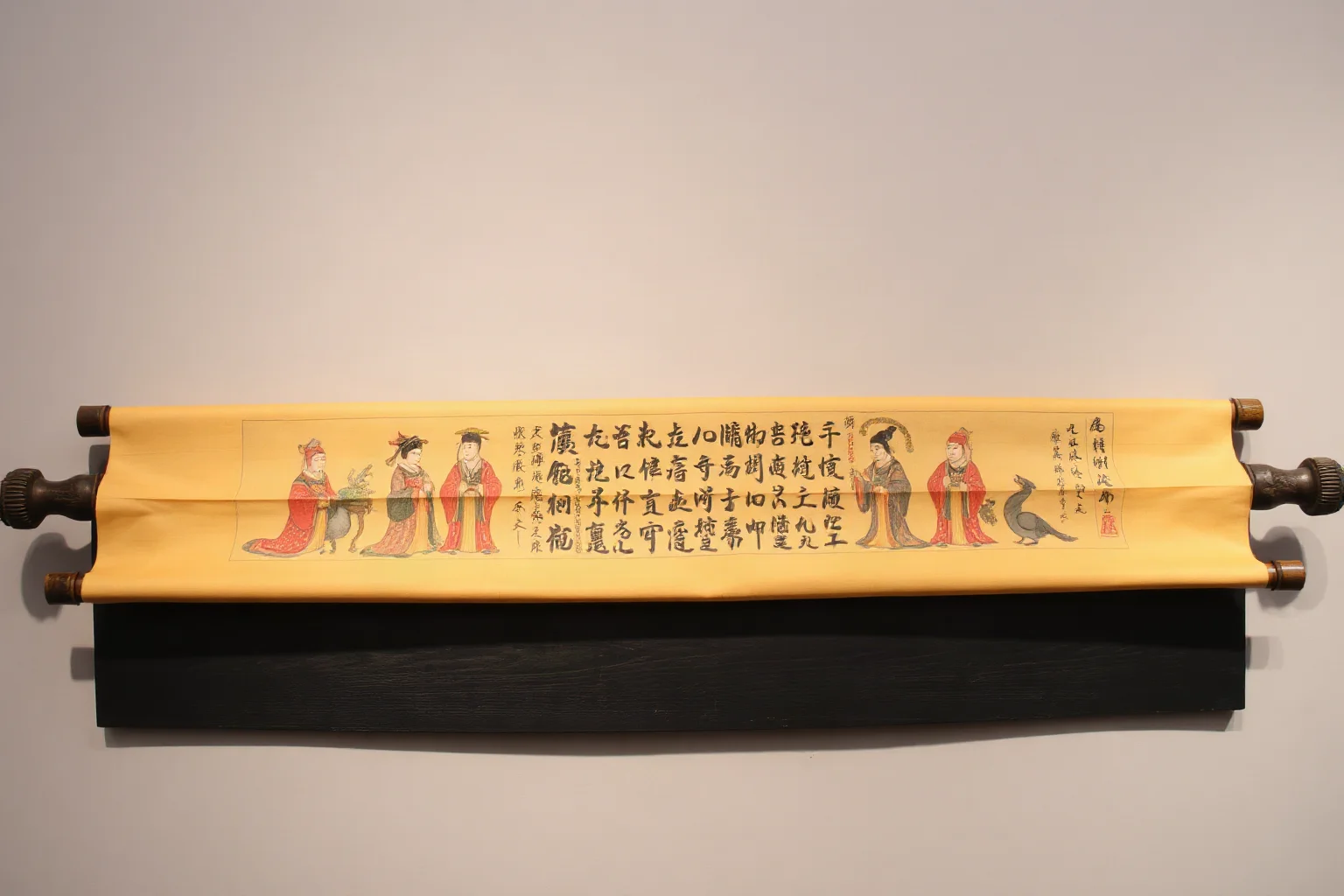
One especially famous surviving artifact connected to the story is the Genji Monogatari Emaki, a set of illustrated hand scrolls created in the 12th century. These scrolls combine calligraphy and painting to depict scenes from the novel, and surviving fragments are treated as Japanese National Treasures today.
Themes That Still Resonate
One reason the Tale of Genji has endured for over a thousand years is its focus on emotional truths that don’t really go out of style. The concept of “mono no aware,” often translated loosely as a gentle, wistful awareness of life’s impermanence, runs throughout the narrative.
Characters fall in love, age, lose status, and face mortality, and the novel treats these moments with a kind of melancholy tenderness rather than moralizing. That emotional honesty is part of why literary scholars keep returning to it as more than just a historical curiosity.
The book also offers a rare, detailed window into the inner lives of Heian-era women, largely because it was written by one. Female characters in the novel are given interior complexity that was uncommon in literature of this period across most of the world.
Its Lasting Influence on Japanese Culture
The Tale of Genji didn’t just influence literature; it shaped Japanese visual art, theater, and even fashion sensibilities for centuries afterward. Ukiyo-e woodblock print artists frequently drew on Genji scenes for inspiration well into the Edo period, centuries after the story was written.
It has also been adapted repeatedly into modern Japanese media, including manga, anime, and film, introducing new generations to Prince Genji’s story in formats far removed from its original court setting. English translations by scholars such as Arthur Waley and Edward Seidensticker, among others, have also introduced the tale genji story to international audiences over the past century.
In Japan, the work is treated as a foundational text of national literature, studied in schools much the way English-speaking students study Shakespeare. Its cultural weight goes well beyond its status as an old or unusual artifact.
Common Misconceptions Worth Clearing Up
Given how often this book gets summarized in a single punchy claim, a few myths have taken root that are worth directly addressing. It is not literally the oldest book on Earth, nor the oldest Japanese book, and it’s not universally agreed upon as the single “first novel” in an absolute, unchallenged sense.
What it is, with much stronger historical footing, is one of the earliest and most influential works of long-form fiction to center on believable, evolving human psychology. That’s a genuinely remarkable achievement, and it doesn’t need embellishment to be impressive.
It’s also worth remembering that authorship itself carries some uncertainty. While Murasaki Shikibu is credited as the primary author, scholars have long debated whether all 54 chapters came from her pen, or whether later chapters were completed or altered by another writer.
Why It Still Matters Today
More than a thousand years after it was written, the Tale of Genji remains a touchstone for understanding early literary craftsmanship and Heian-era Japanese society. It offers historians a rare, detailed look at court customs, aesthetics, and gender dynamics that few other surviving texts capture with this much nuance.
For general readers, it remains a genuinely engaging story about love, ambition, and the passage of time, themes that translate across a thousand years without much difficulty. That combination of historical value and lasting emotional resonance is a rare thing for any text to achieve. Yet despite her towering literary influence, Murasaki Shikibu is rarely mentioned alongside history’s most recognized historical figures, a curious omission given how far her legacy has traveled.
Whether or not you accept the boldest version of the “world’s first novel” claim, there’s no serious argument against the Tale of Genji’s importance. It stands as one of literature’s earliest demonstrations that fiction could do more than entertain; it could explore what it actually feels like to be human.
Final Thoughts
The Tale of Genji earns its reputation not because of a marketing-friendly superlative, but because of what’s actually on the page: a patient, emotionally intelligent portrait of one man’s life and the world around him, written by a woman working within a court culture that rarely gave women that kind of creative platform. That context matters just as much as the text itself.
So the next time someone confidently declares it the single, undisputed oldest book in the world, you’ll know the more accurate and honestly more interesting answer. It’s a groundbreaking psychological novel from 11th-century Japan, written by a remarkable court lady, and its real legacy has never needed exaggeration to be worth celebrating.
Frequently Asked Questions
Who wrote Lady Murasaki’s Tale of Genji?
The Tale of Genji is credited to Murasaki Shikibu, a lady-in-waiting in the Japanese imperial court during the early 11th century. "Murasaki Shikibu" is a court nickname rather than her birth name, which was never reliably recorded, and she's commonly referred to today simply as Lady Murasaki.
When was the Tale of Genji written?
Most historians date its composition to roughly 1000–1012 CE, based on references in Murasaki Shikibu's surviving diary and Heian court records. It was likely written in stages over several years rather than as a single completed manuscript.
Is the Tale of Genji really the first novel in the world?
It's widely considered the first sustained psychological novel due to its deep character development and long narrative arc, but fictional prose narratives existed in other cultures earlier, such as ancient Latin works. So it's more accurate to call it a pioneering psychological novel rather than the absolute first work of fiction ever written.
What is the Tale of Genji about?
It follows the life of Hikaru Genji, a fictional Japanese prince, as he navigates romance, politics, and personal loss within the aristocratic Heian court, before shifting in its final chapters to focus on his descendants after his death.
Is the Tale of Genji the oldest Japanese book?
No, that's a common misconception. Japanese texts like the Kojiki and Nihon Shoki, both historical and mythological chronicles, predate it by roughly 300 years. The Tale of Genji is instead recognized as one of the oldest and most significant works of Japanese narrative fiction, not the oldest Japanese book overall.
How long is the Tale of Genji?
The novel is traditionally divided into 54 chapters and spans several decades in the lives of its characters. In modern English translations, it typically runs over a thousand pages, making it one of the longest and most structurally ambitious works of its era.

Alex Warren
Related Articles