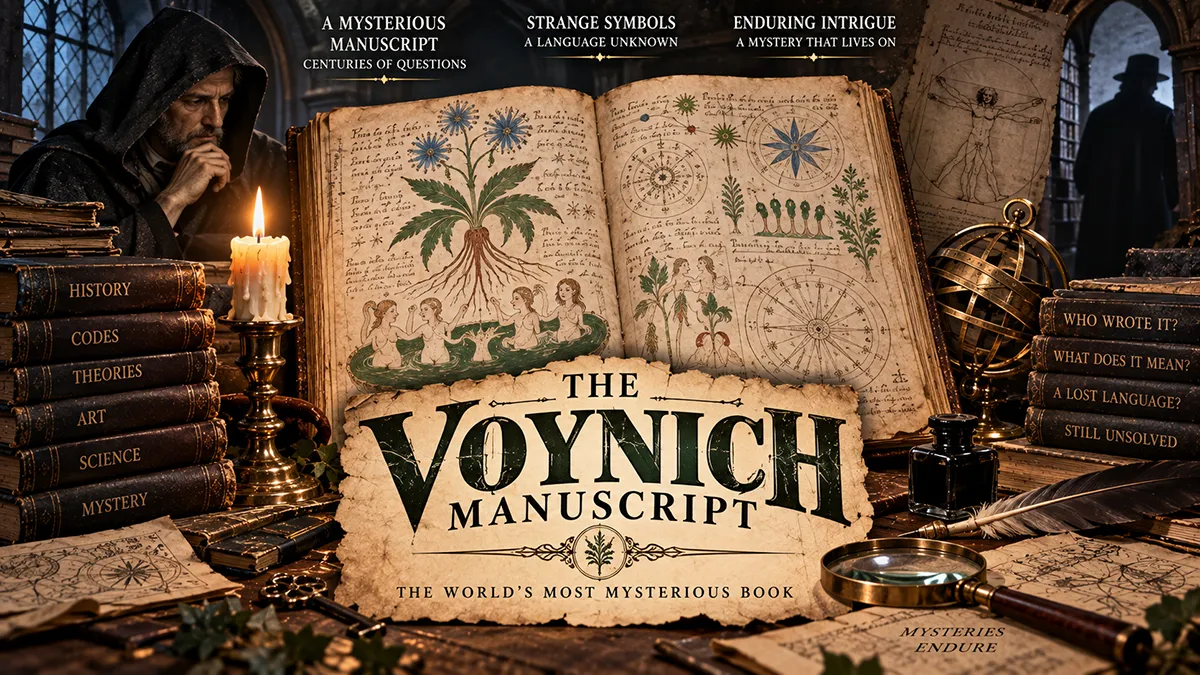
Picture a book written in a language nobody has ever spoken, filled with plants that don’t exist in nature, and illustrated with tiny naked figures bathing in green liquid.
That book is real, it sits in a climate-controlled vault at Yale University, and after more than a century of attention from codebreakers, linguists, and even the National Security Agency, nobody can say for certain what it means.
This is the Voynich Manuscript, sometimes called the Codex Voynich, the Book of Voynich, or simply “the Voynich.” It’s one of history’s most stubborn puzzles, and this guide walks through what we actually know, what’s just speculation, and why the mystery refuses to die.
TL;DR: The Voynich Manuscript is a roughly 600-year-old handwritten book, written in an unknown script and illustrated with impossible plants and strange figures, that no one has ever definitively translated or explained.
What Exactly Is the Voynich Manuscript?
The Voynich Manuscript is a handwritten codex made of animal-skin parchment (vellum), containing around 240 surviving pages of dense, flowing script alongside hundreds of colorful illustrations. It’s currently catalogued as MS 408 in Yale University’s Beinecke Rare Book & Manuscript Library, where it has lived since 1969.
The book gets its popular name from Wilfrid Voynich, a Polish-American antiquarian book dealer who acquired it in 1912. Because no one else had documented the manuscript in any detail before him, his name stuck, even though he wasn’t its creator, translator, or first owner.
What makes it endlessly fascinating is simple: it looks like it should be readable. It has the structure of a real medieval reference book, complete with chapter-like sections, recurring symbols, and illustrations that resemble herbal guides or astrological charts. Yet nobody, from wartime cryptographers to modern AI language models, has produced a translation that scholars widely accept.
The Physical Book: What It Looks Like
The manuscript itself is a fairly small, unassuming object at first glance. It measures about 23.5 by 16.2 centimeters, roughly the size of a modern hardcover novel, and its current binding holds around 240 pages, though gaps in the numbering suggest some pages are missing.
The text is written in a fluid, looping script using what appears to be an iron gall or similar period-appropriate ink. The handwriting is remarkably consistent, which has led some researchers to argue it was written by a single confident scribe, while other analyses suggest at least two distinct hands contributed to the text.
Several pages fold out to form larger diagrams, some spanning four or six panels, which was an unusual and relatively expensive design choice for a medieval manuscript. This detail matters because it tells us whoever commissioned the book was willing to invest real resources into it, suggesting it wasn’t a casual doodle or a quick forgery job.
The Illustrations: Plants, Stars, and Bathing Figures
The manuscript is generally divided by scholars into sections based on the imagery, since there are no chapter titles to guide us. This is one of the more approachable ways to understand the book, even if the categories are modern labels rather than the original author’s own divisions.
The Herbal Section
More than a hundred pages are devoted to drawings of plants, each paired with blocks of text. The strange part is that almost none of these plants correspond to any known species, real or documented in medieval herbals of the period.
Some botanists have proposed that individual drawings combine features from multiple real plants, as if the illustrator merged a root from one species with leaves from another. Others think the plants may be entirely invented, or drawn from memory and imagination rather than direct observation.
The Astronomical and Cosmological Section
This portion contains circular diagrams resembling star charts, zodiac symbols, and what look like sun and moon motifs. Some pages include the twelve traditional zodiac signs, each surrounded by small nude female figures holding stars or standing in barrel-like tubs.
These nude figures have fueled plenty of speculation over the decades, with some amateur theorists reading fertility symbolism, astrological medicine, or even loosely comparing certain imagery to classical Cupid and Venus iconography. None of this has been confirmed by mainstream scholarship, and it’s best treated as visual pattern-spotting rather than established fact.
The Biological Section
This is arguably the strangest part of the book. It shows small nude women, many submerged or interacting with green liquid inside networks of tubes and vessels that some researchers compare to plumbing or the human circulatory system.
Interpretations here range wildly, from balneological (bathing and medical treatment) imagery to allegorical or even alchemical readings. Because nothing else in period art looks quite like it, this section resists comparison and remains one of the manuscript’s most-discussed mysteries.
The Pharmaceutical and Recipes Sections
Toward the back of the book, smaller plant and root drawings appear alongside labeled jars and containers, resembling an apothecary’s reference guide. The final section consists of continuous blocks of text broken into short paragraphs, each marked with a small star or flower in the margin, which some researchers believe functioned like recipes or short entries in a list.
Voynichese: The Manuscript’s Unknown Script
The writing system inside the manuscript has earned its own nickname among researchers: Voynichese. It uses somewhere between 20 and 30 distinct characters, some resembling Latin letters, others looking entirely invented, and a handful appearing nowhere else in any known writing system.
What makes Voynichese genuinely puzzling from a linguistic standpoint is its statistical behavior. Word lengths, letter frequencies, and repetition patterns behave in ways that resemble real natural language, following patterns similar to Zipf’s Law, which describes how word frequencies distribute in genuine human languages.
At the same time, Voynichese breaks rules that virtually all real languages follow. Certain letters almost never appear next to each other, some words repeat immediately in a row far more often than makes sense in natural speech, and there’s unusually low variation between words on the same page, almost as if the text was generated by a formula rather than composed freely.
This strange middle ground, too structured to be pure gibberish, too repetitive to be an ordinary language, is exactly why the debate over whether Voynichese is a real language, a cipher, a constructed language, or an elaborate hoax remains unresolved.
When Was the Voynich Manuscript Written?
For decades, estimates about the manuscript’s age relied purely on handwriting style and the drawing techniques used in the illustrations, both of which pointed vaguely toward the 15th or 16th century. That changed in 2009, when researchers at the University of Arizona used radiocarbon dating on small samples of the vellum itself.
The results narrowed the parchment’s origin to between 1404 and 1438, placing its creation firmly in the early 15th century. It’s worth noting this dates the animal skin the book is written on, not necessarily the exact year the text and illustrations were added, though most scholars agree the writing likely followed soon after the vellum was prepared.
This radiocarbon evidence effectively ruled out several popular theories that had linked the manuscript to later historical figures, since those people simply weren’t alive when the parchment was made. It didn’t, however, settle who actually wrote it or why.
The Ownership Trail: From Prague to Yale
The manuscript’s documented history, known as its provenance, only becomes solid starting in the 17th century. A letter tucked inside the book, written in 1665 or 1666 by Johannes Marcus Marci, a scholar in Prague, states that the manuscript once belonged to Emperor Rudolf II of Bohemia, who reportedly paid a substantial sum for it.
According to that same letter, Rudolf believed the book was the work of Roger Bacon, the 13th-century English friar and early scientific thinker. Most historians today treat this as an attractive legend rather than verified fact, especially since the 2009 carbon dating rules out Bacon, who died in 1292, more than a century before the manuscript’s vellum existed.
After Rudolf, the trail suggests the book passed to Jacobus Sinapius and later into the hands of Georg Baresch, an alchemist in Prague, before reaching Marci, who eventually gifted or sent it to Athanasius Kircher, a Jesuit scholar famous for attempting to decode ancient Egyptian hieroglyphs. From there, it likely stayed within Jesuit collections in Rome for over two centuries.
In 1912, Wilfrid Voynich purchased the manuscript from the Collegio Romano’s Jesuit library, which was selling off items to raise funds. Voynich brought it to the United States and spent years trying to have it authenticated and translated, generating enormous public interest along the way. After passing through several private owners, the book was donated to Yale University’s Beinecke Rare Book & Manuscript Library in 1969, where it remains today.
Who Actually Wrote It?
This is the question everyone wants answered, and it’s the one with the least reliable evidence. Theories have named Roger Bacon, alchemist Edward Kelley, astrologer John Dee, and even Wilfrid Voynich himself as possible authors or forgers, but none of these claims hold up cleanly against the manuscript’s confirmed 15th-century origin.
Some researchers have pointed to Northern Italy as a likely origin point based on stylistic details in the illustrations, like clothing, castle battlements (crenellations) drawn in one diagram, and artistic conventions common to that region and period. This doesn’t identify a specific author, but it does help narrow down a plausible cultural and geographic context for the book’s creation.
Others argue the manuscript may have been produced anonymously, possibly by a physician, apothecary, or scholar compiling personal notes in a private code, never intended for outside readers at all. Without a signed colophon or matching historical record, though, authorship remains an open question rather than a settled answer.
Has Anyone Ever Decoded the Voynich Manuscript?
Short answer: no, not in any way that has satisfied the scholarly community. That hasn’t stopped a long parade of attempts, some serious and methodical, others considerably less so.
William Friedman, a pioneering American cryptanalyst who helped break Japanese codes during World War II, spent years studying the Voynich Manuscript with a dedicated study group, and even he couldn’t crack it. Its resistance to some of history’s best codebreaking minds is a big part of why the manuscript is often compared to other famously unsolved ciphers.
In recent years, computational linguists and even machine-learning researchers have tried applying modern natural language processing tools to Voynichese, hunting for patterns tied to real language families. Several of these projects generated media buzz claiming a breakthrough, but each has been walked back or heavily disputed by manuscript specialists after closer scrutiny, usually because the proposed “translations” didn’t hold up when tested against the full text.
Is the Voynich Manuscript a Hoax?
One compelling theory, proposed by researcher Gordon Rugg in the early 2000s, suggests the entire manuscript could be an elaborate hoax created using a simple grid-based table method to generate seemingly meaningful but ultimately meaningless words. Rugg demonstrated that a similar table-and-grille technique, using tools that would have existed in the medieval period, could produce text with statistical properties resembling Voynichese.
This theory is attractive because it would explain the odd mix of language-like structure and rule-breaking oddity in the text. Critics counter that a hoax explanation doesn’t fully account for the sheer scale of the project, over 200 pages of consistent script and carefully planned illustrations, especially if the goal was simply to trick a buyer.
Other scholars lean toward the idea that the manuscript encodes a real but lost constructed language, a private shorthand system, or an actual substitution cipher that simply hasn’t been broken yet. As of today, every one of these theories, hoax, cipher, or genuine unknown language, remains plausible, and none has enough evidence to be called definitive.
Studying the Manuscript: Monographs and Modern Research
Over the decades, the Voynich Manuscript has generated a surprising amount of serious academic output. Yale University Press published a full facsimile edition in 2016, pairing high-resolution images with scholarly essays examining the vellum, ink, illustrations, and history in far more depth than most casual readers ever see.
Smaller research groups and independent scholars have also published monographs and papers over the years, some through university presses and others through niche academic or hobbyist publishing outlets, each proposing a different angle on dating, linguistics, or possible authorship. Because the manuscript sits at the intersection of history, cryptography, and art history, it tends to attract researchers from wildly different fields, which is part of why the body of Voynich scholarship is so scattered and occasionally contradictory.
Cultural Impact and Popular Fascination
The Voynich Manuscript has become a genuine piece of pop culture, showing up as inspiration for novels, video games, and television shows that borrow its “impossible ancient text” aesthetic. It’s frequently invoked as shorthand for an unsolvable mystery, much the way people reference the Bermuda Triangle or Roswell.
Its fame has also made it a magnet for online misinformation, with recurring viral claims about the manuscript being “finally solved,” only for those claims to quietly fall apart under expert review. This pattern is worth keeping in mind anytime a bold new headline about the manuscript appears, since genuine, peer-reviewed breakthroughs would be major news across serious academic circles, not just social media.
Where Can You See the Voynich Manuscript Today?
The physical manuscript is housed at Yale’s Beinecke Rare Book & Manuscript Library in New Haven, Connecticut, where it’s preserved under strict conservation conditions. It’s occasionally displayed to the public, but given its fragility and value, access is understandably limited.
The good news for the curious is that Yale has digitized the entire manuscript and made high-resolution scans freely available through its online collections. Anyone can browse every page, examine the illustrations up close, and study the strange script of Voynichese from home, without ever needing special permission.
The Enduring Mystery
After more than a hundred years of dedicated study, the Voynich Manuscript still refuses to give up its secrets. We know roughly when it was made, we have a reasonable trail of who owned it after the mid-1600s, and we can describe its script and imagery in exhaustive detail, yet the core questions of what it says and why it was written remain unanswered.
That combination, real documented history paired with a genuinely unsolved core mystery, is rare, and it’s exactly why the manuscript keeps drawing in cryptographers, linguists, historians, and curious readers generation after generation. Until someone produces a translation that survives serious scholarly scrutiny, the Voynich Manuscript will likely remain one of history’s most captivating unanswered questions.
Frequently Asked Questions
When was the Voynich Manuscript written?
Radiocarbon dating conducted in 2009 on the manuscript's vellum dated the parchment to between 1404 and 1438, placing its creation in the early 15th century. This scientific dating ruled out several older theories that linked the manuscript to later historical figures.
What language is the Voynich Manuscript written in?
It's written in an unknown script researchers call Voynichese, using around 20 to 30 unique characters. No one has confirmed whether it represents a real historical language, a cipher, a constructed language, or a hoax designed to look like meaningful text.
Has the Voynich Manuscript ever been translated or decoded?
No widely accepted translation exists. Various individuals and research teams, including cryptographer William Friedman and more recent AI-assisted studies, have proposed decodings, but each has been disputed or debunked by manuscript specialists.
Who wrote the Voynich Manuscript?
The author is unknown. Historical legend once credited 13th-century friar Roger Bacon, but carbon dating disproves this since the parchment postdates his death by over a century. Stylistic clues suggest a possible Northern Italian origin, but no confirmed author has been identified.
Is the Voynich Manuscript a hoax?
It might be, but it's not confirmed. Researcher Gordon Rugg proposed a plausible method for generating hoax text with similar statistical properties to Voynichese, though critics argue this doesn't fully explain the manuscript's scale and consistency.
Where is the Voynich Manuscript now?
The original manuscript is held at Yale University's Beinecke Rare Book & Manuscript Library in New Haven, Connecticut. Yale has also digitized the entire book, and free high-resolution scans are available online for anyone to study.
Why is it called the Voynich Manuscript?
It's named after Wilfrid Voynich, a Polish-American antiquarian book dealer who purchased it in 1912 from a Jesuit college near Rome. He wasn't the author; the name simply stuck because he was the person who brought the manuscript to wider public and scholarly attention.

Alex Warren
Related Articles