
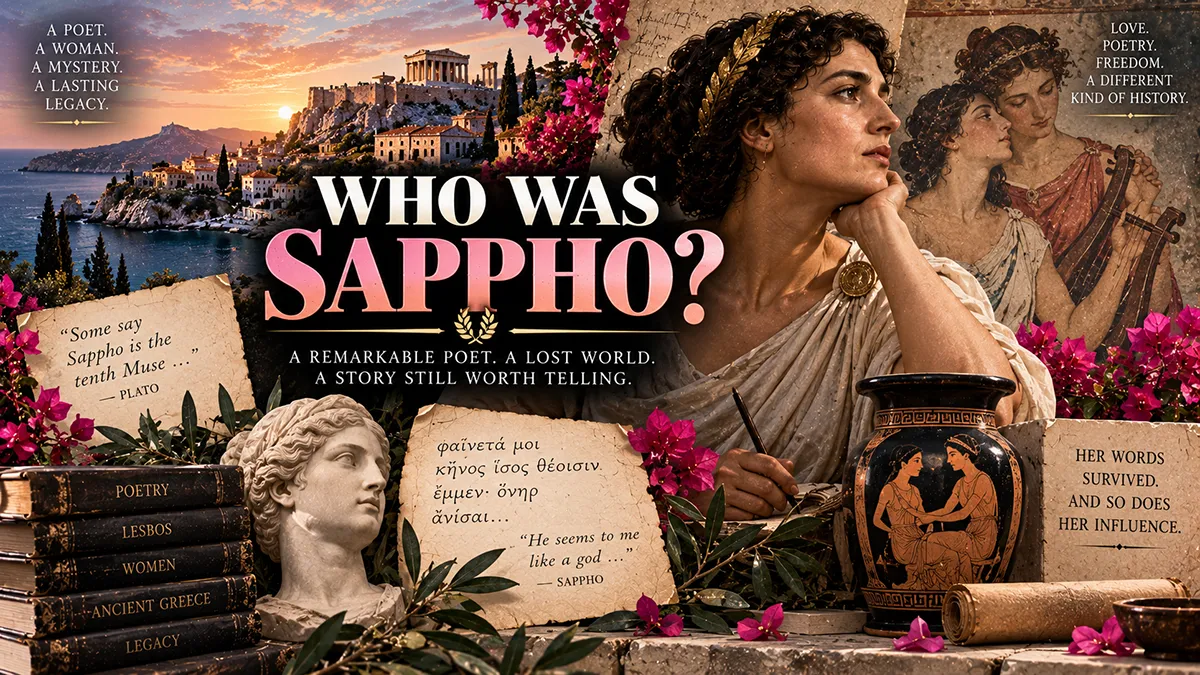
Ask someone to name a poet from ancient Greece, and odds are they’ll say Homer. Ask them to name a woman who wrote poetry in ancient Greece, and if they know the answer at all, it’s almost always Sappho.
She lived roughly 2,600 years ago, left behind only fragments of her work, and yet her name still shows up in classrooms, museums, and everyday language today.
That staying power is remarkable when you consider how little of her actual writing survives. Most of what we “know” about Sappho is a tangle of scraps of papyrus, secondhand gossip from ancient biographers who lived centuries after her, and a fair amount of later myth-making.
So who is Sappho, really, and why does a poet from Lesbos who’s been dead for two and a half millennia still matter?
TL;DR: Sappho was a real lyric poet from the Greek island of Lesbos around 630–570 BCE, celebrated in antiquity for her emotionally direct poetry about love and longing, and her legacy still shapes language, literature, and LGBTQ+ history today.
Who Is Sappho? A Quick Definition
If you’re looking for a simple definition of Sappho, here it is: she was a lyric poet from ancient Greece, born on the island of Lesbos, who composed songs meant to be sung with a lyre.
“Lyric poetry” literally gets its name from that instrument, and Sappho was one of its most celebrated practitioners. Ancient writers ranked her alongside Homer, which was an extraordinary honor in a literary culture dominated by men.
Her poems were personal and emotionally intense, focused on love, desire, longing, and the beauty of everyday moments. Some sources refer to her with slight misspellings like “Saphos” or “Sapphro,” but there’s only one historical figure behind all these variations.
Whether you’ve seen her name written as Sappho, Sapho, or something else entirely, it points back to the same ancient Greek poet.
When Was Sappho Alive?
Pinning down exact dates for anyone in the ancient world is tricky, but most historians place Sappho’s life around 630 to 570 BCE. That puts her firmly in the Archaic period of ancient Greece, before the classical age of Athens that gave us Socrates, Plato, and the Parthenon.
Sappho ancient Greece context matters here: this was a time of small city-states, oral tradition, and a flourishing culture of sung poetry performed at religious festivals and private gatherings.
Because she predates Socrates by roughly 150 to 200 years, the two never crossed paths. You’ll sometimes see “Sappho and Socrates” mentioned together in searches or trivia, but it’s really a comparison of two towering ancient Greek figures from different eras rather than a historical connection.
Socrates was born around 470 BCE, well after Sappho had already become a celebrated literary figure whose work was being copied and studied.
The Poet From Lesbos: Her Life and World
Sappho was born on Lesbos, a large island in the northeastern Aegean Sea, in a city usually identified as Mytilene or possibly Eresos. Lesbos was a wealthy, culturally vibrant place during Sappho’s lifetime, known for music, poetry, and trade.
This is why she’s so often described simply as “the poet from Lesbos” — the island isn’t just a birthplace, it’s practically part of her identity in ancient sources.
Ancient biographical traditions claim she came from an aristocratic family, married a wealthy man, and had a daughter named Cleis, who she mentions affectionately in surviving fragments.
She’s also said to have spent time in exile in Sicily, possibly due to political turmoil on Lesbos, though details are thin and inconsistent across sources.
It’s important to be honest about the gaps here: much of Sappho’s biography comes from later Greek and Roman writers who mixed genuine tradition with speculation, rumor, and even comic exaggeration.
What we can say more confidently is that Sappho ran or was closely associated with a circle of young women, possibly involved in music, poetry, or ritual education.
Ancient sources sometimes call this a school, though that word may impose a modern structure on something much less formal. Many of her poems are addressed to these women, expressing affection, jealousy, admiration, and heartbreak in language that feels startlingly immediate even in translation.
Sappho’s Poetry: What Actually Survives
Here’s a fact that surprises a lot of people: almost none of Sappho’s poetry survives complete. Ancient sources credit her with writing hundreds of poems, organized into multiple books, but time, changing literary tastes, and the fragility of ancient papyrus destroyed the vast majority of it. What remains today is a patchwork of fragments, some just a few words long, others substantial enough to read as something close to a full poem.
The most complete surviving work is often called the “Ode to Aphrodite,” a prayer-like poem in which the speaker asks the goddess of love for help with an unrequited passion. Another famous fragment, sometimes labeled “Fragment 31,” describes physical symptoms of intense longing while watching a loved one talk with someone else — a description so vivid it influenced Roman poets like Catullus centuries later. These surviving pieces are why classicists still rank Sappho’s poetry among the finest lyric writing to come out of ancient Greece.
Most of what survives was recovered from two main sources: quotations by later ancient writers who admired her work, and fragments of actual ancient papyrus discovered in Egypt starting in the late 1800s and continuing into the 20th and even 21st centuries. In fact, new fragments of Sappho’s poetry have been identified as recently as the 2010s, discovered on reused papyrus. This is part of why interest in her keeps being renewed — there’s always a small chance more of her voice is still out there, waiting to be found.
The Themes That Made Sappho Famous
What set Sappho apart from many of her contemporaries wasn’t just technical skill, it was her subject matter. While a lot of early Greek poetry celebrated gods, heroes, and battles, Sappho wrote about personal, intimate emotion. She described jealousy, physical desire, grief, and tenderness with a directness that ancient critics found remarkable, and that modern readers still find relatable.
Much of her work is addressed to women, expressing romantic and erotic longing in ways that were unusually candid for the time. This is the single biggest reason her name has become permanently tied to female same-sex love. The word “lesbian” itself derives directly from Lesbos, her home island, while the word “sapphic” comes straight from her own name.
It’s worth being careful here, though, because ancient Greek attitudes toward gender, sexuality, and relationships didn’t map neatly onto modern categories. Scholars continue to debate exactly how Sappho’s contemporaries understood her poems and her life, and it would be historically inaccurate to claim we know her personal identity with certainty. What we can say is that her poetry gave later generations, especially LGBTQ+ readers and writers, a rare ancient voice that spoke openly about love between women.
Was Sappho a Goddess?
Searches for “Sappho goddess” pop up fairly often, so it’s worth clearing this up directly: no, Sappho was not a goddess, and ancient sources never claimed she was one. She was a mortal woman, a working poet and musician, not a mythological figure like Aphrodite or Athena. The confusion likely comes from how reverently ancient writers spoke about her.
The philosopher Plato reportedly called her “the tenth Muse,” placing her alongside the nine goddesses of the arts in Greek mythology as a kind of honorary tribute to her talent. Some later Greek and Roman writers repeated similarly lofty praise, treating her poetry as divinely inspired. That’s high praise for a poet, but it’s poetic language and admiration, not literal divinity, and it’s a good example of how reputation can blur into legend over enough centuries.
How Did Sappho Die?
This is one of the most searched questions about her, and the honest answer is: we don’t actually know. No reliable ancient source records a confirmed cause or date of death for Sappho. What we have instead is a legend, repeated by some later Greek and Roman writers, that she died by leaping into the sea from a cliff after being rejected by a younger man named Phaon.
Most classical scholars treat this story with real skepticism. It closely resembles a folkloric motif found in several ancient tales about unrequited love, and it may have been popularized by later comic playwrights who mocked or reinterpreted Sappho’s life for entertainment. Because so much of her personal biography was already blurry by the time these stories were written down, it’s difficult to separate genuine tradition from invention.
The more likely, if less dramatic, reality is that Sappho simply lived out her life on Lesbos and died of natural causes at some point in the late 6th century BCE. Given that some fragments suggest she wrote about aging and reflected on her own life in her later poems, this points toward a full life rather than a sudden tragic death. When people ask how Sappho died, the most historically responsible answer is that the romantic cliff-leap story is almost certainly legend, not fact.
Sappho’s Reputation in Ancient Greece
During her own lifetime and for centuries afterward, Sappho’s reputation among ancient Greek poet sappho enthusiasts was enormous. She was performed, quoted, studied, and imitated across the Greek-speaking world. Her image even appeared on coins and pottery from Mytilene, a sign of genuine civic pride in their most famous resident.
Later Greek scholars in the famous Library of Alexandria collected her poems into at least eight or nine books, organized partly by meter. This kind of careful preservation was usually reserved for the most important literary figures, putting her in the company of epic poets like Homer. That’s an extraordinary level of respect for a woman writer in the ancient world, where female voices were rarely given this kind of institutional attention.
Unfortunately, that same body of collected work didn’t survive the centuries that followed. Changes in religious attitudes, shifts in what later Byzantine scribes chose to copy, and simple accidents of history meant that Sappho’s books were gradually lost. By the medieval period, only fragments quoted by other authors, and eventually rediscovered papyrus scraps, remained.
Why Sappho Still Matters Today
So why should we care about a poet from Lesbos whose complete works are lost to time? Part of the answer is literary: even in fragments, Sappho’s poetry is strikingly modern in its emotional honesty. She wrote about heartbreak, jealousy, and desire in ways that still feel relatable, proving that some human experiences simply don’t change much across 2,600 years.
There’s also a historical significance that goes beyond literature. Sappho is one of the only female voices we have from the entire archaic period of ancient Greece, a time otherwise almost exclusively documented by and about men. Her survival, even in fragments, gives modern readers a rare glimpse into how a woman of that era experienced and expressed love, identity, and community.
Finally, there’s her enduring cultural legacy. Words like “sapphic” and “lesbian” trace directly back to her and her home island, making her one of the few ancient figures whose name shaped modern vocabulary around identity and love. For LGBTQ+ history in particular, Sappho remains a foundational reference point, even as scholars continue to debate exactly what her personal life looked like.
Separating the Poet From the Legend
A lot of what circulates about Sappho online blends solid classical scholarship with centuries of embellishment, gossip, and outright invention. Ancient comic playwrights, for instance, sometimes portrayed her as a promiscuous or scandalous figure for laughs, and some of those jokes got passed down as if they were biography. Later Christian and medieval writers, uncomfortable with her poetry’s themes, sometimes tried to reframe or downplay her life entirely.
Modern popular culture has added its own layer of myth-making too, sometimes turning her into a symbol first and a historical person second. That’s not necessarily a bad thing, symbols can be powerful, but it does mean that anyone genuinely curious about who Sappho was should lean on what actual fragments and credible classical scholarship tell us. The honest picture is messier and less tidy than the myths, but it’s also more interesting: a real woman, working in a real literary tradition, whose voice was talented enough to survive against extraordinary odds.
The Bottom Line on Sappho
Sappho was a lyric poet, not a goddess, a mythical figure, or a modern invention, even though her legacy has picked up plenty of legend along the way. She lived on the island of Lesbos roughly between 630 and 570 BCE, composed emotionally direct poetry about love and desire, and was revered in her own time as one of Greece’s greatest poetic voices. Centuries of loss mean we only have fragments of her actual writing today, but those fragments were powerful enough to shape literature, language, and LGBTQ+ history for thousands of years afterward.
The next time someone mentions “the poetess Sappho” or asks who is Sappho in casual conversation, you’ll have a genuinely well-rounded answer ready. She wasn’t a myth, and she wasn’t a goddess, she was a working poet whose talent was so undeniable that people kept trying to preserve, quote, and reinterpret her voice for two and a half thousand years. That’s a legacy most writers, ancient or modern, could only dream of.
Frequently Asked Questions
How did Sappho die?
No reliable ancient source records how or when Sappho actually died. A popular legend claims she leapt from a cliff into the sea after being rejected by a younger man named Phaon, but most historians treat this as a later folkloric story rather than fact. It's more likely she simply lived out her life on Lesbos and died of natural causes sometime in the late 6th century BCE.
Who is Sappho?
Sappho was an ancient Greek lyric poet born on the island of Lesbos around 630 BCE. She was celebrated in antiquity for emotionally direct poetry about love, desire, and personal experience, and ancient writers ranked her among the greatest poets of the Greek world.
When was Sappho alive?
Sappho is generally believed to have lived from around 630 BCE to 570 BCE, placing her in the Archaic period of ancient Greece. This is well before the classical era of Athens and predates philosophers like Socrates by roughly a century and a half.
Why is Sappho called the poet from Lesbos?
Sappho was born and lived on Lesbos, a large island in the northeastern Aegean Sea, which was a wealthy and culturally active place during her lifetime. Her close association with the island is also why words like 'lesbian' derive from its name.
Was Sappho a goddess?
No, Sappho was a mortal woman and a working poet, not a goddess. The philosopher Plato is said to have called her the 'tenth Muse' as a tribute to her talent, but this was poetic praise, not a claim of literal divinity.
Did Sappho and Socrates know each other?
No, Sappho and Socrates never met. Sappho lived roughly 630 to 570 BCE, while Socrates was born around 470 BCE, more than a century after Sappho's death, so their lives never overlapped historically.
What is the definition of Sappho in a literary sense?
In literary terms, Sappho refers to the ancient Greek lyric poet from Lesbos whose surviving fragments are considered some of the finest examples of personal, emotionally driven Greek poetry. Her name is also the root of terms like 'sapphic,' used to describe women-loving-women themes in literature.

Alex Warren
Related Articles