

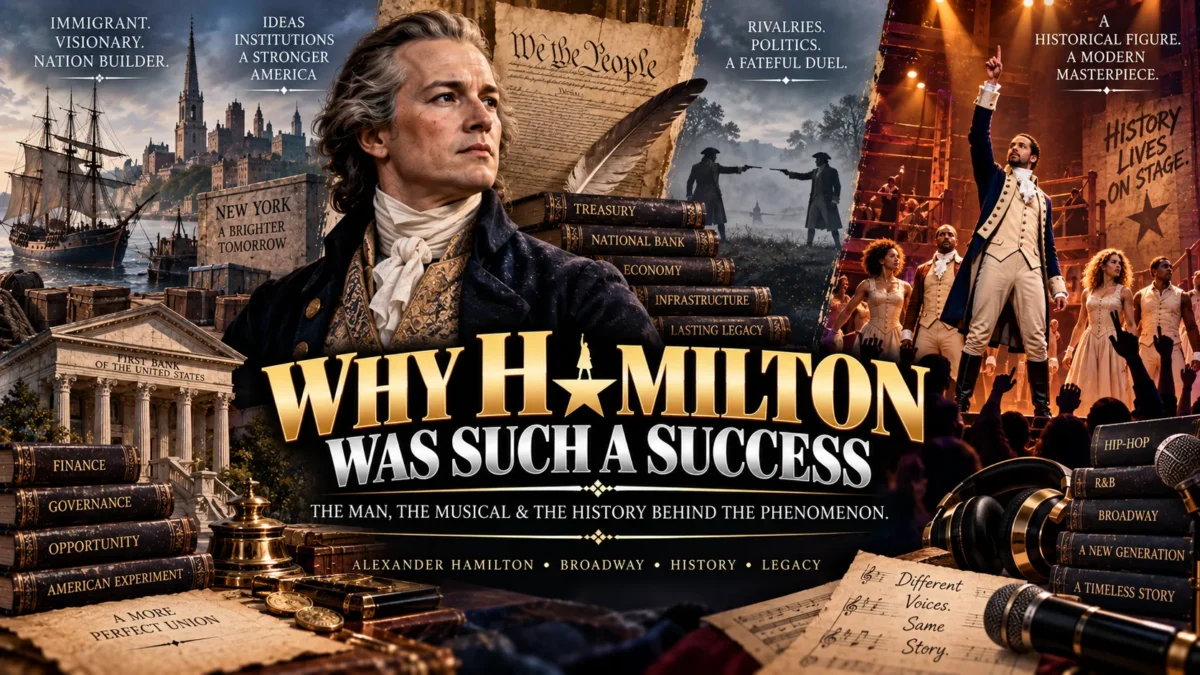
Few names bounce between a Broadway stage and a founding-era history book quite like Hamilton. One minute you’re hearing about a scrappy immigrant clerk who became George Washington’s right-hand man, and the next you’re watching sold-out crowds rap along to songs about the national bank.
That overlap is exactly why so many people end up asking the same two questions at once: what made Alexander Hamilton one of history’s most recognized historical figures, and what made the musical about him such a runaway hit?
This piece tackles both sides of the story. We’ll look at the real man, his genuine achievements and genuine flaws, and then we’ll unpack why Lin-Manuel Miranda’s show became one of the biggest cultural moments in modern theater history.
TL;DR: Alexander Hamilton built much of America’s financial and governmental backbone despite a scandal-filled, controversial life, and the musical Hamilton became a phenomenon by turning that dense history into an emotionally charged, hip-hop-driven story that reframed who gets to tell America’s founding narrative.
What Is Hamilton About, And Why Is It So Popular?

At its core, Hamilton is a sung-and-rapped musical that follows Alexander Hamilton’s life from his impoverished childhood in the Caribbean to his rise as a Revolutionary War officer, Treasury Secretary, and eventually his death in an 1804 duel with Aaron Burr.
It’s told almost entirely through music, blending hip-hop, R&B, jazz, and traditional show-tune styles into one score. Lin-Manuel Miranda wrote the book, music, and lyrics, drawing heavily on historian Ron Chernow’s 2004 biography of Hamilton as source material.
The show premiered Off-Broadway at The Public Theater in early 2015 before transferring to Broadway that August.
It became popular partly because nobody had seen founding-era history told this way before, with a racially diverse cast playing the Founding Fathers (and even Britain’s own Mad King George III as a scene-stealing comic villain) and a score that felt more like a hip-hop album than a period piece. That combination made centuries-old politics feel immediate and personal rather than dusty and distant.
Who Was Alexander Hamilton, Really?
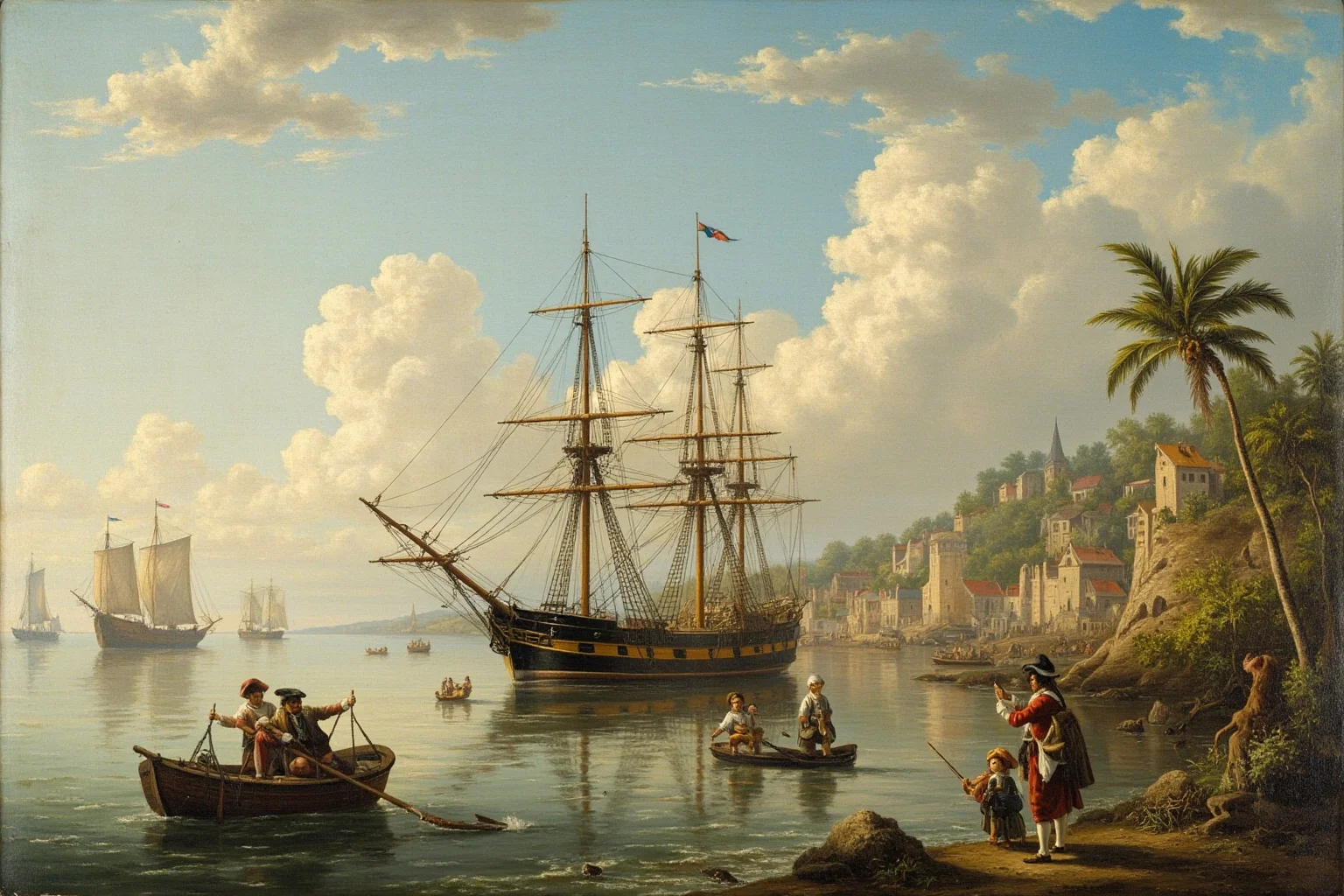
Alexander Hamilton was born on the Caribbean island of Nevis, with most historians placing his birth around 1755 or 1757 (the exact year is genuinely disputed in the historical record).
He was born out of wedlock, which mattered enormously in 18th-century society, and he was orphaned as a child after his mother’s death. Local merchants, impressed by his intelligence and work ethic, helped fund his passage to the American colonies for schooling.
He arrived in New York around 1772 and attended King’s College, now known as Columbia University. When the Revolutionary War broke out, Hamilton joined the Continental Army and eventually became one of George Washington’s most trusted aides-de-camp.
That closeness to Washington would shape the rest of his career and give him a level of influence that few immigrants of his era ever achieved.
What Was Hamilton Known For?
Hamilton’s most lasting legacy comes from his time as the first Secretary of the Treasury under President Washington, a role he held from 1789 to 1795.
He designed the foundation of the American financial system almost from scratch, including a national bank, a plan for the federal government to assume state war debts, and a functioning system of tariffs and customs revenue.
Much of the financial architecture he built still echoes through how the U.S. government manages money today.
He was also a driving force behind the Federalist Papers, a series of essays defending the newly proposed Constitution and urging states to ratify it.
Hamilton wrote the majority of the 85 essays, with James Madison and John Jay contributing the rest. Beyond that, he helped establish what became the U.S. Coast Guard and founded a newspaper, the New York Post, which is still published today.
So when people ask what Hamilton is famous for, the honest answer is: he’s famous for basically inventing the machinery of American federal finance, for shaping the intellectual case for the Constitution, and for dying young in a duel that shocked the nation.
That combination of brilliance, ambition, and tragedy is part of what makes him such compelling material for a stage musical.
Was Hamilton A Good Person?
This is where the story gets more complicated, and it’s worth resisting the urge to paint Hamilton as either a flawless hero or a straightforward villain.
He was, by most accounts, brilliant, hardworking, and genuinely committed to building a stable, functional government out of thirteen fractious states. Contemporaries respected his intellect even when they despised his politics.
He was also arrogant, combative, and prone to feuds that damaged his own career. His affair with Maria Reynolds became public in 1797, and rather than let rumors of financial corruption stand, Hamilton published a lengthy pamphlet admitting the affair in humiliating detail to protect his financial reputation. It’s often called the first major sex scandal in American political history, and it cost him politically and personally.
Hamilton’s relationship with slavery is also genuinely debated among historians rather than settled fact. He was a member of the New York Manumission Society, which advocated for gradual abolition, and the musical leans into this to frame him as a clear abolitionist figure.
But some historians, including a 2020 research paper by Jessie Serfilippi at the Schuyler Mansion historic site, argue Hamilton was more directly involved in buying, selling, or managing enslaved people through his in-laws’ household than popular memory suggests.
Other historians push back on how far that evidence goes, so it’s fair to say his record here is murkier and more contested than either the musical or older biographies imply.
His death itself came from a personal feud he refused to walk away from. Hamilton and Aaron Burr, then the sitting Vice President, had clashed politically for years, and Hamilton’s public criticism of Burr’s character helped trigger the 1804 duel that killed him. Whether that stubbornness reflects principle or ego probably depends on who you ask.
Is The Musical Hamilton Historically Accurate?


Hamilton is more historically grounded than most Broadway shows, largely because Miranda leaned so heavily on Chernow’s biography, but it is not a documentary.
It compresses years of events into single scenes, invents dialogue no one could possibly have recorded, and streamlines complicated relationships for dramatic clarity. That’s normal for historical drama, but it’s worth knowing where the show takes liberties.
One clear example is Angelica Schuyler’s characterization. The musical gives her a romantic longing for Hamilton and frames her as an intellectual equal navigating unrequited feelings, which is a dramatic interpretation rather than a documented fact from surviving letters.
The real Angelica and Hamilton had a warm, flirtatious correspondence, but the specific emotional arc in the show is largely Miranda’s invention for storytelling purposes.
The musical also softens or omits some of Hamilton’s less flattering qualities. His elitist streak, his sometimes condescending view of ordinary citizens, and his complicated record on slavery get far less stage time than his charm and ambition.
Aaron Burr, meanwhile, is portrayed with more sympathy and nuance than many earlier histories gave him, which is itself a reversal of the traditional villain framing.
Timeline compression is everywhere too. Real events that unfolded over years, like Hamilton’s rise at Treasury or the buildup to the Burr duel, get condensed into a handful of songs.
The core facts, such as Hamilton’s immigrant origins, his Treasury role, the Reynolds affair, and the fatal duel, are all historically documented. The emotional interpretation layered on top, though, is Miranda’s artistic reading of the history, not a verbatim transcript of it.
Why Is Hamilton So Popular?
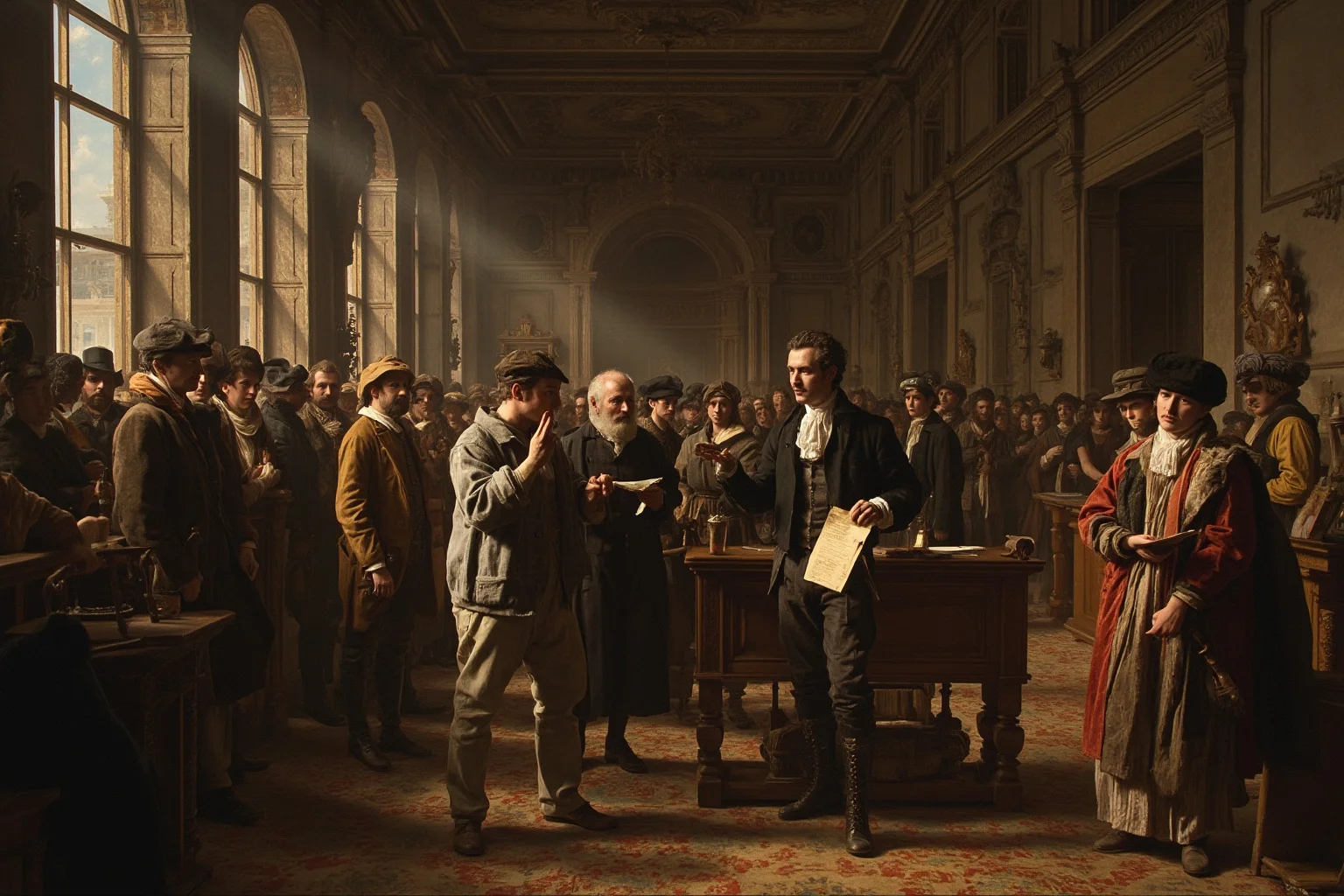
A huge part of the answer comes down to sound. Hip-hop and rap are built around dense wordplay and rapid storytelling, which turned out to be a perfect vehicle for a man who wrote an almost absurd volume of essays, letters, and pamphlets in his lifetime. Miranda has spoken publicly about seeing Hamilton’s life as a hip-hop story from the start, since Hamilton wrote his way out of poverty the same way rappers have historically used words to escape hard circumstances.
Casting was another major factor. Miranda deliberately cast Black, Latino, and Asian American actors in the roles of the Founding Fathers, a choice often summarized by the show’s own tagline about telling the story of America then, as told by America now. That decision made an old, often white-dominated narrative suddenly feel accessible and relevant to a much broader audience.
The timing mattered too. Hamilton arrived in 2015, a moment when audiences were hungry for stories that reexamined American history through a more inclusive lens. It also helped that the show is simply well-crafted, with tight lyrics, memorable hooks, and a genuinely emotional final act that many theatergoers describe as unexpectedly moving.
How Popular Is Hamilton, Really?

The numbers back up the hype. Hamilton won 11 Tony Awards in 2016 out of a record-tying 16 nominations, took home the Pulitzer Prize for Drama, and won a Grammy Award for Best Musical Theater Album.
Tickets became notoriously hard to get and notoriously expensive for years after opening, with resale prices on Broadway regularly climbing into the hundreds of dollars.
The show’s reach expanded even further in 2020 when a filmed version of the original Broadway cast’s performance was released on Disney+, introducing it to millions of households who could never have scored a ticket.
Touring productions have since played across the United States and internationally, and the cast recording became one of the best-selling Broadway albums in history. That combination of critical acclaim, awards, and genuine mainstream reach is a big part of why people keep searching for just how popular the show actually is.
Why Do People Like Hamilton?

Beyond the awards and streaming numbers, people connect with Hamilton because it turns dry political history into a story about ambition, immigration, love, rivalry, and loss.
Many viewers say they didn’t expect to cry during a musical about the Treasury Department, yet the show’s handling of grief, particularly around Hamilton’s son Philip and Hamilton’s own death, hits surprisingly hard.
The show also works because it doesn’t ask audiences to already know the history. Its songs function almost like a narrated timeline, walking newcomers through the Revolutionary War, the Constitutional Convention, and the early republic without ever feeling like a lecture.
That accessibility, paired with an infectious score, is a big reason casual fans and history buffs alike keep coming back to it.
The Bottom Line

Alexander Hamilton’s real success came from turning outsider status into a driving force, building financial systems that outlasted him by centuries, and writing at a pace that shaped the country’s founding documents. He was also flawed, scandal-prone, and left behind a complicated legacy on issues like slavery that historians are still actively debating.
The musical’s success came from a completely different but equally deliberate set of choices: bold casting, a hip-hop-driven score, and a willingness to compress and dramatize history in service of genuine emotional storytelling.
Together, the man and the musical explain why “Hamilton” keeps showing up in search bars and conversations nearly two decades after Chernow’s biography first sparked Miranda’s idea on a beach vacation.
Understanding both sides, the real historical record and the theatrical reinterpretation of it, gives you the fullest and most accurate picture of why this story has stuck around.
Frequently Asked Questions
Why is Hamilton so popular?
Hamilton became so popular because it combined a hip-hop and R&B score with diverse, deliberately non-traditional casting of the Founding Fathers, making a familiar history feel fresh and personal. It also arrived at a cultural moment eager for more inclusive retellings of American history, and its Tony wins, Pulitzer Prize, and Disney+ release later expanded its reach to a global audience.
Is the musical Hamilton historically accurate?
It's broadly grounded in real events, especially since it draws heavily on Ron Chernow's biography, but it compresses timelines, invents some dialogue and relationship details, and softens parts of Hamilton's more controversial record, particularly around slavery and his personal flaws. Core facts like his Treasury role, the Reynolds affair, and his death in a duel with Aaron Burr are historically documented, but the emotional framing is dramatized.
What is Hamilton about and why is it so popular?
Hamilton follows Alexander Hamilton's journey from an impoverished immigrant to a key architect of the American financial and political system, ending with his death in an 1804 duel. It's popular because it tells that story through an innovative hip-hop score and diverse casting, turning founding-era history into an emotionally resonant, modern-feeling narrative.
Was Alexander Hamilton a good person?
Hamilton was undeniably brilliant and hardworking, but he was also arrogant, involved in a public affair, and had a complicated, still-debated relationship with slavery despite his membership in an abolitionist society. Historians generally view him as a consequential but deeply flawed figure rather than a straightforwardly heroic one.
What was Alexander Hamilton known for?
Hamilton is best known for serving as the first U.S. Secretary of the Treasury, where he created the national bank and the framework for federal finances, and for co-writing most of the Federalist Papers defending the Constitution. He's also remembered for his death in a duel with Vice President Aaron Burr in 1804.
How popular is the Hamilton musical?
Hamilton won 11 Tony Awards, a Pulitzer Prize for Drama, and a Grammy Award, and it became one of the highest-grossing and hardest-to-book shows in Broadway history. Its popularity grew even further after the 2020 Disney+ release of the filmed original cast performance introduced it to a much wider global audience.
Why do people like Hamilton so much?
People connect with Hamilton because it turns political history into a deeply human story about ambition, immigration, rivalry, and loss, set to a memorable and genre-blending score. Its accessible, narrative-driven songwriting also makes complex history easy to follow, even for viewers with little prior knowledge of the founding era.

Alex Warren
Related Articles





