

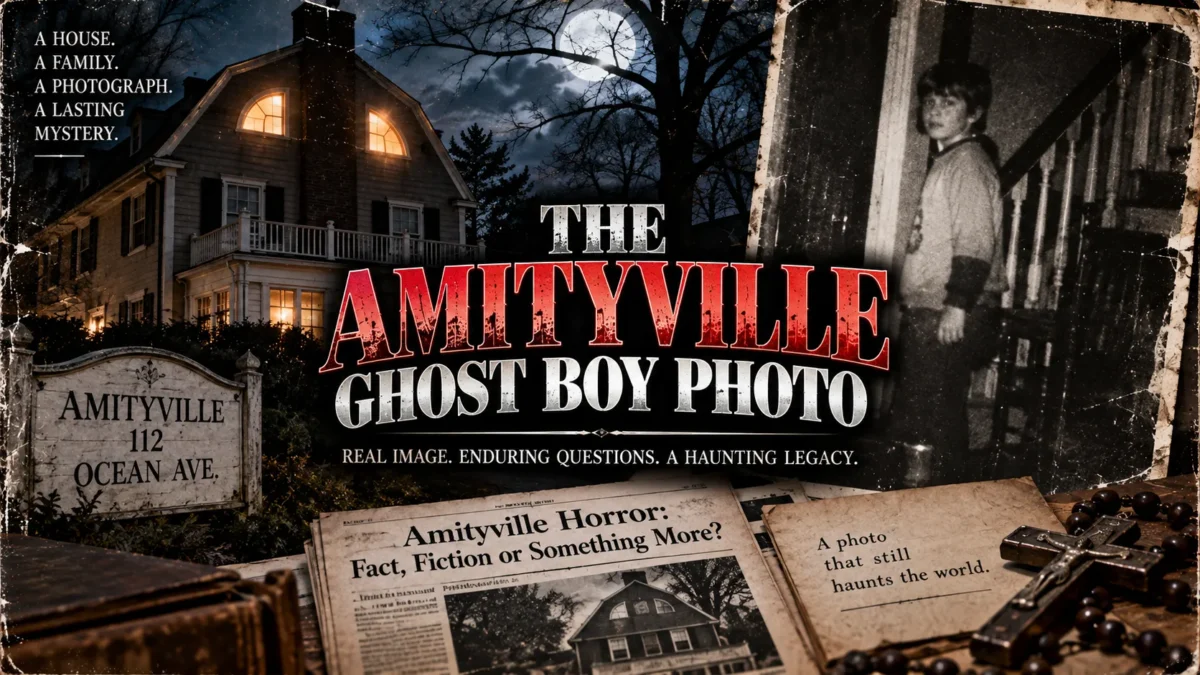
If you’ve spent any time reading about haunted houses, you’ve probably seen it: a grainy black-and-white photo of a dark staircase, with a small pale face and glowing eyes peering out from the shadows.
For decades, this single image has been treated as one of the most compelling pieces of “evidence” ever captured inside America’s most famous haunted house. It’s been reprinted in books, shown on television specials, and shared endlessly online as proof that something otherworldly still lingers at 112 Ocean Avenue.
But the story behind the Amityville ghost boy photo is far messier than most retellings suggest. Taken by a photographer named Paul Bartz during a chaotic night of media attention and paranormal investigation, the image built its reputation on urgency and shock rather than scrutiny.
The deeper you dig into how it was made public, the more the picture starts to look less like undeniable proof and more like a case study in how a grainy photograph, a famous address, and a hungry media cycle can create a legend.
TL;DR: The famous Amityville ghost boy photo, taken by Paul Bartz during a 1976 investigation of the DeFeo/Lutz house, spread for years as proof of a haunting, but the evidence behind it has never held up to real scrutiny.
Setting the Scene: The Real Horror at 112 Ocean Avenue
Before any ghost photo entered the picture, Amityville was already infamous for something far darker than the supernatural. On November 13, 1974, 23-year-old Ronald DeFeo Jr. shot and killed six members of his own family inside the house at 112 Ocean Avenue in Amityville, New York.
His parents and four siblings, including his youngest brother, John Matthew DeFeo, who was just nine years old, died in their beds that night.
The house has since become one of the most infamous addresses in the country, often mentioned alongside other famous American historical homes that draw visitors for very different reasons—history, architecture, or scandal rather than ghosts.
DeFeo was convicted of six counts of second-degree murder in 1975 and sentenced to life in prison, where he remained until his death in 2021.
The house itself sat largely empty and infamous until George and Kathy Lutz bought it at a bargain price and moved in with their children in December 1975.
According to their later, widely disputed account, the family fled just 28 days later, claiming to have experienced terrifying paranormal events inside the home.
That story became the basis for Jay Anson’s 1977 book “The Amityville Horror: A True Story,” followed by the blockbuster 1979 film. It’s important to note that significant parts of the Lutz account have been challenged over the years, including by DeFeo’s own former defense attorney, William Weber, who publicly stated that he and the Lutzes had discussed embellishing details of a haunting to help sell the story.
This context matters, because the ghost boy photo didn’t emerge in a vacuum. It emerged inside a story that was already primed for sensational claims.
What Is the Amityville Ghost Boy Photo?
The Amityville ghost photo shows the interior staircase of the house, dimly lit and slightly out of focus. Near the top of the stairs, viewers can make out what appears to be a small figure, often described as a young boy, with strikingly bright or glowing eyes staring directly into the camera.
Believers have long connected this figure to John Matthew DeFeo, the youngest victim of the 1974 murders, suggesting the photo captured his spirit still lingering in the home.
Whether or not that connection is accurate, the image quickly became one of the most reproduced Amityville ghost images in paranormal media, appearing in countless books, documentaries, and “greatest ghost photos ever taken” roundups.
Unlike many other famous ghost photos, this one carries the extra weight of a very real, very well-documented tragedy behind it. That combination, an infamous crime, a bestselling book, a blockbuster film, and now a photograph, gave the image a kind of built-in credibility that few other paranormal photos ever achieve.
Meet Paul Bartz, the Photographer Behind the Picture
Paul Bartz is the name most closely tied to the Amityville ghost boy photo, and searches for “Paul Bartz Amityville” remain common among people trying to track down the story’s origin.
Bartz wasn’t a ghost hunter by trade; he was a photographer who happened to be present during one of the highly publicized investigations of the house in the mid-1970s.
Because of that one photograph, his name has been permanently linked to the Amityville haunting story ever since.
Over the years, accounts of exactly how and when Bartz took the photo have varied depending on the source, which is itself part of the problem for anyone trying to verify the image’s authenticity. Inconsistent retellings are a common warning sign in paranormal history, and this case is no exception.
The Night the Camera Clicked
The photo is generally tied to one of the media-heavy investigations conducted at the house not long after the Lutz family left, a period when paranormal researchers Ed and Lorraine Warren became involved and press interest in the house was at its peak.
Reporters, photographers, and curious onlookers were granted access to the property, and flash photography was reportedly used throughout the dark rooms and stairwells.
Bartz has described taking a series of photographs that night, one of which, upon development, appeared to show the shadowy figure at the top of the stairs.
In the excitement of the moment, and with a media circus already surrounding the house, the image was treated less like a piece of evidence to be tested and more like a headline waiting to be printed.
That’s a crucial distinction. A photograph taken under chaotic, poorly lit, high-pressure conditions, then immediately shared with a public already primed to believe in a haunting, is not the same as a photograph carefully verified by independent experts before release.
Why This Amityville Ghost Picture Became a Sensation
Once it started circulating, the Amityville ghost picture spread quickly through tabloids, paranormal anthologies, and later, television specials dedicated to the case. It fit perfectly into the existing Amityville Horror narrative, giving the story a visual centerpiece that the book and film alone couldn’t provide.
Audiences already familiar with the DeFeo murders and the Lutz family’s claims had an emotional shorthand ready to go: a murdered child, a haunted staircase, a face in the dark. The photo didn’t need much explanation to feel believable, because the surrounding story had already done most of the persuasive work.
This is a pattern seen again and again with famous ghost photographs. The image itself is often unremarkable on close inspection, but the story wrapped around it does the heavy lifting. It’s the same phenomenon behind other pieces of unlikely Americana, like the infamous Kentucky meat shower of 1876, where a bizarre event snowballed into enduring legend largely because of how the story was told.
The Warrens, the Media, and the Making of a Legend
Ed and Lorraine Warren were already well-known paranormal investigators by the time they became involved with the Amityville case, and their participation added a layer of perceived legitimacy to everything connected to the house. When a demonologist duo with national name recognition puts their reputation behind a haunting, journalists and audiences alike tend to take the claims more seriously.
The timing also mattered enormously. The Amityville Horror book was already a bestseller, and Hollywood was preparing to bring the story to theaters. A dramatic new photograph fit neatly into a media environment hungry for fresh angles on a story the public couldn’t get enough of.
Cracks Begin to Show: What Skeptics Noticed
As the decades passed and the photo kept resurfacing, skeptics and photography analysts began asking harder questions. One of the most frequently raised issues involves those glowing eyes. Bright, reflective eyes in flash photography are a well-documented phenomenon, commonly caused by light bouncing off the retina of a very real, very living person standing in a dark room.
That single detail, often presented as the photo’s spookiest feature, is also one of its most mundane explanations. If a child, whether a crew member’s relative or simply someone else present in the house that night, happened to be standing at the top of the stairs when the flash fired, the resulting “ghost” would look remarkably similar to what appears in the famous frame.
Researchers have also pointed out that accounts of the photo’s origin story shift depending on who is telling it, with details about the date, the exact investigation, and who else was present varying across sources. That kind of inconsistency doesn’t automatically prove a hoax, but it does make independent verification extremely difficult.
The Leading Explanation Behind the Amityville Photo
The most repeated skeptical explanation for the Amityville ghost boy photo is straightforward: a living person, likely a child unaware they’d wandered into the shot, was caught by the camera’s flash in a dark, crowded house full of investigators, reporters, and onlookers. The unusual lighting, grainy film, and low resolution common to 1970s flash photography did the rest, transforming an ordinary moment into an image people wanted to believe was extraordinary.
Bartz himself has maintained over the years that he did not stage the photograph and stands by his account of that night. It’s worth being fair to that position, since there’s no confirmed evidence of deliberate fraud on his part. The more likely issue isn’t a deliberate hoax by the photographer, but rather a case of an ordinary photographic artifact being amplified by an extraordinary story.
Why the Photo Kept Fooling People for Years
A few key factors explain why this particular ghost in Amityville lore managed to hold public fascination for so long. First, the photo emerged in an era before reverse image searches, digital forensics, or widespread photo analysis tools, making it far harder for the average viewer to question what they were seeing.
Second, the image was tied to an already massively popular story. People who had read the book or seen the film arrived at the photo already primed to believe something paranormal had happened in that house, which made critical evaluation less likely.
Third, paranormal media outlets had, and still have, strong incentives to present dramatic photos without heavy caveats. A grainy photo captioned “unexplained” generates far more interest than one honestly labeled “possible flash artifact,” even when the second description is more accurate.
The Larger Amityville Hoax Question
It’s worth zooming out here, because the ghost boy photo doesn’t exist in isolation. The broader Amityville Horror story has faced serious credibility problems for decades, starting with attorney William Weber’s own admission that he had discussed exaggerating aspects of the haunting narrative with the Lutzes to help market the eventual book.
Paranormal investigators, journalists, and skeptics have spent years picking apart inconsistencies between the Lutz family’s original claims and the physical and documentary evidence available. Against that backdrop, a single dramatic photograph taken during a media circus at the house fits a familiar pattern rather than standing as an isolated mystery.
None of this proves that nothing unusual ever happened at 112 Ocean Avenue. It does mean that any single piece of “evidence” from the case, including a famous amityville photo, deserves the same scrutiny as the rest of the story.
Where Things Stand Today
Modern photography analysts and paranormal researchers have far better tools than existed in the 1970s, from digital enhancement to a much wider public understanding of common camera artifacts like flash reflection and lens flare. Revisiting the Amityville ghost boy photo with that knowledge tends to deflate much of its original mystery, even if it doesn’t offer a single, universally accepted final answer.
The image now sits alongside other famous “iconic but unverified” ghost photographs in paranormal history, pictures that became legendary not because they withstood rigorous testing, but because they arrived at exactly the right cultural moment. In that sense, it belongs in the same category as many ocean mysteries we still haven’t solved—cases that endure less because of hard evidence and more because of how compelling the unanswered questions feel. That doesn’t make them worthless as pieces of folklore. It just means they should be enjoyed as compelling stories rather than treated as settled fact.
What This Case Teaches Us About Ghost Photography
The saga of the Amityville ghost boy photo is a useful reminder of how easily a striking image can outrun the facts behind it. A single photo, taken under stressful conditions and released into an already sensational story, can circulate for decades before anyone stops to ask basic questions about how, when, and by whom it was actually made.
That’s not a knock against curiosity about the paranormal. It’s simply a case for applying the same standards to a spooky photograph that we’d apply to any other kind of historical evidence. Interesting stories deserve interesting scrutiny, not blind acceptance.
Final Thoughts on the Amityville Ghost Boy
The Amityville house ghost story has earned its place in American pop culture, built on a genuine tragedy, a bestselling book, and decades of media fascination. The ghost boy photo taken by Paul Bartz became one of the story’s most enduring visual symbols, but enduring popularity and verified authenticity are two very different things.
What we’re left with is a photograph that likely captured something far more ordinary than a ghost, wrapped in a story compelling enough to make millions of people believe otherwise. That, in its own way, might be the most fascinating part of the whole legend.
Frequently Asked Questions
Who is the Amityville Ghost Boy?
The Amityville Ghost Boy refers to a small, pale figure with glowing eyes that appears near the top of a staircase in a famous photograph taken inside the Amityville house. Some believers associate the figure with John Matthew DeFeo, the youngest victim of the 1974 DeFeo family murders, though this connection has never been verified.
Who took the famous Amityville ghost photo?
The photo was taken by a photographer named Paul Bartz during a media-heavy paranormal investigation of the house in the mid-1970s. Bartz has maintained over the years that he did not stage the image.
Who is Paul Bartz?
Paul Bartz is the photographer credited with capturing the Amityville ghost boy photo. He was present during one of the well-publicized investigations of the house and became permanently linked to the Amityville haunting story because of that single photograph.
Is the Amityville ghost photo real?
There is no independently verified evidence that the photo shows a genuine paranormal phenomenon. Many researchers believe the glowing eyes are consistent with a common flash photography artifact caused by light reflecting off the eyes of a living person present in the room.
What actually happened at the Amityville house?
On November 13, 1974, Ronald DeFeo Jr. murdered six members of his family at 112 Ocean Avenue in Amityville, New York. The house later became famous when the Lutz family claimed to experience paranormal events there in late 1975, a story later turned into the bestselling book and film 'The Amityville Horror.'
Is the Amityville house still standing?
Yes, the house still stands in Amityville, New York, though it has been renovated and the address has been changed from the original 112 Ocean Avenue to discourage sightseers. It remains privately owned and is not open to the public.
Why has the Amityville Horror story faced so much skepticism?
Much of the original haunting narrative has been challenged over the years, including by DeFeo's former attorney, William Weber, who said he discussed embellishing parts of the story with the Lutz family. This history has led many researchers to view later additions to the legend, including the ghost boy photo, with significant skepticism.

Alex Warren
Related Articles





