

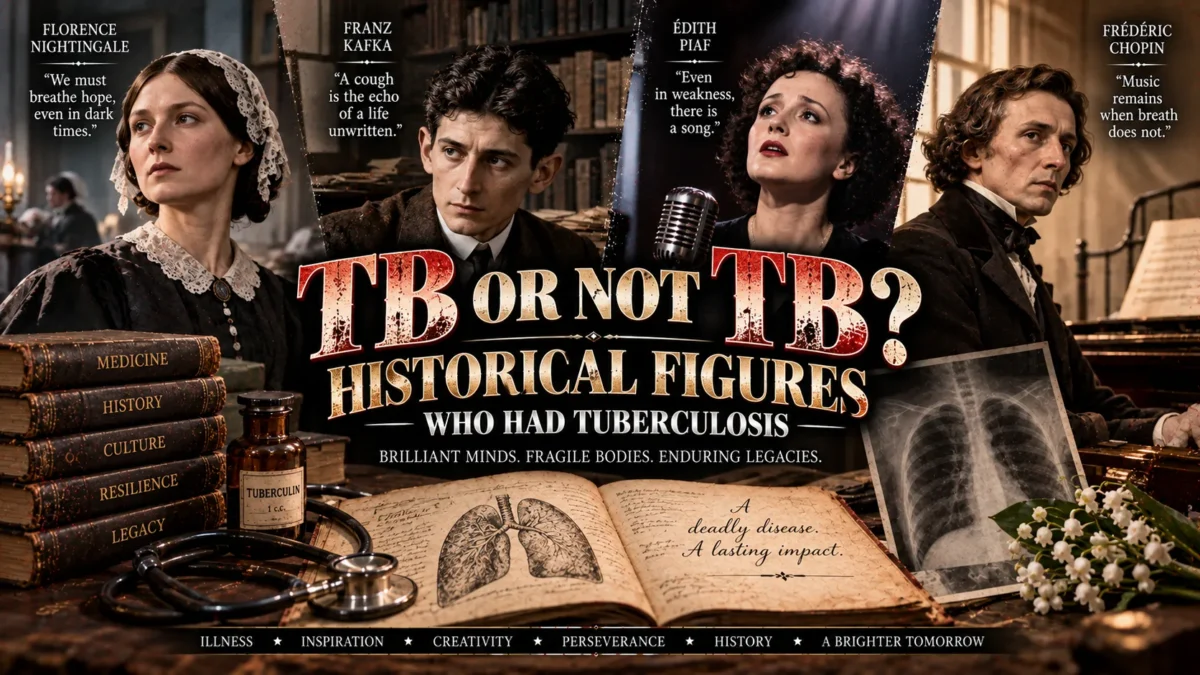
For most of human history, tuberculosis wasn’t just a disease. It was a death sentence wrapped in poetry. Doctors called it “consumption” because it seemed to consume its victims from the inside out, leaving them pale, thin, and feverish before, in most cases, killing them slowly over months or years.
Before antibiotics existed, tuberculosis victims included kings, poets, painters, gunfighters, and future presidents’ wives. It didn’t discriminate by class, talent, or fame, and it left fingerprints on some of the most famous names in history. This list walks through more than twenty of them, separating the well-documented cases from the more speculative ones along the way.
TL;DR: Tuberculosis killed or afflicted an enormous cross-section of history’s most famous writers, artists, leaders, and outlaws, and understanding their stories shows just how deadly “consumption” was before antibiotics arrived in the 1940s.
Why Tuberculosis Touched So Many Famous Lives
Before we get to the list, it helps to understand why tuberculosis famous people cases are so common in history books. TB is caused by the bacterium Mycobacterium tuberculosis, and it spreads through the air when an infected person coughs or sneezes. Crowded 18th and 19th century cities, poor ventilation, and limited medical understanding made it almost impossible to contain.
By the 1800s, tuberculosis is estimated to have caused roughly one in four deaths in parts of Europe, striking especially hard during the Victorian era. It struck the wealthy and the poor alike, though poor nutrition and crowded housing made working-class communities especially vulnerable. Because artists, writers, and performers often lived in exactly those crowded urban conditions, a famous person with tuberculosis was tragically easy to find in nearly every creative field.
There’s also a cultural reason so many well-known TB cases survive in the historical record. The disease’s slow, wasting course inspired a romanticized image of pale, fragile genius that 19th-century writers leaned into heavily. That doesn’t mean the suffering was romantic in real life, but it does explain why so many famous people who died from tuberculosis were artists whose biographies were written and rewritten for generations.
The List: Historical Figures Who Battled Tuberculosis
Here are more than twenty documented or strongly suspected cases of tuberculosis among notable historical figures, spanning royalty, literature, music, politics, and the American frontier.
1. John Keats
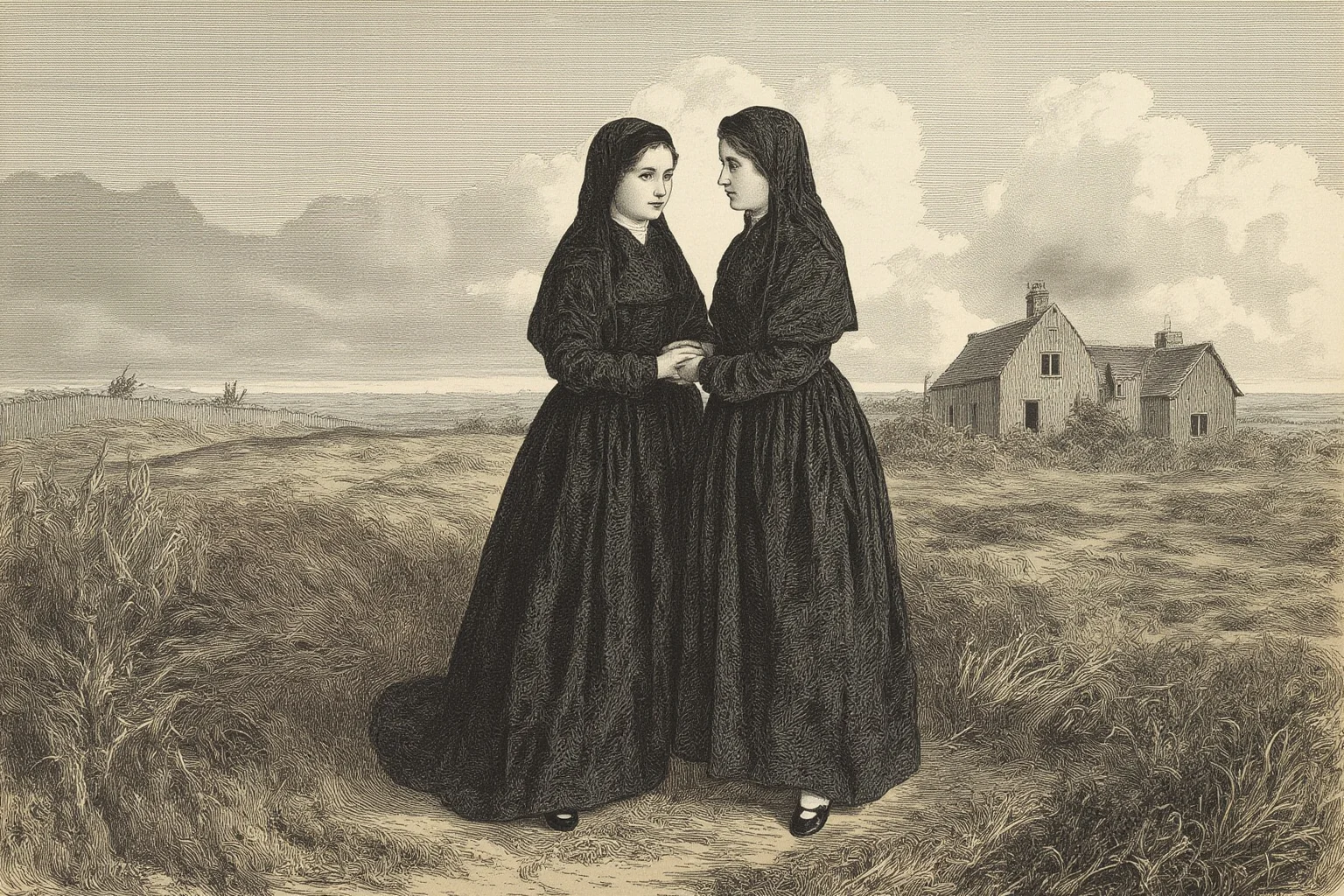
The English Romantic poet trained briefly as a surgeon’s apprentice before turning fully to poetry, and that medical background made his own decline especially painful to watch. He nursed his younger brother Tom through fatal tuberculosis in 1818, and within a year Keats began showing the same symptoms himself.
He moved to Rome in 1820 hoping the warmer climate might help, a common but largely ineffective treatment strategy at the time. Keats died there in February 1821 at just 25 years old, cutting short one of English literature’s most celebrated careers.
2. Emily Brontë

The author of Wuthering Heights fell ill in the autumn of 1848, not long after her brother Branwell’s death, and refused most medical treatment as her condition worsened. Her decline was strikingly fast even by the standards of the disease.
She died in December 1848 at the Brontë family home in Haworth, England. She was only 30 years old.
3. Anne Brontë

Anne, the youngest Brontë sister and author of The Tenant of Wildfell Hall, was diagnosed not long after watching Emily die of the same illness. She traveled to the coastal town of Scarborough in 1849, hoping sea air might slow her decline, a treatment approach widely used for tuberculosis victims of the era.
She died there in May 1849 at age 29, just five months after her sister.
4. Frédéric Chopin
The Polish composer and pianist suffered from chronic respiratory illness for most of his adult life, and his death in Paris in 1849 was long attributed to tuberculosis. Modern researchers have revisited the case, and some now argue his symptoms fit conditions like cystic fibrosis or alpha-1 antitrypsin deficiency just as well.
Without genetic testing on preserved remains, the exact cause remains genuinely debated among medical historians. Chopin’s case is a good reminder that not every historical TB diagnosis is airtight.
5. Franz Kafka

The author of The Metamorphosis and The Trial was diagnosed with tuberculosis in 1917, and the disease shaped the last seven years of his life. He spent long stretches in sanatoriums seeking treatment, including one near Vienna where the illness eventually spread to his larynx.
That throat involvement made eating and speaking excruciating in his final months. Kafka died in 1924 at age 40, largely unpublished during his own lifetime.
6. Robert Louis Stevenson

The author of Treasure Island and Strange Case of Dr Jekyll and Mr Hyde dealt with chronic lung trouble, widely believed to be tuberculosis, from childhood onward. He spent much of his adult life chasing healthier climates, eventually settling in Samoa in the South Pacific.
Stevenson actually lived for decades with his condition, which makes him a genuine example of someone surviving tuberculosis in the 1800s for an extended period. He ultimately died in 1894 from a cerebral hemorrhage rather than TB itself.
7. Doc Holliday

John Henry “Doc” Holliday trained as a dentist before tuberculosis pushed him west in search of a drier climate, a common strategy among tuberculosis victims of the American frontier era. Instead, he became a gambler and gunfighter, best known for his role in the 1881 gunfight at the O.K. Corral in Tombstone, Arizona.
His illness followed him the entire time. He died in Glenwood Springs, Colorado, in 1887 at age 36, reportedly looking at his own bare feet and remarking on the irony of dying in bed rather than in a gunfight.
8. George Orwell

The author of 1984 and Animal Farm had struggled with lung problems since childhood, and he was formally diagnosed with tuberculosis in 1938. A decade later, in 1948, he became one of the first British patients treated with the new antibiotic streptomycin.
The treatment came too late to save him. Orwell died in January 1950 from a pulmonary hemorrhage caused by the disease, just months after finishing his most famous novel.
9. D.H. Lawrence

The controversial author of Sons and Lovers and Lady Chatterley’s Lover was diagnosed with tuberculosis in his twenties and spent much of his later life traveling in search of climates that might ease his symptoms. He lived in Italy, Australia, New Mexico, and the south of France at various points.
None of it stopped the disease’s progress. Lawrence died in Vence, France, in 1930 at age 44.
10. Henry David Thoreau

The author of Walden first contracted tuberculosis as a young man and dealt with recurring bouts of illness for the rest of his life. Some historians believe his time living simply at Walden Pond was, in part, an attempt to improve his health through fresh air and outdoor living.
The disease eventually caught up with him. Thoreau died in Concord, Massachusetts, in 1862 at age 44.
11. Katherine Mansfield

The New Zealand-born short story writer was diagnosed with tuberculosis in 1917 while living in England. She pursued a range of treatments over the following years, including a controversial stay at Georges Gurdjieff’s spiritual institute in France, hoping alternative methods might succeed where conventional medicine hadn’t.
She died there in January 1923 at just 34 years old, cutting short a career many critics consider one of the finest in short fiction.
12. Anton Chekhov

The Russian playwright behind The Seagull and Three Sisters was also a trained physician, which gave him an unusually clear-eyed view of his own tuberculosis diagnosis. He continued writing and even practicing medicine for years after his symptoms began, treating patients despite his own declining health.
He died in 1904 at the German spa town of Badenweiler, where he had traveled for treatment. He was 44 years old.
13. Amedeo Modigliani

The Italian painter and sculptor, known for his elongated portraits, contracted tuberculosis as a teenager in Italy. Life in early 20th-century Paris, marked by poverty and heavy substance use, likely accelerated his decline rather than helping it.
He died in 1920 at age 35 from tubercular meningitis, a severe complication of the disease. His partner, Jeanne Hébuterne, took her own life the following day.
14. Stephen Crane

The American author of The Red Badge of Courage pushed his body hard as a war correspondent, covering conflicts in Greece and Cuba under grueling conditions. His health, likely already compromised by tuberculosis, deteriorated rapidly afterward.
Crane died in Germany in 1900, where he had traveled seeking treatment. He was only 28.
15. Elizabeth Barrett Browning

The English poet suffered from chronic illness starting in her teenage years, with symptoms that many biographers link to a lung condition consistent with tuberculosis, though the exact diagnosis is debated. She continued writing prolifically despite her fragile health, producing celebrated works throughout her marriage to poet Robert Browning.
She died in Florence, Italy, in 1861 at age 55. Her cause of death is still discussed among historians, with lung disease as the leading theory.
16. Vivien Leigh

The actress best remembered for playing Scarlett O’Hara in Gone with the Wind was diagnosed with tuberculosis in the 1940s, a fact not widely publicized at the height of her fame. She experienced recurring bouts of the illness alongside struggles with bipolar disorder for the rest of her life.
Leigh died in London in 1967 at age 53, making her one of the more well-known celebrities with tuberculosis from the 20th century.
17. Eleanor Roosevelt

The longtime American First Lady and human rights advocate developed a rare bone marrow condition later in life that doctors eventually connected to tuberculosis, a form of the disease that can spread beyond the lungs. Diagnosing it took time, since her symptoms didn’t initially resemble classic pulmonary TB.
She died in 1962 at age 78, decades after most of history’s famous tuberculosis victims, illustrating how the disease’s presentation could vary widely.
18. Nelson Mandela
The future South African president contracted tuberculosis in the 1980s while imprisoned, a result of the damp, poorly ventilated conditions common in South African prisons at the time. He was treated and survived, though the illness left lasting effects on his lungs for the rest of his life.
After his release and eventual presidency, Mandela became a prominent advocate for global TB awareness and treatment funding, cementing his place among historical figures who changed the world for the better. His case remains one of the most significant examples of someone surviving tuberculosis in the modern era.
19. Simón Bolívar

The South American revolutionary leader, often called “El Libertador” for his role in liberating several nations from Spanish rule, died in Colombia in 1830. Tuberculosis was the traditional explanation given by contemporaries and early biographers.
Modern historians have proposed alternative theories, including chronic arsenic poisoning, and the true cause remains an active subject of historical debate. As with Chopin, Bolívar’s case shows how difficult retrospective diagnosis can be.
20. Niccolò Paganini

The legendary Italian violinist suffered from chronic illness throughout much of his adult life, and tuberculosis has long been one of several proposed explanations. Others point to complications from mercury-based treatments he received for other conditions, muddying the historical picture considerably.
Because Paganini’s symptoms were so varied and his medical records so incomplete, his exact cause of death is genuinely uncertain. He’s a useful reminder that not every historical illness fits neatly into one diagnosis.
21. Baruch Spinoza
The Dutch philosopher spent years grinding optical lenses as part of his work, a process that exposed him to fine glass dust that may have damaged his lungs over time. He died in 1677 at just 44 years old from what contemporaries described as a wasting lung ailment, commonly labeled tuberculosis by later historians.
Given the era, a definitive modern diagnosis isn’t possible. Still, his case is frequently cited among early documented instances of a famous person with tuberculosis-like illness, and Spinoza is still counted among the smartest people in history despite his early death.
22. Louis XVII of France
The young son of King Louis XVI and Marie Antoinette, known as the “Lost Dauphin,” died in 1795 while imprisoned in the Temple in Paris at just 10 years old. Witness accounts describe symptoms consistent with tuberculosis affecting his joints and lymph nodes, a form sometimes called scrofula.
DNA testing conducted in the 2000s on preserved remains helped settle long-running rumors that the boy had secretly escaped. It confirmed he died in captivity, almost certainly from a tubercular illness worsened by his harsh confinement.
Did Anyone Survive Tuberculosis in the 1800s?
This question comes up constantly, and the honest answer is yes, but survival was far from guaranteed. Before antibiotics, roughly half of all diagnosed tuberculosis cases were fatal, while the other half saw the disease go into a form of remission, sometimes for years or even decades.
Robert Louis Stevenson is a great example of this pattern, living with respiratory illness for most of his life before dying of an unrelated cause. Rest, fresh air, and improved nutrition genuinely could slow the disease’s progress, even though they couldn’t cure it outright.
This understanding led to the rise of the sanatorium movement, starting with physician Hermann Brehmer’s facility in Görbersdorf, Germany, in 1854. Patients were sent to the mountains or seaside for months or years of enforced rest, sunlight, and open-air therapy, and while results varied enormously, some patients did recover enough to resume normal lives.
What didn’t exist until the 20th century was an actual cure. That changed in the 1940s with the discovery of streptomycin by Selman Waksman’s research team, followed by other antibiotics that finally made tuberculosis a treatable, rather than fatal, diagnosis for most patients.
Tuberculosis in the Modern World
It’s tempting to think of tuberculosis as a purely historical disease, but that’s not accurate. TB still infects millions of people worldwide every year, and it remains one of the leading infectious causes of death globally, particularly in regions with limited healthcare access.
Drug-resistant strains have also emerged in recent decades, complicating treatment in ways earlier generations of doctors never had to consider. Nelson Mandela’s later advocacy work highlighted exactly this ongoing struggle, connecting his own personal history with tuberculosis to a much larger global health issue.
The difference between now and the 19th century is enormous, though. Modern antibiotics cure the vast majority of cases when treatment is available and completed properly, something none of the historical figures on this list ever had access to.
Final Thoughts
Looking back at this list, what’s striking isn’t just how many famous people died of tuberculosis, but how varied their lives and circumstances were. Poets in Rome, gunfighters in Arizona, philosophers in Amsterdam, and a future president’s wife in New York all faced the same relentless disease, decades or centuries apart.
Their stories are a reminder of how recent the miracle of antibiotics really is. For most of recorded history, a diagnosis of tuberculosis meant living under a shadow that modern medicine has, for most people, finally lifted.
Frequently Asked Questions
Who are some famous people who died from tuberculosis?
Famous people who died from tuberculosis include poet John Keats, novelists Emily and Anne Brontë, author Franz Kafka, playwright Anton Chekhov, gunfighter Doc Holliday, and writer George Orwell, among many others across different eras and professions.
Did anyone survive tuberculosis in the 1800s?
Yes. Before antibiotics existed, roughly half of diagnosed cases went into remission with rest, fresh air, and good nutrition, though a true cure wasn't possible. Author Robert Louis Stevenson, for example, lived with lung illness for decades before dying of an unrelated cause.
Why did so many writers and artists get tuberculosis?
Tuberculosis spread easily in the crowded, poorly ventilated cities where many 18th and 19th century artists and writers lived and worked. The disease's slow, wasting course also became romanticized in literature, which is part of why so many documented cases involve creative figures.
When did tuberculosis stop being a death sentence?
The turning point came in the 1940s with the discovery of the antibiotic streptomycin by Selman Waksman's research team. Before that, treatment relied mainly on rest, climate, and sanatorium care, which helped some patients but cured no one outright.
Is tuberculosis still a health threat today?
Yes, tuberculosis remains one of the world's leading infectious causes of death, particularly in areas with limited healthcare access, and drug-resistant strains have made some cases harder to treat than in the past.

Alex Warren
Related Articles





