

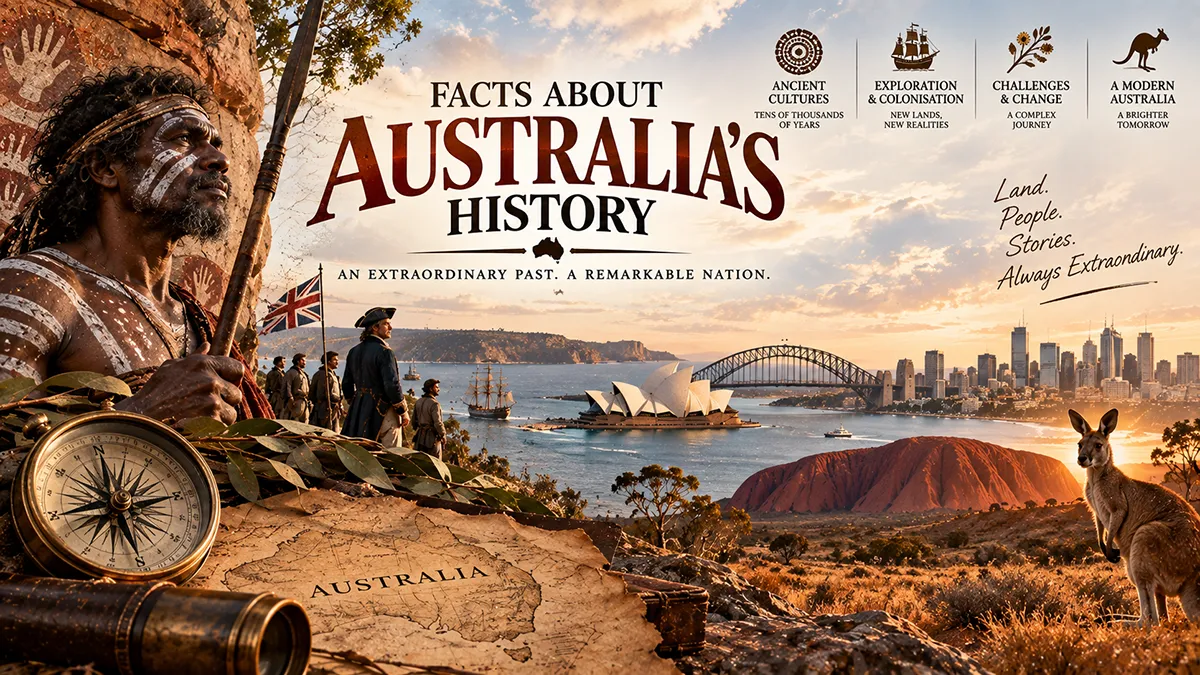
Australian history is far richer and stranger than the sunburnt-country clichés suggest. It stretches back tens of thousands of years before any European ship appeared on the horizon, and it’s shaped by ancient migrations, colonial ambition, gold rushes, world wars, and hard-won social change. Along the way, a few persistent myths have crept into the popular story, and part of understanding Australian history properly means gently correcting them.
This guide walks through the essential facts about Australia’s past in roughly chronological order, from the deep time of the continent’s First Peoples to the modern nation it became in the 20th and 21st centuries. Whether you’re after a brief history about Australia for school, travel, or general curiosity, these 25 facts give you a solid, accurate foundation.
TL;DR: Australian history spans over 65,000 years of Aboriginal and Torres Strait Islander culture through British colonisation, gold rushes, federation, and modern reform, making it one of the world’s most distinctive national stories.
1. Aboriginal and Torres Strait Islander history stretches back at least 65,000 years

Australia is home to the oldest continuous living cultures on Earth, a distinction quite different from the more commonly debated question of the oldest countries in the world, which usually focuses on nation-states rather than unbroken cultural lineages. Archaeological evidence from sites such as Madjedbebe in the Northern Territory suggests Aboriginal peoples have lived on the continent for at least 65,000 years, and possibly longer.
This timeline dwarfs the roughly 235 years since British colonisation began. Any discussion of Australian history that starts in 1788 is only telling a small fraction of the story.
2. Australia was once connected to New Guinea and Tasmania by land
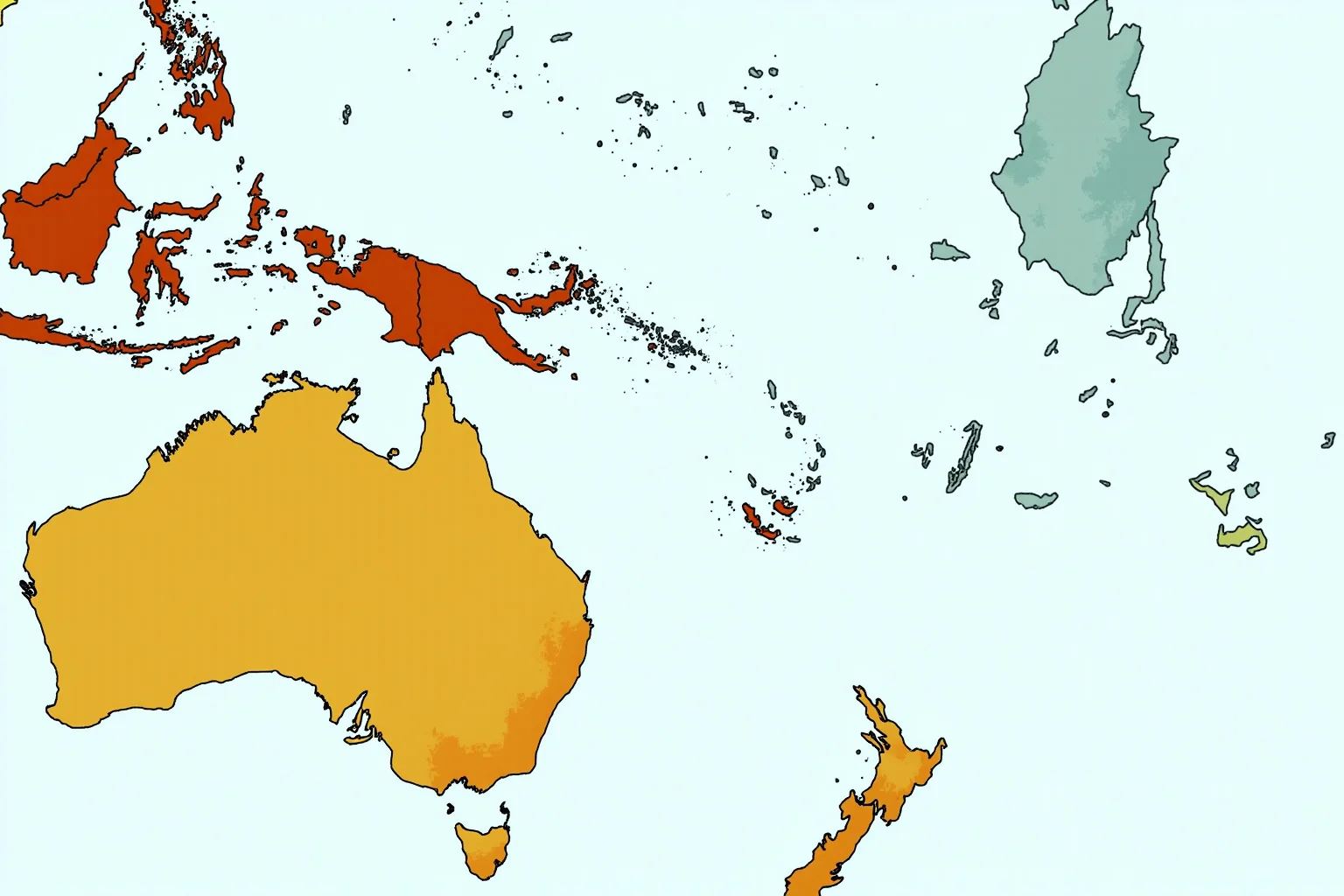
During the last Ice Age, sea levels were much lower, and Australia, New Guinea, and Tasmania formed a single landmass often called Sahul, a small-scale echo of how landmasses have joined and split throughout Earth’s history, as seen on a far grander scale with the ancient supercontinent Pangaea. People and animals could walk between what are now separate places.
Rising seas around 8,000 to 12,000 years ago gradually cut off these land bridges. This explains why Aboriginal groups in far-north Queensland and Torres Strait Islander communities share cultural and historical connections with peoples in New Guinea.
3. There were hundreds of distinct Aboriginal nations before colonisation
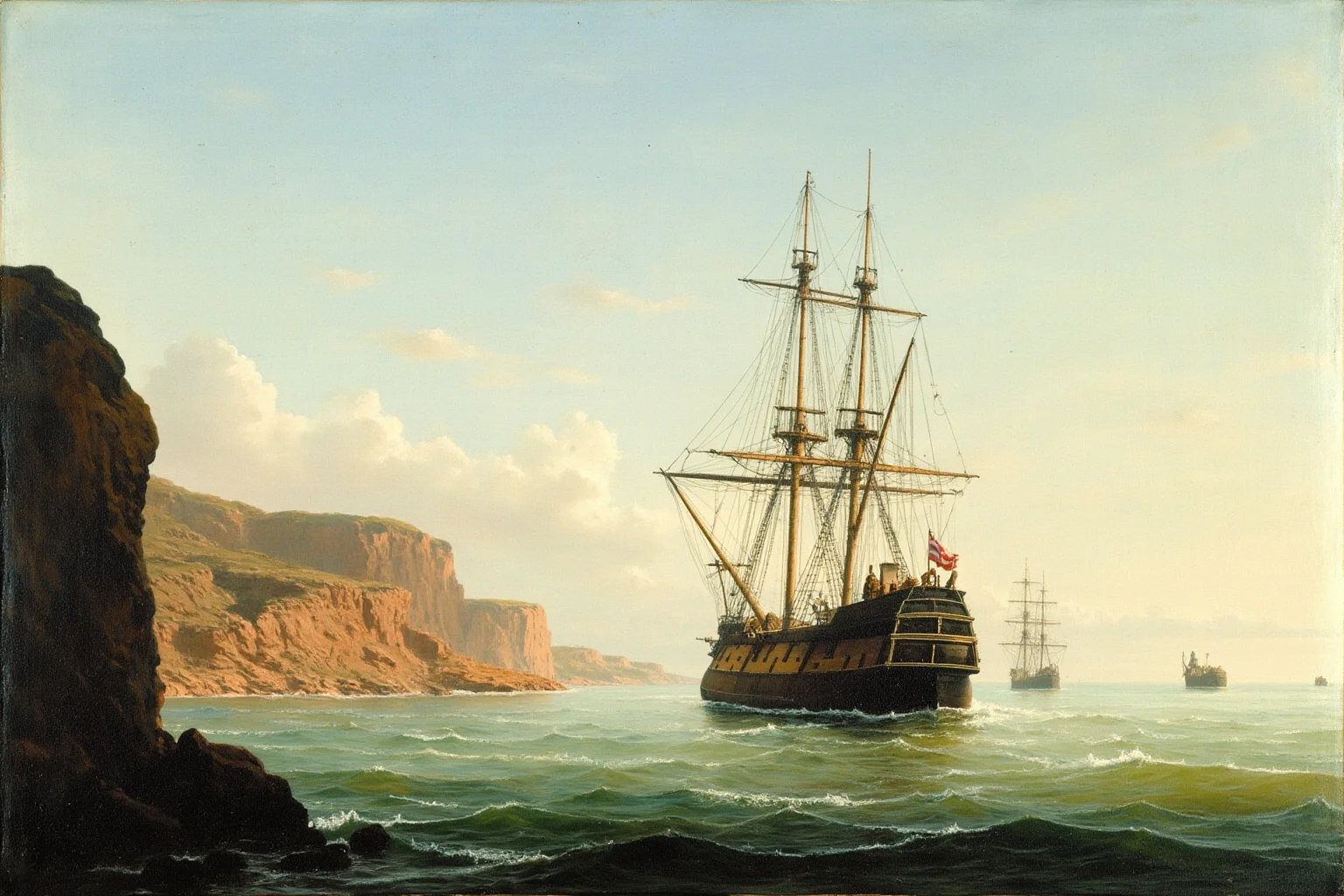
Pre-colonial Australia was not a single culture but a mosaic of several hundred distinct Aboriginal nations, each with its own language, laws, and territory. Estimates suggest between 250 and 750 language groups existed before 1788, depending on how dialects are counted.
Complex systems of land management, trade routes, and kinship connected these groups across the continent. Fire-stick farming, aquaculture systems like those at Budj Bim in Victoria, and seasonal calendars show sophisticated, sustainable land use developed over millennia.
4. A Dutch navigator was the first recorded European to reach Australia
Many people assume Captain Cook was the first European to find Australia, but that’s a myth worth busting straight away. Dutch navigator Willem Janszoon charted part of the western coast of Cape York in 1606, more than 160 years before Cook arrived.
Throughout the 1600s, various Dutch ships mapped sections of the coastline, naming the continent New Holland. Portuguese and other European mariners may have sighted parts of the coast even earlier, though solid evidence is limited.
5. The name Australia comes from a Latin phrase about an imagined southern land
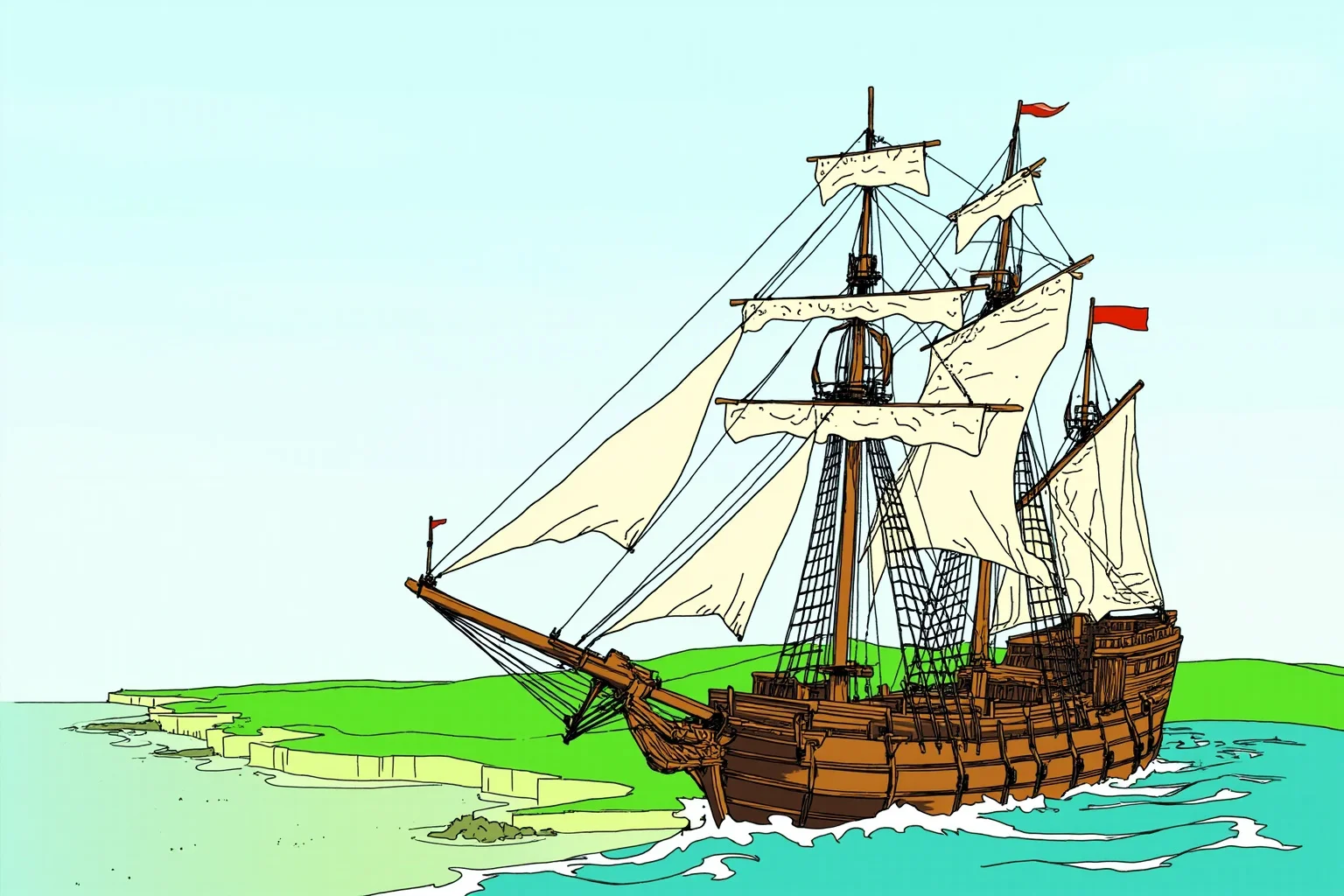
For centuries, European geographers speculated about a great unknown southern continent, referring to it in Latin as “terra australis incognita,” meaning the unknown southern land. The word Australia derives directly from that phrase.
Explorer Matthew Flinders popularised the name Australia in the early 1800s while mapping the coastline, and Governor Lachlan Macquarie later recommended it be formally adopted. Britain officially accepted the name for the continent in 1824.
6. Captain Cook charted the east coast in 1770, he did not discover Australia
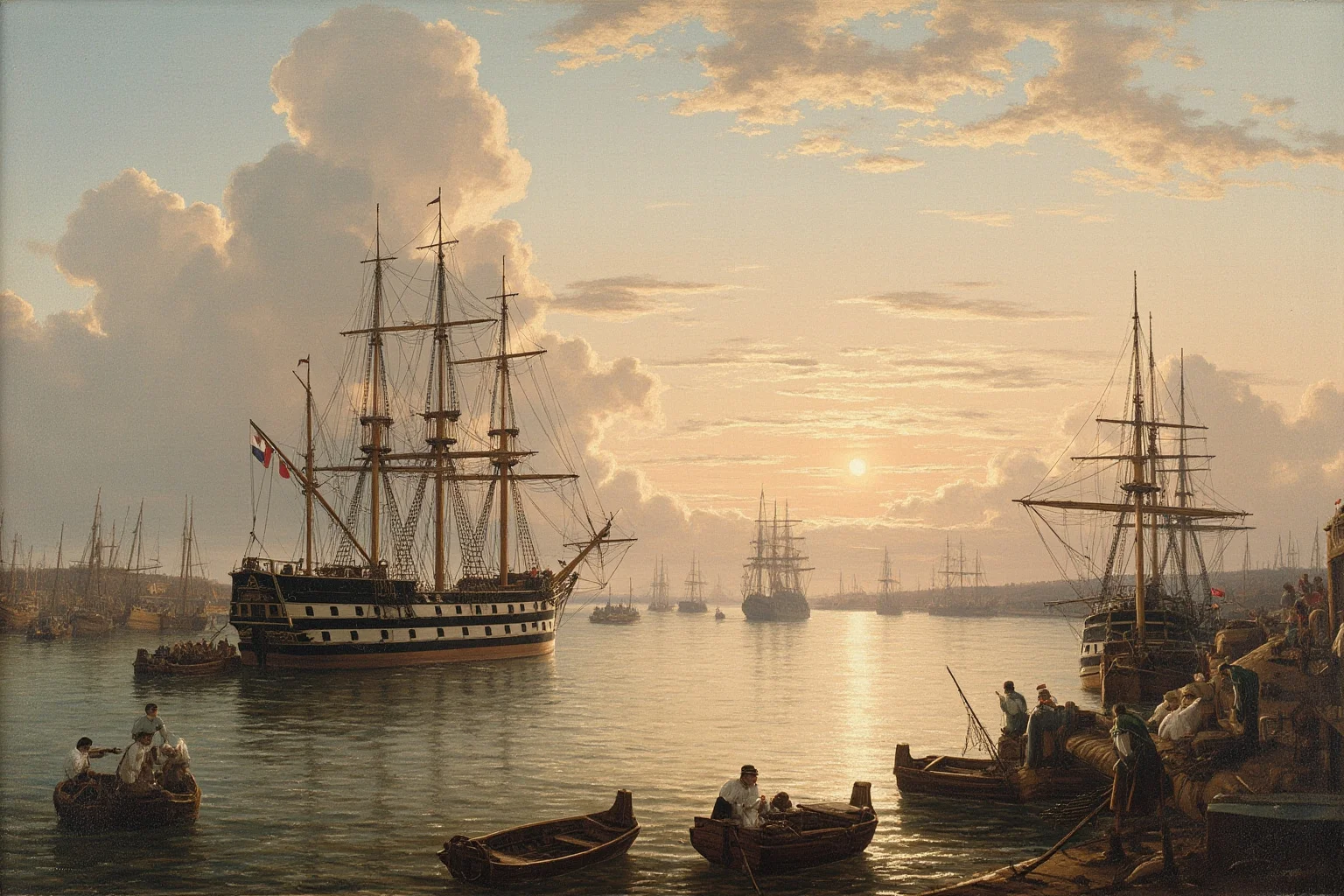
James Cook’s 1770 voyage along Australia’s east coast aboard HMS Endeavour was hugely significant for British interest in the region, and it directly led to colonisation. However, describing this as a “discovery” ignores the tens of thousands of years Aboriginal peoples had already lived there.
Cook claimed the eastern coastline for Britain at Possession Island, naming it New South Wales. His reports back to London set the stage for the First Fleet less than two decades later.
7. The First Fleet arrived in 1788 and established a penal colony

On 26 January 1788, eleven ships known as the First Fleet arrived at Sydney Cove under Captain Arthur Phillip, establishing the first British colony in Australia. It was founded primarily as a penal settlement, partly because Britain had lost access to its American colonies for transporting convicts.
Around 1,000 people arrived on those ships, including roughly 750 convicts along with marines, officers, and their families. This date is now commemorated as Australia Day, though it remains a contested and painful anniversary for many Aboriginal and Torres Strait Islander people, who often call it Invasion Day or Survival Day.
8. The legal doctrine of terra nullius wrongly treated the land as empty
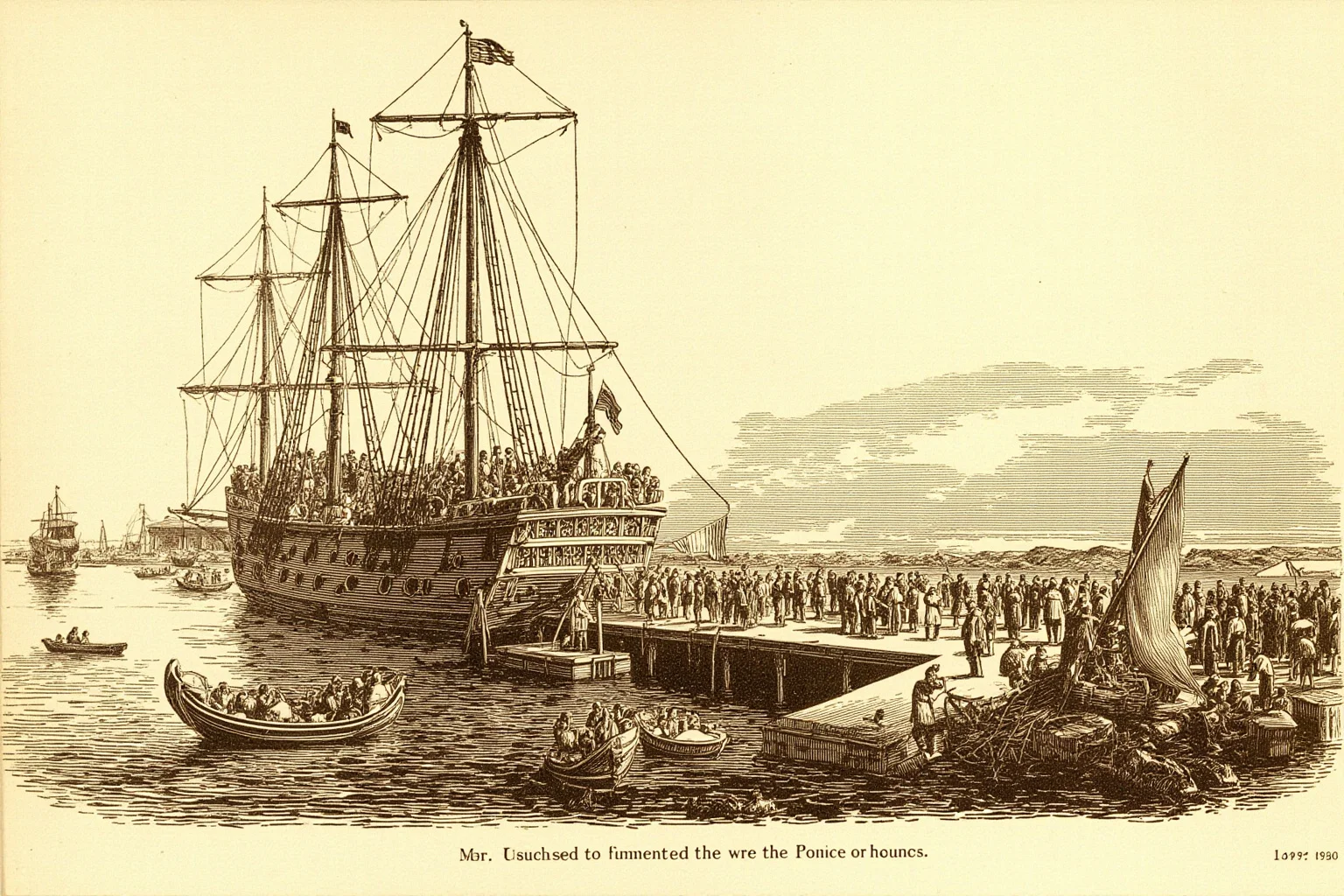
British colonisation was justified using the legal concept of terra nullius, Latin for “land belonging to no one.” This ignored the fact that Aboriginal peoples had complex systems of law, land ownership, and governance across the entire continent.
This doctrine had lasting legal consequences, denying Aboriginal land rights for two centuries. It was not formally overturned until the Mabo decision in 1992, which is covered further down this list.
9. Convict transportation to Australia lasted 80 years and moved over 160,000 people

Between 1788 and 1868, Britain transported around 162,000 convicts to Australian colonies. Many were convicted of relatively minor offences such as theft, and sentences were often disproportionate to the crime by modern standards.
Not everyone sent to Australia was a hardened criminal; some were political prisoners, including Irish rebels. Convict labour built much of early colonial infrastructure, from roads and bridges to public buildings still standing today.
10. The Frontier Wars were a prolonged, often unacknowledged conflict
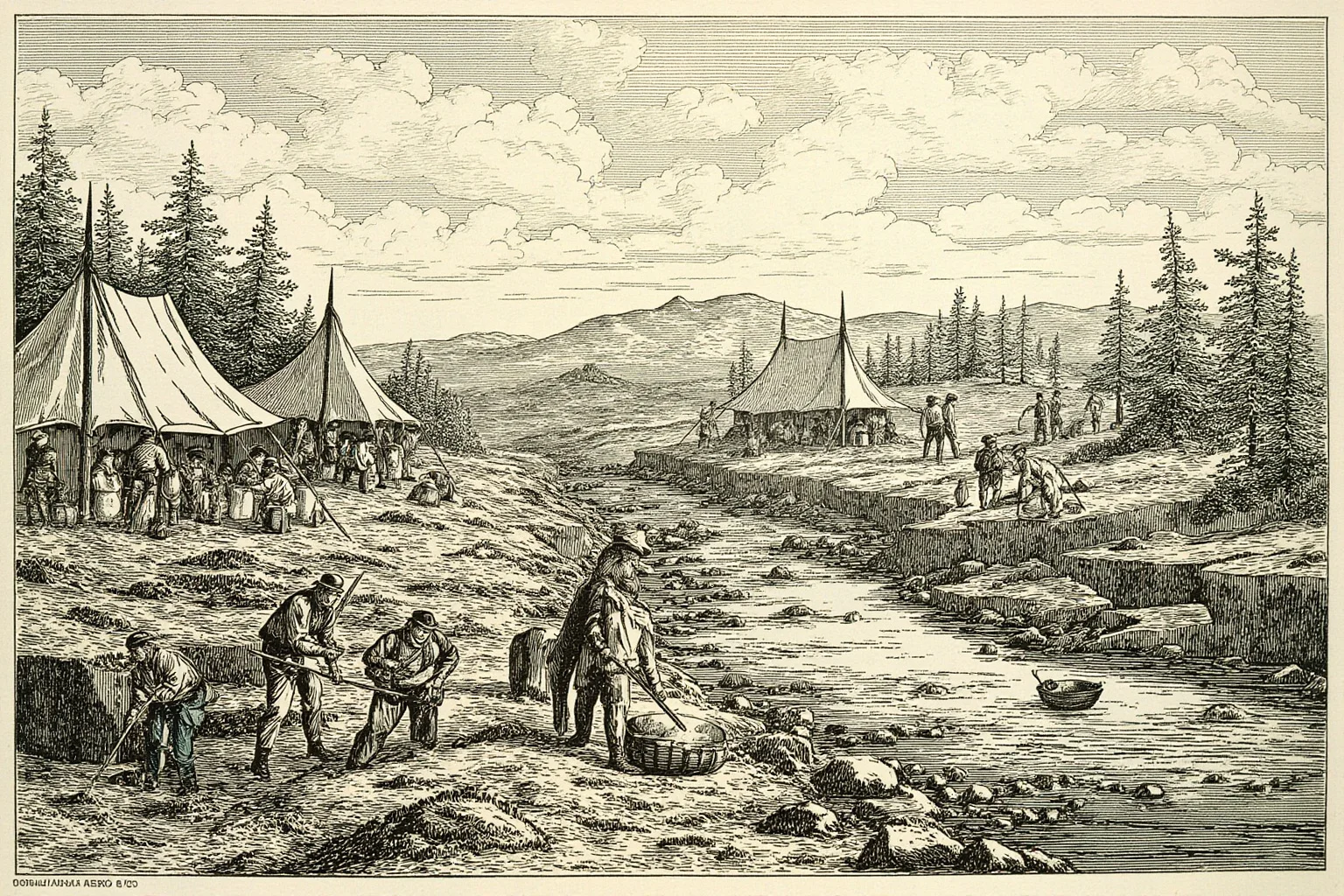
As colonisation expanded, violent conflict broke out between Aboriginal peoples defending their land and colonial settlers and authorities. Historians refer to this period, spanning roughly from 1788 into the early 20th century, as the Australian Frontier Wars.
Thousands of Aboriginal people and some colonists died in these clashes, including massacres, guerrilla resistance, and reprisals. For much of the 20th century this history was largely omitted from mainstream accounts, though it has received far greater historical recognition in recent decades.
11. The 1850s gold rushes transformed Australia’s population and economy
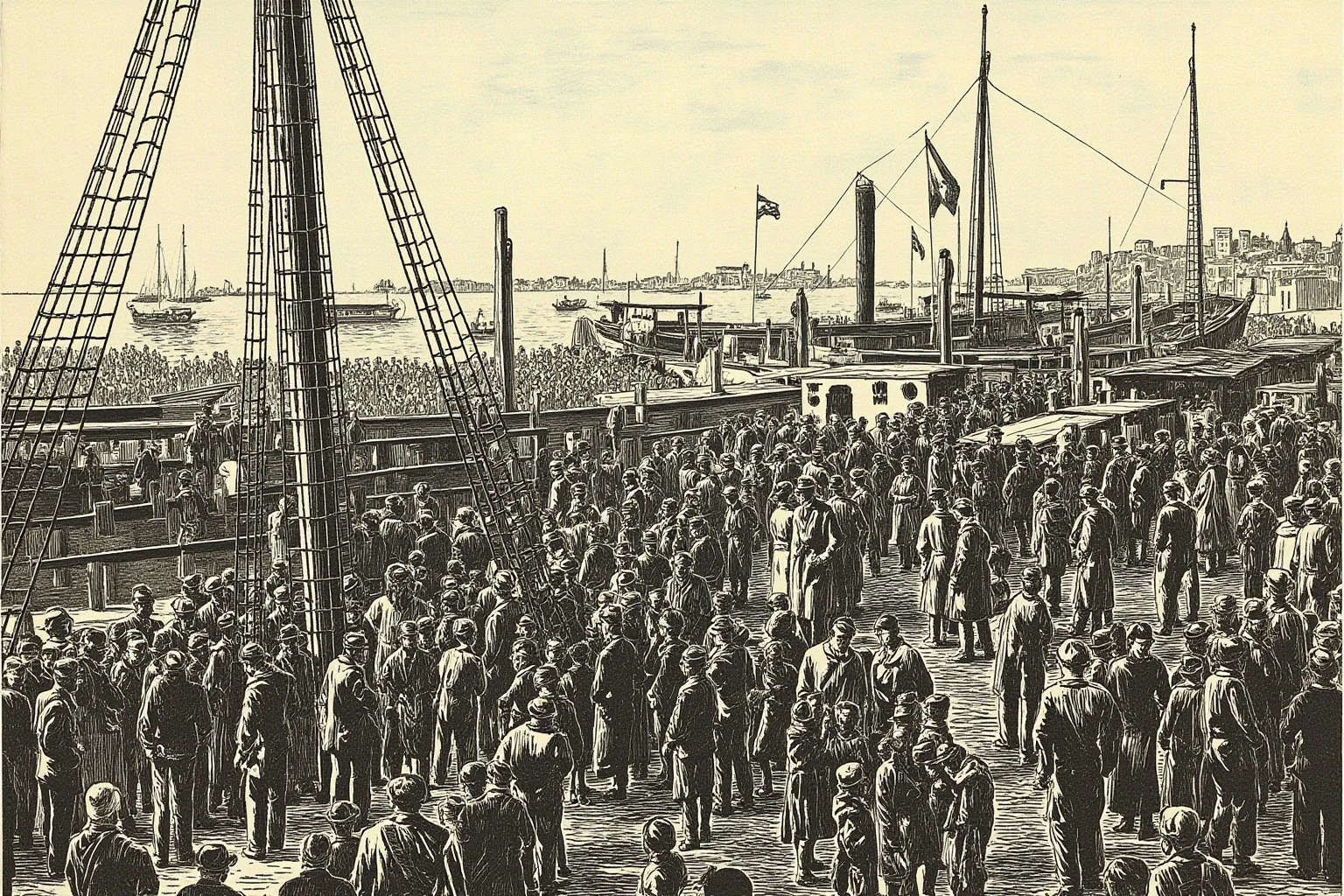
The discovery of gold in New South Wales and Victoria in 1851 triggered a massive rush of migrants from Britain, Europe, China, and the Americas. Victoria’s population alone grew roughly sevenfold during the 1850s as fortune-seekers poured in.
This sudden wealth and population growth reshaped colonial society, fuelling the growth of cities like Melbourne and Ballarat. It also brought new cultural diversity, though this era saw significant discrimination against Chinese miners in particular.
12. The Eureka Stockade is often called the birthplace of Australian democracy

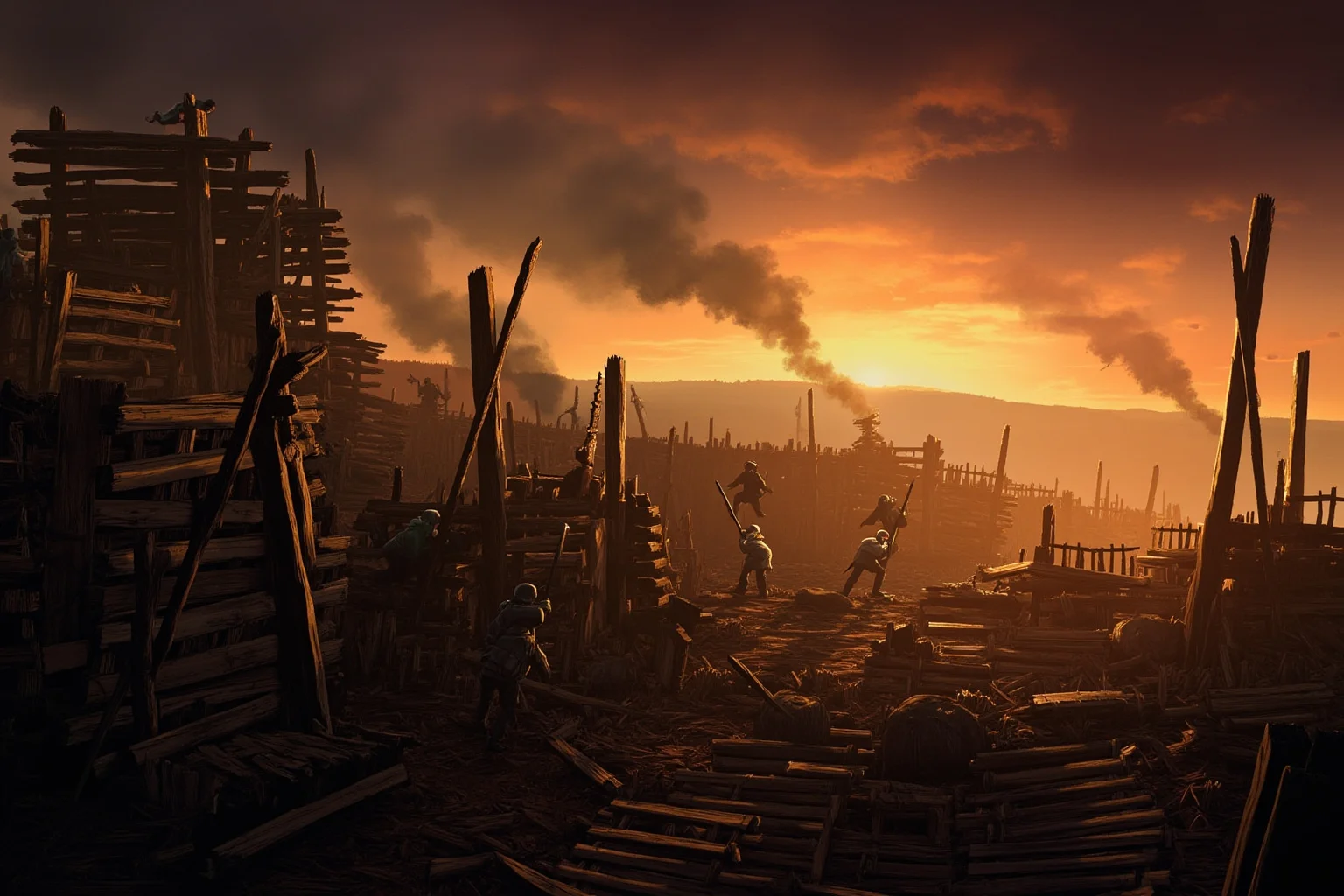
In 1854, gold miners in Ballarat rebelled against unfair licensing fees and lack of political representation, building a wooden stockade and clashing with colonial troops. Around 22 miners and several soldiers died in the brief but fierce battle.
Though the rebellion was crushed, it sparked major political reforms, including expanded voting rights for men in Victoria. Many historians view Eureka as a foundational moment in the push toward Australian democratic institutions.
13. Bushrangers became folk figures in colonial Australian society
Outlaws known as bushrangers, most famously Ned Kelly, roamed the colonial countryside from the early 1800s through to the 1880s. Some were escaped convicts, while others were rural bandits who robbed banks, coaches, and mail runs.
Ned Kelly’s homemade armour and eventual capture and execution in 1880 turned him into an enduring, if controversial, figure in Australian folklore. Public opinion on bushrangers has always been divided between viewing them as violent criminals and as symbols of resistance to colonial authority.
14. Federation in 1901 united six colonies into one nation
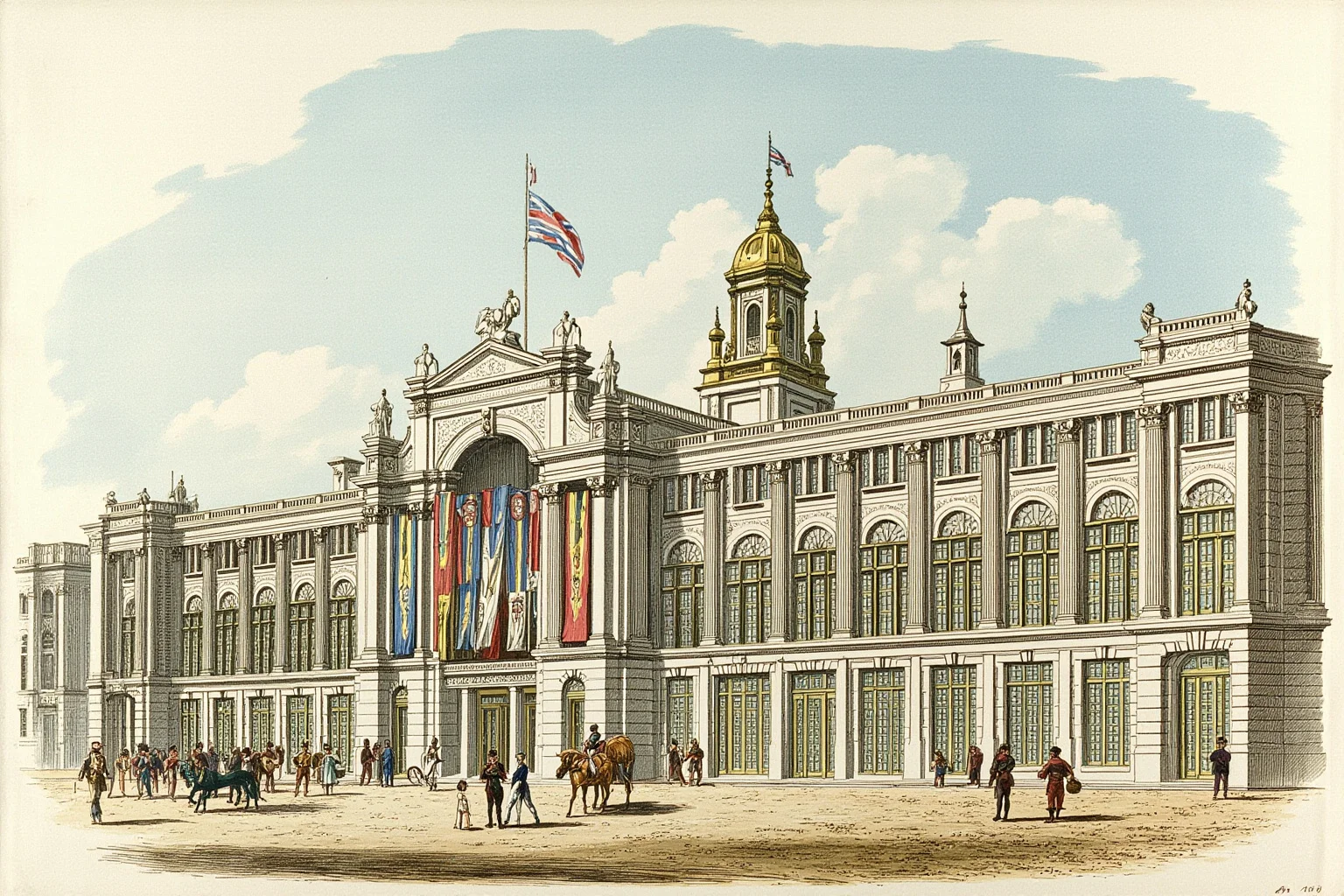
On 1 January 1901, the separate British colonies of New South Wales, Victoria, Queensland, South Australia, Western Australia, and Tasmania united to form the Commonwealth of Australia. This process, called Federation, followed years of debate, referendums, and drafting of a national constitution.
Edmund Barton became the first Prime Minister of the newly formed nation. Australia remained within the British Empire, one of the greatest empires in history, and full legal independence developed gradually over subsequent decades rather than through a single dramatic break.
15. The White Australia Policy restricted immigration for much of the 20th century
One of the new Commonwealth’s first major pieces of legislation, the Immigration Restriction Act of 1901, aimed to limit non-European immigration. This set of policies, broadly known as the White Australia Policy, remained influential in various forms until it was progressively dismantled between the 1950s and 1973.
This is an uncomfortable but important part of Australian historical fact, reflecting the racial attitudes of the era. Its formal end paved the way for the multicultural immigration policies that reshaped the country in the following decades.
16. Gallipoli in 1915 forged the Anzac legend

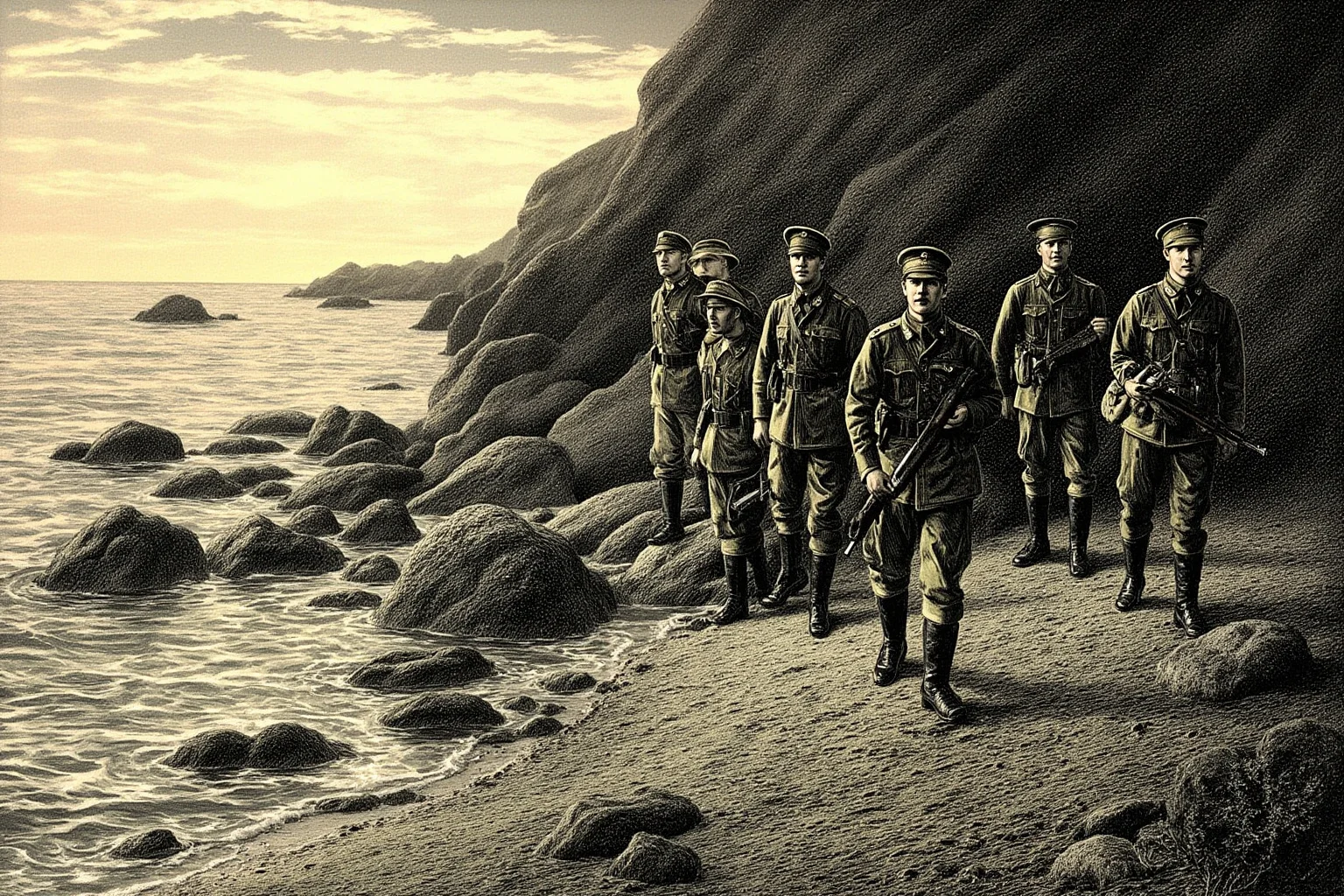
When World War I broke out, Australia, still closely tied to Britain, sent troops to fight overseas. The landing of Australian and New Zealand Army Corps (Anzac) soldiers at Gallipoli in Turkey on 25 April 1915 became one of the defining events in Australian national memory.
The campaign was ultimately a military failure, with heavy casualties on both sides over eight months of fighting. Anzac Day, commemorated every 25 April, grew out of this event and remains one of Australia’s most significant national occasions.
17. Darwin was bombed by Japanese forces during World War II
On 19 February 1942, Japanese aircraft attacked Darwin in the Northern Territory, killing at least 235 people in the deadliest single attack ever launched on Australian soil. It was the first of more than 60 air raids on northern Australia during the war.
This brought the reality of global conflict directly to Australian territory for the first time. Australian troops also fought a brutal campaign against Japanese forces along the Kokoda Track in Papua New Guinea that same year.
18. Post-war immigration reshaped Australian society

After World War II, Australia launched a major immigration program, encouraging arrivals from Britain and increasingly from continental Europe. The Snowy Mountains Hydro-Electric Scheme, built largely by immigrant labour from the late 1940s, became a symbol of this new multicultural workforce.
Over subsequent decades, immigration broadened further to include people from across Asia and the Middle East. This gradual shift laid the groundwork for the culturally diverse Australia recognised today.
19. The 1967 referendum changed how Aboriginal Australians were counted and governed

In May 1967, Australians voted overwhelmingly, over 90 percent in favour, in a referendum to amend the Constitution regarding Aboriginal people. The changes allowed the Commonwealth government to make laws for Aboriginal Australians and included them in the national census.
Contrary to a common misconception, the referendum did not grant Aboriginal people the right to vote, since that had already been established at a federal level earlier in the 20th century. It remains, however, one of the most important civil rights milestones in Australian history.
20. The Whitlam government introduced sweeping reforms in the 1970s

Gough Whitlam’s Labor government, elected in 1972, ended conscription for the Vietnam War, introduced the universal healthcare scheme Medibank, and made university education free. It also formally recognised the People’s Republic of China and pushed forward Aboriginal land rights policy.
These reforms significantly reshaped Australian social policy in a short period. The pace and scale of change made the Whitlam years one of the most consequential periods in modern Australian political history.
21. The 1975 constitutional crisis saw a sitting Prime Minister dismissed
In November 1975, Governor-General Sir John Kerr dismissed Prime Minister Gough Whitlam amid a deadlock over government funding in the Senate. This remains the only time in Australian history that a Governor-General has removed an elected Prime Minister.
The event triggered intense debate about the powers of the Governor-General and the reserve powers of the Crown in Australia’s system of government. It remains a significant reference point in discussions about Australian constitutional reform and republicanism.
22. The Mabo decision overturned terra nullius in 1992

In a landmark 1992 High Court case, Eddie Mabo and fellow Torres Strait Islander plaintiffs successfully argued that the Meriam people held native title over the Murray Islands. The ruling formally rejected the doctrine of terra nullius that had underpinned Australian land law since colonisation.
This decision led directly to the Native Title Act 1993, creating a legal pathway for Aboriginal and Torres Strait Islander groups to claim rights over traditional lands. It stands as one of the most significant legal turning points in Australian history.
23. Sydney hosted the 2000 Olympic Games
The Sydney 2000 Olympic Games were widely praised as one of the most successful Games in modern history, showcasing Australia to a global television audience. Cathy Freeman’s gold medal win in the 400 metres, as an Aboriginal athlete competing in front of a home crowd, became one of the most memorable moments in Australian sporting history.
The Games also served as a moment of national reflection on reconciliation, coming just a few years after the Bringing Them Home report on the Stolen Generations. It remains a touchstone of Australian identity in the early 21st century.
24. A national apology to the Stolen Generations was delivered in 2008

For much of the 20th century, government policies forcibly removed Aboriginal and Torres Strait Islander children from their families, a practice now referred to as the Stolen Generations. On 13 February 2008, Prime Minister Kevin Rudd delivered a formal national apology to those affected, following years of advocacy and the 1997 Bringing Them Home report.
The apology was a significant symbolic step, though debates about further reparations and reconciliation measures have continued since. It’s a reminder that Australian history facts are not confined to the distant past; some of the most important reckonings are still unfolding within living memory.
25. Australia voted against becoming a republic in 1999
In a 1999 referendum, Australians voted on whether to replace the British monarch with an Australian head of state chosen by Parliament. The proposal was rejected, with just under 55 percent voting no, partly due to disagreement over the specific model proposed rather than opposition to a republic itself.
Australia remains a constitutional monarchy today, with the British monarch as head of state represented locally by the Governor-General. The republic debate has resurfaced periodically since, and it remains an open question in Australia’s ongoing constitutional story.
Why This History Still Matters Today
Understanding Australia’s historical facts isn’t just an academic exercise; it shapes how the country understands its identity, its ongoing debates about land rights, and its relationship with Aboriginal and Torres Strait Islander peoples. The gap between the 65,000-year Aboriginal history and the roughly two-century colonial history is central to nearly every major debate in modern Australian politics and culture.
From the Mabo decision to the Stolen Generations apology, much of the most significant historical reckoning has happened within the last 30 years. That suggests Australia’s history is still very much being written, reinterpreted, and, in some cases, corrected as new evidence and perspectives come to light.
Whether you’re drawn to the ancient stories of the continent’s First Peoples, the dramatic arrival of the First Fleet, or the pivotal court decisions and referendums of the modern era, Australian history rewards a closer look. It’s a story with far more depth, complexity, and ongoing relevance than the simplified textbook version often suggests.
Frequently Asked Questions
What is a brief history about Australia?
In brief, Australia's history spans at least 65,000 years of Aboriginal and Torres Strait Islander culture, followed by European exploration from the 1600s, British colonisation starting in 1788, gold rushes in the 1850s, federation into a single nation in 1901, involvement in both World Wars, and major 20th-century milestones like the 1967 referendum and the 1992 Mabo decision. It moved from a collection of British colonies to an independent, multicultural nation over roughly two centuries.
What are some quick history facts of Australia?
Some key facts: Aboriginal peoples have lived in Australia for at least 65,000 years, making it home to the world's oldest continuous cultures; the First Fleet arrived in 1788; the continent's six colonies federated in 1901; and the 1967 referendum and 1992 Mabo decision were major turning points in Aboriginal rights and land law.
Who really discovered Australia?
Aboriginal peoples arrived in Australia at least 65,000 years before any European contact, so they cannot be said to have been 'discovered' by outsiders. Among Europeans, Dutch navigator Willem Janszoon was the first recorded to reach Australian shores in 1606, well before Captain Cook charted the east coast in 1770.
Why is Australia’s national day controversial?
Australia Day is held on 26 January, marking the 1788 arrival of the First Fleet at Sydney Cove. Many Aboriginal and Torres Strait Islander people view this date as marking the start of dispossession and conflict, referring to it instead as Invasion Day or Survival Day, which is why the date remains a subject of ongoing national debate.
When did Australia become independent from Britain?
Australia did not gain independence in one single moment. Federation in 1901 created the Commonwealth of Australia, but full legal independence developed gradually, with key milestones including the Statute of Westminster Adoption Act 1942 and the Australia Act 1986, which removed the last legal ties to the British Parliament.
What was the White Australia Policy?
The White Australia Policy refers to a series of immigration laws, beginning with the Immigration Restriction Act 1901, designed to limit non-European migration to Australia. These policies were progressively dismantled between the 1950s and 1973, paving the way for the multicultural immigration system Australia has today.

Alex Warren
Related Articles





