

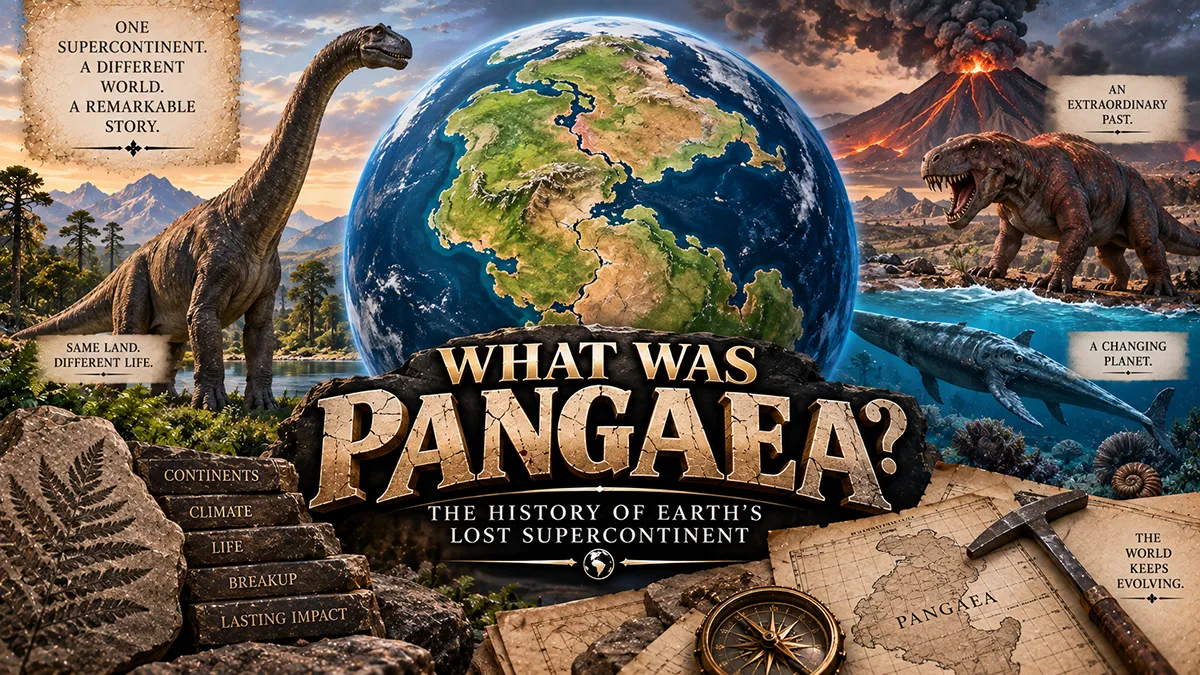
Close your eyes and picture a map with no oceans splitting the continents apart. No Atlantic separating the Americas from Europe and Africa, no Indian Ocean dividing India from Antarctica—a world so connected that the modern question of who really discovered America first would have been meaningless, since there was no ocean to cross at all.
Just one enormous landmass surrounded by a single, world-spanning sea. That landmass had a name, and geologists still study it today: Pangaea.
Pangaea often gets treated like a settled, simple fact from a school textbook diagram, but the real story is richer and stranger than the cartoon version.
It involves a meteorologist who was mocked for decades, an ocean that no longer exists, and a slow-motion breakup that is technically still happening right now. Let’s dig into what Pangaea actually was, how scientists figured it out, and why it still matters.
TL;DR: Pangaea was a single supercontinent that existed roughly 335 to 175 million years ago, formed when Earth’s landmasses collided together and later broke apart to create the continents we live on today.
What Is Pangaea? A Clear Definition
So what is Pangaea, exactly? In the simplest terms, Pangaea was a supercontinent, a single enormous landmass made up of nearly all of Earth’s continental crust squeezed together into one shape.
The word itself comes from Greek, combining “pan” meaning “all” or “entire,” and “Gaia,” the personification of the Earth, so Pangaea essentially translates to “all the Earth” or “whole Earth.”
If you are looking for a strict definition of Pangaea in science, geologists define it as the most recent supercontinent in Earth’s history, existing from the late Paleozoic Era into the early Mesozoic Era.
It formed as ancient continental plates drifted together, and it later split apart through the same tectonic forces, in a process called continental drift, to eventually form the seven continents we recognize today.
You will see both “Pangaea” and “Pangea” used interchangeably, and both spellings are considered correct. Pangaea is the more traditional spelling closer to the original Greek, while Pangea is a simplified, commonly used variant, especially in casual or American writing.
You may also come across misspellings like “Pangeaea” or “Panagaea,” but these are simply typos of the same word, not a different concept.
In a sentence, Pangaea might be used like this: “About 300 million years ago, nearly all of Earth’s land was joined together in a single supercontinent called Pangaea.” That single sentence actually captures the core definition that most people are searching for.
The Scientist Behind the Supercontinent Theory
The idea of Pangaea did not appear out of nowhere. It grew out of a broader concept called continental drift, most famously championed by German meteorologist and geophysicist Alfred Wegener in the early twentieth century, a mind now often counted among the smartest people in history despite the ridicule he faced in his own lifetime.
Wegener noticed that the coastlines of South America and Africa seemed to fit together like puzzle pieces, and he was not the first to notice this, but he was among the first to build a serious scientific argument around it.
In 1912, Wegener proposed that the continents had once been joined and had since drifted apart, a theory he detailed further in his 1915 book “The Origin of Continents and Oceans.”
He pointed to matching fossil records, similar rock formations on continents separated by oceans, and shared ancient plant and animal species as evidence. At the time, many geologists dismissed his ideas because he could not adequately explain the mechanism that would cause continents to move.
It took several more decades, and the mid-twentieth century discovery of plate tectonics and seafloor spreading, for scientists to accept that Wegener had been largely right. Today, the theory of plate tectonics provides the mechanism Wegener lacked, explaining how the rigid plates of Earth’s crust float on a slowly shifting layer of the mantle beneath them.
This is really what people mean when they ask about “Pangaea theory”: it is the application of continental drift and plate tectonics to explain how one supercontinent formed and how it eventually broke apart.
When Did Pangaea Form? Getting the Timeline Right
Pangaea did not form overnight, and it did not exist for all of Earth’s history either. Most geologists place its formation at around 335 to 300 million years ago, during the late Carboniferous Period, as ancient landmasses gradually collided over tens of millions of years.
The supercontinent is generally considered fully assembled by the early Permian Period, roughly 300 to 270 million years ago.
So which era did Pangaea form in? The assembly process spanned the late Paleozoic Era, straddling the Carboniferous and Permian Periods.
Pangaea then persisted through most of the Permian Period and into the Triassic Period, before beginning to break apart around 200 to 175 million years ago, near the boundary of the Triassic and Jurassic Periods.
That means Pangaea’s total lifespan as a unified landmass was roughly 100 to 160 million years, depending on how you define its start and end points. For context, that is longer than the entire time that has passed since the extinction of the dinosaurs.
Pangaea’s age, in other words, is measured in hundreds of millions of years, not merely tens of millions. To put that in perspective, even the oldest people in history lived only around a century, a blink of an eye compared to Pangaea’s hundreds-of-millions-of-year lifespan.
How Was Pangaea Formed?
Pangaea formed through the same forces that continue to reshape Earth’s surface today: plate tectonics. Earth’s crust is broken into large, rigid plates that float on a hot, slowly deforming layer of rock called the mantle. Over vast stretches of time, these plates drift, collide, and separate, driven by heat moving within the planet’s interior.
Before Pangaea existed, Earth’s landmasses were arranged into earlier configurations, including smaller continents and even earlier supercontinents. Through a long series of collisions, these separate landmasses gradually merged. Major mountain-building events, like the collision that formed the Appalachian and Ural mountain ranges, mark the sutures where ancient continents joined together to create Pangaea.
This was not a single dramatic event but an extremely slow process, unfolding over tens of millions of years, at rates similar to how continents move today, just a few centimeters per year. It is worth remembering that the same tectonic forces that built Pangaea are the ones that eventually tore it apart again.
What Did Pangaea Actually Look Like?
Picture a giant, C-shaped landmass stretching from near the North Pole down toward the South Pole, and you have a rough idea of Pangaea’s shape. It was surrounded by a single, colossal global ocean called Panthalassa, whose name fittingly means “all seas.” Tucked into the inner curve of the C shape was a smaller sea called the Tethys Ocean, which separated the northern and southern portions of the supercontinent.
Geologists often describe Pangaea as being composed of two major regions. The northern portion, called Laurasia, roughly corresponded to what would later become North America, Europe, and much of Asia. The southern portion, called Gondwana, roughly corresponded to what would later become South America, Africa, Antarctica, India, and Australia.
Because Pangaea stretched across such a wide range of latitudes, its climate varied dramatically from region to region. Interior areas, far from the moderating effects of the ocean, likely experienced extreme seasonal temperature swings and vast arid deserts, while coastal regions were more temperate and humid.
Life During the Age of Pangaea
The supercontinent’s existence overlapped with major chapters in the history of life on Earth. Pangaea’s assembly during the Permian Period coincided with the rise of early reptiles and the ancestors of modern mammals, known as therapsids.
Because all the land was connected, species could migrate across the entire supercontinent, which explains why paleontologists find closely related fossils on continents that are now separated by thousands of miles of ocean.
The end of the Permian Period, around 252 million years ago, brought the most severe mass extinction in Earth’s history, sometimes called the “Great Dying.”
While Pangaea’s existence did not directly cause this event, some researchers suggest that the supercontinent’s extreme climate and reduced coastal habitat may have been contributing environmental stress factors, though the exact causes remain an active area of scientific study.
Life rebounded during the Triassic Period, still while Pangaea was intact, eventually giving rise to the earliest dinosaurs. So when people ask what period Pangaea existed during, the honest answer spans several: it assembled in the Carboniferous and Permian, persisted through the Permian and Triassic, and began breaking apart near the start of the Jurassic.
How and When Pangaea Broke Apart
Pangaea’s breakup began roughly 200 to 175 million years ago, as rifts opened up and new ocean basins started to form. The first major split separated Laurasia in the north from Gondwana in the south, opening up the early Atlantic Ocean between them. This is the point when many people ask when Pangaea happened, but it is more accurate to say the supercontinent unraveled gradually rather than breaking apart on any single date.
Over the following tens of millions of years, Gondwana itself began splitting apart, eventually separating into South America, Africa, India, Antarctica, and Australia. Laurasia similarly split into North America and Eurasia.
These fragments continued drifting, rotating, and occasionally recombining in smaller ways, slowly arranging themselves into the recognizable map of continents we know today.
This process is still ongoing. The Atlantic Ocean, for example, continues to widen by a few centimeters each year, roughly the same rate your fingernails grow, as North America and Europe drift further apart. In that sense, the breakup of Pangaea never fully finished; it simply continues at a pace too slow for humans to notice day to day.
Was Pangaea Earth’s Only Supercontinent?
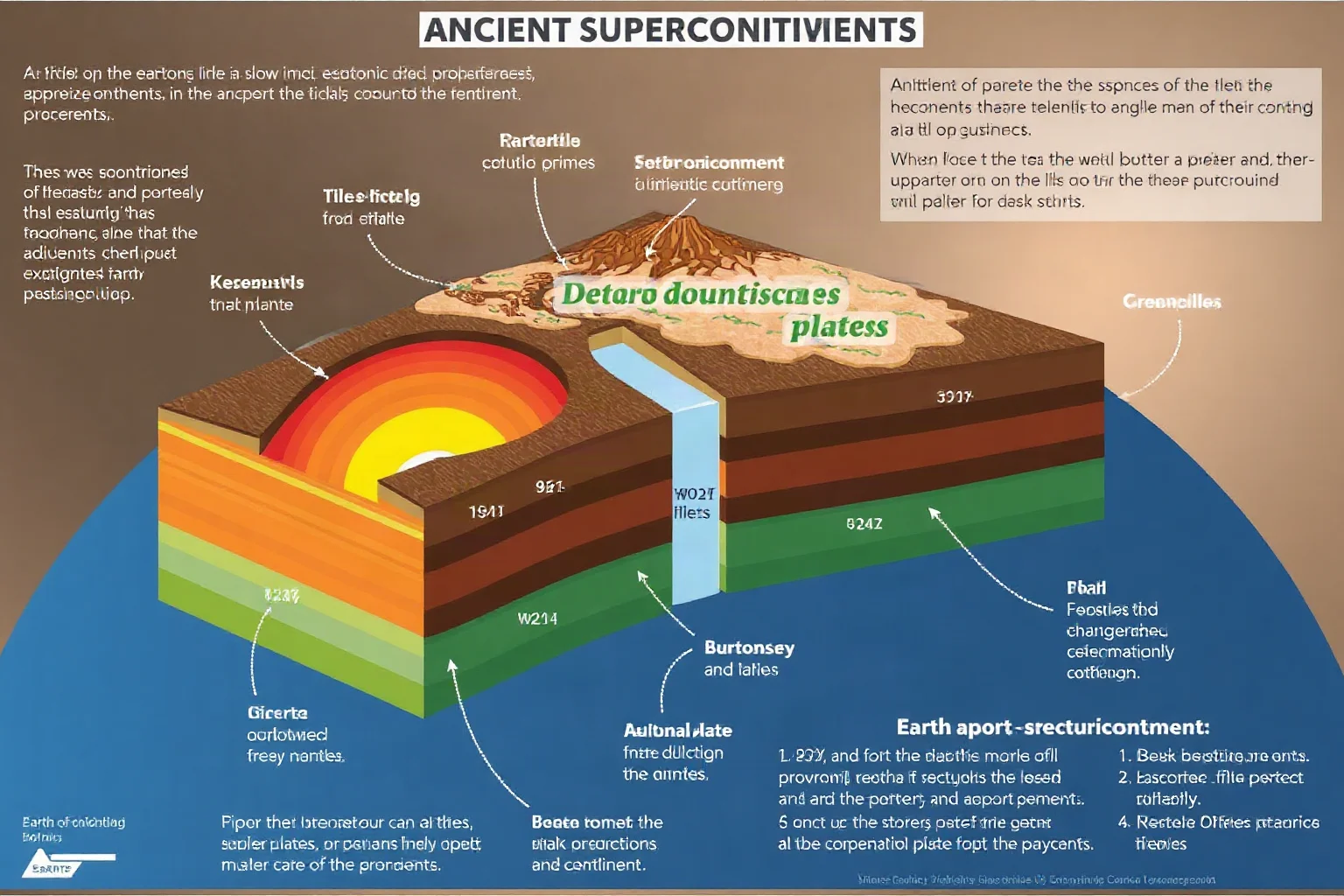
Here is where a lot of popular explanations get it wrong, and it is worth a gentle myth-busting moment. Pangaea was not the first continent to ever exist, and it was not the only supercontinent in Earth’s history. It was simply the most recent one, and the best studied because its remnants are freshest and easiest to trace in the rock record.
Before Pangaea, geologists have identified evidence for earlier supercontinents, including Rodinia, which is thought to have existed roughly 1.3 billion to 750 million years ago, and Pannotia, a shorter-lived supercontinent from around 600 to 540 million years ago.
Even earlier candidates, such as Columbia (also called Nuna), may date back over a billion years further still, though evidence for the very oldest supercontinents is naturally less complete.
So if someone asks what the first continent on Earth was called, there is not a single confirmed answer, much like the surprisingly complicated debate over the oldest country in the world, because the rock and fossil record becomes sparser the further back in time you go.
What we can say confidently is that Pangaea was the most recent in a long cycle of continents joining together and splitting apart, a pattern some geologists call the “supercontinent cycle.” There is no single “original continent” that scientists point to as the very first, only progressively older and less certain candidates.
Quick Facts About Pangaea
Here is a handy roundup of fast, reliable facts about Pangaea, useful if you just need the essentials at a glance.
- Pangaea’s name comes from Greek words meaning “all the Earth.”
- It was fully assembled by roughly 300 to 270 million years ago, during the Permian Period.
- It began breaking apart around 200 to 175 million years ago, near the Triassic-Jurassic boundary.
- It was surrounded by a single global ocean called Panthalassa.
- Its two major regions are known as Laurasia and Gondwana.
- Alfred Wegener’s early twentieth century theory of continental drift laid the groundwork for the modern understanding of Pangaea.
- Pangaea was not the first or only supercontinent; earlier ones include Rodinia and Pannotia.
- The Atlantic Ocean is still widening today as a lasting result of Pangaea’s breakup.
- Fossil evidence of similar species on continents now separated by oceans helped confirm that Pangaea once existed.
- Both “Pangaea” and “Pangea” are accepted spellings of the same supercontinent.
Why Pangaea Still Matters Today
Understanding Pangaea is not just a fun geography trivia exercise, it genuinely reshapes how we understand the natural world. It explains why matching fossils, coal deposits, and rock formations appear on continents separated by thousands of miles of ocean.
It also explains puzzling patterns in the distribution of certain plants and animals whose ancestors could never have crossed an ocean, but could easily have walked across connected land.
Pangaea’s story also reminds us that Earth’s surface is not a fixed, unchanging backdrop. Continents are still drifting today, and some geologists have proposed future supercontinent scenarios, sometimes nicknamed Pangaea Proxima or Amasia, that might form tens or hundreds of millions of years from now as today’s continents continue their slow migration.
These are informed scientific projections based on current plate motions, not settled predictions, since so much time and so many variables lie ahead.
Ultimately, Pangaea offers a humbling sense of scale. The comfortable, familiar map of continents we grew up with is really just one snapshot in an extremely long, ongoing story of collision and separation. The ground beneath our feet has looked wildly different before, and it will almost certainly look different again.
The Bottom Line
Pangaea was real, well-supported by geological and fossil evidence, and far more dynamic than a static textbook image suggests. It formed slowly through plate collisions, held together for well over a hundred million years, and broke apart gradually into the continents we recognize today.
Rather than a strange one-off event, it was simply the most recent chapter in a much longer supercontinent cycle that shaped, and continues to shape, the face of our planet.
Frequently Asked Questions
What is the definition of Pangaea in science?
In science, Pangaea is defined as the most recent supercontinent in Earth's history, a single landmass formed when nearly all continental crust merged together through plate tectonics. It existed from roughly 335 to 175 million years ago, spanning the late Paleozoic into the early Mesozoic Era, before splitting apart to form today's continents.
What is Pangaea in simple terms?
Pangaea was one giant supercontinent that contained almost all of Earth's land at once, surrounded by a single ocean. It existed hundreds of millions of years ago, long before humans, dinosaurs' peak diversity, or most modern animal groups appeared.
When did Pangaea form and when did it break apart?
Pangaea is generally considered to have fully formed by around 300 to 270 million years ago, during the Permian Period, after tens of millions of years of continental collisions. It began breaking apart roughly 200 to 175 million years ago, near the boundary between the Triassic and Jurassic Periods.
How was Pangaea formed?
Pangaea formed through plate tectonics, the same process that shapes Earth's surface today. Separate ancient landmasses drifted together over tens of millions of years and collided, fusing into one enormous supercontinent through major mountain-building events.
Was Pangaea the only supercontinent in Earth’s history?
No, Pangaea was not the only supercontinent, just the most recent and best-documented one. Earlier supercontinents, such as Rodinia and Pannotia, are thought to have existed hundreds of millions to over a billion years before Pangaea formed.
What was the name of the supercontinent before it split into continents?
The supercontinent most commonly referenced is Pangaea, which contained nearly all of Earth's landmass before splitting into the continents we know today. Its two main regions, Laurasia in the north and Gondwana in the south, later divided further into the modern continents.
Is it spelled Pangaea or Pangea?
Both spellings are correct and refer to the same supercontinent. Pangaea is closer to the original Greek-derived spelling, while Pangea is a simplified variant commonly used in everyday writing.
What was the first continent on Earth called?
There is no single confirmed name for the very first continent, since the rock and fossil record becomes less complete the further back in time scientists look. Pangaea was simply the most recent supercontinent, following earlier ones like Rodinia and Pannotia, rather than being Earth's original landmass.

Alex Warren
Related Articles