

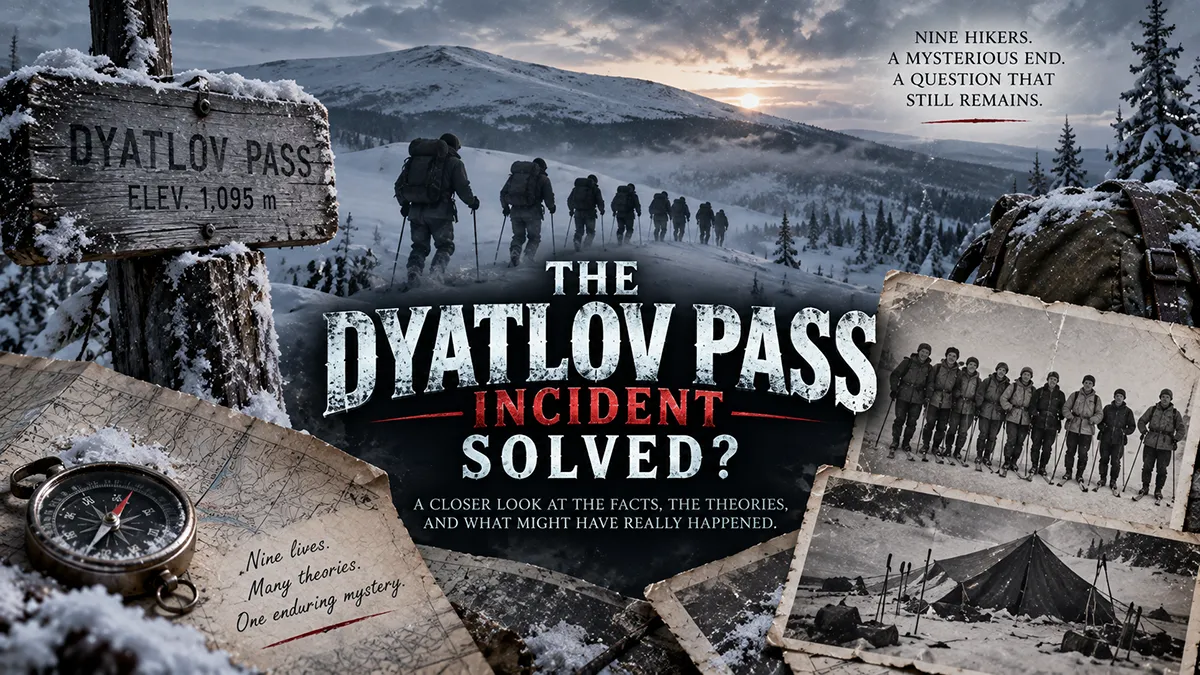
In February 1959, nine experienced hikers walked into the frozen Ural Mountains and never walked back out.
When searchers finally found their camp weeks later, they discovered a tent slashed open from the inside, footprints in the snow leading away from shelter, and bodies scattered across a frozen slope in various states of undress and injury. No survivors. No clear villain. No easy answers.
More than six decades later, the Dyatlov Pass incident remains one of the 20th century’s strangest unsolved mysteries — a story that has spawned documentaries, books, video games, and endless internet debate.
But in recent years, new forensic science and a reopened Russian investigation have brought us closer than ever to a real answer. This is the story of what happened, why it captivated the world, and whether the case has actually been solved.
TL;DR: A 1959 Soviet expedition ended in the deaths of nine hikers under bizarre circumstances, and while a 2021 scientific study points strongly to a rare slab avalanche as the trigger, some details of the Dyatlov Pass incident still resist a fully tidy explanation.
What Was the Dyatlov Pass Incident?
The Dyatlov Pass incident refers to the deaths of nine Soviet hikers in the northern Ural Mountains in February 1959. The group was led by Igor Dyatlov, a 23-year-old engineering student at the Ural Polytechnic Institute, and the expedition has carried his name ever since.
You’ll sometimes see it written slightly differently online — as the Dylatov Pass, Dyalov Pass, or even Datlov Pass — but these are all misspellings of the same tragic event.
The hikers were experienced skiers and mountaineers, not careless amateurs. They were attempting to reach Otorten Mountain, a demanding but not unprecedented route for a group of their skill level. What should have been a challenging but survivable winter trek instead became a case study in unanswered questions.
What makes this story so enduring isn’t just that nine people died in the wilderness. It’s the sheer strangeness of the physical evidence left behind — details so odd that even seasoned investigators at the time struggled to make sense of them.
Where Is Dyatlov Pass Located?
The Dyatlov Pass location sits in the northern Ural Mountains of Russia, close to the border between Europe and Asia. It lies in Russia’s Sverdlovsk Oblast region, not far from the mountain the hikers were originally trying to reach, Otorten.
The pass itself didn’t have this name before 1959. It was originally an unnamed mountain saddle, but it was renamed Dyatlov Pass in honor of the expedition’s doomed leader shortly after the tragedy.
Locally, the indigenous Mansi people reportedly referred to the general area with a name that translates roughly to “Dead Mountain,” a detail that has fueled decades of eerie speculation, even though the naming predates the 1959 incident and had unrelated origins.
The terrain is remote, exposed, and brutally cold in winter, with the kind of wind-scoured slopes that make survival difficult even for well-prepared travelers. That isolation is a big part of why the case took so long to piece together, and why some details may never be fully resolved.
The 1959 Expedition: Who Were the Hikers?
The group consisted of ten people who set out together, though one member, Yuri Yudin, turned back early due to illness — a decision that almost certainly saved his life. The remaining nine included seven men and two women, most of them students or graduates of the Ural Polytechnic Institute with substantial outdoor experience.
This wasn’t a group of naive weekend campers. Several members held “Grade II” hiking certifications, a serious qualification in the Soviet outdoor sports system, and the trek was intended to earn them an even higher certification level. They were well-equipped for the conditions they expected to face.
Their planned route was tough, but not extreme by the standards of experienced Soviet mountaineers of the era. That’s part of why the case rattled people so deeply at the time and continues to do so today — this wasn’t a group of people who took obvious, foolish risks.
Timeline: What Happened at Dyatlov Pass
Understanding what happened at Dyatlov Pass starts with the timeline reconstructed from the hikers’ own diaries, photographs, and the physical evidence at the scene. The group began their trek on January 27, 1959, and made steady progress toward Otorten Mountain over the following days.
On February 1, the hikers set up camp on the slope of a mountain the Mansi people called Kholat Syakhl. Photographs developed later showed the group digging into the snow and pitching their tent on the open slope rather than in the shelter of the treeline, a decision some later analysts questioned but that experienced skiers sometimes made for practical reasons.
Sometime during the night, something caused the group to cut their way out of the tent from the inside and flee downhill toward the treeline, over a kilometer away, in freezing temperatures and, in several cases, without proper winter clothing or footwear. That single fact — fleeing a warm shelter into a subzero night — is the central puzzle every theory has to explain.
The Search and Discovery of the Bodies
When the hikers failed to check in as planned, friends and family raised the alarm, and a search effort began in late February 1959. Search teams eventually found the abandoned tent, cut open from the inside, partially collapsed under snow.
The first two bodies were discovered near a large cedar tree at the edge of the forest, close to the remains of a small fire. Both men were dressed inadequately for the cold, wearing only light clothing, suggesting they had left the tent in a hurry.
Three more bodies were found between the cedar tree and the tent, in positions that suggested they had died while trying to climb back toward camp. It would take until May, when the snow finally melted, for searchers to locate the remaining four hikers in a ravine further into the woods, and their condition raised even more troubling questions than the first five.
The Strange and Disturbing Details
The official Soviet investigation, and every re-examination since, has had to grapple with a set of details that don’t fit neatly together. The tent had been cut open from the inside, meaning the hikers chose to slash their way out rather than exit through the entrance, which pointed toward panic or a perceived threat too urgent to wait for.
Some of the hikers found near the cedar tree had only socks or a single boot, and were dressed in far less clothing than the brutal cold demanded. This has been one of the most cited pieces of evidence for the “paradoxical undressing” theory associated with severe hypothermia, though it’s also consistent with several other explanations involving panic or injury.
The four bodies recovered later, in the ravine, showed severe injuries: crushed ribs, a fractured skull, and other trauma consistent with immense blunt force, yet with no external wounds or bruising to suggest a physical assault.
One woman among this group was missing her tongue and eyes, a detail that fueled some of the wildest theories but is also explainable by natural decomposition and small scavenger activity after months exposed in a ravine with running water.
Adding to the eerie reputation of the case, some of the hikers’ clothing was later found to have elevated levels of radioactivity, though experts have pointed out this was plausibly linked to certain consumer items and clothing treatments common in the Soviet era, rather than evidence of a secret nuclear incident.
Early Theories: Avalanche, Weather, and Panic
The original Soviet investigation in 1959 concluded, somewhat vaguely, that the hikers died as a result of “a compelling natural force,” without ever specifying what that force actually was. That deliberately ambiguous phrasing has done more to fuel speculation over the decades than almost any other single fact in the case.
An avalanche was one of the earliest and most obvious suspects, since it could explain both the panicked flight from the tent and some of the traumatic injuries found on the later bodies. Critics of this theory pointed out that the slope’s angle seemed too gentle for a classic avalanche, and that the pattern of undisturbed snow around the tent didn’t initially look consistent with a slide.
Other early theories focused on extreme cold and disorientation, essentially arguing that panic, hypothermia, and difficult terrain combined to produce a chain of fatal decisions. This explanation accounts for some of the deaths reasonably well but always struggled to fully explain the severe crushing injuries found on the four hikers discovered in the ravine.
Wilder Theories That Captured the Public Imagination
Because the official explanation was so vague, alternative theories flourished almost immediately, and the Dyatlov Pass incident became fertile ground for speculation far beyond mainstream science. Some suggested a secret Soviet military weapons test, pointing to the remote location and Cold War-era secrecy as circumstantial support.
Others proposed encounters with the Mansi people, an indigenous group living in the region, though investigators quickly ruled this out since there was no evidence of a struggle with other people, and the Mansi were cooperative with the search effort.
Cryptid enthusiasts have long pointed to the case as evidence of a yeti-like creature, a theory with no supporting physical evidence but plenty of dramatic appeal for documentaries and pop culture retellings.
A more scientifically grounded, if still speculative, theory involves infrasound — the idea that wind moving over the pass’s specific terrain shape could have generated a phenomenon known as a Kármán vortex street, producing low-frequency sound and vibration capable of inducing panic and nausea. It’s an intriguing hypothesis, but like several others, it remains difficult to test conclusively after more than sixty years.
Russia Reopens the Case: The 2019 Investigation
Interest in Russia’s Dyatlov Pass incident never really faded, and in 2019 Russian authorities formally reopened an investigation into the deaths, partly in response to renewed public pressure from victims’ relatives and researchers. Officials announced they would focus on three main scenarios: an avalanche, a snow slab collapse, or a hurricane-like weather event, deliberately setting aside the more exotic theories that had dominated popular discussion for decades.
Prosecutors involved in the 2019 review were notably direct in ruling out foul play, secret weapons testing, or any human violence, stating there was no evidence of other people at the scene. This shifted mainstream attention firmly back toward natural, explainable causes rather than conspiracy.
The reopened investigation reflected a broader trend: using modern forensic and environmental science to revisit an old case rather than relying solely on 1959-era assumptions and equipment, not unlike the detailed technical reconstruction that finally explained the botched repair behind Japan Airlines Flight 123. That approach set the stage for one of the most compelling explanations to date.
The 2021 Slab Avalanche Study: Has Dyatlov Pass Been Solved?

In 2021, a team of researchers led by Swiss scientists Johan Gaume and Alexander Puzrin published a study in the journal Communications Earth & Environment that modeled a specific type of avalanche event at the site. Their research used engineering and snow-science modeling, along with data from real-world case studies including a well-documented 1970s slab avalanche in Canada, to test whether a delayed, localized snow slab collapse could realistically account for the evidence.
Their conclusion was that a slab avalanche was indeed physically plausible, even on the pass’s relatively gentle slope, because the hikers had cut into the snow to pitch their tent, creating an artificial disturbance in an already tensioned snow layer above them. Combined with high winds redistributing snow onto the slope after the cut was made, this could have triggered a delayed slide hours after the hikers made their camp, rather than immediately.
Critically, the model showed that such a slide could produce blunt force trauma similar to that seen in the four bodies found in the ravine, without necessarily leaving the kind of obvious surface disturbance searchers expected from a classic avalanche. This addressed one of the longest-standing objections to the avalanche theory: the seemingly unaffected snow around the tent.
This is the strongest evidence yet that the Dyatlov Pass incident has been solved, and many outlets reported it as such at the time. However, it’s important to be precise about what the study actually demonstrated: it showed a slab avalanche was scientifically plausible and consistent with the physical evidence, not that it was proven beyond any doubt as the definitive, complete explanation for every detail of that night.
Why Some Researchers Still Aren’t Fully Convinced
Despite the strength of the 2021 study, it hasn’t ended the debate entirely, and it’s worth understanding why. Some independent researchers who have spent years studying the case argue that the slab avalanche model, while plausible, still doesn’t perfectly account for every detail, including the specific pattern of the hikers’ movements after fleeing the tent.
Others point out that no avalanche debris was definitively documented by the original 1959 search teams, though supporters of the theory note that a small, localized slide combined with weeks of subsequent snowfall could easily have obscured the evidence by the time thorough searches took place. This is a case where the physical trace of the proposed event may simply not have survived long enough to be checked.
There’s also a reasonable, more general critique worth acknowledging: after six decades, some questions about the exact sequence of events that night may be permanently unanswerable, regardless of how good any single model becomes. Good historical and forensic work can narrow the range of plausible explanations dramatically without claiming to reconstruct every individual decision made by nine frightened people in the dark.
Why the Dyatlov Pass Incident Still Fascinates the World
Part of what keeps the 1959 Dyatlov Pass incident so alive in public imagination is the collision of hard, verifiable facts with genuinely bizarre details, the same combination that keeps stories like the Lost Colony of Roanoke and the search for Jack the Ripper’s true identity alive in the public imagination decades or centuries later. Radioactive clothing, missing tongues, and a bizarre official verdict of “a compelling natural force” are the kind of details that resist a fully satisfying, mundane explanation even when a mundane explanation is probably correct.
The case has also benefited from the passage of time and the opening of Soviet-era archives, giving researchers access to diaries, photographs, and case files that weren’t available to Western audiences for decades. This slow drip of new material has kept the story feeling active and unresolved, rather than fading into a footnote of Cold War history.
Culturally, the incident has inspired films, documentaries, video games, and countless online forums dedicated to picking apart every photograph and diary entry from the expedition. That obsessive, detail-driven fandom has arguably done as much to keep the mystery alive as any new scientific study.
What We Can Say With Confidence Today
Putting the more sensational theories aside, a few things about the Dyatlov Pass incident are genuinely well-supported by evidence. The hikers were experienced and well-prepared, there is no credible evidence of an attack by other people, and the extreme cold and terrain of the northern Urals were more than capable of producing a fatal chain of events on their own.
The 2021 slab avalanche study represents the most scientifically rigorous explanation produced to date, and it fits the physical evidence better than most competing theories, including the injuries, the tent’s condition, and the hikers’ apparent panic. It doesn’t require secret weapons, cryptids, or conspiracies, just a rare but physically possible combination of terrain, snow conditions, and weather.
Whether that counts as the case being fully “solved” depends a bit on how strict a standard you apply. In the sense of identifying the most probable natural cause with real scientific modeling behind it, yes, the Dyatlov Pass incident looks close to solved. In the sense of accounting for every single detail with total certainty, some reasonable doubt understandably remains.
Final Thoughts on Russia’s Most Enduring Mountain Mystery
The Dyatlov Pass incident endures because it sits right at the intersection of tragedy, science, and unanswered questions, and that combination is almost irresistible. Nine young, capable people died in circumstances that were genuinely strange, and it’s taken over sixty years of forensic science, archival research, and dogged investigation to get close to a credible explanation.
The 2021 avalanche modeling study doesn’t erase every open question, and honest researchers continue to debate the finer details of that February night. But it does represent real, serious progress toward answering one of the 20th century’s most puzzling wilderness mysteries, grounded in physics rather than speculation.
For now, the fairest summary is this: the Dyatlov Pass incident has likely been narrowed down to its most probable natural cause, even if a handful of smaller details may never be perfectly explained. That’s not a dramatic, cinematic ending, but it’s an honest one — and honest answers are ultimately what this decades-old mystery deserves.
Frequently Asked Questions
Has the Dyatlov Pass incident been solved?
Not with absolute certainty, but a 2021 scientific study using avalanche modeling found strong evidence that a rare slab avalanche, triggered by the hikers cutting into the snow to pitch their tent, best explains the physical evidence. Most researchers now consider this the leading explanation, though a few finer details are still debated.
What happened at Dyatlov Pass?
In February 1959, nine Soviet hikers led by Igor Dyatlov cut open their tent from the inside and fled downhill into freezing temperatures, apparently in a panic. All nine died from a combination of exposure and, in four cases, severe blunt trauma, with the exact trigger event debated for decades until recent avalanche research offered a strong natural explanation.
Where is Dyatlov Pass located?
Dyatlov Pass is located in the northern Ural Mountains of Russia, in the Sverdlovsk Oblast region near Otorten Mountain. The pass was unnamed before 1959 and was renamed in honor of expedition leader Igor Dyatlov after the tragedy.
How many hikers died at Dyatlov Pass?
Nine hikers died during the 1959 expedition. A tenth member, Yuri Yudin, turned back early due to illness before the group reached the fatal campsite, which almost certainly saved his life.
What is the most likely explanation for the Dyatlov Pass incident?
Current scientific consensus leans toward a delayed slab avalanche, supported by a 2021 study published in Communications Earth & Environment. The model showed that cutting into the snow to set up camp, combined with wind-loaded snow above the tent, could trigger a slide capable of causing the injuries found on the victims.
Why is it called the Dyatlov Pass incident?
The event is named after Igor Dyatlov, the 23-year-old student who led the ill-fated 1959 expedition. The mountain pass where the group died had no official name before the tragedy and was later named in his memory.

Alex Warren
Related Articles