
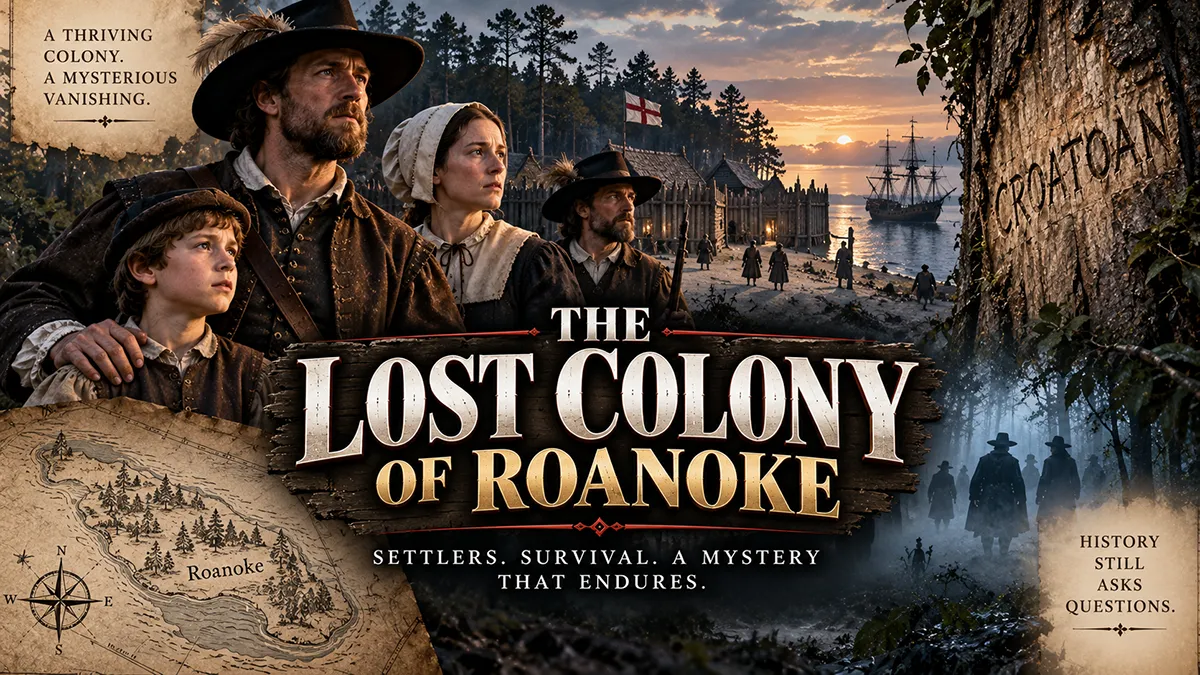
Few stories in early American history are as haunting as the disappearance of the Roanoke Colony. More than 115 men, women, and children vanished from a small settlement on the North Carolina coast, leaving behind almost nothing except a single carved word.
For over four centuries, historians, archaeologists, and armchair detectives have tried to explain what happened to them.
The truth is messier and more fascinating than most popular retellings suggest. This is a look at what we actually know about the Roanoke Colony, what remains genuinely uncertain, and why the phrase “Lost Colony” still captures imaginations today.
TL;DR: The Roanoke Colony was an English settlement that vanished from North Carolina’s Roanoke Island sometime after 1587, and while no single theory has been proven, evidence increasingly points to the colonists assimilating with local Algonquian communities rather than meeting a sudden, violent end.
What Was the Roanoke Colony?
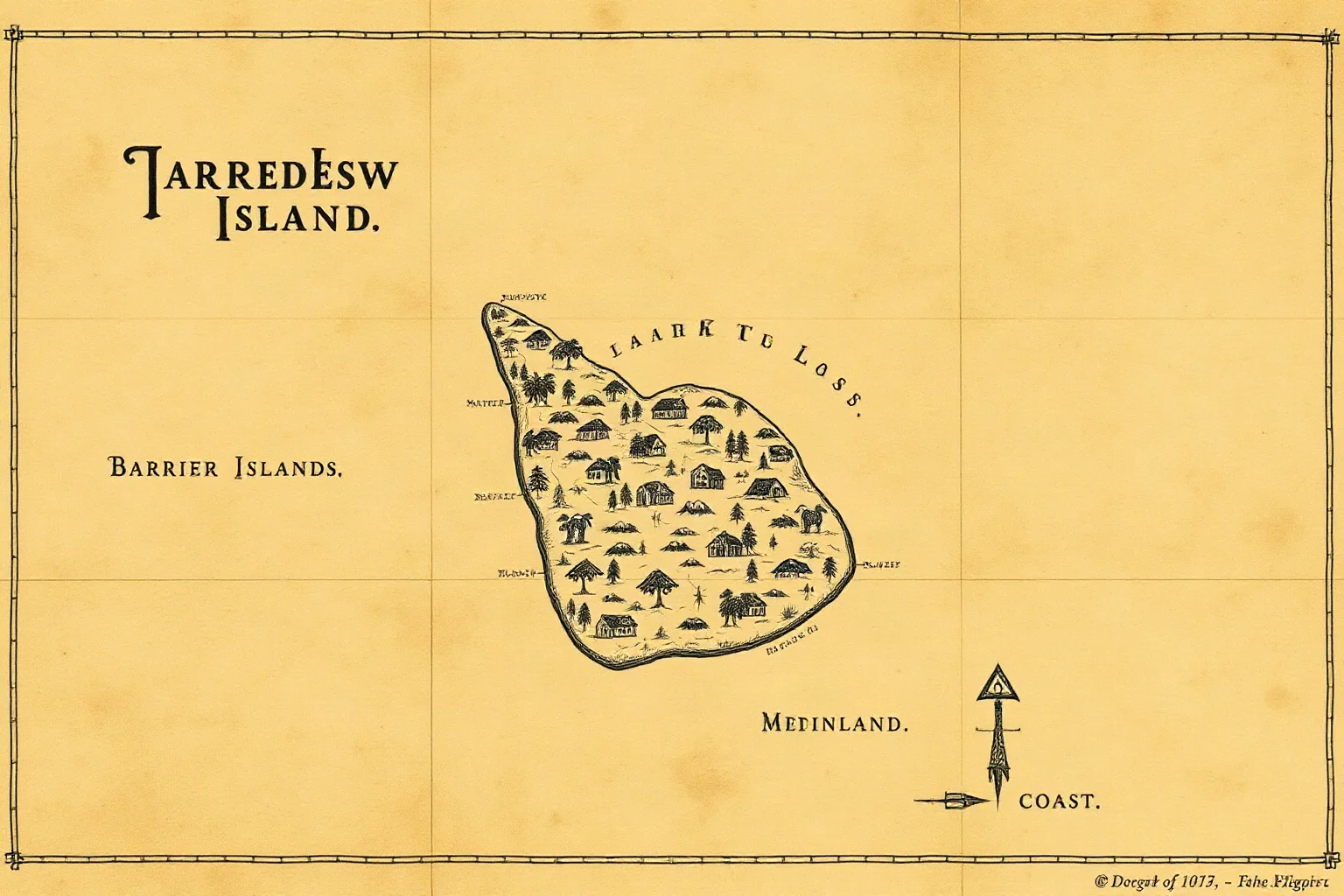
The Roanoke Colony was England’s first attempt at a permanent settlement in North America. It was located on Roanoke Island, a narrow strip of land tucked between the Outer Banks and the mainland of what is now North Carolina.
This is an important distinction, because the colony is sometimes mixed up with the modern city of Roanoke, Virginia, which is a different place entirely and has no direct historical connection to the settlement.
So what is the Roanoke Colony, in simple terms? It refers to two separate English settlement attempts on Roanoke Island in the 1580s, sponsored by Sir Walter Raleigh under a charter from Queen Elizabeth I. The first attempt, in 1585, was a small military outpost. The second, in 1587, was meant to be a true civilian colony, complete with families, craftsmen, and children.
It is that second group, the 1587 colonists, whose fate remains unresolved. When their governor returned after a supply trip, the entire settlement had vanished without a clear explanation. That mystery is what most people mean when they refer to the Lost Colony of Roanoke today.
Who Founded the Roanoke Colony—and Why?
Sir Walter Raleigh is usually credited as the founder of the Roanoke Colony, though he never actually set foot on Roanoke Island himself. He was granted a charter by Queen Elizabeth I in 1584, giving him the right to explore and settle land in North America on England’s behalf. Raleigh financed the voyages and organized the leadership, but the actual work of exploring, governing, and settling fell to others.
England’s motives were part economic ambition and part geopolitical rivalry. Spain already had a substantial foothold in the Americas, and English leaders wanted their own base for trade, resource extraction, and potentially privateering against Spanish shipping. Roanoke Island was chosen partly because it was hidden behind barrier islands, making it harder for Spanish patrols to spot from the open Atlantic.
The key figures who actually established and led the colony included Ralph Lane, who governed the 1585 military settlement, and John White, an artist and colonial administrator who led the 1587 civilian colony. Two Native men, Manteo and Wanchese, had traveled to England in 1584 and returned as guides and interpreters, playing a crucial role in relations between the English and local Algonquian-speaking communities.
Establishing the Colony: A Timeline
Understanding when the Roanoke Colony was established, and how many attempts there were, helps clear up a lot of confusion. This wasn’t a single event but a series of voyages spread across several years.
The 1584 Reconnaissance Voyage
Before any colonists arrived, Raleigh sent a scouting expedition to the region in 1584. This voyage assessed the land, made contact with local Algonquian communities, and brought Manteo and Wanchese back to England. The information gathered helped convince Raleigh that Roanoke Island was a workable site for a permanent English presence.
The 1585 Military Colony
The first actual settlement attempt happened in 1585, when Ralph Lane led roughly 100 men to Roanoke Island to build a fort and outpost. This was largely a military and exploratory mission rather than a true civilian colony, and relations with nearby Native communities soured over time due to misunderstandings, food shortages, and violence. When Sir Francis Drake’s fleet passed by in 1586 after raiding Spanish holdings in the Caribbean, the struggling colonists chose to abandon the site and sail home with him.
The 1587 Colony and the Birth of Virginia Dare
Raleigh tried again in 1587, this time sending about 115 colonists, including women and children, under the leadership of John White. This is the group most closely associated with the Lost Colony story. Shortly after arriving, White’s daughter Eleanor Dare gave birth to a girl named Virginia Dare, believed to be the first English child born in the Americas.
Supplies were already running low, so the colonists convinced White to sail back to England and secure more resources. War between England and Spain delayed his return for nearly three years, a gap that would prove fatal to any easy explanation of what happened next.
What Happened When John White Returned?
When John White finally made it back to Roanoke Island in August 1590, he found the settlement completely deserted. Houses had been dismantled, and there was no sign of struggle, fire, or mass graves. The scene suggested an organized departure rather than a sudden catastrophe.
The most famous clue was a single word carved into a wooden post: “CROATOAN.” Nearby, the letters “CRO” were carved into a tree. Before leaving, White had arranged a signal system with the colonists. A cross carved alongside any message was supposed to indicate they had left under distress, and no such cross was found.
Croatoan was the name of a nearby island, now generally identified with part of present-day Hatteras Island, and it was closely associated with a Native community allied with the English. Weather conditions made it too dangerous for White’s ships to search further, and he was forced to return to England without finding the colonists. That single unresolved trip is the direct source of the entire “Lost Colony” mystery.
Why Is It Called the Lost Colony?
The nickname “Lost Colony” isn’t just dramatic branding, it reflects a genuine historical gap. Unlike most colonial failures of the era, which usually left behind graves, wreckage, or eyewitness accounts, the 1587 Roanoke settlers left almost no physical trace at all. No bodies were ever found on the island, and no credible written record surfaced describing their fate in detail.
This is also why the disappearance is often described as one of history’s great “disappearing colony” cases, in the same league as other enduring unsolved mysteries like who Jack the Ripper really was. It wasn’t that the colonists were rumored to have died, it’s that they seemingly ceased to exist as a distinct group overnight, from the perspective of the historical record. That absence of evidence, rather than any single dramatic event, is what has kept the mystery alive for more than 400 years.
Theories Behind the Roanoke Colony Disappearance
Historians and archaeologists have proposed several explanations over the centuries. None has been proven beyond reasonable doubt, and it’s worth treating each one as a theory rather than a settled fact. Here are the most credible and most discussed possibilities.
1. Assimilation with the Croatoan and Local Algonquian Tribes
This is currently the theory with the strongest circumstantial support. The carved word “CROATOAN” strongly suggests the colonists intended to relocate to that community, likely due to dwindling supplies and existing friendly relations through Manteo. Archaeological digs on Hatteras Island have uncovered English artifacts, including signet rings, gun parts, and copper items, mixed among Native American materials dating to the right period.
2. Death by Disease, Famine, or Drought
Tree-ring studies have shown that the years around 1587 coincided with one of the worst droughts in the region in centuries. Combined with limited farming experience and strained relations with some nearby tribes, starvation or disease could have devastated the colony. This wouldn’t necessarily explain the total absence of graves or remains, however.
3. A Devastating Storm or Hurricane
The Outer Banks are notoriously vulnerable to hurricanes, and a major storm could have destroyed the settlement or forced an emergency evacuation. This theory has less direct supporting evidence than others, but it remains plausible given the region’s climate history.
4. Attack by Rival Tribes
Relations between the 1585 colonists and some nearby Native groups, particularly after violent encounters instigated by Ralph Lane’s men, had already left lasting resentment. Some historians have proposed that a rival group unfriendly to the English may have attacked the 1587 settlement. There is no confirmed archaeological evidence of a massacre at the original site, which weakens this theory somewhat.
5. Spanish Attack
Spain considered the entire Atlantic coast part of its sphere of influence and had previously destroyed a French colony in Florida. Spanish patrol records from the era have been examined by historians, and no confirmed record of an attack on Roanoke has been found, making this theory possible but currently unsupported by direct evidence.
6. Relocation to the Chesapeake Bay
John White and some contemporaries believed at least some colonists may have originally planned to move further north toward the Chesapeake Bay region before ending up diverted to Croatoan. Later English colonists at Jamestown in the early 1600s heard secondhand reports and rumors of English-looking people living among Native communities inland, though nothing was ever definitively confirmed.
7. The Dare Stones Hoax
In the 1930s, a series of inscribed stones surfaced claiming to be messages carved by Eleanor Dare herself, describing deaths and travels of the colonists. They generated huge public excitement at the time. Later forensic and historical analysis found strong evidence that most, if not all, of the stones were forgeries, and they are now generally dismissed by serious historians.
What Modern Archaeology Tells Us
Modern research has moved the conversation away from pure speculation and toward physical evidence. Excavations led through projects like the First Colony Foundation and independent researchers on Hatteras Island have recovered English-made items dating to the late 1500s in Native American occupation layers. This doesn’t prove exactly what happened, but it does support the idea that at least some colonists lived among, traded with, or were absorbed into local Algonquian communities rather than dying immediately.
Some Native American communities today, including the Lumbee people of North Carolina, have longstanding oral traditions connecting their ancestry to the Roanoke settlers. These traditions deserve respect as part of the historical conversation, even though they haven’t been definitively proven through documentary or genetic evidence. DNA testing projects have been attempted over the years, but conclusive genealogical links have not been established.
What’s clear is that the old image of colonists simply vanishing into thin air doesn’t match the evidence. The far more likely story is one of adaptation, survival, and integration, even if the exact details remain unresolved.
Quick Facts About the Roanoke Colony
- The first Roanoke settlement attempt was in 1585, led by Ralph Lane, and lasted less than a year before the colonists returned to England.
- The second colony, established in 1587 under Governor John White, is the group associated with the Lost Colony mystery.
- Virginia Dare, born in 1587, is traditionally recognized as the first English child born in the Americas.
- John White did not return to Roanoke until 1590, nearly three years after leaving, due to war between England and Spain.
- The only physical clues left behind were the word “CROATOAN” carved on a post and “CRO” carved on a nearby tree.
- No bodies, graves, or signs of battle were ever discovered at the original settlement site.
- Roanoke Island is located in present-day North Carolina, not near the modern city of Roanoke, Virginia.
- The 1930s “Dare Stones” claiming to document the colonists’ fate are now considered forgeries by most historians.
- Archaeologists have found 16th-century English artifacts mixed with Native American materials on Hatteras Island, once called Croatoan.
- The Roanoke story predates the more famous Jamestown settlement by roughly two decades, making it England’s earliest colonial attempt in what is now the United States.
The Legacy of the Lost Colony Today
The story of Roanoke has taken on a life far beyond the historical record itself. “The Lost Colony,” an outdoor symphonic drama first performed in 1937, still runs seasonally on Roanoke Island and is one of the longest-running outdoor plays in the United States. Fort Raleigh National Historic Site now preserves part of the original settlement area, offering visitors a tangible connection to the events.
The mystery has also become shorthand in popular culture for any group or place that disappears without explanation, placing it alongside other historical events that changed the world in the public imagination, which is part of why terms like “disappearing colony” and “disappeared colony” get applied to Roanoke so often. Its blend of real historical stakes and genuine unanswered questions makes it a rare case where the truth is just as compelling as the legend.
Final Thoughts
The Lost Colony of Roanoke endures not because it’s unsolvable in some supernatural sense, but because the surviving evidence is genuinely limited. Every generation of historians and archaeologists has added a little more context, from drought data to buried artifacts, without ever delivering a complete final answer. That combination of real mystery and real research is exactly what keeps people searching.
What we can say with confidence is that the 1587 colonists most likely didn’t vanish in some inexplicable instant. They almost certainly moved, adapted, and in many cases probably lived on among neighboring Native communities. The full, detailed story of individual lives after 1587 may never be fully recovered, but the broad outline is becoming clearer with each new dig, and that’s a far more grounded ending than the ghost stories usually suggest.
Frequently Asked Questions
What is the colony of Roanoke Island?
The colony of Roanoke Island refers to English settlement attempts made in 1585 and 1587 on Roanoke Island, off the coast of present-day North Carolina. The 1587 group, led by Governor John White, is the settlement famously known as the Lost Colony after it vanished before White's return in 1590.
When was the Roanoke Colony established?
The first Roanoke settlement was established in 1585 under Ralph Lane, and it failed within a year. The second and more famous colony was established in July 1587 under John White, and it is this group whose disappearance became known as the Lost Colony.
Who founded the Roanoke Colony?
Sir Walter Raleigh financed and organized the Roanoke expeditions under a charter from Queen Elizabeth I, though he never traveled to the colony himself. Ralph Lane led the first 1585 settlement, and John White governed the 1587 colony most associated with the disappearance.
What happened to the Lost Colony of Roanoke?
No one knows for certain, but the leading theory is that the colonists relocated to live among the Croatoan people, based on the word 'CROATOAN' carved at the abandoned site. Other theories include disease, drought, storms, or conflict, though none have been definitively proven.
Why did the Roanoke Colony fail?
The colony likely struggled due to a combination of severe drought, dwindling supplies, and a three-year delay in resupply caused by war between England and Spain. These pressures probably forced the remaining colonists to relocate rather than continue struggling on Roanoke Island alone.
Where was the Lost Colony of Roanoke located?
The Lost Colony was located on Roanoke Island, situated between the Outer Banks and the mainland of what is now North Carolina. It is unrelated to the modern city of Roanoke, Virginia, despite the similar name causing frequent confusion.
Why is Roanoke called the Lost Colony?
It earned the nickname because the 1587 colonists disappeared without leaving behind bodies, wreckage, or a clear written explanation, unlike most failed colonial settlements of the era. The near-total absence of physical evidence is what makes the case genuinely unusual among historical mysteries.
What happened to the colonists of Roanoke?
Current archaeological evidence suggests many colonists may have assimilated into nearby Algonquian-speaking communities, particularly around Croatoan territory on present-day Hatteras Island. This isn't proven with certainty, but it is considered the most evidence-supported explanation among historians today.
What are the main theories about the Roanoke Colony disappearance?
The leading theories include assimilation with the Croatoan or other Algonquian communities, death from drought or disease, destruction by a storm, conflict with rival Native groups, and a possible Spanish attack. The assimilation theory currently has the strongest circumstantial archaeological support.
Was Roanoke the first English colony in America?
Roanoke was England's first attempted permanent colony in what is now the United States, predating the successful Jamestown settlement by about twenty years. Its failure directly influenced how later colonial ventures, including Jamestown, were planned and supplied.

Alex Warren
Related Articles