

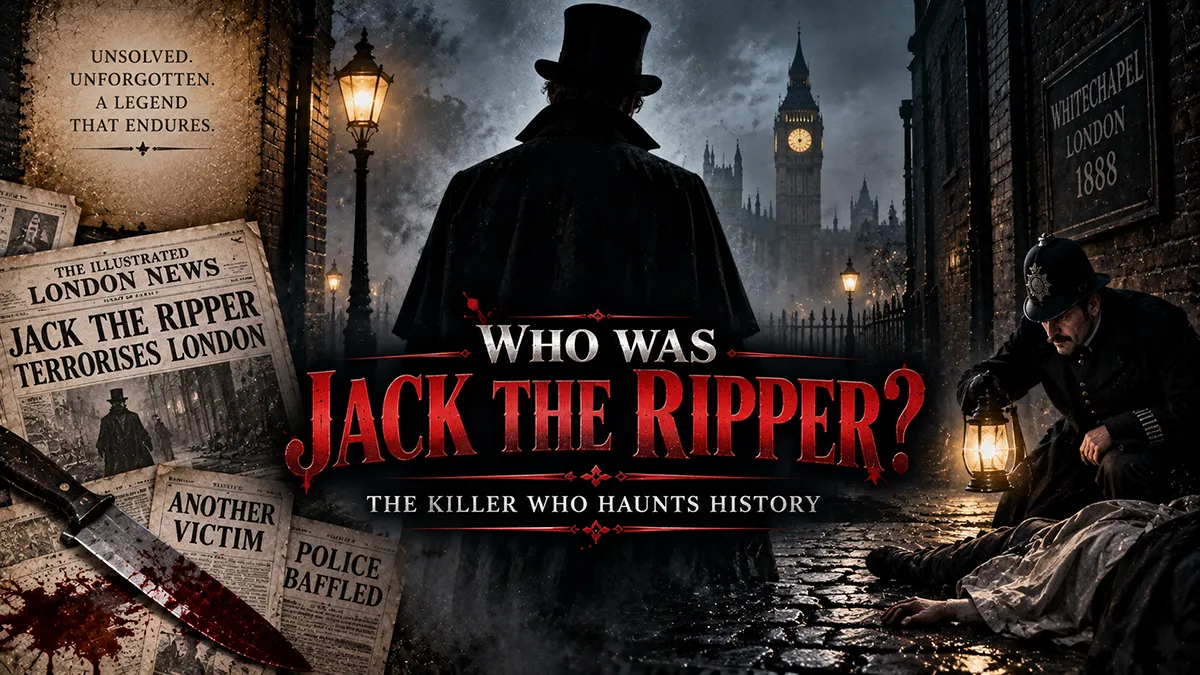
Few names in criminal history carry as much dread and fascination as Jack the Ripper. For more than 130 years, this shadowy figure has haunted books, films, walking tours, and late-night conversations about the darker corners of Victorian London. Yet for all the theories and true-crime obsession, one uncomfortable truth remains: nobody actually knows who Jack the Ripper was.
This post separates the documented facts from the myths that have piled up over more than a century of speculation. We’ll walk through the real timeline, the real victims, the real investigation, and the most credible suspects, all while being honest about what historians and Scotland Yard’s own case files can and cannot prove.
TL;DR: Jack the Ripper was the unidentified killer behind at least five brutal murders in London’s Whitechapel district in 1888, and despite countless suspects and theories, his true identity has never been confirmed.
Who Was Jack the Ripper? A Quick Overview
Jack the Ripper is the name given to an unidentified serial killer who murdered and mutilated at least five women in the impoverished Whitechapel district of East London in 1888. The killer was never caught, never named with certainty, and never brought to trial. Everything we “know” about him comes from police reports, newspaper coverage, coroner’s inquests, and letters that may or may not have actually been written by the murderer himself.
So when people ask “who was Jack the Ripper,” the honest answer is that we don’t know, and that uncertainty is exactly why the case still fascinates true-crime fans, historians, and armchair detectives today. What we do know is grim, well-documented, and worth understanding on its own terms.
The case is less a story of a single villain and more a portrait of a city, a police force, and a community grappling with a killer who seemed to vanish into the fog every time he struck. That mystery is the real story of Jack the Ripper.
The Time Period: When Was Jack the Ripper Active?
If you’re wondering when was Jack the Ripper active, the answer is a surprisingly narrow window. The core murders attributed to the Ripper took place between August and November 1888, making the time period of Jack the Ripper’s crimes just a few months rather than years, a good reminder that when you look at major historical time periods and eras, some of the most infamous episodes unfold in a matter of weeks rather than decades.
So what year was Jack the Ripper active? The canonical five murders, the ones most historians agree were likely committed by the same person, occurred in 1888. Some researchers have proposed that earlier or later Whitechapel-area killings might be connected, but there’s no solid consensus on that, and most experts treat 1888 as the defining year.
To break it down further, here is the generally accepted timeline of the canonical murders:
- Mary Ann Nichols — killed in the early hours of August 31, 1888
- Annie Chapman — killed on September 8, 1888
- Elizabeth Stride — killed on September 30, 1888
- Catherine Eddowes — also killed on September 30, 1888, roughly an hour after Stride
- Mary Jane Kelly — killed on November 9, 1888
After Kelly’s murder, the killings that fit the Ripper’s pattern stopped. No one knows for certain why the murders ended when they did, which only adds to the mystery of when Jack the Ripper was truly “active” versus simply quiet.
The Whitechapel Murders: Understanding the Victims
Any real story of Jack the Ripper has to center the victims, not just the killer. All five women were working-class residents of Whitechapel, a desperately poor and overcrowded district of London’s East End in the late 1800s. Several of them had, at times, turned to sex work to survive amid extreme poverty, a detail Victorian newspapers seized on in ways that were often more sensational than sympathetic.
Mary Ann Nichols, Annie Chapman, Elizabeth Stride, Catherine Eddowes, and Mary Jane Kelly are known collectively as the “canonical five” victims. Each murder involved a knife, and the injuries grew more severe as the killings continued, culminating in the extremely violent mutilation of Mary Jane Kelly, whose body was found indoors rather than in a street or alley like the others.
It’s worth noting that Whitechapel in 1888 was already struggling with overcrowding, unemployment, and inadequate policing before the murders began. The Ripper case intensified public attention on those conditions, even if it did little to immediately improve them.
How the Name “Jack the Ripper” Came About
The killer wasn’t given his infamous nickname by police investigators. Instead, the name comes from a letter sent to the Central News Agency in London, signed “Jack the Ripper,” which was later shared with the press.
Historians and researchers remain divided on whether this letter, often called the “Dear Boss” letter, was actually written by the murderer or fabricated by a journalist looking to sell papers. Whitechapel murders had already been generating enormous public interest, and a catchy nickname made the story even more irresistible to Victorian readers.
Whatever its true origin, the name stuck. It transformed an unidentified criminal into a kind of dark legend, one whose invented identity has arguably become more famous than the real details of the case.
Jack the Ripper’s Early Life: Why We Don’t Actually Know
A lot of people search for details about Jack the Ripper’s early life, hoping for a biography the way you’d find for a historical figure like a king or a general. Here’s the catch: because the killer was never conclusively identified, there is no verified early life, family history, or background to describe.
Any biography of Jack the Ripper you encounter is inherently a biography of a suspect, not a confirmed person. Books and documentaries sometimes blur this line, presenting a suspect’s childhood or career as though it directly explains the murders, but that’s speculation dressed up as fact.
This is one of the most important things to understand about the case. The lack of a real biography isn’t a gap in the historical record waiting to be filled; it’s the central, defining feature of the mystery itself.
The Investigation: Scotland Yard’s Hunt for a Killer
The Metropolitan Police, along with the City of London Police (since one murder, Catherine Eddowes, fell just inside the City’s jurisdiction), launched an intensive investigation. Officers conducted door-to-door interviews, forensic examinations by the standards of the day, and analysis of the many letters the public and press claimed came from the killer.
Detectives faced serious obstacles. Whitechapel was densely populated, poorly lit at night, and full of narrow courts and alleys where a killer could disappear quickly. Forensic science in 1888 was also decades away from tools like fingerprinting or DNA analysis, which limited what investigators could actually prove even when they had strong suspicions.
Scotland Yard’s files on the case, some of which remain preserved in the UK National Archives, show a methodical but ultimately unsuccessful effort. Several suspects were investigated and cleared, and public pressure on the police mounted with each new murder, but no arrest ever followed.
Top Suspects Over the Years
One reason the phrase “info on Jack the Ripper” generates so much search interest is the sheer number of suspects that have been proposed since 1888. It’s important to stress that none of these have ever been proven, and many are now considered unlikely by serious historians.
Montague John Druitt was a barrister and teacher whose suicide shortly after the final canonical murder led some police officials at the time to name him as a leading suspect, though the evidence connecting him to the crimes is thin and largely circumstantial.
Aaron Kosminski was a Polish-Jewish immigrant living in Whitechapel who was named by a senior police official, Sir Melville Macnaghten, as a suspect. Some modern researchers have pointed to disputed DNA analysis of items linked to the case, but these claims have been challenged by other scientists and are far from conclusively accepted.
Francis Tumblety was an American con man and self-styled doctor who was investigated by police at the time and later fled to the United States, making him an intriguing but unproven suspect.
Walter Sickert, a well-known painter, was proposed as a suspect decades later, largely popularized by crime novelist Patricia Cornwell. Most historians consider the evidence against him weak.
Dozens of other names have surfaced over the decades, from royal physicians to local butchers, but no suspect has ever been definitively linked to the murders through solid, verifiable evidence. Treat any documentary or book claiming to have “finally solved” the case with healthy skepticism.
Why Was Jack the Ripper Never Caught?
This question sits at the heart of the case’s enduring mystery. Several factors combined to make identifying the killer extremely difficult in 1888, and even harder to prove with certainty today.
Forensic science was primitive by modern standards, with no fingerprinting database, no DNA testing, and limited ability to preserve or analyze crime scene evidence. Witness accounts were often inconsistent, colored by poor lighting, fear, and the sensational press coverage swirling around the case.
Whitechapel’s geography also worked in the killer’s favor, offering countless dark alleys, courtyards, and escape routes in one of London’s most crowded neighborhoods. Combined with a police force still developing modern investigative techniques, these conditions created something close to a perfect environment for a killer to strike repeatedly and vanish each time.
Jack the Ripper in Popular Culture
The Ripper case didn’t stay confined to Victorian newspapers. It has inspired novels, films, television series, video games, walking tours through modern Whitechapel, and an entire subgenre of true-crime analysis often nicknamed “Ripperology.” Despite never being identified, he has arguably become one of the most recognized historical figures of all time, ironically more famous than many real, verified people from history.
This cultural afterlife is part of why so many people search for the jack the ripper story without realizing how much of what they’ve absorbed comes from fiction rather than fact. Characters, motives, and even physical descriptions in movies and books are frequently invented, since so little verified information about the killer actually exists.
It’s a useful reminder to approach dramatized versions of the story, however entertaining, as interpretations rather than history. The real case is compelling enough without embellishment, and it deserves to be understood on its own terms.
Separating Fact from Fiction: Common Myths
Given how much has been written about this case, it’s worth directly addressing a few persistent myths.
Myth: Jack the Ripper was definitely a doctor or surgeon. In reality, coroners at the time debated whether the mutilations showed anatomical knowledge, and experts disagreed then just as historians disagree now. It’s a theory, not a fact.
Myth: The murders were part of a royal conspiracy. This theory, popularized by various books and films, has no credible historical evidence behind it and is generally dismissed by serious historians.
Myth: All the Ripper letters were genuine communications from the killer. Most researchers believe the vast majority of the hundreds of letters received by police and press were hoaxes, and even the most famous ones remain of disputed authenticity.
Myth: The case has been “solved” by modern DNA science. Several claims of this kind have made headlines over the years, but each has faced significant scientific criticism regarding contamination, chain of custody, and methodology. None has achieved broad acceptance among historians or forensic experts.
What the Case Tells Us About Victorian London
Beyond the mystery itself, the Jack the Ripper case offers a genuine window into life in 1888 London. It exposed just how dire conditions were in the East End, where poverty, overcrowding, and inadequate sanitation were daily realities for thousands of residents.
The intense press coverage of the murders also shaped how newspapers covered crime going forward, blending public safety reporting with sensationalism in ways that still echo in modern media. Social reformers at the time used the public horror over the murders to push for improvements in housing and policing in Whitechapel, with mixed and gradual results.
In that sense, the story of Jack the Ripper isn’t only about one killer. It’s also about a city forced to confront its own inequality under a very unflattering spotlight, joining a long list of historical events that quietly reshaped the world, even if its impact was felt more locally than globally.
Closing Thoughts
So, who was Jack the Ripper? The honest, historically responsible answer is that we simply don’t know, and probably never will with total certainty. What we do know is the documented sequence of five brutal murders in Whitechapel in the autumn of 1888, a flawed but genuine police investigation, and more than a century of theories that have never risen to the level of proof.
That unresolved ending is uncomfortable, but it’s also the truth. Treating any single suspect as the definitive answer does a disservice to the real history, and to the five women whose deaths started it all.
The next time you come across a documentary or article claiming to have finally unmasked Jack the Ripper, it’s worth asking what actual evidence backs that claim. In a case this old, this poorly documented by modern forensic standards, and this thoroughly mythologized, healthy skepticism is the most historically accurate response of all.
Frequently Asked Questions
Who was Jack the Ripper?
Jack the Ripper is the name given to an unidentified serial killer responsible for at least five brutal murders in Whitechapel, London, in 1888. Despite an extensive police investigation and more than a century of theories, the killer's true identity has never been confirmed.
When was Jack the Ripper active?
The canonical Jack the Ripper murders took place between late August and early November 1888, a period of roughly ten weeks. Some researchers have speculated about connections to earlier or later crimes, but there is no firm consensus beyond this core timeframe.
What year was Jack the Ripper active?
The murders widely attributed to Jack the Ripper occurred in 1888, specifically the canonical five killings between August and November of that year.
How many victims did Jack the Ripper have?
Historians generally agree on five 'canonical' victims: Mary Ann Nichols, Annie Chapman, Elizabeth Stride, Catherine Eddowes, and Mary Jane Kelly. Some researchers have proposed additional victims, but these connections are debated and not universally accepted.
Was Jack the Ripper ever identified or caught?
No. Despite dozens of proposed suspects over the past century, ranging from local laborers to physicians and even a painter, no one has ever been conclusively proven to be Jack the Ripper. The case remains officially unsolved.
Why is he called Jack the Ripper?
The nickname comes from a letter sent to a news agency in 1888, signed 'Jack the Ripper.' Whether the actual killer wrote this letter or a journalist invented it remains disputed, but the name became permanently attached to the case after it was published.

Alex Warren
Related Articles