

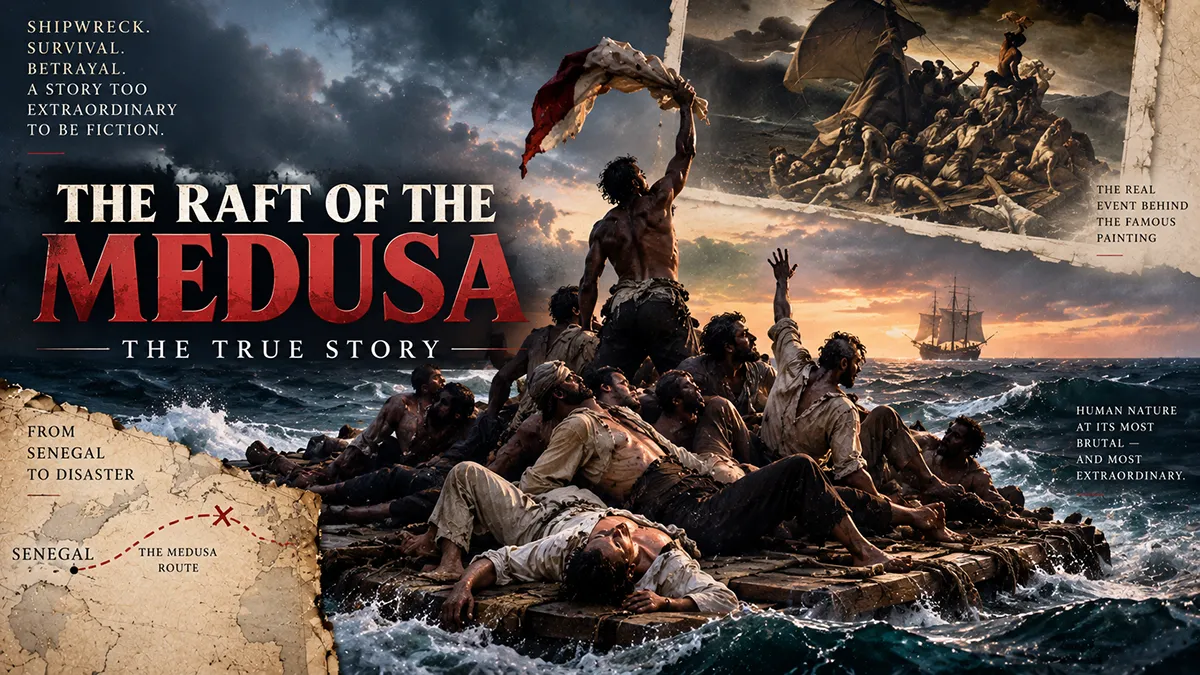
Few paintings in the history of art carry the weight of an actual atrocity on their canvas the way The Raft of the Medusa does.
It looks like a scene ripped from mythology, all writhing bodies and stormy light, but there is no monster here and no metaphor either. This is reportage, painted three years after the fact, of a real disaster that scandalized France and nearly toppled a government.
The story behind the painting is arguably more disturbing than the painting itself, involving incompetence, abandonment, starvation, and things survivors would spend the rest of their lives trying to forget.
This is the full story of the wreck, the raft, and the young artist who turned a national disgrace into one of the most important works in the Louvre.
TL;DR: The Raft of the Medusa by Théodore Géricault depicts the real 1816 wreck of the French frigate Méduse, whose officers abandoned 147 people on a makeshift raft, only 15 of whom survived a horrifying 13-day ordeal.
What Happened to the Medusa? The Real Shipwreck Story
In June 1816, the French naval frigate Méduse set sail for Senegal, carrying colonial administrators, soldiers, and settlers to reclaim the colony of Saint-Louis from British control. The ship was part of a small convoy, but it was traveling under the command of Hugues Duroy de Chaumareys, a captain who had barely sailed in over twenty years. He owed his position to political connections under the restored French monarchy, not to naval experience.
Chaumareys pushed the Méduse too close to the West African coast in an effort to save time. On July 2, 1816, the ship ran aground on the Bank of Arguin, a notorious sandbank off the coast of what is now Mauritania, roughly 50 kilometers from shore.
The ship itself was not badly damaged at first, and there was time to plan an orderly evacuation. Instead, what followed was one of the most shameful episodes in French maritime history, and it is this second disaster, not the grounding itself, that made the wreck of the Medusa infamous, often ranked among the worst man-made disasters in history.
Who Was to Blame? Incompetence, Politics, and a Fatal Decision
The Méduse carried six lifeboats, but they could not hold all 400-plus people aboard. Someone came up with the idea of building a large raft from the ship’s timber and masts to carry the overflow, roughly 147 men and one woman, while the boats towed it to shore.
The raft was hastily constructed, about 20 meters long and 7 meters wide, with almost no railing and no real means of steering. It rode so low in the water that anyone standing on it was submerged to the waist, and there was no food or fresh water stored for the journey.
Within hours, the towing ropes were cut loose, either deliberately or in the chaos of rough seas. Accounts differ on exactly who ordered it, but the effect was the same: the lifeboats, carrying the officers, the captain, and the colonial governor, rowed away toward the coast, leaving the raft and everyone on it to drift alone in the open Atlantic.
Life and Death on the Raft
What happened over the next 13 days is the reason this story still shocks people two centuries later. With no food, no water, and no way to steer, the people on the raft descended quickly into panic, violence, and despair. Fights broke out over the first night as some tried to seize control, and dozens were killed or thrown overboard in the chaos.
By the third day, starvation had set in, and survivors later testified that some resorted to eating the flesh of those who had died. Weakened men who could not stand were reportedly thrown into the sea by others determined to conserve dwindling scraps of food and space. Sharks are believed to have circled the raft, though the exact details of these encounters, as with much of the ordeal, come only from survivor testimony written down after the fact.
By the time a passing ship, the Argus, spotted the raft on July 17, 1816, only 15 of the original 147 people were still alive. Several of them died shortly after being rescued, their bodies and minds ruined by nearly two weeks of exposure, dehydration, and horror.
Rescue, Survivors, and the Scandal That Followed
Two of the survivors, the engineer Alexandre Corréard and the ship’s surgeon Henri Savigny, wrote a detailed account of the disaster after their rescue. Their book named names, accused Captain Chaumareys of cowardice and incompetence, and directly implicated the French government for appointing an unqualified officer to command the ship.
The account became a sensation in France precisely because it embarrassed the newly restored monarchy of Louis XVIII, one of the many heroes and villains of the French Revolution whose legacies shaped the politics of the era. Chaumareys was eventually court-martialed, but critics felt his punishment, a few years in prison, was far too lenient given the scale of the horror.
The public was primed for outrage, and the medusa shipwreck became shorthand for the corruption and cronyism of the restoration government. It was against this backdrop of scandal that a young, ambitious painter named Théodore Géricault decided this was the subject that would make his career.
Théodore Géricault and the Making of a Masterpiece
Théodore Géricault was in his late twenties, already trained in the grand tradition of history painting, when he became fixated on the Medusa affair. Géricault’s raft of the Medusa project would consume nearly a year and a half of his life, an extraordinary commitment for a single canvas.
He approached it with an almost obsessive dedication to accuracy. Géricault interviewed survivors Corréard and Savigny directly, and reportedly had a scale model of the actual raft built in his studio so he could study how bodies would realistically be arranged upon it.
He visited hospitals and morgues to study the color and texture of dying and dead flesh, and by some accounts, he even kept severed limbs in his studio for weeks to observe how they decayed. Whether every detail of these studio stories is verifiable, the finished painting’s unsettling realism makes clear that Géricault treated this less like a commission and more like an investigation.
Inside the Painting: Composition, Characteristics, and Style
The finished canvas is enormous, measuring roughly 4.9 by 7.2 meters, meaning the figures on it are close to life-sized. This scale was traditionally reserved for grand historical or religious subjects, and Géricault’s choice to use it for a contemporary news event was itself a radical statement.
One of the defining characteristics of The Raft of Medusa is its pyramidal composition. Bodies are piled from the lower-left corner, where the dead and dying lie tangled together, up toward a peak on the right, where a Black survivor waves a cloth toward a barely visible ship on the horizon.
The lighting is theatrical and dramatic, borrowing from Baroque painters like Caravaggio and Rubens, with harsh contrasts between shadowed flesh and bursts of stormy light. The color palette is deliberately muted and earthy, dominated by greys, browns, and sickly flesh tones, which only intensifies the sense of exhaustion and decay.
This blend of a mythological-scale composition with a grim, true-to-life subject is why art historians consider it a landmark of French Romanticism. It rejected the cool, idealized order of Neoclassicism in favor of raw emotion, movement, and contemporary tragedy.
Symbolism in The Raft of the Medusa

The symbolism in The Raft of the Medusa operates on more than one level. On the surface, it is a document of a specific disaster, but Géricault clearly intended broader commentary as well.
The pyramid of bodies moves the viewer’s eye from death and despair at the bottom toward a fragile gesture of hope at the top, suggesting a journey from hopelessness toward survival. Some art historians read this as a meditation on the human condition itself, the way people cling to hope even amid overwhelming suffering.
The prominent inclusion of a Black survivor at the painting’s peak has also drawn significant scholarly attention. France was in the middle of heated debates over slavery and abolition at the time, and some historians argue Géricault was making a pointed statement about equality and shared humanity amid disaster, though this interpretation remains a subject of ongoing debate rather than settled fact.
Finally, many viewers have read the painting as a broader allegory for the French state itself, a ship of leadership run aground by incompetence while ordinary people were left to suffer the consequences. Given the political scandal the wreck had caused, this reading would not have been lost on audiences in 1819.
The Painting’s Debut and the Scandal at the Salon
Géricault submitted the painting to the Paris Salon of 1819 under the more neutral title “Scène de Naufrage,” or “Shipwreck Scene,” likely to soften its overt political charge. Audiences and critics, however, immediately recognized the subject, and the painting became the talk of the Salon.
Reactions were sharply divided. Some critics praised its ambition and technical mastery, while others were horrified by its unflinching, almost journalistic depiction of death, cannibalism, and government failure. The government itself, still smarting from the original scandal, was reportedly uneasy about the painting’s popularity.
Despite, or because of, the controversy, the painting won a gold medal at the Salon. The French state eventually purchased it, and it entered the Louvre’s collection, ensuring that this brutal chapter of French history would remain on public view indefinitely.
The Raft of the Medusa at the Louvre Today
Today, the raft of the Medusa Louvre display remains one of the museum’s most visited and most discussed works. It hangs in the Denon Wing among other monumental French paintings, including Delacroix’s Liberty Leading the People, in a room specifically designed to house large-scale 19th-century history paintings.
Standing in front of it, visitors often describe being struck by its sheer physical scale, something photographs rarely convey. The life-sized figures and the raft’s exact positioning make the viewer feel almost level with the desperate survivors themselves.
If you’re planning a trip and searching for the raft of medusa Louvre location specifically, it’s worth noting the painting is permanently displayed, not part of a rotating exhibit, making it one of the more reliable Louvre highlights to plan around alongside the Mona Lisa and Venus de Milo.
Why “Wrath of Medusa” Is a Common Mix-Up

A quick note on a common search mix-up: many people look for the “wrath of Medusa painting,” assuming this artwork depicts the snake-haired Gorgon from Greek mythology. It’s an understandable mistake, since the ship itself was named after the mythological Medusa, and the title alone can be misleading if you’re not familiar with the history.
However, Géricault’s painting has nothing to do with the Gorgon’s curse or wrath at all. The Méduse was simply the name of the French naval frigate, chosen the way ships are often named after mythological figures, and the painting depicts the very real human tragedy that followed its wreck, not any supernatural vengeance.
So if you’re searching for “wrath of Medusa” hoping to find myth-based artwork, know that the raft of the Medusa story is actually grounded firmly in real 19th-century history, not ancient legend.
Legacy: How the Raft of the Medusa Changed Art
The raft of the Medusa’s influence stretched far beyond its own era. It’s widely credited as one of the paintings that launched the Romantic movement in France, inspiring later artists like Eugène Delacroix, who reportedly modeled for one of the figures on the raft and went on to paint his own politically charged masterpieces.
The painting also set a precedent for artists tackling current events with the same seriousness once reserved for history, mythology, or religion. This idea, that ordinary contemporary suffering was a worthy subject for grand-scale art, would go on to influence everything from war photography to modern photojournalism.
Internationally, the work is known by several names, including Le Radeau de la Méduse in its original French and La Balsa de la Medusa in Spanish-speaking countries. Its enduring fame across languages is a testament to how universally its themes of abandonment, survival, and institutional failure still resonate.
The Legacy of a National Wound
More than two centuries later, the raft of the Medusa story still functions as a kind of moral case study. It’s referenced in discussions of leadership failure, media scandal, and the ethics of survival under extreme conditions, far beyond the world of art history, in much the same way modern disasters like the Deepwater Horizon oil spill are still studied for what they reveal about institutional negligence.
Géricault died young, at just 32, only a handful of years after finishing the painting, and never lived to see quite how influential it would become. Yet the raft of Medusa by Théodore Géricault remains one of the most studied, reproduced, and discussed paintings in Western art, a permanent reminder that sometimes the most powerful history paintings are simply telling the truth.
The brutal story behind The Raft of the Medusa isn’t a legend passed down through centuries of retelling. It’s a documented tragedy, painted by a man determined to make sure the world couldn’t look away from it.
Frequently Asked Questions
What is the true story behind The Raft of the Medusa?
The Raft of the Medusa depicts the aftermath of the 1816 wreck of the French frigate Méduse off the coast of West Africa. When the ship ran aground, 147 people were placed on a hastily built raft and abandoned by the officers in lifeboats; only 15 survived a horrifying 13-day ordeal at sea before rescue.
Who painted The Raft of the Medusa?
The painting was created by French Romantic artist Théodore Géricault, who spent about 18 months researching and painting the work, interviewing survivors and studying corpses to achieve realistic detail. It debuted at the Paris Salon of 1819.
Is ‘Wrath of Medusa’ the same painting as The Raft of the Medusa?
No, this is a common mix-up. The painting has nothing to do with the mythological Gorgon Medusa; the ship was simply named Méduse. 'Wrath of Medusa painting' searches often lead people to this same historical artwork, which depicts a real shipwreck, not Greek mythology.
Where is The Raft of the Medusa located today?
The painting is permanently displayed at the Louvre Museum in Paris, in the Denon Wing, alongside other large-scale 19th-century French history paintings such as Delacroix's Liberty Leading the People.
How many people survived the real Medusa shipwreck?
Of the 147 people originally placed on the raft, only 15 were still alive when the ship Argus rescued them 13 days later. Several of those survivors died shortly after rescue due to the severity of their condition.
What is the symbolism in The Raft of the Medusa?
The painting's pyramidal composition moves the eye from death and despair at the bottom toward a fragile gesture of hope at the top, symbolizing the tension between suffering and survival. Many historians also read it as a political critique of the French government's incompetence and a commentary on shared humanity amid disaster.
How big is the actual Raft of the Medusa painting?
The canvas measures approximately 4.9 by 7.2 meters, making most of the depicted figures close to life-sized. This monumental scale was traditionally reserved for historical or religious subjects, making Géricault's use of it for a contemporary event especially striking.
Did people really resort to cannibalism on the Medusa raft?
Survivor testimony from Alexandre Corréard and Henri Savigny, published shortly after the rescue, described extreme desperation aboard the raft, including violence and the consumption of the dead for survival. While these accounts are considered historically credible, some specific details of the ordeal rely solely on survivor memory rather than independent verification.

Alex Warren
Related Articles