
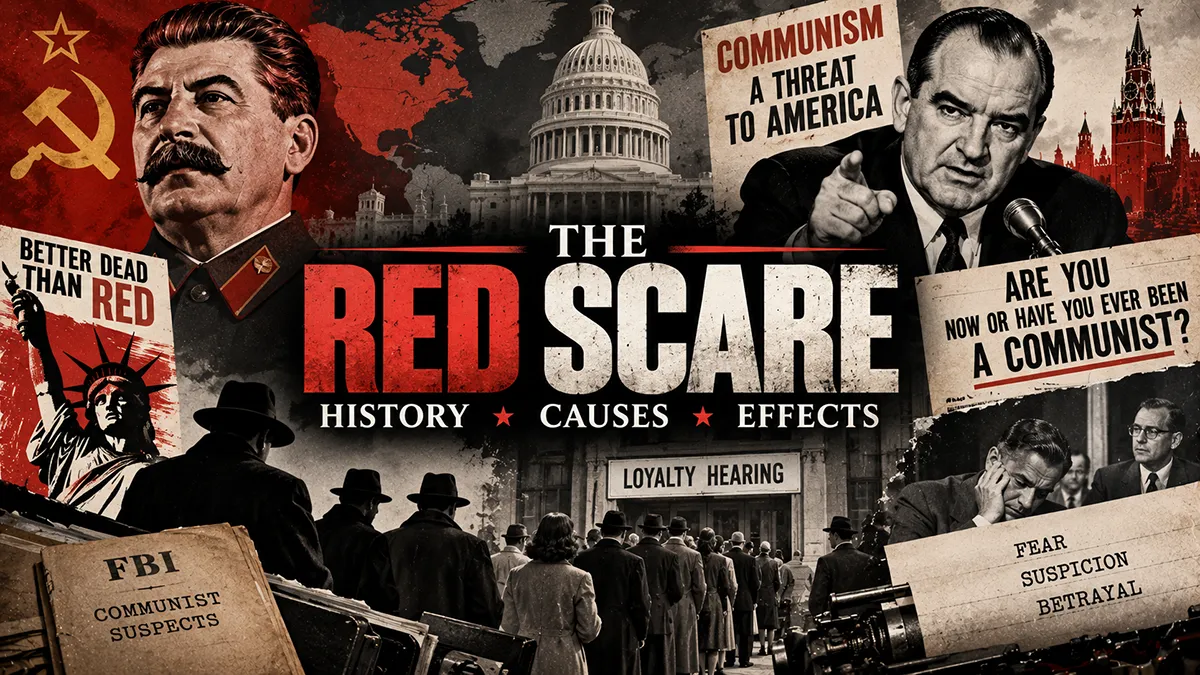
Few phrases from American history carry as much lingering unease as “the Red Scare.” It conjures images of loyalty oaths, blacklisted actors, and senators waving folders of secret names.
But the Red Scare wasn’t a single event — it was two distinct waves of anti-communist fear, separated by nearly three decades, that each left deep scars on American law, culture, and civil liberties.
Understanding what the Red Scare actually was — and wasn’t — helps explain why the United States still argues over the balance between national security and personal freedom today. This guide walks through the definition, causes, timeline, and lasting legacy of both Red Scares in plain language.
TL;DR: The Red Scare refers to two periods of intense American fear of communism — one after World War I (1917–1920) and one during the early Cold War (roughly 1947–1957) — that led to real crackdowns on civil liberties whose legal and cultural effects are still felt today.
What Was the Red Scare? A Simple Definition
So, what is the Red Scare, exactly? In the simplest terms, the Red Scare definition in U.S. history refers to periods of widespread public fear and government action against communism, socialism, and radical political movements believed to threaten American institutions.
The word “red” comes from the color long associated with communist and socialist movements, tracing back to European revolutionary flags and the Soviet Union’s own imagery.
When people ask “what’s the Red Scare” or look for a red scare short definition, most historians point to two separate episodes rather than one continuous event.
The First Red Scare ran roughly from 1917 to 1920, following the Russian Revolution and World War I. The Second Red Scare, closely tied to the early Cold War and often called the McCarthy era, ran from about 1947 to 1957.
Both waves shared a common thread: fear that communist agents, sympathizers, or ideas were secretly working to undermine American government, labor markets, and culture from within. That fear, whether justified or wildly exaggerated in specific cases, drove real policy, real investigations, and real consequences for thousands of ordinary people.
When Was the Red Scare? A Quick Timeline
A common search is simply “when was the Red Scare” or “what year was the Red Scare,” and the honest answer is that there were two distinct red scare dates to know.
- First Red Scare: 1917–1920, sparked by the Russian Revolution of 1917 and the aftermath of World War I.
- Second Red Scare: roughly 1947–1957, unfolding alongside the Cold War standoff between the United States and the Soviet Union.
Some historians stretch the Second Red Scare’s active years slightly earlier or later, since Cold War anxiety about communism never fully disappeared until the Soviet Union’s collapse in 1991. But the most intense period of investigations, blacklists, and congressional hearings is generally dated to that decade after World War II.
What Caused the First Red Scare?
If you’re wondering what caused the first Red Scare, the answer involves a perfect storm of global and domestic events. The Bolshevik takeover of Russia in 1917 stunned the Western world, showing that a communist revolution could actually topple an empire. American officials and much of the public worried a similar uprising could happen at home.
Domestic unrest made those fears feel urgent. The years right after World War I brought major labor strikes, including a general strike in Seattle and a police strike in Boston, along with a wave of anarchist-linked bombings in 1919, including one that damaged the home of U.S. Attorney General A. Mitchell Palmer. Palmer responded with what became known as the Palmer Raids, mass arrests targeting suspected radicals and immigrants, many of which were later criticized for violating basic civil liberties.
Economic anxiety played a role too. Returning soldiers competed for jobs, inflation was rising, and immigration had surged in the preceding decades, feeding nativist suspicion that foreign-born workers were importing dangerous ideologies. This mix of revolution abroad, unrest at home, and immigration anxiety is what started the Red Scare in its first form.
What Caused the Second Red Scare?
The causes of the second Red Scare were different in flavor but similar in structure. After World War II, the United States and the Soviet Union emerged as rival superpowers, each fielding some of the largest militaries in the world, with opposing economic systems, kicking off the Cold War. The Soviet Union’s rapid acquisition of atomic weapons technology by 1949, combined with the fall of China to communism that same year, alarmed American leaders and citizens alike.
Espionage cases deepened the anxiety. The trial and conviction of Alger Hiss, a former State Department official accused of passing secrets to the Soviets, and the espionage case against Julius and Ethel Rosenberg, executed in 1953 for passing atomic secrets, convinced many Americans that communist infiltration wasn’t paranoid fantasy but a real, documented threat.
This is the heart of red scare Cold War history: it wasn’t just abstract ideological fear, it was tied to specific, high-profile events that seemed to confirm the worst suspicions. Whether every accusation from that era held up to scrutiny is a separate question — many did not — but the underlying anxiety had real triggers.
Why Did Americans Fear Communism So Deeply?
A lot of readers ask why America feared communism, or why the U.S. feared the spread of communism, as if it were purely irrational. The truth is more nuanced. Communism as practiced under Stalin’s Soviet Union involved totalitarian control, suppression of dissent, and the elimination of private property and religious freedom — all things that clashed directly with American ideals of individual liberty and free enterprise.
Americans also feared communism’s stated goal of global revolution. Soviet rhetoric explicitly called for the spread of communism worldwide, and the USSR backed communist movements and governments in Eastern Europe, and later in Asia — among the historical events that changed the world more than people often realize — which made the ideology feel less like a distant philosophy and more like an expanding threat.
At the same time, fear of communism was amplified — and sometimes exploited — by politicians, media figures, and interest groups who benefited from stoking public anxiety. This combination of genuine geopolitical concern and political opportunism is key to understanding why the fear ran so deep and lasted so long.
The United States Feared a Communist Revolution In… Where, Exactly?
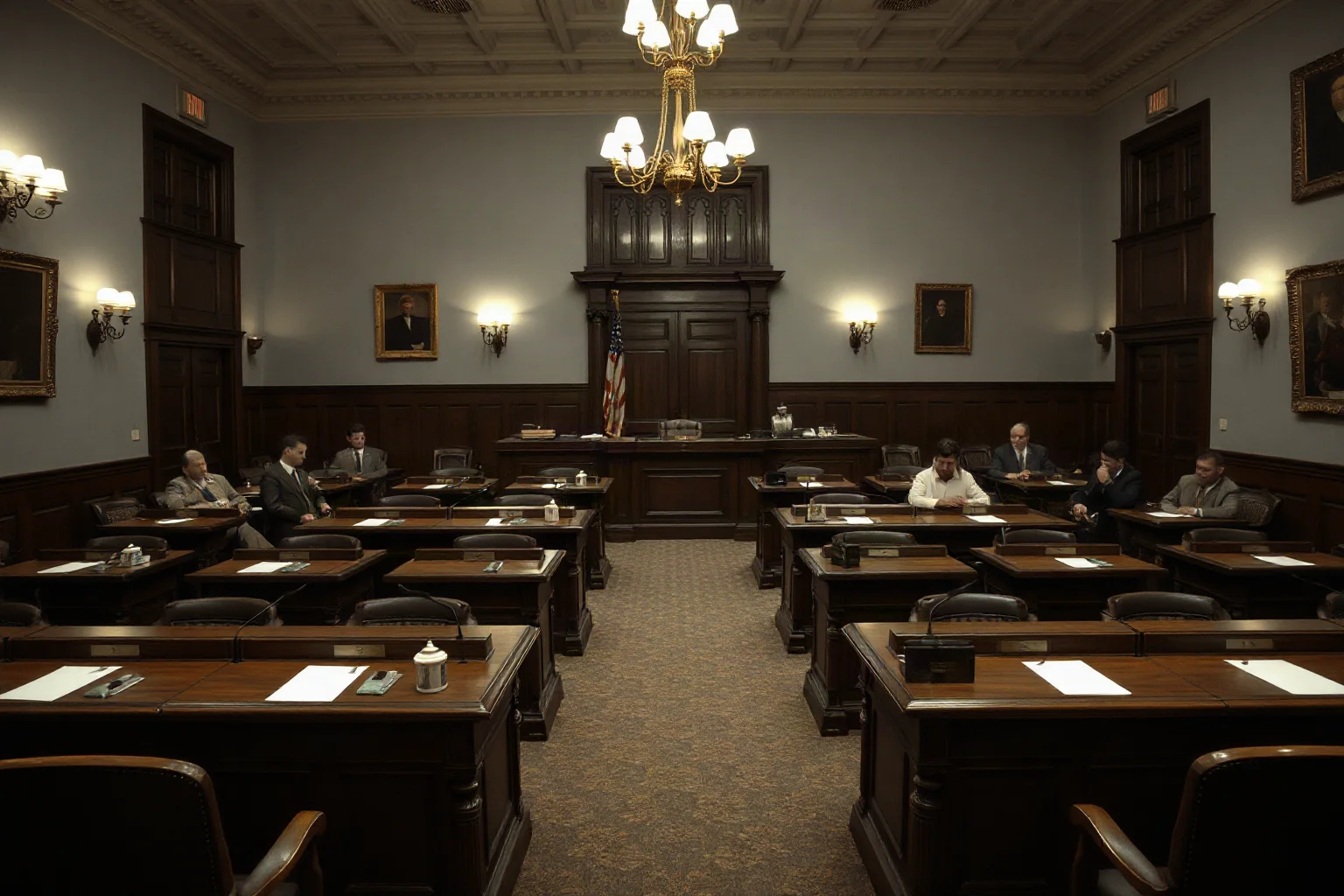
One specific search worth addressing is the idea that “the United States feared a communist revolution in” some particular country or region. During the Cold War, American policymakers worried about communist revolutions spreading across multiple regions, especially Eastern Europe, China, and later parts of Latin America and Southeast Asia, including Korea and Vietnam.
This fear of a spreading, almost domino-like series of communist takeovers became known as the “domino theory,” which held that if one nation fell to communism, its neighbors would soon follow. That theory directly shaped major U.S. foreign policy decisions, including intervention in the Korean War and later the Vietnam War — two of the longest and shortest wars in history that reshaped America’s 20th-century foreign policy.
HUAC, McCarthyism, and Congressional Investigations
No discussion of the Red Scare is complete without HUAC. So what does HUAC stand for in Red Scare history? HUAC stands for the House Un-American Activities Committee, a congressional committee originally formed in 1938 to investigate disloyalty and subversion, which became a central engine of the Second Red Scare.
HUAC’s most famous investigations targeted the entertainment industry, questioning writers, directors, and actors about alleged communist ties. Those who refused to cooperate or name colleagues, sometimes called the “Hollywood Ten,” were jailed for contempt of Congress and blacklisted from work in the industry for years.
Senator Joseph McCarthy of Wisconsin became the era’s most notorious figure, giving the period its popular nickname, “McCarthyism.” Beginning in 1950, McCarthy claimed to have lists of communists working inside the U.S. government, though he rarely produced solid evidence to back up his sweeping accusations. His influence collapsed after the televised Army-McCarthy hearings in 1954, when his aggressive tactics were exposed to a national audience, and the Senate formally censured him later that year.
It’s worth being careful here about myth versus fact. McCarthy did not personally create the Red Scare — the anxiety and investigative machinery already existed through HUAC and the Justice Department — but he became its most visible and most reckless public face for a few pivotal years.
How Did Americans Show Their Fear of Communism?
People researching how Americans showed their fear of communism are often surprised by how far it reached into everyday life. Fear wasn’t confined to Washington hearing rooms; it showed up in schools, workplaces, and living rooms across the country.
- Loyalty oaths: Many government employees, teachers, and even entertainers were required to sign statements affirming they were not communists.
- Blacklisting: Suspected communists or sympathizers in Hollywood, academia, and other industries were quietly barred from employment.
- Duck-and-cover drills: Schoolchildren practiced civil defense drills in case of nuclear attack, reflecting fear of Soviet aggression.
- Popular culture: Films, comic books, and television shows of the era frequently featured communist infiltrators or alien invaders as thinly veiled Cold War allegories.
These behaviors reflected a society where suspicion had become almost routine, and where being labeled “un-American” could end a career or ruin a reputation overnight.
Effects and Consequences of the Red Scare
The effects of the Red Scare were wide-ranging and, in some cases, long-lasting. On the legal and political side, the era produced the Smith Act of 1940, which made it a crime to advocate the violent overthrow of the government, and the McCarran Internal Security Act of 1950, which required communist organizations to register with the federal government.
Careers and lives were destroyed by accusation alone, often without formal charges or a fair chance to respond. Thousands of federal employees were investigated, and many lost their jobs based on thin or unverifiable evidence of disloyalty, a practice that heavily damaged due process protections during the period.
The labor movement also felt lasting effects, since unions were frequently accused of harboring communist sympathizers, which weakened their political standing for years afterward. Immigration policy tightened as well, with the Immigration and Nationality Act of 1952 including provisions to deport immigrants found to have communist affiliations, showing how the Red Scare affected immigration well beyond the 1920s Palmer Raids.
How Did the Red Scare Affect American Civil Liberties?
This is one of the most important legacies to understand. The Red Scare repeatedly tested the First Amendment’s protections of speech and association, and in many cases, those protections lost.
Courts initially upheld convictions of people simply for belonging to the Communist Party or teaching Marxist theory, most notably in the 1951 Supreme Court case Dennis v. United States. It wasn’t until 1957, in Yates v. United States, that the Supreme Court began narrowing the scope of the Smith Act, ruling that merely advocating communist ideas in the abstract wasn’t the same as actively organizing to overthrow the government.
These cases mattered because they established precedent for how far the government could go in policing political belief versus political action — a tension that still surfaces in modern debates about surveillance, protest rights, and national security law.
First vs. Second Red Scare: What’s the Difference?
Comparing the first vs second Red Scare side-by-side makes the pattern clearer.
- Trigger: The First Red Scare followed the Russian Revolution and WWI-era labor unrest; the Second followed the rise of the Soviet Union as a nuclear-armed Cold War rival.
- Key figures: The First was driven largely by Attorney General A. Mitchell Palmer and the Justice Department; the Second is most associated with Senator Joseph McCarthy and HUAC.
- Primary targets: The First mostly targeted immigrants, labor organizers, and anarchists; the Second focused heavily on government employees, educators, and entertainment industry figures.
- Scale and duration: The Second Red Scare lasted longer, roughly a decade compared to about three years for the First, and left a deeper mark on federal law and popular culture.
Despite these differences, both scares shared the same underlying mechanism: a real geopolitical or domestic shock, amplified by media coverage and political ambition, that led to sweeping — and often disproportionate — crackdowns on suspected radicals.
A Note on the “Blue Scare”
You may occasionally come across the term “Blue Scare” while researching this period. It’s a much less common label, sometimes used by historians to describe public backlash against police officers and other public-sector workers who unionized or went on strike around 1919, most famously during the Boston Police Strike. It’s a related but distinct phenomenon from the Red Scare, tied more to fears about public-sector unrest than communist ideology specifically, so it’s worth not confusing the two terms.
How Did the Red Scare End?
The First Red Scare fizzled out by 1920, partly because predicted revolutionary uprisings never materialized in the U.S., and partly because public attention shifted toward postwar economic recovery. Attorney General Palmer’s own credibility took a hit after his dire warnings of nationwide violence failed to come true.
The Second Red Scare wound down more gradually through the mid-to-late 1950s. McCarthy’s public downfall in 1954 removed the era’s most aggressive figure, while Supreme Court rulings like Yates v. United States began reining in the broadest anti-communist prosecutions. Growing public discomfort with blacklisting and loyalty investigations, along with a slow cultural shift toward more critical reporting on McCarthy-style tactics, also helped the fever break.
Cold War tensions with the Soviet Union didn’t disappear, but the intense domestic hunt for hidden communists inside American institutions largely faded by the early 1960s.
The Lasting Impact and Legacy of the Red Scare
So what was the lasting impact of the Red Scare, and why does it still matter? First, it left a legal legacy of Supreme Court decisions that continue to shape how courts weigh free speech against claimed national security threats. Second, it left a cultural memory of how quickly fear can override due process, a cautionary story invoked whenever new “scare” narratives emerge around national security.
The entertainment industry still references the Hollywood blacklist as a symbol of how political pressure can override artistic freedom. Meanwhile, the phrase “witch hunt” — often applied to the McCarthy era — has become permanent shorthand in American politics for accusations pursued without solid evidence.
Perhaps most importantly, the Red Scare shaped how later generations think about balancing security and liberty. Debates over surveillance programs, loyalty tests, and political dissent in more recent decades routinely draw comparisons back to this period, showing that its lessons — about both real threats and real overreach — are still being processed today.
Final Thoughts
The Red Scare wasn’t a single dramatic moment but two overlapping stories about fear, power, and the fragile line between vigilance and paranoia. It genuinely responded to real events — a revolution, a global rival, actual espionage cases — but it also produced real damage to innocent people’s careers, freedoms, and reputations.
That dual legacy is exactly why the Red Scare remains such a widely studied entry among the biggest events in American history. It’s a reminder that fear, once it takes hold of a nation’s politics, can reshape laws and lives long after the original threat has faded.
Frequently Asked Questions
What was the Red Scare?
The Red Scare refers to two periods in American history — one from 1917 to 1920 and another from roughly 1947 to 1957 — marked by intense public and government fear of communism and radical political movements. Both periods led to investigations, arrests, blacklists, and new laws aimed at suspected communists and sympathizers.
What caused the Red Scare?
The First Red Scare was caused by the 1917 Russian Revolution, postwar labor strikes, and a series of anarchist bombings in 1919. The Second Red Scare was driven by Cold War tensions with the Soviet Union, the USSR's atomic weapons program, China's fall to communism in 1949, and high-profile espionage cases like the Rosenberg trial.
When did the second Red Scare start and end?
The Second Red Scare is generally dated from around 1947, shortly after World War II, through about 1957, though intense investigations peaked in the early 1950s during the height of Senator Joseph McCarthy's influence.
What does HUAC stand for?
HUAC stands for the House Un-American Activities Committee, a U.S. congressional committee that investigated alleged communist influence, most famously in the entertainment industry and federal government, during the Second Red Scare.
Who started the Red Scare?
No single person started either Red Scare. The First Red Scare grew out of postwar unrest and was intensified by Attorney General A. Mitchell Palmer's raids, while the Second Red Scare built on existing HUAC investigations and became most associated with Senator Joseph McCarthy, though he did not create the underlying fear on his own.
How many Red Scares were there in U.S. history?
Historians generally recognize two separate Red Scares: the First Red Scare from 1917 to 1920, and the Second Red Scare, often called the McCarthy era, from approximately 1947 to 1957.
What was the effect of the Red Scare on civil liberties?
The Red Scare led to loyalty oaths, blacklists, deportations, and prosecutions for merely belonging to or advocating communist ideas, which strained First Amendment protections. Supreme Court cases like Dennis v. United States and later Yates v. United States shaped how far the government could legally go in policing political belief.
Why was it called the Red Scare?
The name comes from the color red, long associated with communist and socialist movements through symbols like the Soviet flag, making the fear of communist infiltration commonly known as the 'Red Scare.'
What is the difference between the First and Second Red Scare?
The First Red Scare (1917–1920) followed the Russian Revolution and targeted immigrants, anarchists, and labor organizers. The Second Red Scare (1947–1957) unfolded during the Cold War and focused on government employees, educators, and entertainers suspected of communist ties, lasting significantly longer and leaving a deeper legal legacy.
How did the Red Scare end?
The First Red Scare faded by 1920 after predicted uprisings failed to occur. The Second Red Scare wound down through the mid-to-late 1950s following Senator McCarthy's public downfall in 1954 and Supreme Court rulings that limited anti-communist prosecutions.

Alex Warren
Related Articles