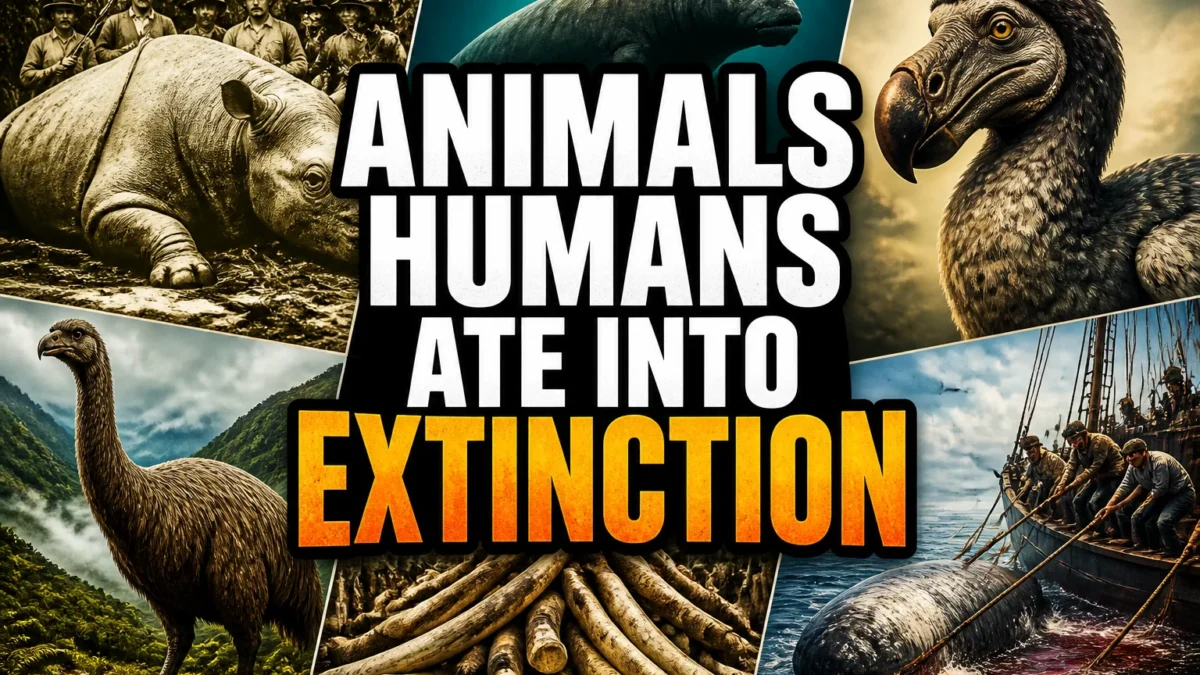
When humans find an abundant food source, history shows we can take it until there is nothing left. This top 10 extinct animals list looks at species that were eaten, harpooned, trapped, or clubbed out of existence. It is a sobering record of appetite, opportunity, and ecological change.
Not every animal on this list vanished because people were hungry alone. Hunting for food often worked alongside introduced predators, habitat loss, and the commercial wildlife trade. Together those pressures turned thriving species into extinct animals because of humans.
TL;DR: The dodo, passenger pigeon, Steller’s sea cow, great auk, moa, aurochs, Caribbean monk seal, spectacled cormorant, heath hen, and quagga are ten animals that humans ate or hunted to extinction—each a warning about overexploitation.
What Does “Eaten Into Extinction” Actually Mean?
The phrase “eaten into extinction” sounds simple, but real extinctions are rarely caused by hunger alone. Hunting for meat, eggs, oil, or hides often worked alongside habitat loss, introduced predators, and disease. That combination makes these stories more complex—and more useful—than a simple moral fable.
For this list, the focus is on animals that were hunted to extinction or nearly so because humans saw them as food. Some were easy to catch, some were abundant enough to seem endless, and some lived only in small isolated populations. All of them disappeared after humans became their main threat.
Extinction is not always a clean, single-cause event. In many cases, the final blow came from rats, pigs, goats, or habitat loss rather than the dinner table. Still, human harvest was the pressure that made the difference for the animals below.
Some conservationists avoid the phrase “eaten into extinction” because it can oversimplify complex events. It also risks blaming indigenous peoples or local communities while obscuring the roles of colonialism, global trade, and introduced species. The stories below try to give each species its full historical context.
Still, the pattern is hard to dismiss. Repeatedly, a naive animal met a new human appetite, and local abundance became global demand. That pattern repeated across oceans, islands, and continents from the 1400s onward.
How Many Animals Are Extinct Because of Humans?
There is no single official number for how many animals are extinct because of humans. Many species disappear before they are ever scientifically described, and historical records are incomplete. What researchers can say is that human activity has driven confirmed extinctions in every major animal group, from birds to mammals to shellfish.
The animals that have become extinct because of humans include far more than famous examples like the dodo. Some were eliminated by introduced rats or cats, some by deforestation, and some by industrial harvest. The species on this list represent a specific slice of that wider crisis: animals that were hunted to extinction for food, feathers, oil, or hides.
The full list of species that have gone extinct because of humans is much longer than any top-10 article can capture. Many losses happened on remote islands, where isolated animals had no fear of people. Other losses happened on continents, after new weapons and markets made hunting more efficient.
IUCN Red List counts include hundreds of animal extinctions recorded since 1500, but even those figures are conservative. Many invertebrates, fish, and small island species may have vanished before anyone could document them. The true number of extinct animals because of humans is almost certainly higher.
This article does not claim that the ten species below are the only top 10 extinct animals caused by humans. They are selected because strong historical evidence links their decline to human consumption. Other species, from island lizards to freshwater fish, have their own parallel stories.
10 Animals That Were Hunted to Extinction
This list is ordered roughly by the scale of the loss and the timing of each species' final record. Each entry tells the same core story from a different corner of the world. The entries are not ranked by importance; each one is a separate case study. Together they show how appetite could become extinction in a matter of decades or, in some cases, a few hundred years.
1. Dodo: The Flightless Bird That Became an Icon
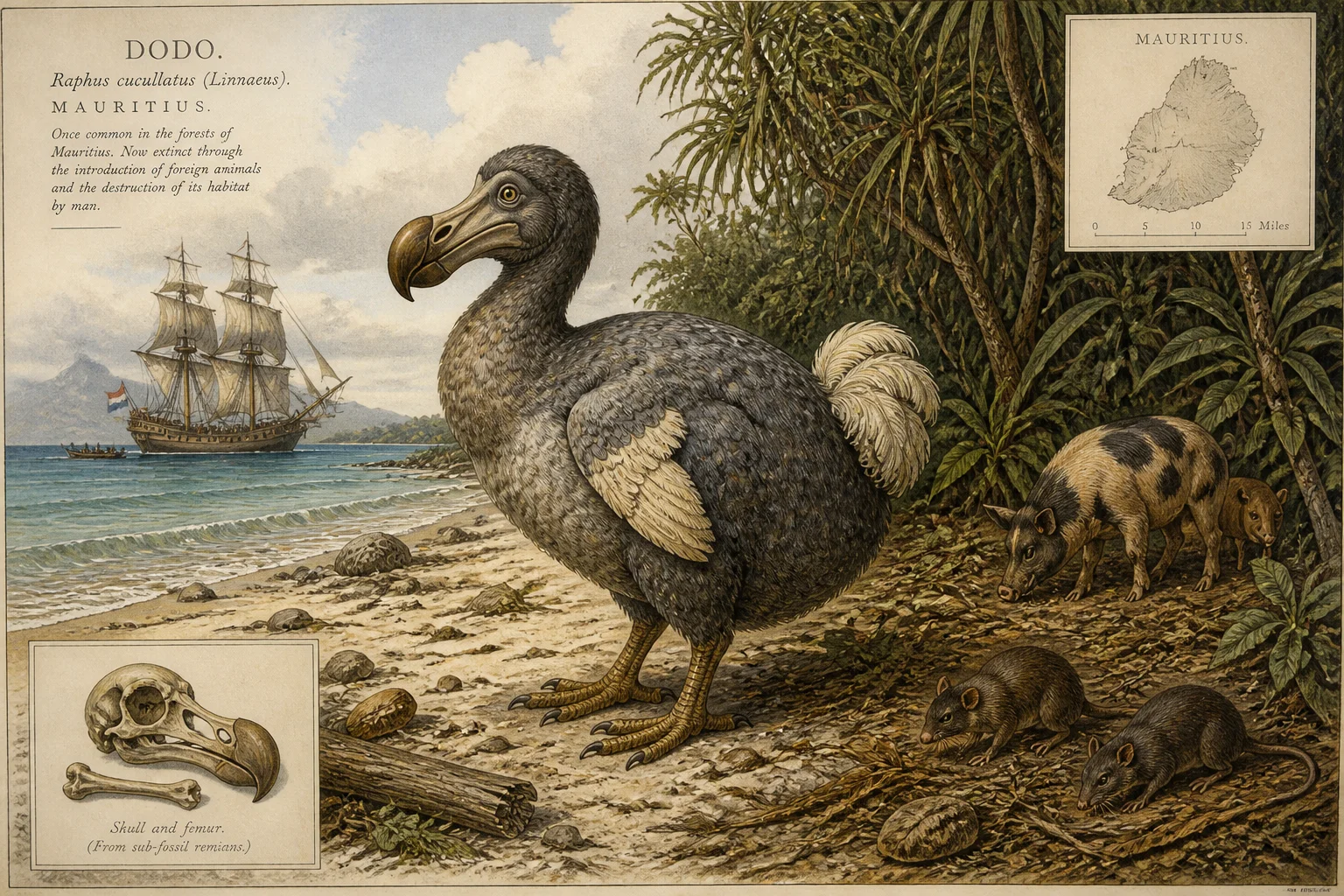
The dodo lived only on Mauritius, a volcanic island in the Indian Ocean, and had no native mammalian predators. Dutch sailors first recorded it in 1598 and found the flightless bird remarkably easy to catch. Because it could not fly and showed little fear of people, it became a convenient source of fresh meat for ships.
But the dodo was not simply eaten to extinction. Settlers and sailors also brought rats, pigs, monkeys, and goats that devoured eggs and chicks, while forest clearing shrank its habitat. The last generally accepted sighting came around 1662, less than a century after Europeans arrived.
Myth check: the dodo was not a clumsy overstuffed bird too dumb to survive. It was a well-adapted island species that had evolved without mammals, then met a sudden wave of hunters and predators.
The dodo became a global shorthand for extinction because its loss felt so avoidable. It still reminds us that an animal can be both common on one island and completely vulnerable to outside pressures.
Seventeenth-century accounts of dodo meat are mixed, with some sailors calling it tough and others treating it as survival food. That does not make the dodo any less hunted—it simply reminds us that ship crews killed whatever they could catch. Even a “bad-tasting” animal can be driven to extinction if it is easy to take.
2. Passenger Pigeon: From Billions to Zero
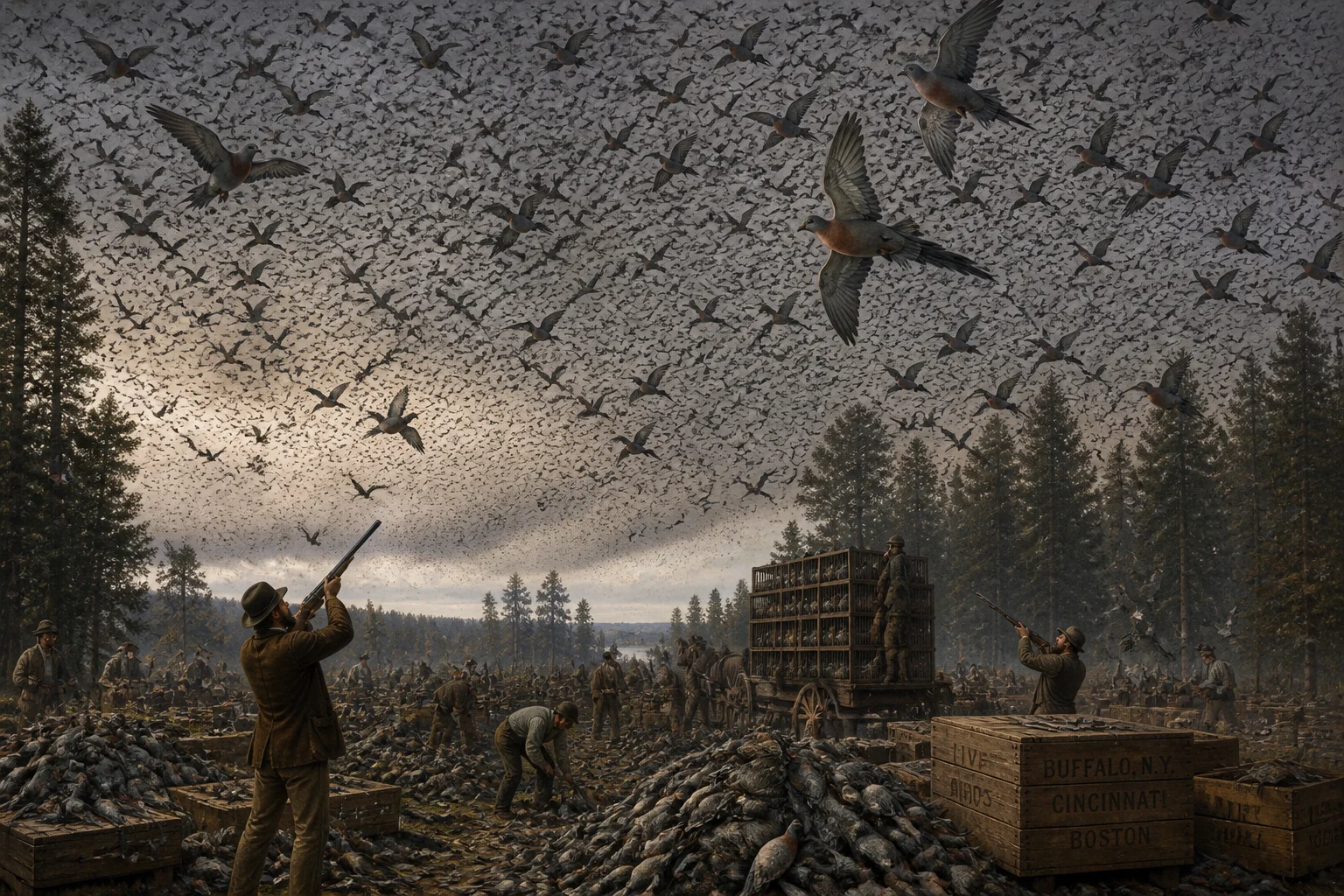
Passenger pigeons were once among the most numerous birds on Earth, with flocks that may have contained billions of individuals. Commercial hunters killed them by the ton for cheap meat in 19th-century North America, shipping barrels of birds to eastern cities. Deforestation of hardwood forests compounded the pressure by destroying nesting sites.
The collapse was astonishingly fast. By the 1890s, the great nesting colonies were gone, and the last known passenger pigeon, Martha, died at the Cincinnati Zoo on September 1, 1914. Her death turned the species into a global symbol of human-driven extinction.
The passenger pigeon challenges the myth that abundant animals cannot go extinct. Its story shows that even an overwhelming population can collapse when exploitation is industrial and unregulated.
The bird was a superabundant species that lived in enormous colonies, but those colonies made it easy to find and kill. Once nesting sites were fragmented, the species could not reproduce fast enough to replace the losses.
Modern ecological studies suggest the passenger pigeon may not have been a typical pigeon; it needed social flocks to breed successfully. When hunting scattered the great colonies, even surviving birds may have failed to reproduce. That social dependency helps explain why the species went from billions to none so quickly.
3. Steller’s Sea Cow: A Giant Gone in 27 Years
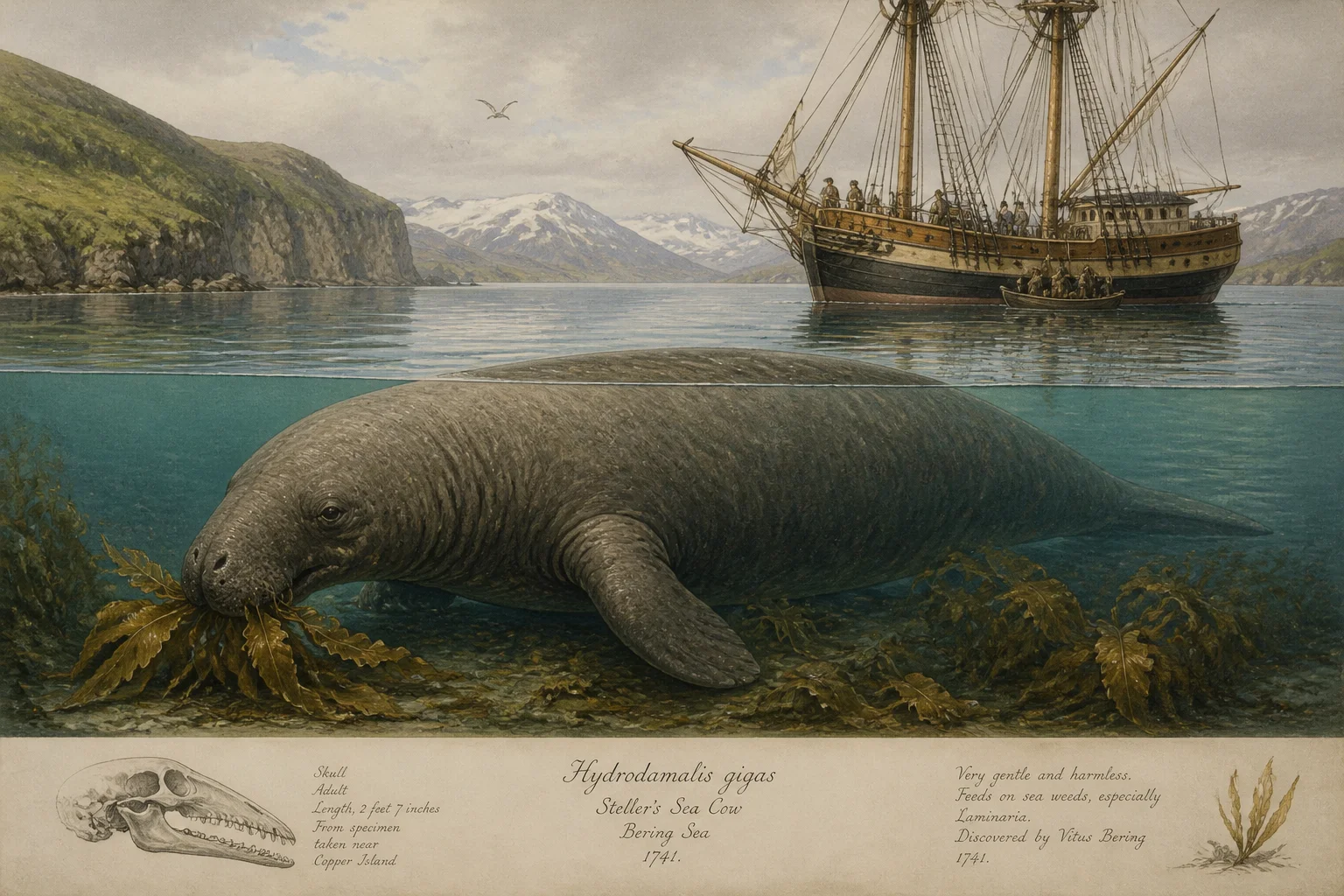
Steller’s sea cow was a giant marine mammal that lived only around the Commander Islands in the Bering Sea. It was first described by naturalist Georg Wilhelm Steller in 1741 after Vitus Bering’s shipwrecked crew encountered it. The slow-moving animal was hunted for its meat and thick blubber.
Sailors and fur traders found the sea cow easy to harpoon, and the species disappeared by 1768, roughly 27 years after Western science first recorded it. Its extinction is often cited as one of the fastest known for a marine mammal after human contact.
Steller’s sea cow was already limited to a cold refuge when Europeans arrived, but commercial hunting removed the last known population. The story shows how quickly a local species can vanish when a valuable food source is found.
Unlike the dodo, the sea cow was not spread across a large island; it lived in a tiny range. That small geographic footprint made even a few hunting seasons enough to wipe out the entire species.
There are no complete Steller’s sea cow skeletons left in the sea, but museums hold enough bones to show it was a specialized kelp feeder. It depended on cold, shallow waters where kelp was abundant. Human hunters did not just kill the adults; they removed the species from the only habitat it could use.
4. Great Auk: The Original “Penguin”
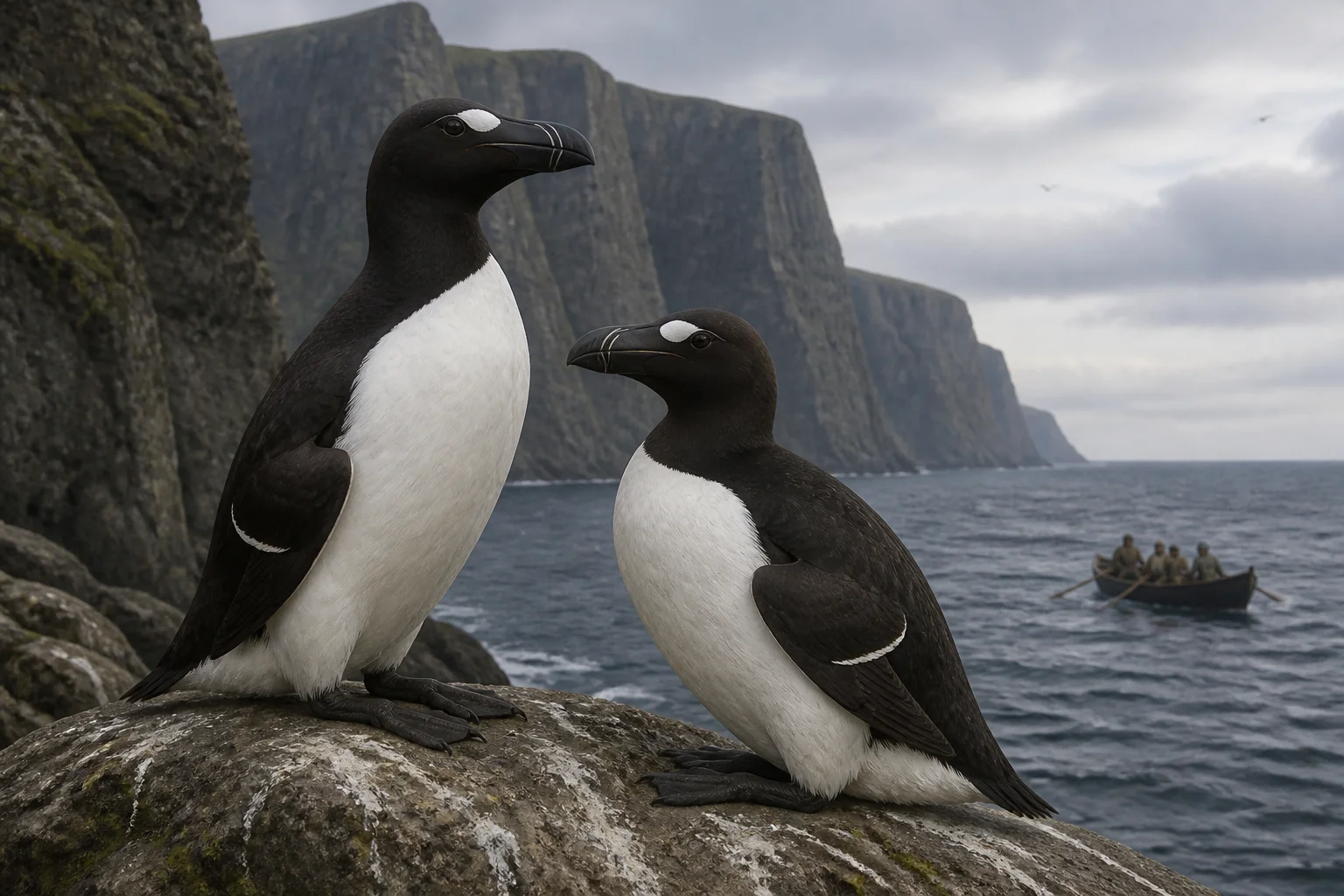
The great auk was a large, flightless seabird of the North Atlantic, breeding on remote rocky islands from Canada to Iceland. It was hunted for its meat, eggs, and downy feathers, and later for museum specimens as it became rare. Sailors often drove the birds onto shore and killed them in large numbers.
The final known breeding pair was killed on Eldey Island, Iceland, in 1844, an event that has become a landmark in conservation history. Although other sightings were reported later, no confirmed great auks survived.
The great auk is not a penguin, though the two are often confused. Its disappearance helped inspire the first modern bird-protection laws in Britain.
By the time people noticed the great auk was disappearing, collectors and museums actually increased demand for specimens. This paradox—where rarity made the bird more valuable—sped up its final decline.
Great auks were already exploited by coastal Norse and Indigenous peoples for centuries before the final commercial wave. Those earlier harvests did not extinguish the bird, but the global demand for museum skins and collections did. The last pairs were killed as collectors scrambled to get specimens.
5. Moa: New Zealand’s Vanished Giants
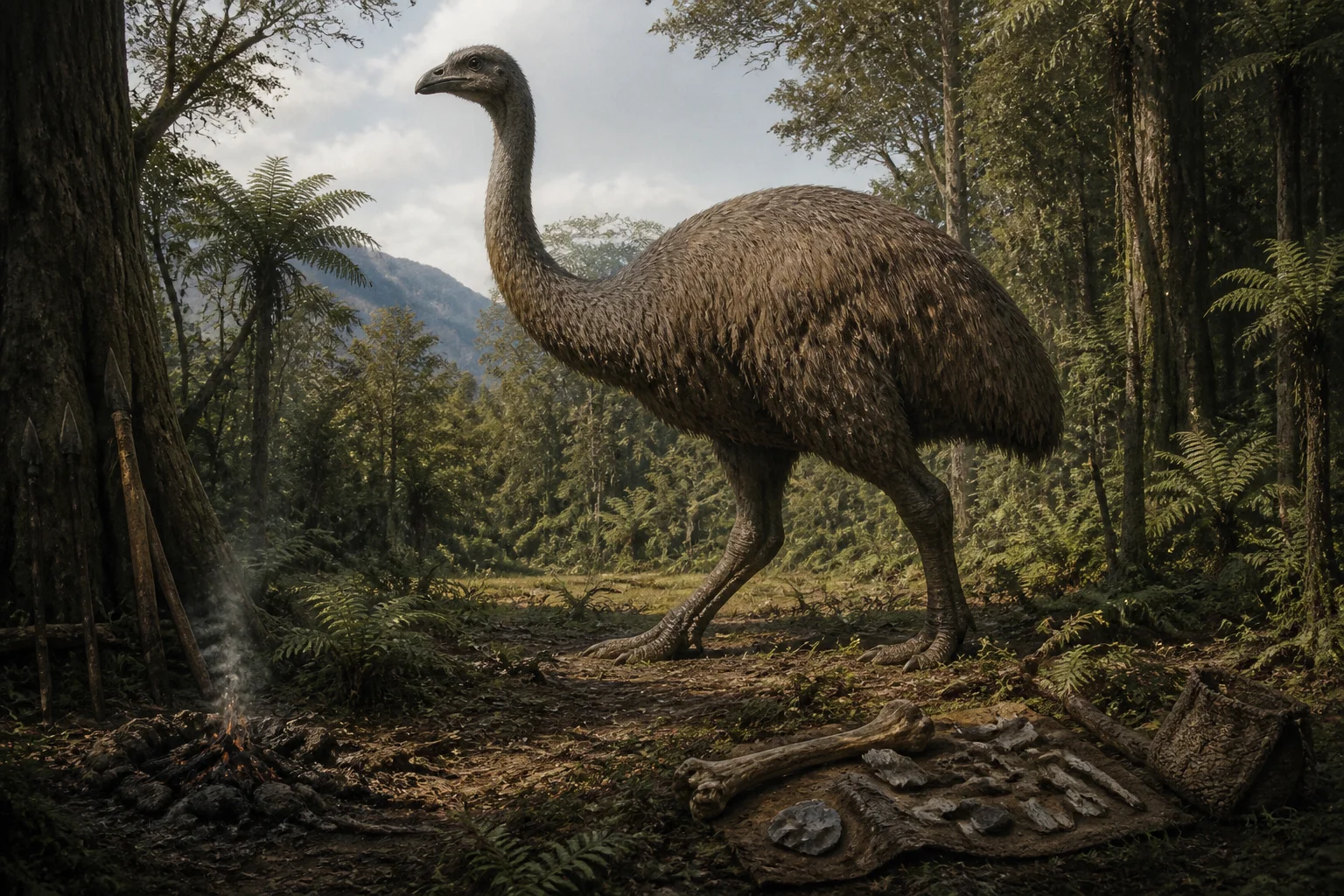
Moa were a group of large, flightless birds that lived only in New Zealand, with some species growing taller than a modern ostrich. Polynesian settlers arrived around 1300 CE and hunted moa for meat, eggs, and bones used for tools. Archaeological sites contain enormous quantities of moa remains.
Within a few hundred years of human arrival, all moa species were gone; most researchers place the extinction by the mid-1400s, though a few may have lingered in remote valleys. Habitat burning likely played a role, but hunting pressure was a central driver.
Moa extinction is one of the clearest archaeological examples of people arriving on an island and rapidly eating a native species to extinction. It remains a warning about what can happen when a new predator meets animals with no evolved fear of humans.
Because moa left behind huge piles of butchered bones, researchers can trace human harvest patterns in unusual detail. The evidence shows that people targeted large adults and eggs, removing the next generation at the same time.
Some scholars debate whether all moa species were gone before the arrival of Europeans in New Zealand in 1642. The current evidence says yes: no European explorer ever saw a living moa. That makes moa a rare case of an extinction completed entirely before European colonization.
6. Aurochs: The Wild Ancestor of Cattle
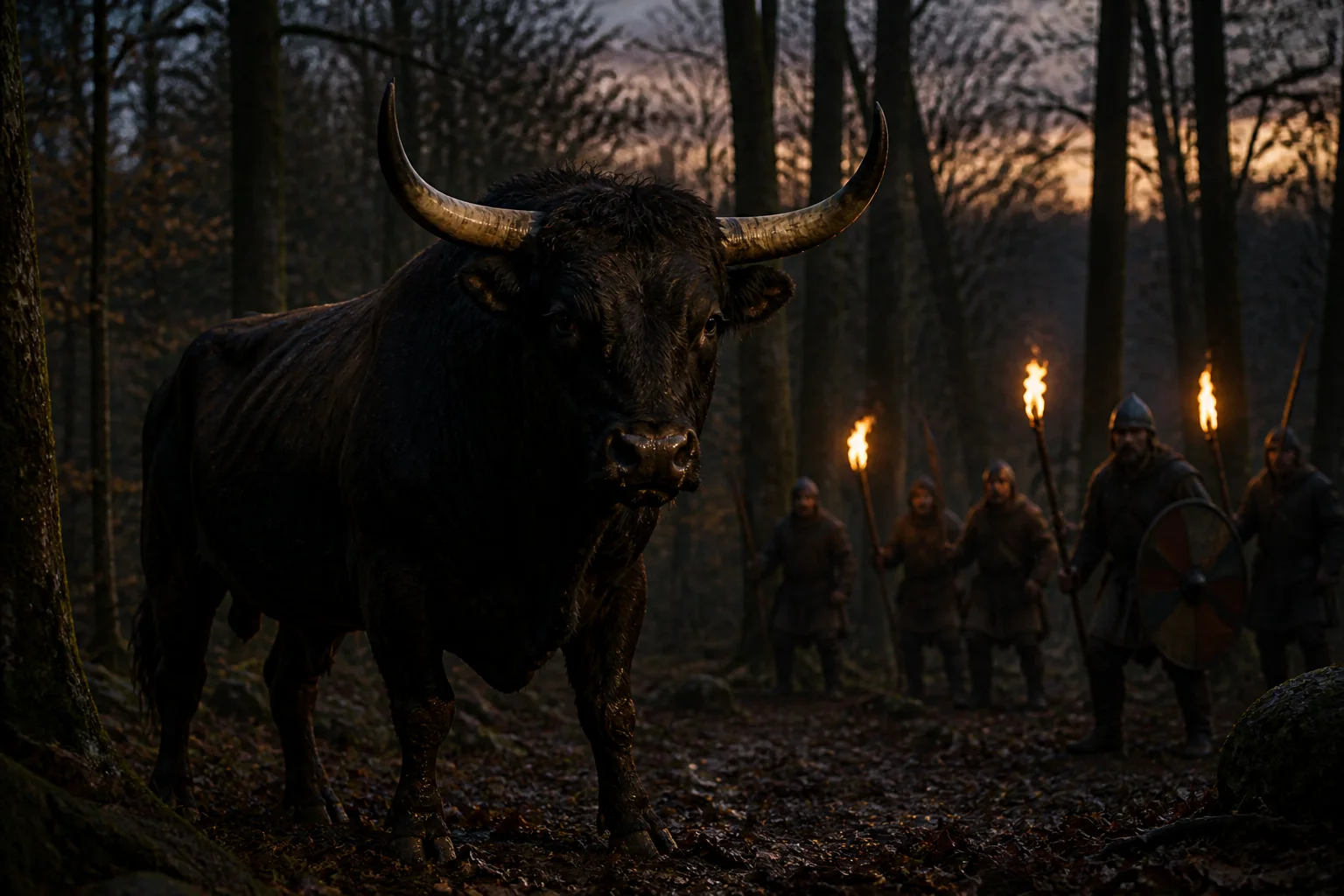
The aurochs was the wild ancestor of domestic cattle and once ranged across Europe, Asia, and North Africa. Ancient people hunted aurochs for meat and hides, and their image appears in European cave art. Over thousands of years, hunting, domestication, and habitat loss pushed the species into isolated populations.
By the Middle Ages, aurochs survived mainly in managed royal forests and protected lands in Eastern Europe. The last known aurochs, a female, died in Poland’s Jaktorów Forest in 1627.
The aurochs did not disappear overnight; it was a slow-motion extinction in which human pressure played a central role. Yet its genes live on in domestic cattle, and modern breeding projects try to recreate some of its wild traits.
The aurochs shows that domestication did not automatically save wild relatives. Instead, the wild form became a competitor for land and a target for hunters, while the domesticated version multiplied under human care.
Royal hunting reserves did not always mean protection in the modern sense. Aurochs were sometimes harvested under strict rules, but those rules limited who could kill them rather than whether the species could survive. By the 1600s, legal protection was too little and too late.
7. Caribbean Monk Seal: A Tropical Seal Hunted for Oil and Meal
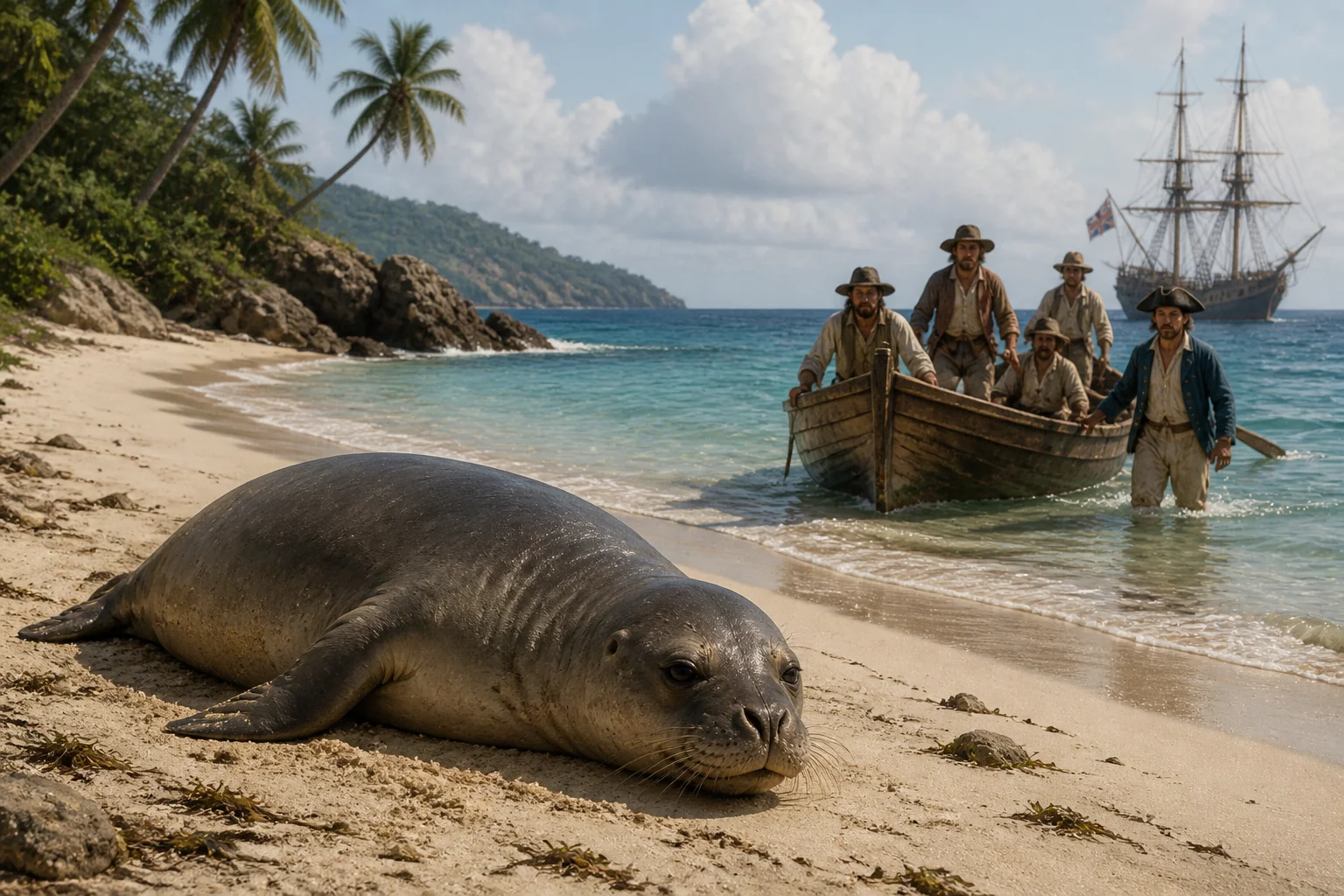
The Caribbean monk seal was a warm-water seal found in the Caribbean Sea and Gulf of Mexico. European explorers and fishermen hunted it for meat, oil, and hides, and it was killed in large numbers during the colonial era. Columbus reportedly described “sea wolves” in 1494, likely this species.
By the late 19th century, sightings were rare, and the last confirmed record came from the Caribbean in 1952. It was formally declared extinct by the U.S. government in 2008.
The monk seal’s extinction is a reminder that not all human-caused extinctions are ancient history. It vanished within living memory, after centuries of overharvesting left too few animals to recover.
Once the seal became rare, coastal development and fishing may also have disturbed its haul-out sites. Because the species was already in steep decline, these extra pressures likely sealed its fate.
The Caribbean monk seal’s warm-water habits made it easy for sailors to find on sandy beaches and rocky coves. Once harpooned, it could be rendered into oil for lamps and machinery. That utility made it a target in many colonial economies.
8. Spectacled Cormorant: A Rare Bird from the Fog
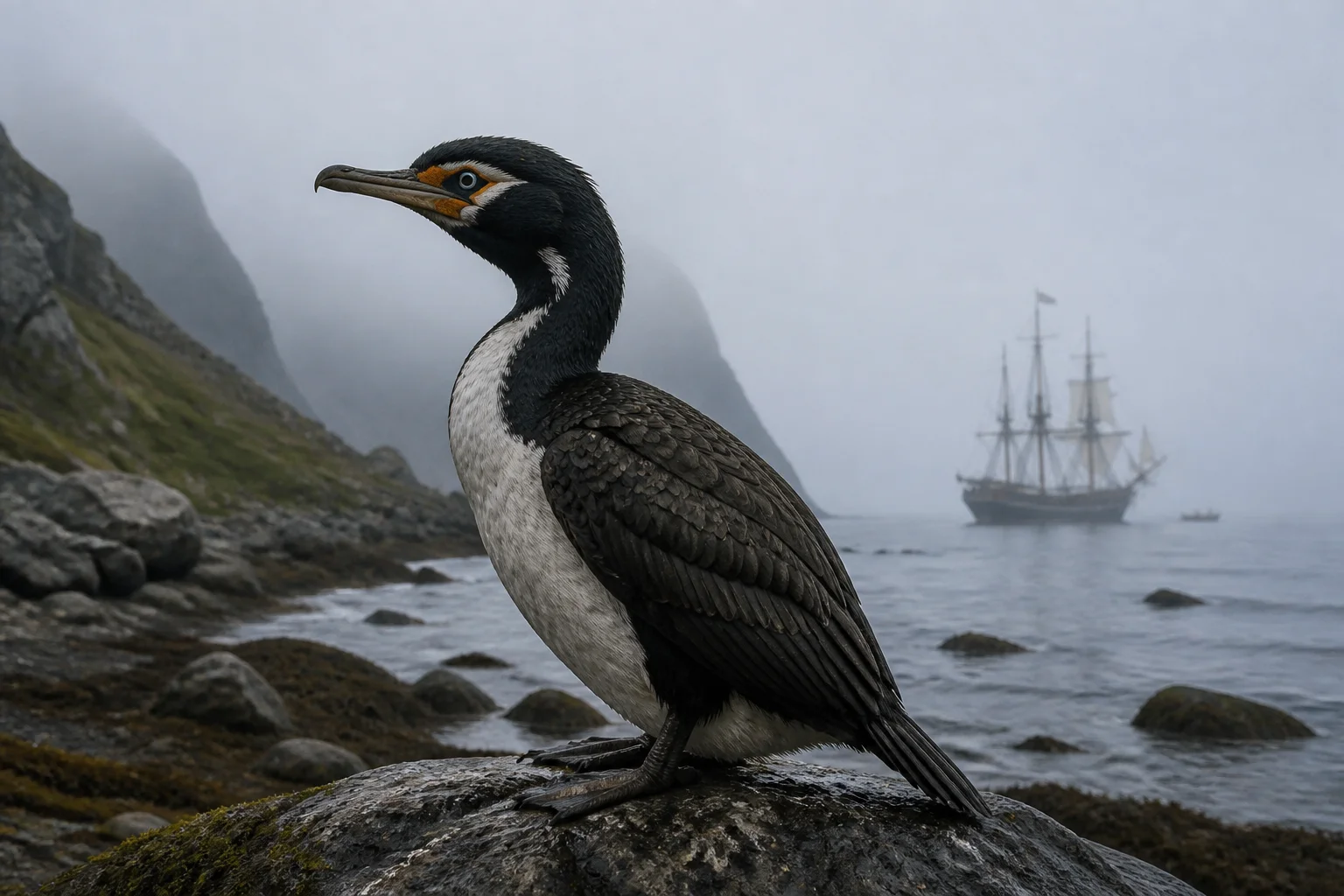
The spectacled cormorant was a large, nearly flightless seabird found only on Bering Island and nearby rocks in the North Pacific. It was described by naturalists in the 1700s, and visiting sailors and fur hunters killed it for food. Its dense feathers and plump body made it an easy target.
The last known records of the living bird date to about 1850. Because it lived in a remote, foggy region, its decline was not carefully monitored, but overhunting is considered the main cause.
Like Steller’s sea cow, the spectacled cormorant was a local species that disappeared quickly once human hunting began. It is much less famous than the dodo, but it tells the same basic story.
Its limited range and small population meant that even opportunistic hunting could be devastating. The bird had no retreat once the Bering Sea fur trade intensified.
Few spectacled cormorant specimens exist today, so scientists know less about its behavior than about other extinct birds. What they do know is that it was never widespread. That narrow range made it especially vulnerable to even modest hunting pressure.
9. Heath Hen: A Mainland Bird Eaten Out of Existence
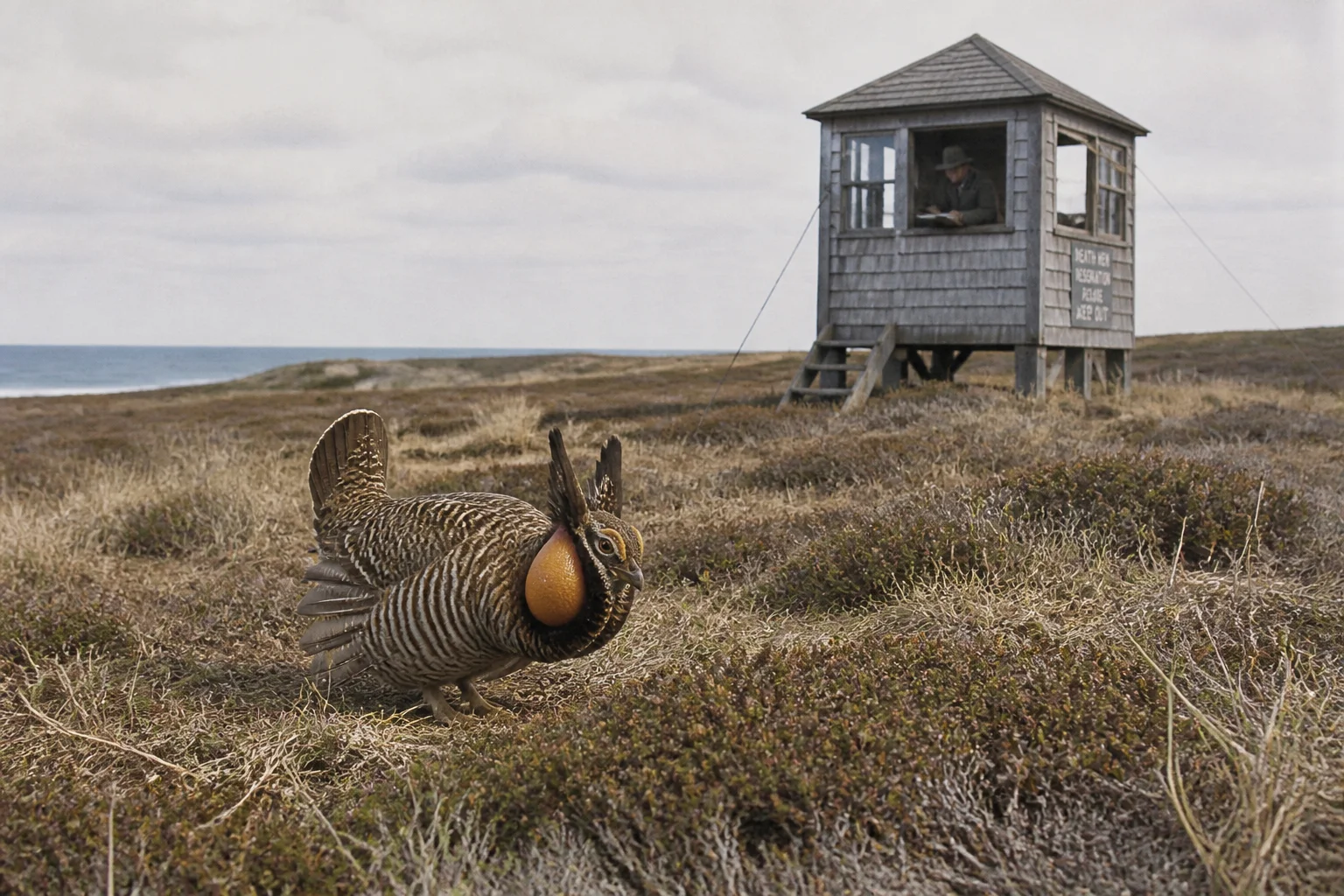
The heath hen was a subspecies of the greater prairie chicken that lived along the eastern coast of North America from New England to the Southeast. Colonists and early Americans hunted it so heavily that by the late 1800s it survived only on Martha’s Vineyard. Its meat was common in markets and taverns.
A state reserve was created to protect the last birds, but a fire, disease, and predators reduced the flock further. The last known heath hen, nicknamed Booming Ben, was last heard in 1932.
The heath hen shows that legal protection can come too late if a species is already functionally extinct. It also complicates the myth that extinction only happens to exotic island animals; this was a mainland bird eaten out of existence.
Despite being protected, the remaining population was too small and too vulnerable to disturbance. Its final years became an early lesson in the limits of rescue when a species is already at the brink.
The heath hen’s final reserve on Martha’s Vineyard became a test of early conservation methods. Wildlife managers tried to protect nesting areas and control predators, but the population was already too small. The last male sang on vacant heath until no females remained.
10. Quagga: A Half-Striped Zebra Hunted to the End
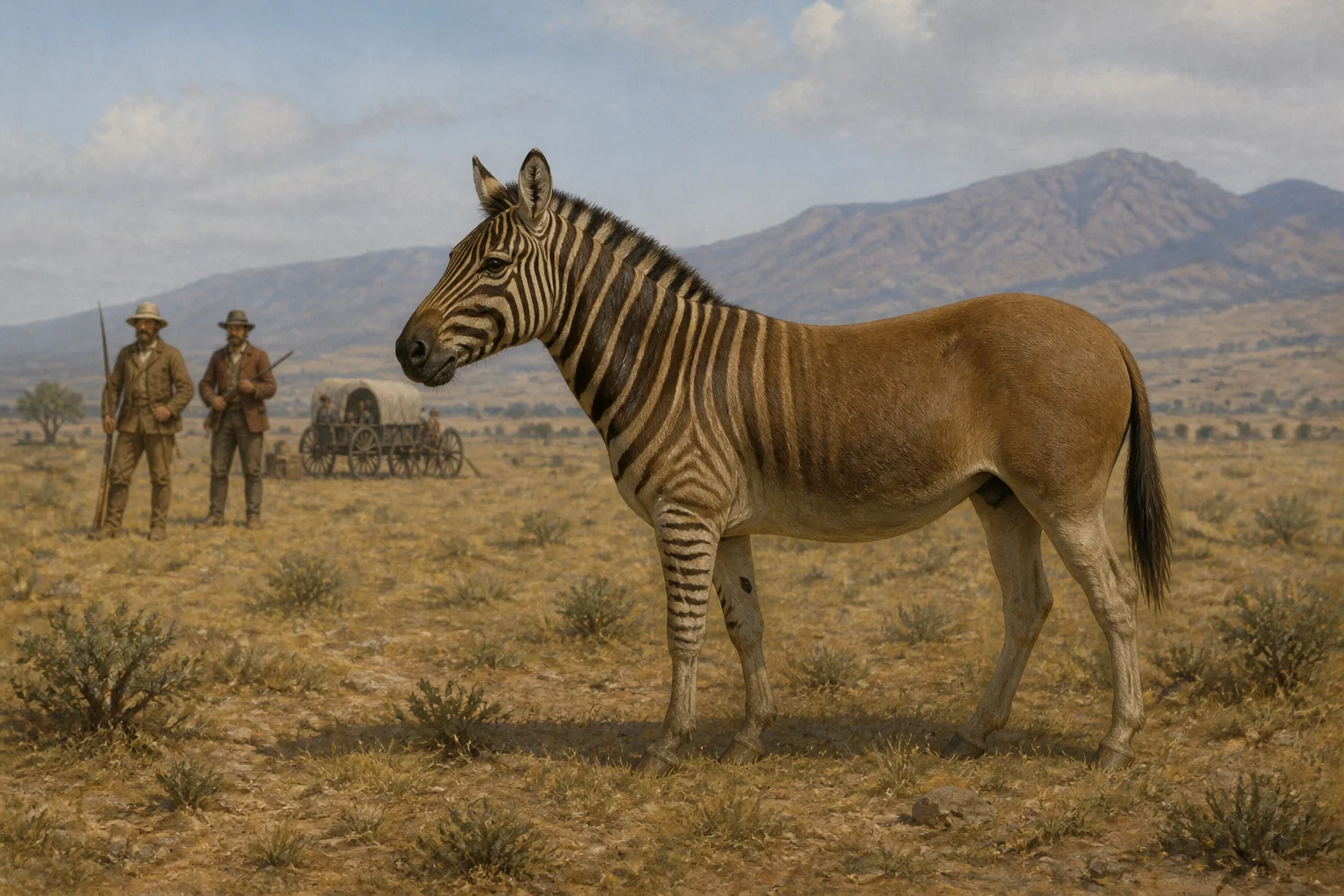
The quagga was a striking zebra subspecies from South Africa, with stripes only on the front half of its body. European settlers hunted it for meat, hides, and to reduce grazing competition for livestock. Large culls in the 19th century quickly collapsed its numbers.
The last wild quagga was shot in 1878, and the final captive individual died at Amsterdam Zoo in 1883. It was one of the first animals to have its DNA studied, decades after its disappearance.
The quagga’s extinction was not purely about food, but meat and leather markets played an important role. Its story has led to selective breeding projects that aim to restore quagga-like characteristics in plains zebras.
The quagga is a reminder that extinction stories are rarely simple. A species can be hunted for multiple reasons—food, trade, and pest control—and still disappear because of human choices.
Quagga herds were once common enough to be seen from afar on the plains. Settlers shot them in large numbers because their hides became useful leather and their meat fed workers and dogs. The species’ very visibility on open ground worked against it.
Why These Extinctions Still Matter
These ten animals were not doomed by stupidity, weakness, or bad luck. They were adapted to their environments, sometimes in spectacular abundance, until human harvest changed the rules. Their extinctions remind us that abundance is not a permanent shield.
Modern conservation measures, from hunting limits to protected areas, grew partly out of these painful losses. The passenger pigeon and great auk, for example, helped inspire early wildlife protection laws. Those laws arrived too late for them but not for every species.
Looking at extinct animals because of humans can feel bleak, but it also clarifies what choices matter now. Sustainable harvest, habitat protection, and rapid intervention can still keep many living species from joining this list. The ultimate lesson is not that humans always destroy wildlife; it is that appetite without limits can.
Frequently Asked Questions
What are the top 10 extinct animals that humans ate into extinction?
The best-known examples include the dodo, passenger pigeon, Steller’s sea cow, great auk, moa, aurochs, Caribbean monk seal, spectacled cormorant, heath hen, and quagga. These ten species were hunted for meat, eggs, oil, or hides and also faced pressures like habitat loss and introduced predators.
How many animals are extinct because of humans?
There is no single exact number because many species vanish before they are scientifically described. The IUCN has recorded hundreds of animal extinctions since 1500, and many researchers believe the true number is higher.
What animals were hunted to extinction for food?
The passenger pigeon, Steller’s sea cow, great auk, moa, and Caribbean monk seal are among the clearest examples. Many others, such as the dodo and quagga, were hunted for food alongside other uses like hides or trophies.
Are all extinct animals because of humans the result of hunting?
No. Humans also cause extinctions through habitat destruction, introduced species, pollution, and climate change. The species in this list were heavily hunted, but many also faced introduced predators and habitat loss.
What is the difference between extinct and extinct in the wild?
A species is extinct when no living individuals remain anywhere. Extinct in the wild means it survives only in captivity or cultivation, not in its natural habitat.

Alex Warren
Related Articles