
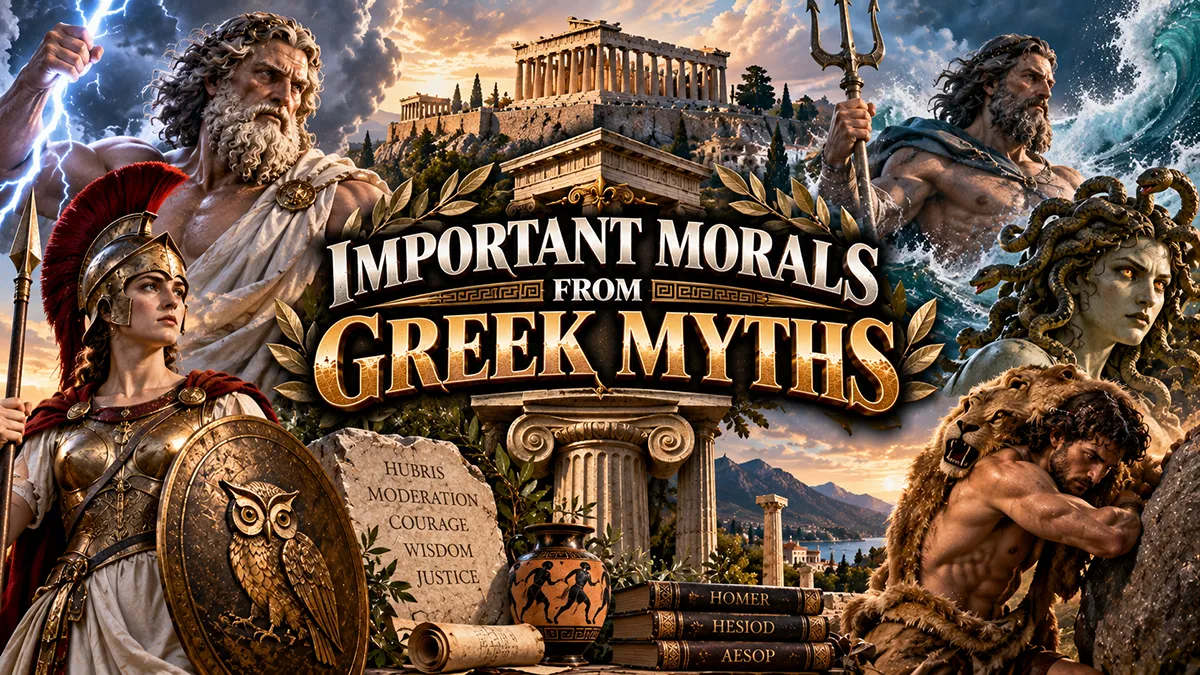
Long before self-help books and classroom life-lessons, the ancient Greeks were already working out how to talk about pride, greed, courage, and grief. They just did it through stories about gods, monsters, and mortals who couldn’t quite help themselves.
Greek mythology stories weren’t written down as moral instruction manuals, but the lessons baked into them have outlasted empires, and we still reach for them whenever we want to explain why arrogance backfires or why patience pays off.
This guide walks through some of the most famous Greek myths and Greek fables, unpacking the moral or theme at the heart of each one. Whether you’re a student looking for myth examples for students, a teacher hunting for greek mythology lessons, or just someone who loves a good story, you’ll find plenty of popular Greek mythology stories here, told honestly and without pretending every ancient source agrees on every detail.
TL;DR: Greek myths endure not because of their monsters and gods, but because each story—from Icarus’s fall to the tortoise’s slow win—still teaches a clear, relatable lesson about human nature.
What Is the Purpose of Greek Myths?
Ancient Greek storytellers didn’t sit down to write fables in the way Aesop later did. Myths and legends in ancient Greece grew out of oral tradition, shaped over generations by poets like Homer and Hesiod, and later collected by playwrights and historians. Their purpose was layered: myths explained natural phenomena, honored the gods, reinforced cultural values, and gave communities a shared identity.
So why are Greek myths important today, thousands of years later? Part of the answer is that they double as early psychology lessons. They dramatize universal struggles—jealousy, ambition, temptation, loss—through characters larger than life, which makes the lessons easier to remember than a dry list of rules.
That’s also what makes Greek morality in these stories so interesting to modern readers. The gods themselves are rarely perfectly virtuous, which means the “morals” aren’t always tidy. Often the lesson is less “be good” and more “here’s what happens when pride, greed, or carelessness take over.”
Myths, Fables, and Parables: What’s the Difference?
It’s worth pausing on vocabulary, since people often use “greek fables,” “greek parables,” and “greek myths” interchangeably. Strictly speaking, a myth involves gods, heroes, or the origins of the world, while a fable is a short teaching tale, often starring animals, with an explicit moral stated at the end.
Aesop, a Greek storyteller traditionally dated to the 6th century BCE, is credited with popularizing the fable format, making him something of a founding Greek moralist.
Greek parables and folktales sit somewhere in between, sometimes overlapping with mythology and sometimes standing on their own as simple, moral-driven stories.
For this list, we’ve included both mythological tales and a few classic Aesop’s fables, since together they represent the full range of common Greek myths and stories people search for when they want lessons wrapped in narrative.
Common Themes in Greek Mythology
If you read enough Greek legends stories back to back, patterns start to emerge. Hubris—excessive pride, especially pride that challenges the gods—shows up constantly and almost always ends badly. Fate is another recurring theme; characters try to outrun their destiny and usually can’t.
Other themes in Greek mythology include the tension between mortal ambition and divine order, the dangers of unchecked curiosity, and the idea that cleverness often triumphs over brute strength. Loyalty, hospitality, and respecting the natural cycle of life and death also appear again and again, especially in stories tied to the seasons or the underworld.
22 Important Morals Taught From Greek Myths
Below are some of the best Greek myths and most famous Greek fables, each paired with the moral or theme it’s best known for.
These are simple Greek myths in the sense that their core lessons are easy to grasp, even though the stories themselves are rich with detail and, depending on the ancient source, sometimes told with slightly different endings.
1. Pandora’s Box — The Danger of Unchecked Curiosity
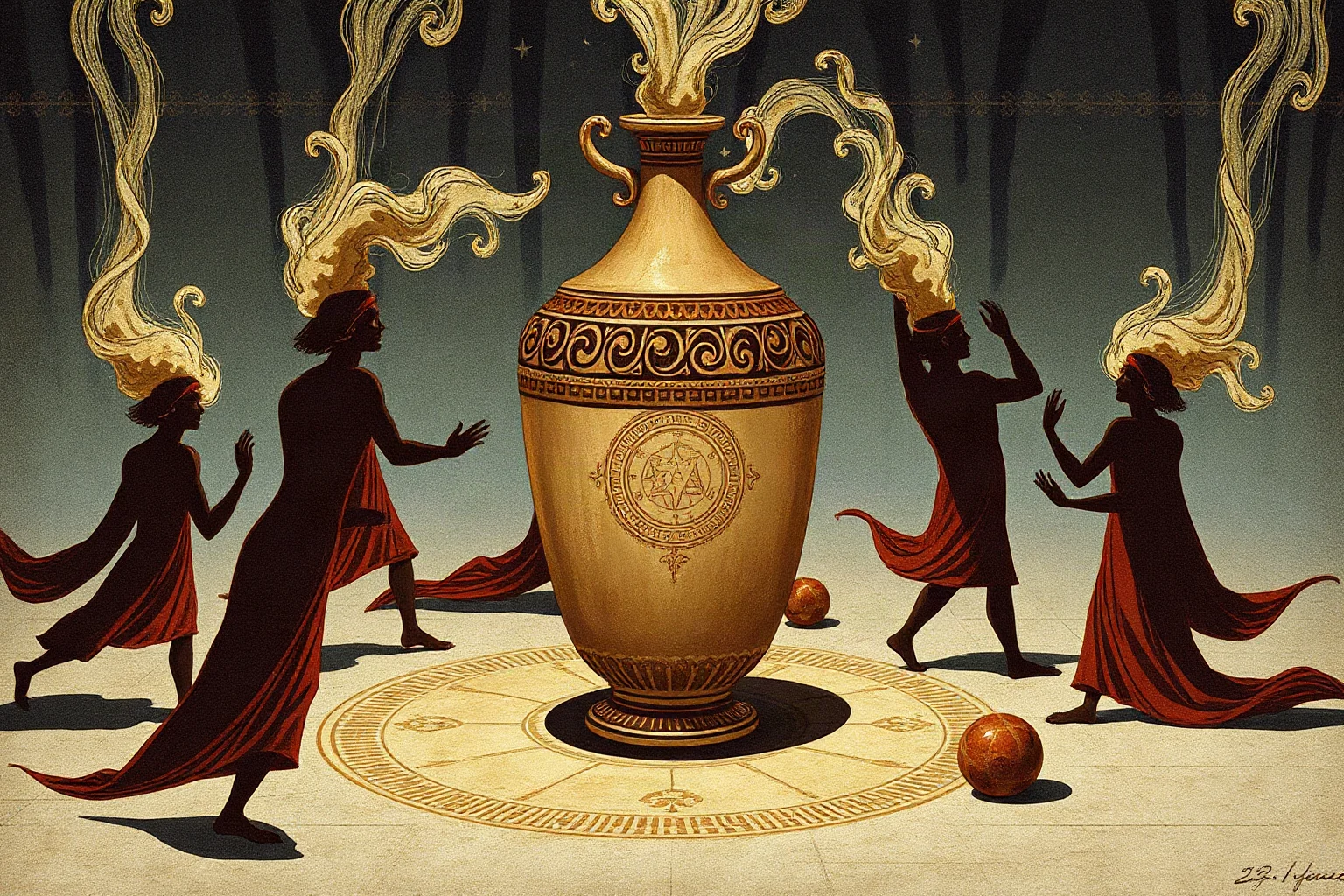
According to Hesiod’s account, Pandora was given a sealed jar (later mistranslated as a “box”) and told never to open it. Curiosity won out, and she released hardship, disease, and misfortune into the world, though hope reportedly remained inside.
The moral isn’t simply “don’t be curious”—it’s a warning about ignoring clear boundaries and warnings, especially ones meant to protect a community. It’s one of the most famous Greek myths precisely because everyone recognizes the impulse to peek.
2. Icarus and Daedalus — The Peril of Hubris

Daedalus built wings of feathers and wax so he and his son Icarus could escape Crete. He warned Icarus not to fly too close to the sun, but Icarus, thrilled by flight, ignored him, and the wax melted.
This is one of the most commonly cited Greek myth examples for a reason: it’s a clean, visual metaphor for overconfidence. The lesson isn’t about ambition itself, but about ignoring wise counsel when success starts to feel effortless.
3. King Midas and the Golden Touch — Greed’s Hidden Cost
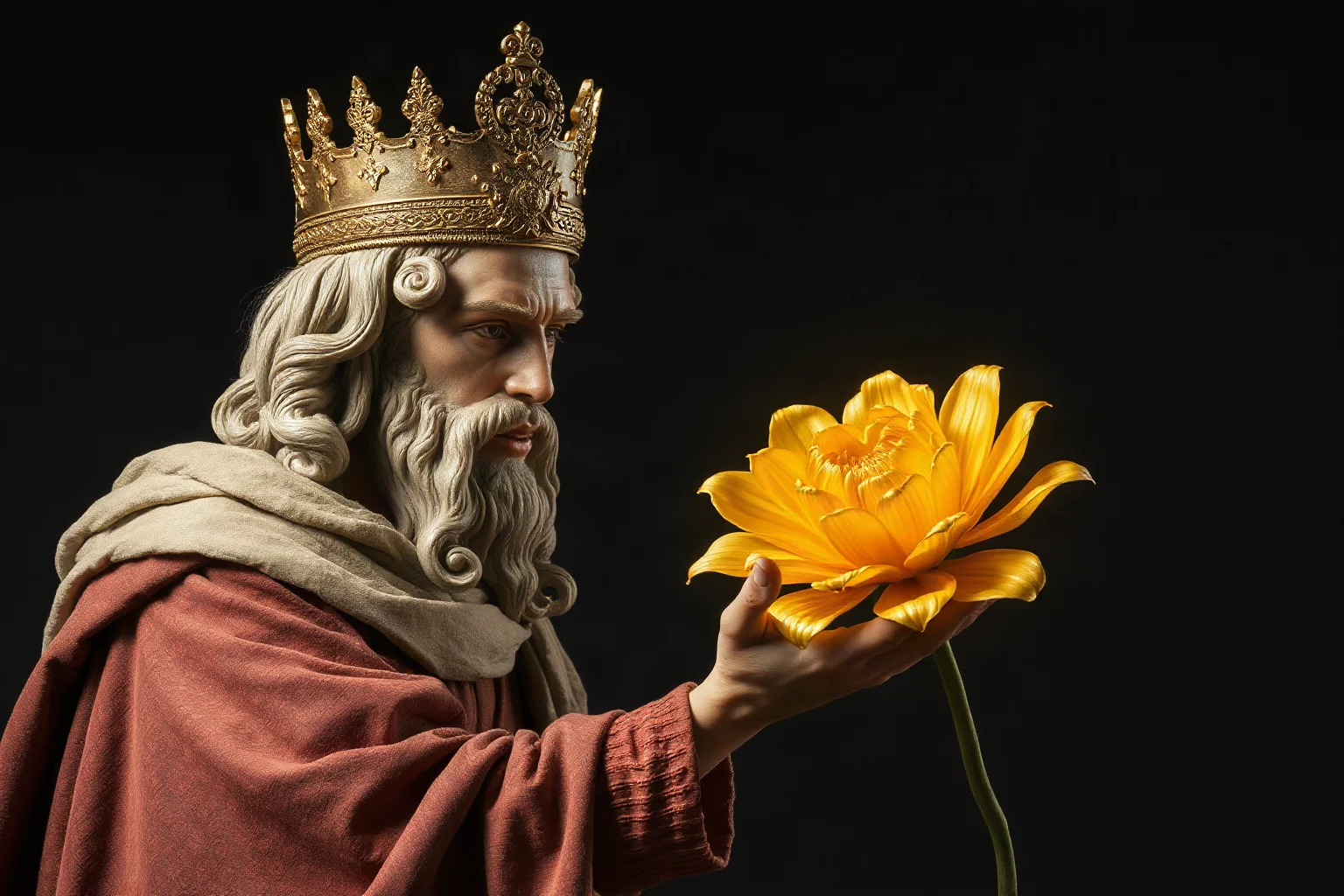
Midas asked the god Dionysus for the power to turn everything he touched into gold. He quickly realized the curse in the gift when his food, wine, and even his own daughter turned to metal.
The story is a straightforward parable about greed outrunning good judgment. It’s frequently taught to younger readers because the cause and effect are so immediate and easy to follow.
4. Arachne vs. Athena — Pride Before the Gods

Arachne, a mortal weaver, boasted that her skill surpassed the goddess Athena’s. In most versions, a weaving contest followed, and Arachne’s disrespect toward the gods led to her transformation into a spider.
The theme here is about proportion: skill and confidence are fine, but publicly humiliating a deity (or, in modern terms, arrogance without humility) invites disaster. It’s a common thread across Greek legends stories involving mortals who challenge divine authority.
5. Prometheus and the Gift of Fire — The Price of Defiance
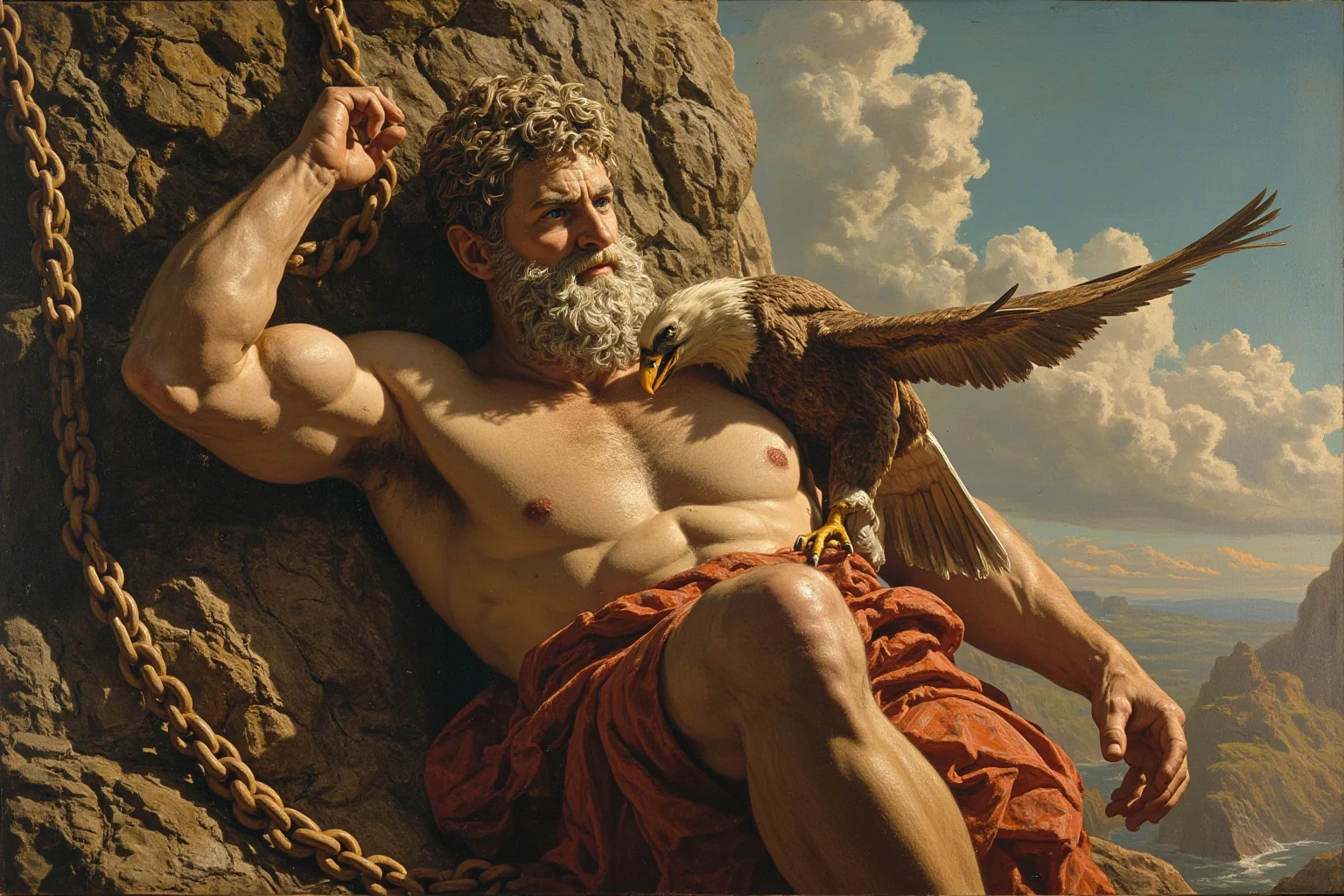
Prometheus stole fire from the gods to give to humanity, defying Zeus’s wishes. He was punished severely, chained to a rock with his liver eaten daily by an eagle, according to the most familiar version of the myth.
Unlike many myths on this list, Prometheus isn’t punished for a personal flaw—he’s punished for compassion toward humans. It complicates the idea of “morals” in mythology, showing that Greek morality isn’t always about simple right and wrong; sometimes it’s about power.
6. Sisyphus and the Eternal Boulder — Deceit Catches Up With You

Sisyphus tricked death itself more than once, according to ancient sources, and was punished by being forced to push a boulder up a hill for eternity, only for it to roll back down each time. His punishment became a symbol of futile, endless labor.
The moral is about the limits of cunning: cleverness that relies on deception eventually meets a consequence that can’t be outsmarted. It’s also become a popular philosophical metaphor for repetitive, meaningless struggle.
7. Narcissus and His Reflection — The Trap of Vanity

Narcissus was so captivated by his own reflection in a pool of water that he couldn’t look away, eventually wasting away and dying at that spot. The word “narcissism” comes directly from his name.
It’s a tidy warning about self-obsession blinding someone to real relationships and real life. Few Greek myth examples have entered everyday language as thoroughly as this one.
8. Echo’s Punishment — The Cost of Careless Words

In the same myth cycle, the nymph Echo was cursed by Hera and could only repeat what others said, having lost her own voice. Different sources give slightly different reasons for her punishment, but talking too much at the wrong moment is a common thread.
Paired with Narcissus, her story rounds out a lesson about communication: both silence forced upon someone and words used carelessly can cause lasting harm. It’s a quieter moral, but a memorable one.
9. Odysseus and the Sirens — Self-Control Over Temptation

In Homer’s Odyssey, Odysseus wanted to hear the Sirens’ irresistible song without being lured to his death, so he had his crew plug their ears while he was tied to the mast. The plan let him experience temptation without succumbing to it.
The lesson is about foresight and self-discipline rather than simple avoidance. Sometimes the smartest move isn’t refusing temptation outright, but planning ahead so it can’t control you.
10. Persephone and the Changing Seasons — Accepting Life’s Cycles

Persephone, daughter of Demeter, was taken to the underworld by Hades, and her time spent there each year was later used to explain the cycle of winter and spring. It’s one of the most famous Greek myths tied to nature itself.
The theme is less about a single character’s flaw and more about acceptance—recognizing that loss, dormancy, and renewal are part of a natural, unavoidable rhythm. It’s a rare myth where the “moral” is closer to comfort than warning.
11. Orpheus and Eurydice — Grief, Trust, and Letting Go

Orpheus’s music was so powerful he was allowed to lead his dead wife Eurydice out of the underworld, on one condition: he couldn’t look back at her until they reached the surface. He looked back too soon, and lost her forever.
This myth is often read as a lesson about trust and patience during grief. It also captures how impatience, even from love, can undo an otherwise hard-won second chance.
12. Phaethon and the Sun Chariot — Overreaching Ambition

Phaethon begged his father Helios to let him drive the sun chariot for a day. He lost control almost immediately, scorching the earth, and Zeus had to strike him down to stop the destruction.
Like Icarus, Phaethon’s story warns against taking on responsibility beyond one’s ability, purely to prove something. It’s a favorite among short Greek mythological stories used in classrooms because the stakes escalate so quickly.
13. Niobe’s Boast — The Fall of Excessive Pride

Niobe bragged that her fourteen children made her superior to the goddess Leto, who had only two. Leto’s children, Apollo and Artemis, killed Niobe’s children in response, and Niobe wept until she turned to stone.
It’s a harsh myth by modern standards, and worth reading with that context in mind rather than as an endorsement of the gods’ actions. The moral, as ancient audiences likely understood it, centers on the danger of comparing mortal fortune to divine favor.
14. Theseus and the Minotaur — Courage Guided by Cleverness

Theseus volunteered to enter the Labyrinth to kill the Minotaur, using a thread given by Ariadne to find his way back out. Brute courage alone wouldn’t have solved the maze; the plan required careful thinking too.
The lesson pairs bravery with strategy, suggesting that heroism in Greek myths often isn’t about strength alone. It’s one of the most popular Greek stories for exactly that reason—it rewards wit as much as valor.
15. Perseus and Medusa — Wisdom Over Brute Strength
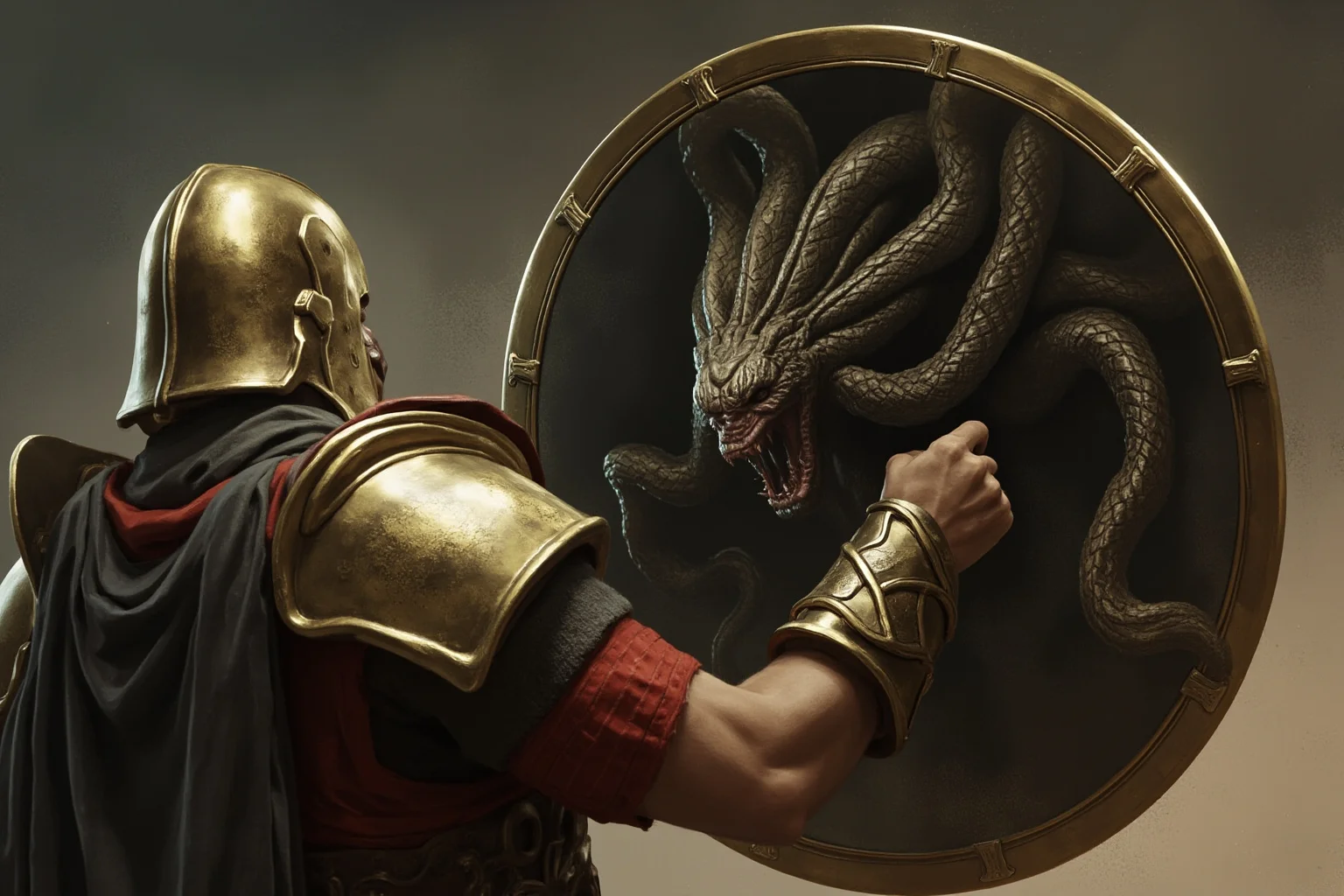
Perseus defeated Medusa, whose gaze turned people to stone, by using a polished shield to view her reflection instead of looking directly at her. Tools and cleverness did what strength alone couldn’t.
This myth reinforces a theme seen throughout Greek mythology: outsmarting a problem is often more effective, and safer, than confronting it head-on. It’s frequently included in lists of greek myth ideas for retelling because the solution is so clever and visual.
16. Atalanta’s Race — Staying Focused Amid Distraction

Atalanta, a swift runner, agreed to marry any suitor who could beat her in a footrace. Hippomenes won by dropping golden apples along the track, distracting her just long enough to pull ahead.
Depending on how it’s told, the moral shifts between a warning about distraction and a nod to resourcefulness. Either way, it’s a favorite example of how ancient Greek tales often reward strategy over raw talent.
17. Bellerophon and Pegasus — When Ambition Outgrows Wisdom

Bellerophon tamed the winged horse Pegasus and achieved great heroic feats, but grew arrogant enough to try flying to Mount Olympus itself. Zeus sent a gadfly to spook Pegasus, and Bellerophon fell back to earth.
The story mirrors Icarus and Phaethon in warning against ambition that forgets its limits. Together, these three myths form a kind of ancient trilogy on the dangers of hubris.
18. The Trojan Horse — The Danger Hidden in Gifts
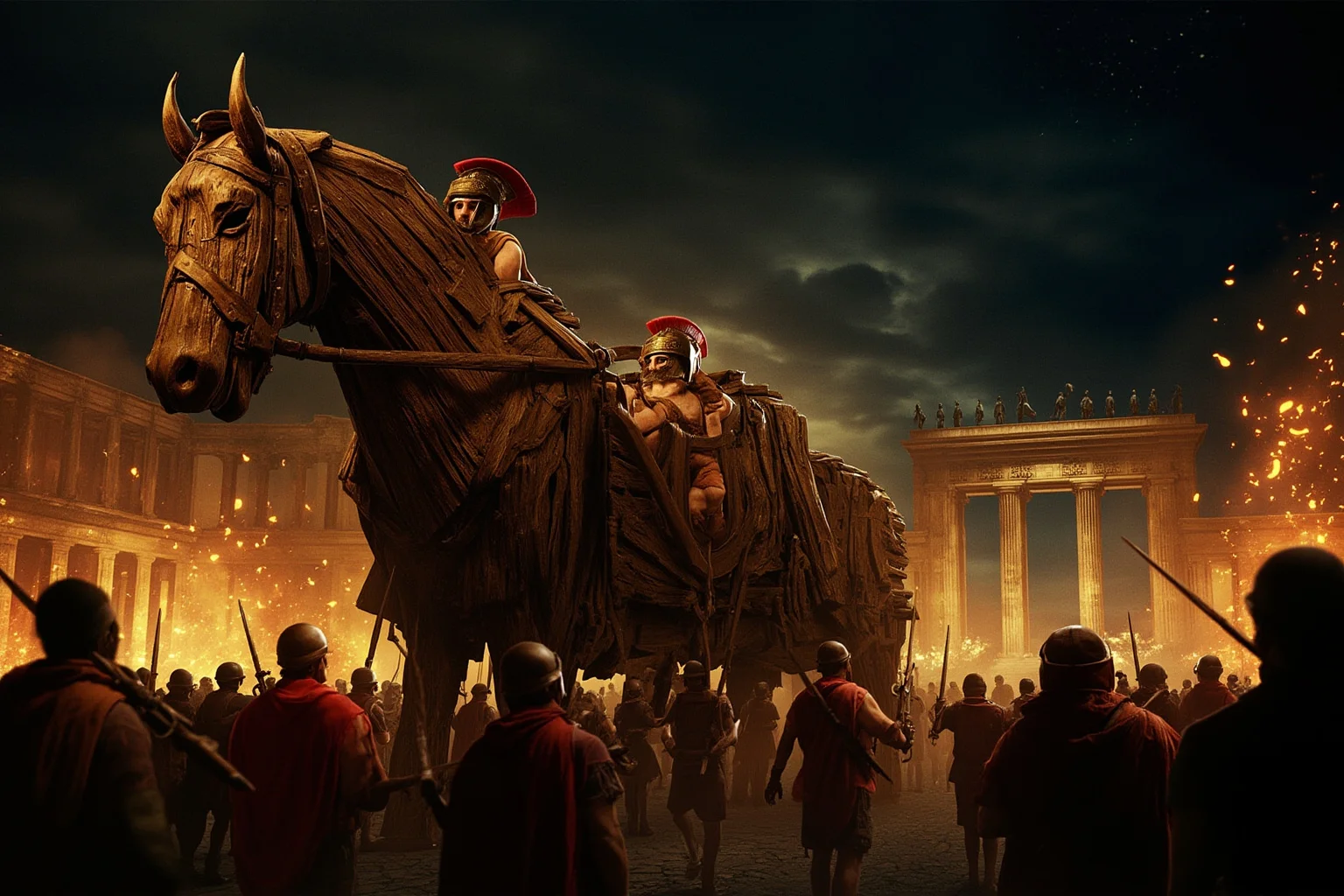
After a ten-year siege, the Greeks left a massive wooden horse outside Troy’s gates as a supposed peace offering. Trojan soldiers hid inside, and the plan let Greek forces finally breach the city.
The enduring lesson, “beware of gifts from enemies,” comes directly from this story, and it’s still referenced anytime a hidden threat is disguised as generosity. It’s arguably one of the most famous Greek myths stories in Western culture, even outside mythology circles.
19. Demeter’s Grief — Respecting the Balance of Nature

When Persephone was taken to the underworld, Demeter’s grief was so overwhelming that crops failed and the earth turned barren. Only a negotiated compromise, allowing Persephone to return part of the year, restored balance.
The theme extends the Persephone myth into a broader statement about interconnectedness—human, divine, and natural forces all affect one another. It’s a good example of how Greek myths explained agricultural cycles long before science offered other answers.
20. The Tortoise and the Hare (Aesop’s Fable) — Steady Effort Beats Arrogance

Unlike the god-driven myths above, this is a classic Greek fable: a boastful hare mocks a slow tortoise into a race, then naps midway through, confident in an easy win. The tortoise plods on and crosses the finish line first.
“Slow and steady wins the race” has become one of the most quoted morals from any ancient source. It’s often one of the first greek myths for 6th graders and younger students encounter, since the message is so direct.
21. The Boy Who Cried Wolf (Aesop’s Fable) — Honesty Builds Trust

A shepherd boy repeatedly tricks his village by falsely shouting that a wolf is attacking, purely for attention. When a wolf actually appears, no one believes him, and the flock is lost.
The lesson about the cost of dishonesty is about as clear as Greek fables get. It’s a staple in discussions of greek morals because it shows consequences building gradually rather than happening all at once.
22. The Ant and the Grasshopper (Aesop’s Fable) — Foresight and Diligence

The ant spends summer storing food for winter, while the grasshopper plays and mocks the ant’s caution. When winter comes, the grasshopper is left with nothing.
This fable rewards preparation and hard work over short-term enjoyment, a theme that shows up across many cultures’ folktales, not just Greek ones. It remains one of the most commonly taught myth examples for students learning about consequences and planning ahead.
In What Areas Have Greek Myths Influenced Our Culture?
Greek mythology’s fingerprints are everywhere, often in places people don’t immediately notice. Psychology borrows heavily from myth—terms like “narcissism” and “Oedipus complex” come straight from these stories. Astronomy does too, since planets, constellations, and even some elements are named after Greek gods and heroes.
Literature and film constantly rework these plots, from epic fantasy to superhero franchises built on hero’s-journey structures first mapped out in myths like Perseus and Theseus. Even everyday phrases—”Achilles’ heel,” “Pandora’s box,” “Trojan horse”—trace directly back to specific stories on this list. That kind of staying power is a big part of why Greek myths are important well beyond the classroom.
Bringing These Lessons Into the Classroom
Teachers often reach for Greek mythology lessons because the stories are short, vivid, and naturally spark discussion about right, wrong, and everything murky in between. For greek myths for 6th graders specifically, myths with clear cause-and-effect structures—Icarus, Midas, the Tortoise and the Hare—tend to land best, since the moral doesn’t require much unpacking.
For older students, more complicated stories like Prometheus or Niobe open up richer conversations, since the “lesson” isn’t always comfortable or fair by modern standards. That discomfort is worth sitting with rather than smoothing over, since it reflects how ancient Greek morality actually worked: shaped by gods who weren’t always just, in a world where fate often overruled fairness.
Final Thoughts
What makes these stories endure isn’t perfect moral clarity; it’s how honestly they capture human weaknesses that haven’t changed much in a few thousand years. Pride still trips people up, curiosity still leads somewhere unexpected, and patience still tends to outlast impulsiveness. That’s probably the real answer to what is the purpose of Greek myths: not to hand down rules, but to hold up a mirror.
Whether you came looking for popular Greek mythology stories to read aloud, greek myth ideas for a school project, or just a refresher on your favorite Greek myths from childhood, these 22 tales cover the range—from towering hubris to quiet, steady persistence. Read enough of them, and the through-line becomes clear: the Greeks were telling us, long before modern self-help ever existed, to watch our pride, keep our word, and never assume we’ve outsmarted fate.
Frequently Asked Questions
What are the main themes in Greek mythology?
The most recurring themes in Greek mythology include hubris (dangerous pride, especially toward the gods), the inescapability of fate, the tension between mortal ambition and divine order, and the rewards of cleverness over brute force. Loyalty, grief, and respect for nature's cycles also appear frequently, particularly in myths tied to the seasons and the underworld.
What is the purpose of Greek myths?
Greek myths originally served several purposes: explaining natural phenomena, honoring the gods, preserving cultural values, and giving communities a shared history and identity. Because they dramatize universal struggles like jealousy, greed, and ambition through memorable characters, they also functioned as early tools for teaching moral and social lessons.
Why are Greek myths important today?
Greek myths are important because their themes—hubris, temptation, loyalty, and consequence—still describe human behavior accurately, which is why they're constantly referenced in literature, psychology, and everyday language. Phrases like "Achilles' heel" and "Pandora's box" show just how deeply these stories are embedded in modern culture.
What’s the difference between a Greek myth and a Greek fable?
A Greek myth typically involves gods, heroes, or the origins of the world and natural events, while a Greek fable is a short teaching tale, often featuring animals, with an explicit moral stated directly. Aesop is the most famous source of Greek fables, whereas myths were shaped over generations through oral tradition and later recorded by poets like Homer and Hesiod.
What are some common Greek myths people should know?
Some of the most common and widely referenced Greek myths include Pandora's Box, Icarus and Daedalus, King Midas and the Golden Touch, Prometheus and Fire, and the Trojan Horse. These are frequently taught because their morals about curiosity, pride, greed, and deception are easy to grasp and still relevant today.
Are Greek myths appropriate for kids and students?
Many Greek myths, especially simpler ones like the Tortoise and the Hare or King Midas, work well for younger students because their morals are clear and their plots are short. Some myths involve violence or mature themes, so teachers often choose age-appropriate versions or focus on stories with more straightforward lessons for younger grades.

Alex Warren
Related Articles