
Type “who was the first gay person” into a search bar and you’ll get a lot of confident-sounding answers. The truth is messier and, honestly, more interesting than any single name could capture.
Same-sex love and desire show up in nearly every era and culture historians have studied, long before anyone used a word like “gay” or “homosexual” to describe it.
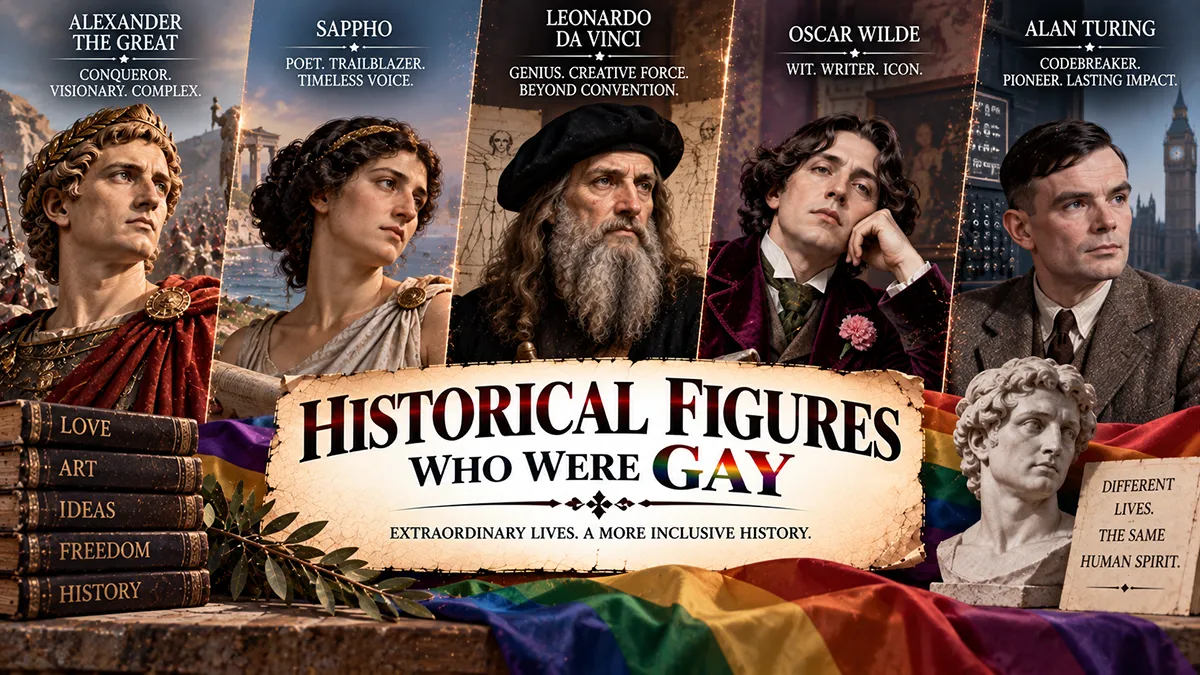
This post takes a myth-busting look at that question, then walks through 23 real historical figures — poets, emperors, scientists, artists, and activists — whose same-sex relationships or attractions are documented by historians.
Some lived openly by the standards of their time; others were forced into secrecy or even prosecuted. All of them are part of the long, tangled story of gays in history.
TL;DR: There’s no verifiable “first gay person” in history — same-sex attraction predates written language — but figures from Sappho to Alan Turing to Freddie Mercury show how same-sex love has shaped art, science, and politics for thousands of years.
Who Was the First Gay Person? Busting a Persistent Myth
Let’s address the big question head-on, because it’s the one bringing most readers here. Who is the first gay person in the world? Nobody knows, and nobody ever will, because sexual orientation isn’t something that was “invented” at a specific point in time.
Same-sex attraction and behavior appear in the archaeological and written record as far back as we have records at all. Cave art, ancient legal codes, religious texts, and mythology from Mesopotamia, Egypt, Greece, and beyond all reference relationships or acts between people of the same sex. That means the first gay person, whoever they were, almost certainly lived and died with no name that survived to us, long before recorded history began.
When people ask who was the first gay man or who was the first ever gay person, they’re usually really asking a different, more answerable question: who is the earliest documented same-sex relationship or attraction we have evidence for? That’s a question historians can actually engage with, and it’s the one this article focuses on.
It’s also worth saying plainly: sexuality is a universal human trait, not a trend with an origin date. Every generation includes people who loved others of the same sex, whether or not their culture had language for it or allowed them to live it openly.
Who Invented the Word “Gay”? A Quick Language Detour
A related and genuinely fascinating question is who invented “gay” as a word for same-sex attraction, since that’s a completely separate issue from who was the first gay person. The word itself is old — it entered English from the Old French “gai,” meaning lighthearted, joyful, or carefree, and it carried that meaning for centuries.
The shift toward meaning “homosexual” happened gradually, mostly as slang within gay subcultures in the early-to-mid 20th century, particularly in the United States and Britain. It wasn’t coined by one person; it evolved the way most slang does, through communities using an existing word in a new, coded way that outsiders wouldn’t necessarily catch.
The clinical term “homosexual” has a more traceable origin. It was coined in 1869 by Austro-Hungarian writer Karl-Maria Kertbeny, who used it in pamphlets arguing against Prussian sodomy laws. So while we can point to who popularized specific vocabulary, that’s a very different thing from identifying history’s first gay person — the words came thousands of years after the reality they describe.
How Historians Actually Talk About Sexuality in the Past
Before diving into names, it’s worth pausing on method, because this is where a lot of pop-history claims go wrong. Gay historians and scholars of sexuality generally avoid slapping modern labels like “gay” or “lesbian” onto historical figures without caveats, because those identity categories are relatively modern inventions.
A person in ancient Rome or Tang-dynasty China who had same-sex relationships didn’t necessarily think of themselves the way a 21st-century person who identifies as gay does. Concepts of sexual identity, as opposed to sexual behavior, developed gradually and look different across cultures and eras. That’s why many historians prefer descriptive language — “had a male lover,” “wrote love poetry to a woman” — over retroactively assigning modern labels.
That said, using contemporary terms like gay, lesbian, or bisexual as a practical shorthand is common and reasonable, as long as readers understand it’s an approximation. This list uses that approach: modern language for a historical audience, applied to people whose documented relationships and attractions clearly involved members of the same sex.
23 Famous Historical Figures Who Were Gay, Lesbian, or Bisexual
What follows is a chronological tour through some of the most well-documented examples of famous gay people in history. It’s not an exhaustive list — entire books have been written on this subject — but it covers a wide range of eras, cultures, and professions, from ancient poets to modern astronauts.
1. Sappho of Lesbos (c. 630–570 BCE)
Sappho is often the first name that comes up in any discussion of ancient LGBTQ+ history, and for good reason. This Greek poet from the island of Lesbos wrote intensely personal love poetry addressed to women, which is where the words “sapphic” and “lesbian” both come from.
Only fragments of her work survive, but they’re vivid enough that scholars have debated her sexuality for centuries. Ancient sources themselves were divided, some treating her romantic interest in women as unremarkable and others adding invented biographical gossip. Either way, she remains one of the earliest documented voices of same-sex desire in Western literature.
2. Alexander the Great (356–323 BCE)
Alexander’s relationship with his companion Hephaestion has fascinated historians for centuries. Ancient sources describe a bond so close that Alexander was reportedly devastated, almost inconsolable, when Hephaestion died.
Whether the relationship was sexual, romantic, or an intense same-sex friendship by ancient standards is genuinely debated among gay historians and classicists. What’s not debated is that their closeness was noted and discussed by contemporaries, making Alexander a frequent example in discussions of gay men in history.
3. Emperor Hadrian (76–138 CE)
Hadrian, the Roman emperor famous for Hadrian’s Wall, had a well-documented relationship with a young man named Antinous. When Antinous drowned in the Nile, Hadrian’s grief was so public and so extreme that he founded a city in his memory and had him deified.
Statues of Antinous were erected throughout the empire, making him one of antiquity’s most-depicted figures. Roman elite culture had different norms around same-sex relationships than we do today, but Hadrian’s devotion to Antinous still stands out in the historical record.
4. King James I of England (1566–1625)
The king behind the King James Bible had a series of close male favorites, most notably Robert Carr and George Villiers, Duke of Buckingham. Contemporary letters between James and Villiers survive and use notably tender, affectionate language.
Historians disagree on exactly how to characterize these relationships, but the intimacy documented in surviving correspondence has made James a regular subject in books about historical LGBTQ figures and royal history alike.
5. Leonardo da Vinci (1452–1519)
Leonardo, often ranked among the smartest people in history, was investigated, though never convicted, on a sodomy accusation in Florence in 1476, along with several other young men. He never married, kept close male companions and apprentices throughout his life, and left his estate largely to his assistant Francesco Melzi.
None of this proves a modern sexual identity, but combined, it’s enough that many historians consider him one of the more plausible examples of a gay or bisexual man among Renaissance-era famous homosexuals.
6. Michelangelo (1475–1564)
Michelangelo wrote over 300 poems, many addressed to a young nobleman named Tommaso dei Cavalieri in unmistakably romantic language. He also wrote passionate poetry to a woman, Vittoria Colonna, later in life, which is part of why scholars now often describe him as bisexual rather than exclusively gay.
His surviving letters and sonnets to Cavalieri remain some of the most direct literary evidence of same-sex love from the entire Renaissance period.
7. Christopher Marlowe (1564–1593)
Marlowe, the Elizabethan playwright and rival of Shakespeare, was reputed by contemporaries to have same-sex attractions, based on reports from informants and gossip recorded after his death. These accounts should be treated cautiously since some came from hostile sources during a politically charged investigation.
Still, his plays, including “Edward II” about a king’s relationship with a male favorite, engage openly with same-sex desire in ways unusual for the period.
8. Anne Lister (1791–1840)
Anne Lister was an English landowner whose extensive diaries, written partly in a secret code, documented her relationships with women in explicit detail. Decoded decades after her death, the diaries are considered some of the most direct first-person evidence of lesbian identity in the historical record.
She’s often called “the first modern lesbian” because her writing shows clear self-awareness about her orientation, not just behavior — a rare and valuable thing for historians studying this era.
9. Lord Byron (1788–1824)
The Romantic poet Byron had relationships with women throughout his life, but letters and biographical accounts also point to same-sex relationships, including during his travels in Greece and with school friends in England. Sodomy was a capital offense in Britain during his lifetime, which pushed much of this side of his life into euphemism and secrecy.
Biographers generally describe him today as bisexual, based on the surviving correspondence.
10. Oscar Wilde (1854–1900)
Wilde is probably the most famous name connected to 19th-century gay history, largely because of how publicly his life fell apart. His relationship with Lord Alfred Douglas led to a series of trials in 1895, after which Wilde was convicted of “gross indecency” and sentenced to two years of hard labor.
The trial devastated his career and health, and he died just a few years after his release. His case remains one of the starkest examples of how criminalization shaped gay men’s lives well into the modern era.
11. Pyotr Ilyich Tchaikovsky (1840–1893)
The Russian composer behind “Swan Lake” and “The Nutcracker” is widely understood by biographers to have been attracted to men, based on his letters and the accounts of people close to him. He lived in a period and country where this had to remain largely private, and he briefly married a woman in an attempt to conform to social expectations.
The marriage ended quickly and unhappily, and most modern biographers treat his same-sex attraction as well established.
12. Walt Whitman (1819–1892)
The American poet’s collection “Leaves of Grass,” particularly the “Calamus” poems, celebrates intense romantic and physical affection between men in ways that were bold for 19th-century America. Whitman never explicitly labeled his own sexuality in the terms we’d use today.
But the language and imagery in his work, along with letters to male companions, have made him a central figure in American historical LGBTQ studies.
13. Radclyffe Hall (1880–1943)
Hall was an English author best known for “The Well of Loneliness,” a 1928 novel about a lesbian relationship that was banned in Britain for obscenity shortly after publication. Hall lived openly with her partner, Una Troubridge, at a time when doing so was genuinely risky.
Her novel became a touchstone text for lesbian visibility in English literature, despite — or maybe because of — the controversy it caused.
14. Virginia Woolf (1882–1941)
Woolf was married to Leonard Woolf, but she also had a well-documented romantic relationship with writer Vita Sackville-West. Their letters survive and are unmistakably affectionate; Woolf’s novel “Orlando” is widely read as a tribute to Sackville-West.
Most biographers today describe Woolf as bisexual, based on this relationship alongside her marriage.
15. Gertrude Stein (1874–1946)
Stein, the American writer and art patron, lived openly with her partner Alice B. Toklas in Paris for decades, at the center of a famous circle of modernist artists and writers. Their relationship was an open secret among their social circle and is well documented in letters and memoirs from the period.
Stein rarely wrote about her sexuality in explicit public terms, but her domestic partnership with Toklas was stable, public within their community, and lasted until Stein’s death.
16. Alan Turing (1912–1954)
Turing, the mathematician whose codebreaking work at Bletchley Park helped the Allies during World War II, was prosecuted in 1952 under British law for “gross indecency” after his relationship with a man became known to police. He accepted chemical castration as an alternative to prison.
He died two years later of cyanide poisoning, ruled a suicide by the inquest at the time, and received a posthumous royal pardon in 2013. His case remains one of the most cited tragedies in modern gay historical memory.
17. Bayard Rustin (1912–1987)
Rustin was a key organizer of the 1963 March on Washington and a close advisor to Martin Luther King Jr., cementing his place among the most iconic revolutionary figures in history, yet his contributions were often downplayed during his lifetime because he was an openly gay Black man in a deeply homophobic era. He was arrested in 1953 under a morals charge related to his sexuality.
He continued organizing and advocating for civil rights and, later, LGBTQ rights, until his death, and received a posthumous Presidential Medal of Freedom in 2013.
18. James Baldwin (1924–1987)
Baldwin, one of the towering American writers of the 20th century, explored same-sex desire directly in his 1956 novel “Giovanni’s Room,” a bold move at the time for a Black gay author writing for a mainstream audience. He lived much of his adult life abroad, partly to escape the racism and homophobia he faced in the United States.
His essays and novels remain foundational texts in both African American literature and LGBTQ literary history.
19. Marlene Dietrich (1901–1992)
The German-American actress and singer had relationships with both men and women throughout her life, something fairly openly discussed within Hollywood circles even if not in the mainstream press. Biographers point to affairs with several women alongside her marriage and relationships with men.
She’s frequently cited among famous gay and bisexual women of the early Hollywood era.
20. Frida Kahlo (1907–1954)
The Mexican painter, married to muralist Diego Rivera, also had documented relationships with women, which biographers and her own letters confirm. Her bisexuality is now widely acknowledged in art history, though it received little public attention during her own lifetime.
Kahlo’s personal life, like her art, resisted the neat categories her contemporaries tried to impose on her.
21. Harvey Milk (1930–1978)
Milk made history in 1977 as one of the first openly gay men elected to public office in the United States, serving on the San Francisco Board of Supervisors. His election and outspoken advocacy made him a national symbol for gay rights.
He was assassinated in 1978 by a former colleague, and his life and death galvanized the LGBTQ rights movement for decades afterward.
22. Freddie Mercury (1946–1991)
The Queen frontman was famously private about the specifics of his personal life, though he had relationships with both women and men, including a long-term partnership with Jim Hutton in his later years. He never gave a single public label to his own sexuality in interviews.
He died of complications from AIDS in 1991, and his life remains one of the most widely discussed examples of a famous gay or bisexual public figure in modern music.
23. Sally Ride (1951–2012)
Ride became the first American woman in space in 1983, and it was only revealed after her death from cancer in 2012 that she had been in a 27-year relationship with her partner, Tam O’Shaughnessy. The obituary her family released, naming O’Shaughnessy as her survivor, was effectively how the public learned she was gay.
Her story is a reminder that even recent history includes people who kept their orientation private for entirely understandable professional and personal reasons.
Why These Stories Matter Today
Taken together, these 23 lives show something important: same-sex attraction has never been confined to one country, century, or profession. From ancient poets to Cold War-era scientists, homosexual people in history have shaped literature, politics, science, and culture, often while navigating enormous personal risk.
It’s also worth noting how uneven the surviving evidence is. Wealthy, literate, and famous people left letters, diaries, and paintings behind; ordinary people mostly didn’t, which means the historical record almost certainly underrepresents the full scope of same-sex love throughout history. The names on this list are simply the ones history happened to preserve well enough for us to study.
That unevenness is also why questions like “who is the most famous gay person” or “who is the gayest person ever” don’t really have objective answers, much like similar debates about the most recognized historical figures of all time. Fame and documentation aren’t the same as representativeness — they just tell us whose story survived.
The Bottom Line
There’s no single answer to who was the first gay person, who was the first gay man, or when the first gay person lived, because same-sex attraction is simply part of the range of human experience across all of recorded history and almost certainly long before it. What we can do is study the individuals whose lives left enough of a trace for historians to piece together, from Sappho’s fragments of poetry to Alan Turing’s wartime code-breaking to Sally Ride’s quietly revealed partnership.
Each of these figures lived within the norms, laws, and dangers of their own time, which makes their stories worth understanding on their own terms rather than forcing them into modern boxes. What connects them isn’t a shared identity so much as a shared reality: love and attraction between people of the same sex has always been part of the human story, told in whatever language each era allowed.
Frequently Asked Questions
Who was the first gay person?
There's no verifiable answer to who was the first gay person, since same-sex attraction has existed throughout human history and almost certainly predates written records entirely. Historians can only point to the earliest documented examples of same-sex relationships, such as ancient Greek poetry or Mesopotamian texts, not an actual "first" individual.
Who was the first gay man in recorded history?
There's no single confirmed first gay man, but some of the earliest documented same-sex relationships in the historical record involve figures like Alexander the Great and his companion Hephaestion, or Roman emperor Hadrian and Antinous. These are among the earliest well-documented cases, not necessarily the earliest instances of same-sex attraction itself.
Who invented the word ‘gay’?
No single person invented the word "gay." It originally meant carefree or joyful in Old French and English, and it gradually took on the meaning of "homosexual" through slang used within gay communities in the early-to-mid 20th century. The related clinical term "homosexual" was coined by writer Karl-Maria Kertbeny in 1869.
Who is the most famous gay person in history?
There's no single most famous gay person, since fame depends on era, country, and field. Commonly cited examples include Oscar Wilde in literature, Alan Turing in science, Harvey Milk in politics, and Freddie Mercury in music, each famous within very different contexts.
How do historians know if someone in the past was gay?
Gay historians typically rely on surviving letters, diaries, poetry, legal records, and contemporary accounts rather than assuming based on speculation. Because modern sexual identity labels didn't exist in the same form in earlier eras, historians describe documented relationships and behaviors carefully rather than definitively assigning modern categories.
Were there openly gay people in ancient history?
Attitudes toward same-sex relationships varied widely by culture and era; some ancient societies, like parts of ancient Greece, were relatively accepting of certain same-sex relationships under specific social norms. Others enforced strict penalties, so "openness" looked very different depending on when and where someone lived.
What does it mean to call a historical figure bisexual or gay if they didn’t use those words themselves?
It means applying modern terminology as a practical shorthand for documented same-sex relationships or attraction, while recognizing the historical figure likely didn't think about their own identity in the same framework. Most careful historians use these labels with that caveat rather than treating them as the person's own self-description.

Alex Warren
Related Articles