

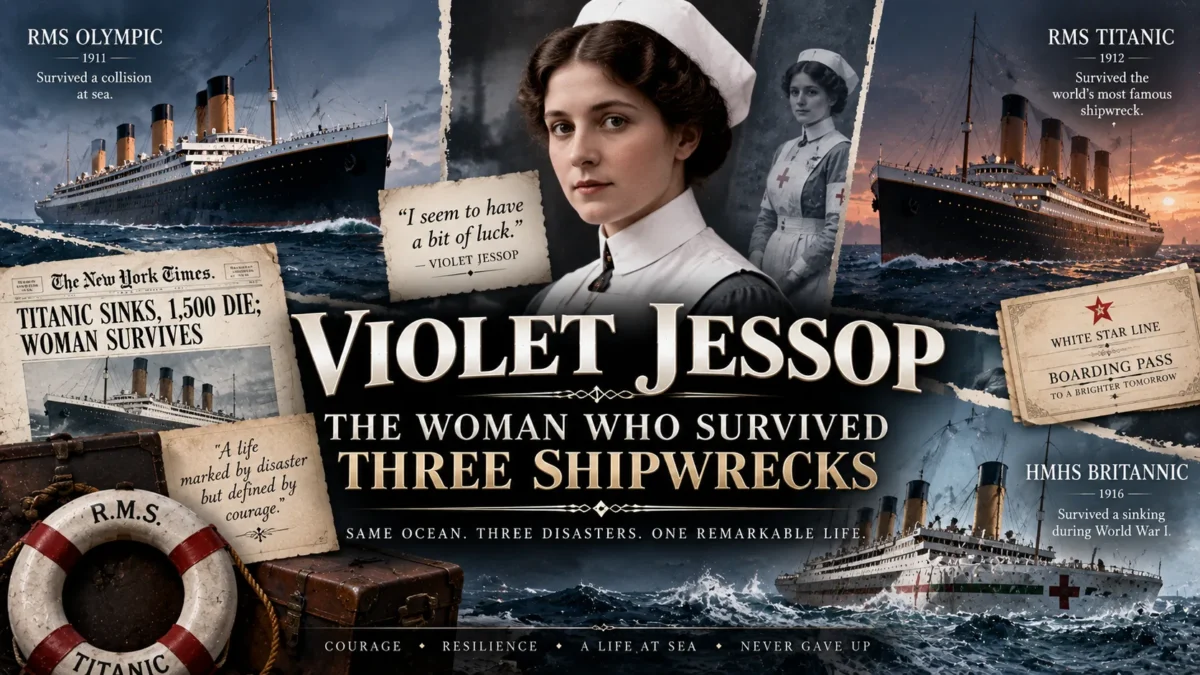
If you’ve ever fallen down a late-night internet rabbit hole about the Titanic, you’ve probably stumbled across her name. Violet Constance Jessop, an ocean liner stewardess with a knack for being on the wrong ship at the wrong time, has become one of the most quietly remarkable figures of the early 20th century.
She wasn’t a captain, an engineer, or a wealthy passenger — she was a working woman who served tea and made beds for a living, and she happened to be aboard three of the most infamous ships in maritime history.
Her story has been retold so many times, in so many slightly different versions, that it’s worth pulling apart what we actually know from what has been embellished along the way. This is the real story of the woman who survived the Titanic, the Britannic, and a near-catastrophic collision aboard the Olympic — told with as much historical accuracy as the record allows.
TL;DR: Violet Jessop, an Irish-Argentine ocean liner stewardess, survived a serious collision on the RMS Olympic in 1911, the sinking of the RMS Titanic in 1912, and the sinking of the HMHS Britannic in 1916, making her one of history’s most famous survivors of maritime disaster.
Who Was Violet Jessop?
Violet Constance Jessop was born on October 2, 1887, near Bahía Blanca, Argentina, to Irish immigrant parents who had settled there to farm sheep. She was the eldest of nine children, though only six survived to adulthood, a grim but common reality for large families at the time. Her early life was shaped by hardship well before she ever set foot on an ocean liner.
As a child, Violet contracted a serious illness, often described in accounts of her life as tuberculosis, and doctors reportedly gave her little chance of survival.
She pulled through, but the experience of being written off and beating the odds became, in hindsight, an eerie preview of the rest of her life, not unlike the resilience shown by other historical figures who defied dire medical expectations, such as Helen Keller.
After her father died, the family relocated to England, and financial pressure began to shape Violet’s future in ways she couldn’t have predicted.
From Convent School to the High Seas
Violet was educated at a convent school in England, and for a time it seemed she might follow a fairly ordinary path. That changed when her mother fell ill and could no longer work as a stewardess herself, the very job that had been supporting the family. Violet, still in her early twenties, stepped in to take her mother’s place at sea.
This was not a glamorous decision. Stewardesses in the early 1900s worked long hours for low pay, tending to the needs of first- and second-class passengers on ocean liners. Violet initially struggled to get hired because employers worried her youth and good looks would attract unwanted attention from male passengers and crew, so she reportedly dressed plainly and downplayed her appearance to land the job. She started with the Royal Mail Line before moving to the White Star Line, the company that would define the most dramatic chapters of her life.
Shipwreck Number One: The RMS Olympic Collision (1911)
Before the Titanic ever set sail, Violet was working aboard its sister ship, the RMS Olympic. On September 20, 1911, the Olympic collided with a British warship, HMS Hawke, off the coast of England. The collision tore a significant hole in the Olympic’s hull below the waterline, but thanks to its watertight compartment design, the ship stayed afloat and limped back to port.
No one died in the incident, and the Olympic was repaired and returned to service. For Violet, it was a frightening but survivable brush with disaster, one that gave her firsthand experience with the limits of the “unsinkable” reputation these massive new liners were being given. It also, unknowingly, set the stage for what was coming just seven months later.
Shipwreck Number Two: The RMS Titanic (1912)
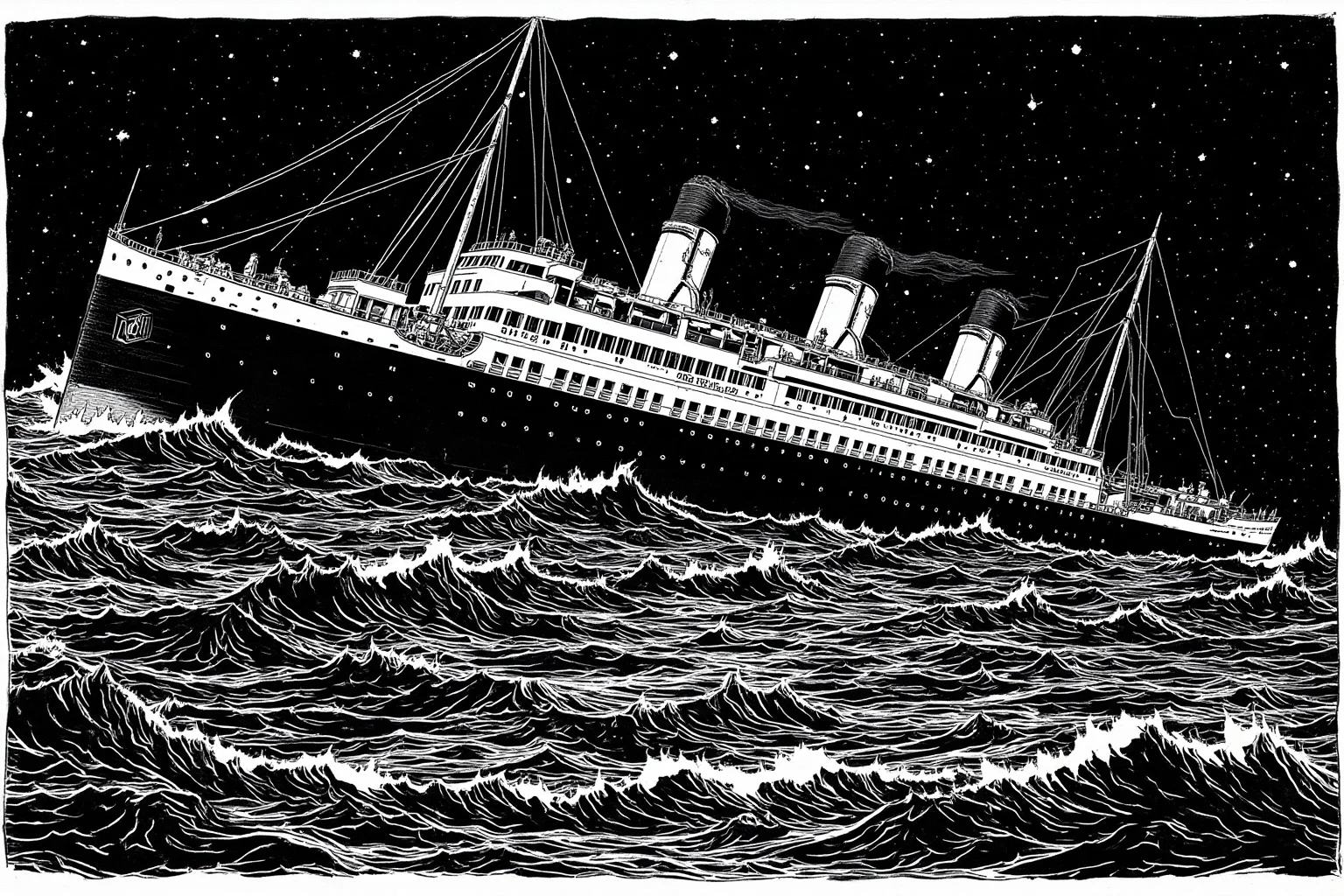
In April 1912, Violet was working as a stewardess aboard the RMS Titanic, the largest and most luxurious ship afloat at the time. On the night of April 14–15, the ship struck an iceberg in the North Atlantic and began taking on water. Violet was reportedly ordered onto the deck to help demonstrate to frightened, mostly non-English-speaking third-class passengers that lifeboats were safe, since crew wanted to reassure the public despite the chaos unfolding.
She survived the sinking in Lifeboat 16, one of the boats lowered from the Titanic as the ship went down in the early hours of April 15, 1912. More than 1,500 people died that night, making it one of the deadliest peacetime maritime disasters in history. Violet’s survival placed her among a relatively small group of crew members who lived to tell their story, and it is the event most people associate with her name today.
A popular anecdote claims that as Violet sat in the lifeboat, a crew member or officer handed her a baby to hold, and that years later a woman approached her and thanked her, claiming to be that same baby grown up. This story appears in various retellings of Violet’s life, but it traces back largely to her own personal recollections and has never been independently verified through documented records. It’s a touching story, but it belongs in the category of “widely repeated” rather than “historically confirmed.”
Shipwreck Number Three: The HMHS Britannic (1916)
After the Titanic disaster, Violet didn’t abandon life at sea. During the First World War, she served as a nurse with the British Red Cross aboard the HMHS Britannic, a sister ship to both the Olympic and the Titanic that had been converted into a hospital ship. On November 21, 1916, the Britannic struck a mine in the Aegean Sea near the Greek island of Kea and began to sink rapidly.
The Britannic went down far faster than the Titanic had, in under an hour, though the death toll was much lower because most lifeboats were able to launch and the water was warmer. Violet reportedly jumped from the ship into the sea, and the suction from the sinking hull pulled her underwater, where she struck her head on the ship’s keel. She survived the ordeal, though she and others who studied her life later noted she suffered lasting effects from the head injury.
A frequently cited detail from Violet’s own memoir is that, amid the panic of the Britannic sinking, she made sure to grab her toothbrush because she had regretted not having one after the Titanic sank. Because this detail comes from her own written account rather than an outside witness, it should be treated as her personal recollection rather than an independently verified fact, though there’s no strong reason to doubt a small, human detail like this. It has become one of the most quoted lines associated with her story precisely because it feels so real.
Separating Fact From Legend
Violet Jessop’s story has been retold in books, documentaries, and countless online listicles, and along the way some details have hardened into “facts” that historians can’t fully confirm. The core timeline, however, is well documented, she really did work aboard the Olympic during its 1911 collision, the Titanic during its 1912 sinking, and the Britannic during its 1916 sinking. That alone makes her an extraordinary figure in maritime history, regardless of the smaller embellishments.
The primary source for much of what we know about her personal thoughts and feelings during these events is her own memoir, which was written later in life and eventually edited and published posthumously by maritime historian John Maxtone-Graham under the title “Titanic Survivor.” Memoirs are valuable historical sources, but they are also shaped by memory, time, and a narrator’s sense of storytelling, so some specific anecdotes are best understood as her personal account rather than court-verified fact.
It’s also worth noting that Violet was not the only crew member to work on multiple White Star Line disasters, since sister ships shared crews and this was a small, close-knit industry. What set her apart was surviving not one but two major sinkings, plus a serious collision, all in the space of about five years.
Life After the Disasters
Remarkably, Violet Jessop kept working at sea for decades after the Britannic sank. She continued her career as a stewardess with the White Star Line and later the Red Star Line, spending a working life at sea that spanned roughly four decades in total. She reportedly worked aboard the Olympic again in later years, the very ship where her string of maritime near-misses had begun.
She eventually retired in 1950 and settled in Suffolk, England, where she lived a quiet life far removed from the drama of her younger years. Violet Jessop died in 1971 at the age of 83, having outlived the disasters that could easily have killed her three times over. Friends and biographers later gave her the nickname “Miss Unsinkable,” a fitting, if slightly cheeky, tribute to her survival record.
Why Her Story Still Captivates Us
Part of what makes Violet Jessop so compelling is that she wasn’t famous in her own lifetime. She wasn’t a titan of industry or a first-class passenger whose name appeared in newspaper society pages alongside history’s most powerful women, she was working-class crew, the kind of person history often overlooks entirely. Her survival wasn’t a matter of privilege or luck tied to wealth, it was a mix of circumstance, quick thinking, and sheer resilience.
Her story also offers a useful reminder about how legends grow around real events. The genuine, documented facts of her life, three ships, three disasters, one extraordinary career at sea, are dramatic enough without embellishment. Yet the retellings over the decades have added color, some of it possibly true, some of it unverifiable, blurring the line between the woman and the myth.
That’s not a criticism of Violet herself, who by all accounts simply lived her life and later wrote down her memories as she recalled them. It’s more a reflection of how compelling true stories tend to accumulate extra layers of legend the longer they’re told, especially when the subject was a real person who is no longer around to confirm or deny each detail.
The Bigger Picture: Working Women at Sea
It’s easy to focus on the shipwrecks and forget that Violet Jessop’s career says something important about working women in the early 20th century maritime industry, a workforce whose stories are often overshadowed by more celebrated figures like the smartest women in history. Stewardesses like her performed demanding physical labor, often for passengers who barely registered them as individuals, and did so within a rigid class system that mirrored the divisions on land. Her decades-long career, bookended by two world-famous disasters, is also simply the story of a working woman supporting her family through an unglamorous but essential job.
That context matters when we tell her story today. Violet Jessop wasn’t chasing headlines or seeking out danger, she was doing her job, again and again, on ships that happened to make history for the worst possible reasons. Her endurance through three separate disasters says as much about the era’s maritime risks as it does about her own personal grit.
Final Thoughts
Violet Jessop’s life reads almost like fiction, a working stewardess who brushed against catastrophe not once but three times and lived to describe it in her own words. The documented core of her story, the Olympic collision, the Titanic sinking, and the Britannic disaster, is remarkable enough on its own merits. The smaller legendary details, the rescued baby, the grabbed toothbrush, add color and humanity to the tale, even if some of them can’t be fully verified beyond her own recollections.
What remains certain is that Violet Jessop endured what most people would consider unthinkable, not once, but repeatedly, and then went right back to work at sea. That combination of tragedy, resilience, and quiet endurance is exactly why, more than a century later, people are still searching her name and retelling her story, even though she never quite reached the ranks of the most recognized historical figures.
Frequently Asked Questions
Who is the woman who survived the Titanic and other shipwrecks?
Her name was Violet Constance Jessop, an Irish-Argentine ocean liner stewardess born in 1887. She survived a serious collision aboard the RMS Olympic in 1911, the sinking of the RMS Titanic in 1912, and the sinking of the HMHS Britannic in 1916.
How did the woman who survived the Titanic also survive other disasters?
Violet Jessop worked as crew, not a passenger, for the White Star Line, which operated all three ships as sister vessels. Because she kept working at sea after each incident, she happened to be aboard for the Olympic's collision, the Titanic's sinking, and later served as a Red Cross nurse on the Britannic when it sank during World War I.
Is Violet Jessop’s story historically verified?
The core facts, that she worked on the Olympic, Titanic, and Britannic during their respective disasters, are well documented in historical records. Some specific personal anecdotes, like the rescued baby story, come primarily from her own later memoir and are not independently verified beyond her own account.
What happened to Violet Jessop on the Britannic?
The Britannic, serving as a hospital ship during World War I, struck a mine in the Aegean Sea in November 1916 and sank quickly. Violet reportedly jumped into the water and was pulled under by suction from the sinking hull, striking her head on the ship's keel, but she survived.
Why is Violet Jessop sometimes called ‘Miss Unsinkable’?
The nickname was given to her later, reflecting her remarkable survival of three major maritime incidents in the space of about five years. It wasn't a title she used during her working life but has become a popular way to describe her legacy.
Did Violet Jessop really carry a baby off the sinking Titanic?
This is one of the most repeated stories about her, but it traces back mainly to her own personal recollections rather than independently documented evidence. It's a widely told part of her legend, though historians treat it as unverified rather than confirmed fact.

Alex Warren
Related Articles





