
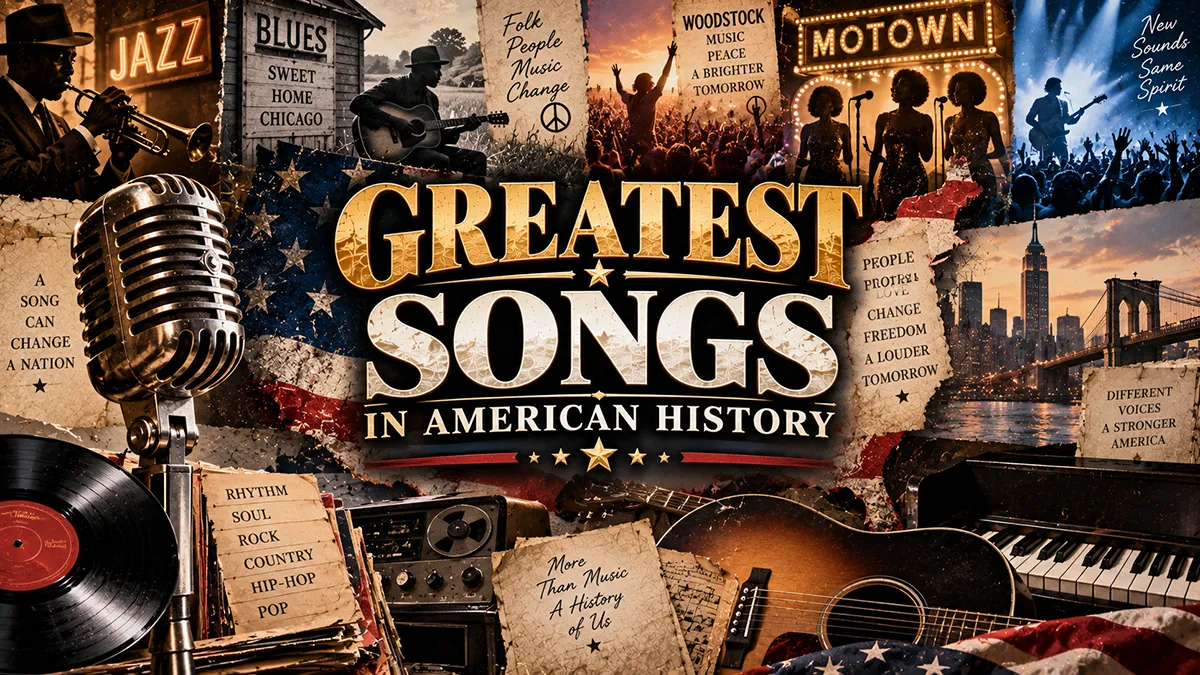
Ask ten people to name “the most American song ever,” and you’ll likely get ten different answers. Some will shout a Springsteen anthem, others will hum a Sousa march, and someone will inevitably bring up a folk tune written during the Great Depression. That’s the fascinating thing about songs about America — they’re less a single genre and more a running argument about what the country actually is.
This list pulls together the patriotic hymns, protest songs, and pop anthems that historians, musicologists, and everyday listeners keep coming back to. Some of these tracks celebrate the United States without irony. Others question it, mourn it, or both at once. Together, they form something close to a musical timeline of American history.
TL;DR: From “The Star-Spangled Banner” to “This Is America,” the greatest American songs span 250 years and reveal a country that has always used music to celebrate, question, and define itself.
What Makes a Song “American”?
There’s no official checklist for what counts as an American song, which is part of why lists like this one spark debate. Some tracks earn the label through subject matter — literal songs about the USA, its landscapes, or its history. Others earn it through sound, drawing on blues, gospel, country, and jazz traditions that developed on American soil.
A lot of the most iconic American songs actually do both at once. They tell a specific American story while also borrowing from a distinctly American musical lineage. That combination is why certain songs get replayed at every Fourth of July barbecue while others get studied in history classrooms.
It’s worth noting upfront that “patriotic” and “critical” aren’t opposites in this catalog. Several of the songs below were written as love letters to the country; others were written as pointed critiques of it. Many of the most enduring ones manage to be both, which is exactly why they’ve stuck around.
How the “Number One Song in America” Actually Gets Decided
People searching for the number one song in America right now are usually asking about the Billboard Hot 100, the industry’s main singles chart since 1958. It combines streaming numbers, radio airplay, and digital sales into a single weekly ranking. It is not a vote on patriotism or cultural importance — it’s a snapshot of what’s popular that particular week.
That distinction matters because a song can top the charts without becoming a lasting piece of American historical songs canon, and plenty of genuinely important songs never hit number one at all. “This Land Is Your Land” never topped a pop chart, yet it’s arguably more embedded in American identity than most songs that did. Chart success and cultural staying power are related, but they’re not the same thing.
With that context in mind, here’s a rundown of the songs that keep showing up whenever people debate the best America songs of all time — whether they ever hit number one or not.
The 25 Greatest Songs in American History
This isn’t a strict, scientific ranking — no such ranking exists. It’s a curated tour through the songs that historians, critics, and generations of listeners have treated as touchstones, arranged loosely by era so you can hear the country’s story unfold.
1. “The Star-Spangled Banner” (1814)

Francis Scott Key wrote the lyrics after watching the Battle of Fort McHenry from a ship in Baltimore’s harbor during the War of 1812. He set his words to an existing British melody, “To Anacreon in Heaven,” which was originally a drinking song for a London social club.
Congress didn’t make it the official national anthem until 1931, more than a century after Key wrote it. Before that, “My Country, ‘Tis of Thee” and “Hail, Columbia” were both treated as unofficial anthems, which is a detail most people never learn in school.
2. “America the Beautiful” (1895/1910)

Katharine Lee Bates wrote the poem after a trip to the summit of Pikes Peak in Colorado, and it was later set to a hymn melody composed by Samuel A. Ward. Many Americans actually prefer it to the official anthem because the melody is easier to sing and the lyrics focus on landscape rather than battle.
It has been proposed as a replacement national anthem more than once over the past century. It has never gained enough political traction to actually replace “The Star-Spangled Banner,” but the debate itself says something about how Americans relate to their patriotic songs.
3. “My Country, ‘Tis of Thee” (1831)

Samuel Francis Smith wrote this while a divinity student, reportedly finishing it in about half an hour. It shares its melody with “God Save the King/Queen,” the British royal anthem, which is a fun irony for a song about American independence.
For much of the 19th century, this was the closest thing the young country had to an official anthem. It’s rarely sung today outside of school assemblies, but it’s a key piece of American historical songs history.
4. “Yankee Doodle” (18th century)

The tune’s origins are murky, but it likely started as a British song mocking unsophisticated American colonists before the colonists reclaimed it as their own during the Revolutionary War. That reversal — taking an insult and turning it into a badge of pride — is a very American move.
It’s simple, silly, and has survived for roughly 250 years, which makes it one of the oldest surviving songs in the United States songbook, in much the same way some of America’s oldest churches have quietly survived just as long. Kids still learn it before they learn almost any other tune tied to U.S. history.
5. “Battle Hymn of the Republic” (1862)

Julia Ward Howe wrote the lyrics after visiting a Union Army camp during the Civil War, setting them to a marching tune already popular among soldiers. It became one of the most powerful songs about United States history precisely because it was written in the middle of the conflict it describes.
The song has since been used across wildly different political contexts, from labor movements to civil rights marches. Its melody, borrowed and repurposed, shows how songs can outlive the specific moment that produced them.
6. “God Bless America” (1918/1938)

Irving Berlin, a Russian-Jewish immigrant, wrote an early version in 1918 and revised it for singer Kate Smith in 1938 as war loomed again in Europe. It’s frequently mistaken for the national anthem, but it has never held that official status.
It’s a patriotic standard, not a legally designated anthem, and that distinction is one of the most common myths surrounding songs about America. Berlin’s own immigrant background adds a layer of meaning that’s easy to miss if you only know the chorus.
7. “This Land Is Your Land” (1940/1944)

Woody Guthrie wrote this partly as a response to “God Bless America,” which he felt ignored the hardship many Americans faced during the Depression. The full version includes verses questioning private property and poverty that are almost never taught in schools.
The cheerful, singable chorus made it a staple for children’s music programs, but the original lyrics are far more pointed than most people realize. It’s a great example of how a song can be adopted as pure patriotism while carrying a much more complicated original message.
8. “America” — Simon & Garfunkel (1968)

This quieter, folk-rock “America” follows two young travelers hitchhiking across the country, searching for something they can’t quite name. It’s less a celebration than a meditation, released during a decade of deep national unrest.
Paul Simon’s lyrics capture a kind of restless searching that feels very different from the triumphant tone of older patriotic songs about America. It’s proof the country’s songbook has room for doubt as well as pride.
9. “America” — Neil Diamond (1980)

Written for the film “The Jazz Singer,” Neil Diamond’s “America” is an unapologetic immigration anthem, built around the idea of people coming to the country “on the boats” seeking a better life — the same story symbolized by the Statue of Liberty itself. It leans fully into big, brassy optimism.
It’s become a staple at naturalization ceremonies and Fourth of July events, making it one of the more literal songs about the USA as a land of opportunity. Its earnestness is exactly why some listeners love it and others find it a little too on the nose.
10. “A Horse with No Name” — America (1971)

Here’s where the band literally named America enters the picture, since a lot of people searching for songs by the group America land on this track first. Formed by the sons of U.S. Air Force personnel stationed in England, the trio ironically wrote much of their early material while living abroad.
“A Horse with No Name” became their breakout hit and is still their most recognized song. It’s often mistaken for a Neil Young track because of its similar folk-rock sound, which is a fun bit of music trivia in its own right.
More Songs From the Group America Worth Knowing
If you enjoyed that entry, it’s worth digging into the rest of the band’s catalog, since several other songs from the group America hold up just as well. “Ventura Highway,” “Sister Golden Hair,” and “Tin Man” all reached the charts in the early-to-mid 1970s and showcase the same warm harmonies and acoustic-driven sound.
None of these songs are actually about American history or identity in a literal sense — the band’s name is mostly a coincidence tied to their British upbringing. But their catalog is a real answer for anyone specifically searching for songs by the group America rather than songs about the country itself.
11. “American Pie” — Don McLean (1971)

Don McLean’s sprawling, cryptic epic mourns “the day the music died,” widely understood to reference the 1959 plane crash that killed Buddy Holly, Ritchie Valens, and The Big Bopper. The lyrics also weave in allusions to the 1960s more broadly, from the Kennedy assassination to the rise of Bob Dylan.
At over eight minutes long, it broke conventional radio rules and still became a number one hit. It remains one of the most analyzed and debated American song titles in pop music history, with fans still arguing over exact meanings decades later.
12. “Fortunate Son” — Creedence Clearwater Revival (1969)

John Fogerty wrote this as a furious response to class inequality during the Vietnam War draft, pointing out that wealthy, well-connected young men often avoided combat while working-class draftees did not. Despite its blistering guitar riff making it a staple at sports events and rallies, it’s actually a protest song.
It’s frequently misused in contexts that miss its critical edge entirely, which makes it one of the best examples of a myth worth busting. This is not a cheerful patriotic anthem — it’s a pointed piece of American historical songs commentary.
13. “Born to Run” — Bruce Springsteen (1975)

Springsteen’s breakthrough single captures a very specific strand of American mythology: the open road, the small town you’re desperate to escape, and the promise of reinvention just past the horizon — the same restless frontier spirit behind ongoing debates about whether the Wild West was really so wild. It’s less about the country as a nation and more about a feeling many Americans recognize instantly.
Critics have long pointed to this track as one of the clearest distillations of blue-collar American songwriting. It helped cement Springsteen’s reputation as a chronicler of working-class American life.
14. “Born in the U.S.A.” — Bruce Springsteen (1984)

This title track is probably the most misunderstood song on this entire list. Its booming chorus and flag-draped album cover led many listeners, including politicians who tried to use it in campaigns, to treat it as a straightforward patriotic anthem.
The verses actually tell the story of a Vietnam veteran who returns home to unemployment and neglect. It’s a sharp critique wrapped in a stadium-sized hook, and that tension is exactly why it’s remained one of the most iconic American songs of the 1980s.
15. “American Woman” — The Guess Who (1970)

This Canadian band’s hit is sometimes assumed to be a love song, but it’s widely interpreted as a commentary on American militarism and cultural influence during the Vietnam War era. Guitarist Randy Bachman has said the guitar riff came together almost by accident during a live performance.
Its gritty rock sound made it a crossover hit despite, or maybe because of, its ambivalent stance toward its subject. It’s a reminder that plenty of songs about the USA come from outside observers looking in.
16. “Sweet Home Alabama” — Lynyrd Skynyrd (1974)

Written partly as a response to Neil Young’s critical songs about the American South, this track became a Southern rock anthem almost overnight. Its relationship to the region’s complicated history, including its brief nod to Governor George Wallace, has made it a source of ongoing debate.
It remains one of the most streamed classic rock songs from American artists, decades after its release. Whatever your take on its politics, it’s undeniably one of the most recognizable Southern entries in the broader catalog of American music songs.
17. “Living in America” — James Brown (1985)

James Brown recorded this for the “Rocky IV” soundtrack, and its horn-driven energy turned it into an instant celebration of American ambition and hustle. It gave Brown, already a legend, one of his biggest hits of the 1980s.
The song’s optimism fits neatly alongside the era’s broader wave of upbeat, patriotic pop, even though it came from a soul and funk pioneer rather than a rock or country act. It’s proof that songs representing America have never been confined to one genre.
18. “Rockin’ in the Free World” — Neil Young (1989)

Neil Young wrote this as a scathing critique of Reagan-era policy failures, homelessness, and environmental neglect, even though its title and chorus get co-opted as a straightforward celebration surprisingly often. It’s another entry in the long tradition of protest songs mistaken for cheerleading.
The track’s raw, distorted guitar sound also helped influence the grunge movement that dominated rock a few years later. It’s one of the clearer examples of how a catchy hook can outrun its actual message in public memory.
19. “Ohio” — Crosby, Stills, Nash & Young (1970)

Neil Young wrote this within days of the Kent State shootings, in which National Guard troops killed four unarmed college students during a Vietnam War protest. The band rushed it to release almost immediately, making it one of the fastest reactions to a real news event in American rock history.
Its stark lyrics, including the repeated line “four dead in Ohio,” gave it a documentary-like weight rare in popular music. It stands as one of the most direct songs related to American history ever to become a radio hit.
20. “God Bless the U.S.A.” — Lee Greenwood (1984)

Lee Greenwood wrote this earnest country anthem after being asked what freedom meant to him, and it became especially popular during the Gulf War and after the September 11 attacks. It’s one of the most requested patriotic songs at American public events, from ballgames to political rallies.
Its straightforward, unironic celebration of the country makes it a useful contrast to some of the more conflicted songs on this list. Not every entry in this genre needs a hidden critique to matter.
21. “Only in America” — Brooks & Dunn (2001)

This country duo released their optimistic single about American opportunity just weeks before the September 11 attacks, and radio stations leaned on it heavily in the aftermath as a source of comfort. Its message about dreamers rising “from the bottom to the top” resonated with a country processing tragedy.
It remains a staple of American popular songs in the country genre, often played at graduations and civic events. Timing, more than songwriting alone, cemented its place in the culture.
22. “Party in the U.S.A.” — Miley Cyrus (2009)

This pop hit isn’t really about patriotism at all — it’s about the disorientation of moving from a small town to Los Angeles, using “U.S.A.” almost as shorthand for the whole sprawling, overwhelming country. Its massive chorus turned it into a genuine cultural moment.
It’s a good example of how usa songs pop culture has absorbed the country’s name as a kind of vibe rather than a specific statement. The lyrics barely mention actual American history, but the title alone was enough to make it iconic.
23. “Empire State of Mind” — Jay-Z ft. Alicia Keys (2009)

This track is technically a love letter to New York City rather than the whole country, but it’s become shorthand for American urban ambition worldwide. Alicia Keys’s soaring hook and Jay-Z’s verses about hustling in the city gave it crossover appeal far beyond hip-hop audiences.
It’s frequently included on lists of the best US songs of the 2000s because of how thoroughly it captures a specific American dream narrative. Few songs have made a single city feel like a stand-in for an entire nation’s ambitions.
24. “This Is America” — Childish Gambino (2018)

Donald Glover’s genre-blending track and its accompanying music video sparked immediate, intense debate about gun violence, racism, and distraction culture in the United States. It topped the Billboard Hot 100, making it a rare protest song to also become the actual number one song in America the week it peaked.
Its unsettling tone marks a sharp departure from earlier, more triumphant songs about America on this list. It’s proof that the tradition of using music to wrestle with the country’s contradictions is very much alive.
25. “Alright” — Kendrick Lamar (2015)

Released on the album “To Pimp a Butterfly,” this track became an anthem for the Black Lives Matter movement, with its refrain — “we gon’ be alright” — chanted at protests across the country. It blends jazz, funk, and hip-hop into something that feels both hopeful and defiant.
It’s a modern entry in a very old American tradition: using music to process pain while insisting on a better future. That combination links it directly back to spirituals and civil rights-era songs from a century earlier.
Old America Songs vs. New: How the Genre Has Evolved
Looking at this list side by side, a clear pattern emerges. Early American songs, from “Yankee Doodle” through the Civil War hymns, were built around shared, communal singing meant for crowds, churches, and campfires.
By the 20th century, songwriters like Woody Guthrie and Irving Berlin began using the same tradition to make personal arguments about what the country should be. And from the 1960s onward, rock, soul, country, and hip-hop artists increasingly used the format to question the nation as often as they praised it.
That shift, from communal celebration to individual commentary, mirrors the country’s own growth. It’s a big part of why this genre stays so interesting: it’s never been just one thing, and it was never really meant to be.
Why These Songs Still Matter
Music historians often point out that a country’s most popular songs double as an informal record of its anxieties and aspirations. You can trace major shifts in American life, from wartime sacrifice to civil rights struggles to immigration debates, just by following the songwriting.
That’s part of why lists like this one keep circulating. People aren’t just looking for background music for a barbecue; they’re looking for songs that describe America in a way that feels true to their own experience of it.
Whether your favorite entry here is a solemn hymn from the 1860s or a defiant hip-hop track from 2015, you’re tapping into the same long tradition. Americans have always used song to argue with, and about, their own country.
Final Thoughts
There’s no single “most American song ever,” and that’s kind of the point — much like there’s no single, tidy answer to which nation is truly the oldest country in the world. The strength of this catalog comes from its range, spanning colonial fiddle tunes, Civil War hymns, Dust Bowl folk songs, Vietnam-era protest rock, and 21st-century hip-hop.
If you’re building your own usa song list, don’t feel obligated to pick only the cheerful, flag-waving entries. Some of the most powerful songs about United States history are the ones willing to ask hard questions.
Start with a few tracks from this list, dig into the stories behind them, and you’ll likely find yourself hearing familiar songs in a completely different way.
Frequently Asked Questions
What is the official song of the United States?
"The Star-Spangled Banner" has been the official national anthem of the United States since Congress designated it in 1931. Before that, songs like "My Country, 'Tis of Thee" and "Hail, Columbia" functioned as unofficial anthems, so the country actually had several unofficial "songs of the United States" long before one became law.
What is considered the most American song ever written?
There's no single agreed-upon answer, since opinions split between purely patriotic songs like "America the Beautiful" and complex, questioning ones like "This Land Is Your Land" or "Born in the U.S.A." Most historians would say the honest answer is that several songs share that title depending on the era and viewpoint.
Is ‘God Bless America’ the national anthem?
No, that's a common misconception. "God Bless America," written by Irving Berlin, is a beloved patriotic standard, but the official national anthem remains "The Star-Spangled Banner," designated by Congress in 1931.
What songs are by the band America?
The folk-rock trio America is best known for "A Horse with No Name," "Ventura Highway," "Sister Golden Hair," and "Tin Man," all released in the early-to-mid 1970s. Despite the band's name, most of their songs aren't about the country itself, since the group formed from musicians raised in England.
How is the number one song in America determined?
The Billboard Hot 100 is the standard measure, combining streaming activity, radio airplay, and sales data into one weekly ranking. It reflects current popularity rather than historical or cultural importance, which is why some deeply influential songs never actually reached number one.
What are some historical songs about American events?
"Battle Hymn of the Republic" was written during the Civil War, "Ohio" responded directly to the 1970 Kent State shootings, and "This Land Is Your Land" reflected Depression-era hardship. Each ties directly to a specific moment in American history rather than general patriotism.
What makes a song ‘typical’ of American music?
Typical American music tends to blend traditions from multiple cultures, especially blues, gospel, folk, and country roots, into new hybrid genres like rock and roll, soul, and hip-hop. That blending, rather than any single sound, is often cited as the defining trait of American popular music.
Are patriotic songs and protest songs both considered American songs?
Yes, both traditions sit comfortably under the same umbrella. Songs like "God Bless the U.S.A." celebrate the country directly, while songs like "Fortunate Son" or "This Is America" critique it, and both approaches have deep roots in American songwriting history.

Alex Warren
Related Articles