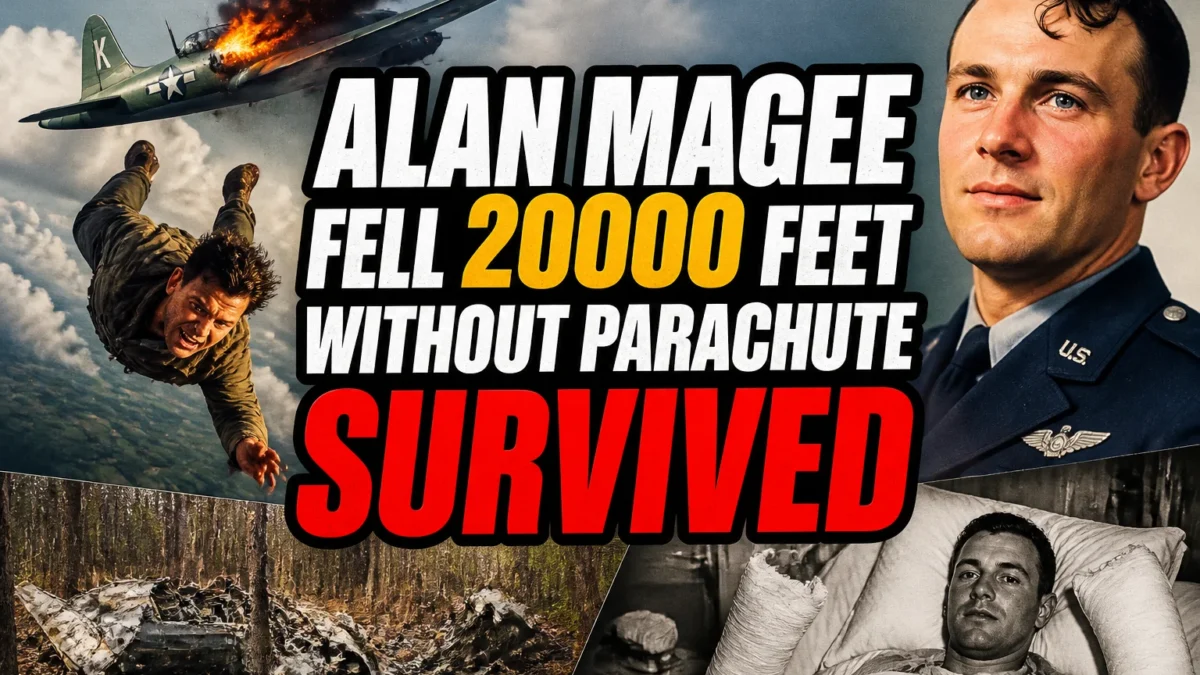
The story of Alan Magee sits at the strange edge of World War II history, where a single bad day over France became one of the most remarkable survival events of the air war. It sounds like a tall tale, but the core of the story is supported by military records, contemporary reports, and the airman’s later recollections.
If you have typed “Alan McGee WW2” into a search bar, you are not alone; the misspelling is common, but the man’s surname was Alan Magee. His fall from a damaged B-17 without a functioning parachute is still used today as a benchmark against other extreme-fall survival cases.
TL;DR: Alan Magee survived a roughly 20,000-foot fall from a crippled B-17 over Saint-Nazaire, France, in 1943 by crashing through a railway station’s glass roof, then lived out the war as a prisoner.
Why Saint-Nazaire Was a Target Worth Dying For
On January 3, 1943, Eighth Air Force bombers attacked the German submarine pens at Saint-Nazaire on the French Atlantic coast. These U-boat pens were massively reinforced concrete structures that sheltered submarines from direct bomb hits, making them a critical target in the Battle of the Atlantic.
The port was not just a naval base; it was a symbol of Germany’s reach into the Atlantic shipping lanes. U-boats operating from Saint-Nazaire and other French bases sank hundreds of thousands of tons of Allied merchant shipping, so the raid carried real strategic weight.
Heavy flak, fighter defenses, and cloudy winter weather made the mission dangerous. B-17 crews flew high to reduce the danger from ground fire, but that altitude created its own set of problems long before Magee’s fall.
The B-17 Ball Turret Gunner’s World
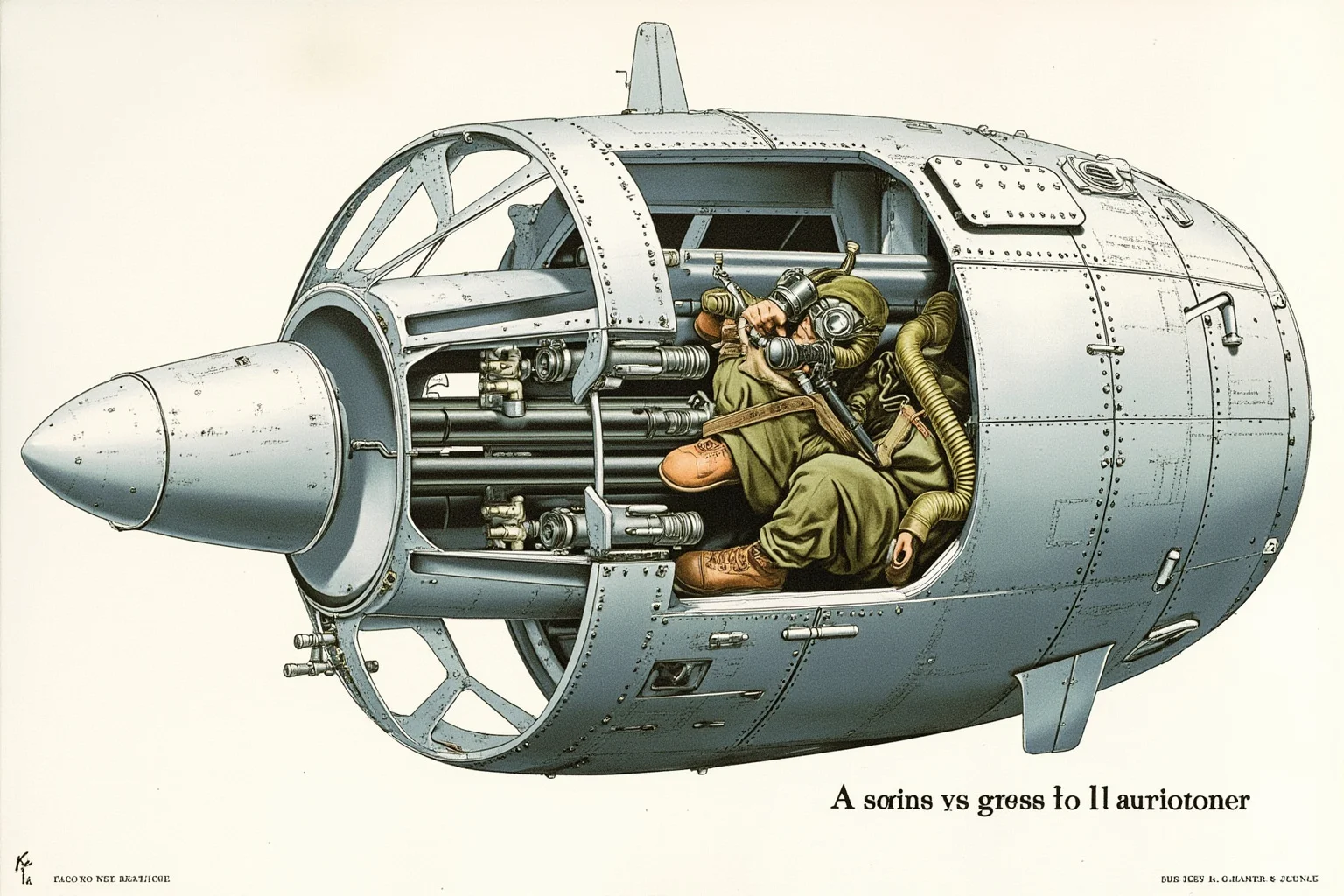
Alan Magee served as a ball turret gunner on a B-17 Flying Fortress, the four-engine heavy bomber that became a symbol of the American daylight bombing campaign. The ball turret hung beneath the fuselage and gave the gunner a clear view of attacks from below.
It was also one of the most exposed jobs in the aircraft. The gunner sat curled inside a metal sphere, with ammunition, a gunsight, and twin .50-caliber machine guns packed tightly around him.
Many gunners could not wear a parachute inside the cramped turret. The chute was often stored in the fuselage behind them, a detail that would become terrifyingly relevant if the bomber was hit and began to spin.
The 303rd Bomb Group and a Costly Mission
Magee flew with the 303rd Bomb Group, an early Eighth Air Force unit based in England. The group had already learned how brutal unescorted daylight bombing could be over occupied Europe.
In early 1943, long-range fighter escort was limited, and German pilots were often free to attack bomber formations without American fighters interfering. That meant a German fighter could focus on a damaged bomber and follow it down.
Magee’s aircraft has been identified in many unit histories as Snap! Crackle! Pop!, a B-17 with a cheerful name that matched the breakfast cereal slogan. Names like that hid the grim reality of the group’s loss rate, which remained high throughout the winter of 1943.
The Attack That Ripped the Bomber Apart
German fighters hit the formation as it approached the target. Accounts from the mission describe a running battle with enemy interceptors, flak, and the usual confusion of radio chatter.
Magee’s B-17 took severe damage and began to lose control. The exact sequence of events varies from account to account, but the bomber was critically wounded, and the young gunner was likely injured or trapped in the chaos.
At some point during the emergency, Magee left the aircraft without a usable parachute. Some retellings say his chute had been destroyed by shell fragments; others suggest he was thrown clear in a violent maneuver. What is not disputed is that he fell from roughly 20,000 feet.
How Long Does It Take to Fall 20,000 Feet?
The question “how long does it take to fall 20000 feet” is a natural one, because the number is hard to visualize. A human in free fall does not simply plummet at movie speed; the body accelerates until air resistance balances gravity and a terminal velocity takes over.
For a belly-to-earth skydiver, terminal velocity is typically around 120 miles per hour. Reaching that speed takes about 12 seconds and roughly 1,500 feet, after which the remaining 18,500 feet are covered at a fairly steady rate.
A stable free fall from 20,000 feet therefore lasts somewhere around 100 to 120 seconds, or close to two minutes. Tumbling, heavy clothing, or an unconscious body can increase drag and change the timing, so no single number applies to every case.
For Magee, those two minutes would have been a violent blur of thin air, extreme cold, and acceleration. The more urgent question was never how long the fall lasted, but how the impact failed to kill him.
The Thin Air at 20,000 Feet
At 20,000 feet, the atmosphere is much thinner than at sea level, and temperatures in winter over France can drop far below zero. Bomber crews relied on oxygen masks and electrically heated suits to stay functional.
A crewman suddenly exposed to that altitude without oxygen could lose consciousness in a matter of minutes, not seconds, but the cold and wind blast could debilitate him quickly. Magee’s exact state during the fall is not known, which is why false certainty should be avoided.
Escape from a B-17 at altitude also meant risk of hitting the horizontal stabilizer or being knocked unconscious by the slipstream. Some airmen died before they ever reached the ground, making any analysis of an extreme fall incomplete.
How B-17 Escape Hatches Could Become Traps
The B-17 was a tough aircraft, but its escape routes were not forgiving. A spinning or diving bomber could pin a crewman inside, jam a hatch, or make it impossible to reach a parachute.
In the ball turret, the gunner had to rotate the turret into a specific position to open the internal hatch and climb back into the fuselage. If the turret mechanism was damaged, that route could disappear in seconds.
Magee’s eventual exit may have been assisted by damage to the aircraft, but no single account should be treated as the final word. The chaos of combat makes precise re-creation difficult.
The Glass Roof in Saint-Nazaire
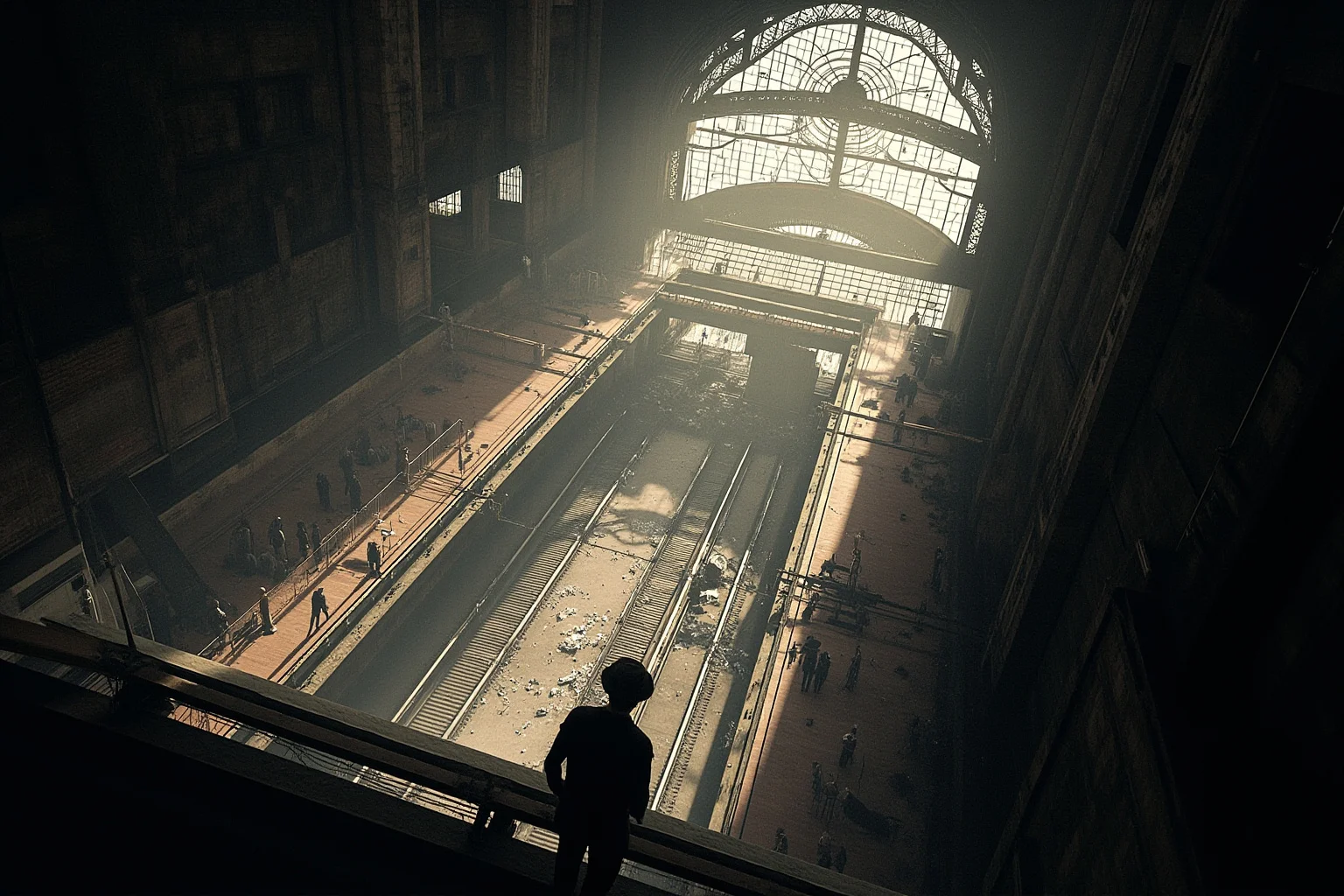
Magee crashed through the glass roof of the Saint-Nazaire railway station. The station building, near the U-boat pens, had a large skylight or glass canopy that broke under the impact.
Survivors of extreme falls often hit a surface that gives way just enough to extend deceleration time. Glass, tree branches, snow, and corrugated roofs can spread the force over a fraction of a second longer than solid concrete would allow.
Even so, hitting glass after falling 20,000 feet is not a soft landing. Magee suffered severe injuries, including broken bones and deep lacerations, and he was discovered alive among the wreckage of the roof.
Injured, Captured, and Treated
German personnel found Magee alive and took him into custody as a prisoner of war. According to later accounts, he received medical treatment from German military doctors, who likely kept him alive long enough to reach a hospital.
His wounds were serious enough that survival was far from guaranteed. Multiple fractures, deep cuts, and shock accompanied the trauma of falling through a building and then being moved as a captive.
Magee remained in German prisoner-of-war camps until the war in Europe ended in 1945. Captivity added hunger, cold, overcrowding, and uncertainty to an already staggering fight for survival.
Prisoner of War Life and the Long Wait
Surviving the fall did not end Magee’s fight. As a wounded prisoner, he had to recover in German custody while Allied and Axis forces continued to fight across Europe.
Allied airmen in German POW camps faced overcrowding, poor rations, and the psychological strain of waiting. Camp conditions worsened as the war turned against Germany and resources became scarce.
Magee’s survival into 1945 is another layer of the story that often gets compressed into a single sentence. The years between the fall and liberation were their own test of endurance.
Alan Magee vs. “Alan McGee WW2” and Other Retellings
One of the most common errors in retellings is the spelling “Alan McGee.” The airman’s name was Alan Magee, but the McGee variant spread through word of mouth, early newspaper rewrites, and decades of internet keyword searches.
The altitude also varies. Some sources say he fell 20,000 feet, while others cite 22,000 feet or use rounded numbers that make the story easier to repeat.
Combat records from a damaged, spinning bomber are rarely precise enough to nail down an exact altitude. None of that changes the central event: a U.S. airman fell a very long way without a parachute and survived. The lesson for readers is to treat exact figures as approximate and to check primary records when possible.
The Physics of Surviving an Extreme Fall
Falling from 20,000 feet is usually lethal, and no parachute can change the final velocity unless something else slows the body. Survival depends on reducing peak impact force by extending the time over which the body stops.
The human body can tolerate surprisingly high g-forces for a few milliseconds, but not a sudden stop from terminal velocity onto a rigid surface. A yielding surface, even a brittle glass roof, can change a fatal impact into a survivable one by deforming before the body does.
Magee’s case follows that pattern. The glass gave way, his descent was interrupted before he hit the station floor, and his injuries were severe but distributed. It was not magic or a tall tale; it was physics, material failure, and chance aligning in a very unlikely way.
Other Famous Extreme Fall Survivors
Magee is often grouped with a small number of people who survived falls from high altitudes without a parachute. One of the best documented is RAF flight sergeant Nicholas Alkemade, who fell about 18,000 feet from a burning Lancaster in 1944 and landed in pine trees and deep snow.
Vesna Vulović, a flight attendant, survived a fall of more than 30,000 feet in the 1972 breakup of a DC-9 over Czechoslovakia. Her survival is attributed in part to being pinned inside a section of the aircraft, which altered the fall.
Alan Magee’s case is different because he hit a glass roof rather than trees or snow. These cases are rare enough that each one highlights how specific the circumstances must be for a person to walk away, or be carried away, alive.
Does This Mean Parachutes Were Overrated?
No. Magee’s survival is an outlier, not a reason to question parachute use. For every documented survivor of a no-chute extreme fall, thousands of similar cases ended in death.
Parachutes remain the primary means of surviving an aircraft escape because they reduce the terminal velocity of a falling person to a survivable rate. Magee survived despite not having one, not because going without one was a reasonable choice.
Bomber crewmen knew the odds. The fact that some men beat those odds does not make the air war less dangerous, nor does it diminish the value of the equipment that saved countless other lives.
What the Records Actually Say
World War II combat records are not always tidy. A Missing Air Crew Report or a group history can document the loss of an aircraft without including every detail of how one crewman ended up in a railway station.
Later interviews with Magee filled in some gaps, but memory and oral history can introduce small variations in altitude, wounds, and the sequence of escape. That is normal for combat stories, especially those told decades after the event.
The consistent core is confirmed by multiple sources: Magee fell from a high-altitude bomber without a parachute, struck the station, and survived. The exact altitude is best understood as an estimate rather than a laboratory measurement.
The Thin Line Between Fact and Legend
War stories travel fast and change shape. Magee’s fall has been repeated with different altitudes, different injuries, and even different spellings because memory, media, and military records do not always align.
That does not mean the story is false. It means the known facts sit inside a frame of uncertainty, and responsible retelling should label speculation clearly.
For readers, the best approach is to accept that an airman did survive an extreme fall and to avoid repeating the most dramatic claims as if they were measurements.
The Cost of the January 3 Raid
The Saint-Nazaire mission of January 3, 1943, was not a cheap success. Bomber groups lost aircraft to fighters and flak, and many airmen were killed, wounded, or captured.
Each loss represented a full crew: pilot, copilot, navigator, bombardier, radio operator, and gunners. Alan Magee’s survival was one thread in a much larger fabric of loss that day.
Historians of the Eighth Air Force often use early raids like Saint-Nazaire to show how dangerous the campaign was before fighter escort improved. Magee’s fall was extraordinary, but the mission’s losses were tragically ordinary.
Remembering One Airman in a Larger War
Alan Magee’s story is often told as an individual miracle, but it also belongs to the larger history of the U.S. Army Air Forces in Europe. Tens of thousands of bomber crewmen flew dangerous daylight missions over occupied territory, and many did not return.
Magee survived the fall and the war, eventually returning to civilian life. He died in 2003 at the age of eighty-four, leaving behind a story that still circulates in books, documentaries, and online forums.
His name should be spelled correctly: Alan Magee, not Alan McGee. But the confusion has never stopped people from finding the story, and that search for “Alan McGee WW2” remains a strange digital tribute to a real man’s survival.
What You Should Take Away From the Search for “Alan McGee WW2”
If you arrived at this story through the phrase “Alan McGee WW2,” you are part of a large group of readers misdirected by a spelling error. The correct spelling is Alan Magee, but the wrong form has become an accidental keyword of his story.
Search engines, forums, and old newspaper scans keep the error alive. That detail itself is a small lesson in historical literacy: names matter, but the broader event can survive even when the spelling does not.
Why His Survival Still Matters
Alan Magee matters because his story compresses the dangers of the air war into one vivid event. The fall, the glass roof, the injuries, and the captivity all reflect what bomber crews risked.
He also matters because his case is often used to test claims about other falls. Knowing the physics and record-keeping limits helps readers separate plausible events from internet fakes.
Finally, his story is a reminder that luck plays a real but unglamorous role in history. Saying he was lucky does not diminish his suffering or the medical care that kept him alive.
The Takeaway from a 20,000-Foot Fall
The strange case of Alan Magee reminds us that extreme survival stories are never as clean as their headlines. The altitude was an estimate, the fall was chaotic, and the rescue was tangled with the violence of war itself.
Yet the core facts survive scrutiny: Magee fell from a high-altitude bomber without a usable parachute, struck the glass roof of a French railway station, and lived to speak about it. That is remarkable enough without exaggeration.
If you want a single image to remember, picture a young airman falling through thin January air toward a glass ceiling that should never have broken his fall in the way it did. The story is a reminder that history’s most unlikely outcomes sometimes have real documentation, not just myth.
Frequently Asked Questions
How long does it take to fall 20000 feet?
For a typical human in free fall, it takes roughly 100 to 120 seconds to fall 20,000 feet. The body accelerates for about 12 seconds and 1,500 feet until reaching terminal velocity, usually around 120 mph, then covers the remaining distance at that speed. Body position, clothing, tumbling, and weather can change the exact time.
Did Alan Magee really fall 20,000 feet without a parachute?
Yes, according to U.S. military records and contemporary accounts, Alan Magee fell from roughly 20,000 feet after his B-17 was crippled over Saint-Nazaire, France. Some retellings give 22,000 feet or rounded figures, but the core event is documented. Survival from such a fall is extremely rare, which is why the story remains famous.
Why do some people search for Alan McGee WW2?
McGee is a common misspelling of Magee. The airman’s name was Alan Magee, but early newspaper rewrites, word of mouth, and internet searches spread the McGee variant widely enough that it became a common way to find the story.
How did Alan Magee survive the fall?
He crashed through the glass roof of the Saint-Nazaire railway station. The yielding glass likely extended the impact long enough to reduce peak force, and he received prompt medical care from German personnel. He still suffered severe fractures, deep cuts, and shock.
Was Alan Magee captured after the fall?
Yes. German forces found him alive and took him prisoner. He was treated for his injuries and remained in German prisoner-of-war camps until the war in Europe ended in 1945.

Alex Warren
Related Articles